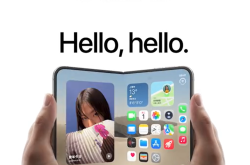
[Data Microscope] 100 Million Foldable Phones Split the Smartphone Market in Half
 09/14 2026
 330
330
In early September 2026, the smartphone industry took an unexpected turn, breaking away from its traditional practice of “staggered releases” (Note: “tacit understanding” is a direct translation but may not fully convey the nuance in English; “staggered releases” is a more industry-specific term).
On the afternoon of September 7, Huawei launched its second-generation triple-fold Mate XT 2. That same evening, Xiaomi made its debut with the “medium-fold” 18 Fold. Then, at 1:00 AM Beijing Time on September 10, Apple introduced its long-rumored foldable iPhone Duo under the theme “Surprise and shine.”
Within just three days, three flagship models were unveiled, all foldable and priced around RMB 10,000, leading to a direct head-to-head clash. This event was dubbed by the industry as a rare “three-way showdown” in the foldable phone race.
Behind this seemingly coincidental timing lay a significant milestone. On September 7, Counterpoint Research released a forecast with a clear judgment: global cumulative shipments of foldable smartphones would exceed 100 million units by the end of 2026. Eight years had passed since the first commercial foldable phone debuted in 2019 for this category to reach its first “100 million” milestone in the smartphone world. More notably, Counterpoint also predicted that the next 100 million units would be achieved in just three years.
Why did this eight-year “fold” finally explode in this particular year? What is the significance of reaching 100 million units? And how are foldable phones reshaping the once-solid smartphone market? This article first uses a data microscope to dissect the origins of these 100 million units, then examines how they are reshaping market dynamics, redefining form factors, and mobilizing an entire supply chain.
01. Eight Years of Gradual Warm-Up, Then Sudden Acceleration: The Velocity Curve Behind 100 Million Units
Let’s start with the total volume. According to Counterpoint Research’s Foldable Smartphone Market Forecast, global cumulative shipments of foldable smartphones are projected to surpass 100 million units by the end of 2026—a landmark integer threshold since the category’s birth in 2019. Chronologically, these 100 million units emerged slowly: annual global shipments numbered just hundreds of thousands when foldable phones first debuted in 2019. Despite doubling annually in subsequent years, the absolute scale remained negligible compared to the smartphone market’s annual shipment volume, which exceeds 1 billion units.
However, a slow warm-up does not equate to stagnation. The critical factor lies in the sudden steepening of the growth curve. Counterpoint data shows that foldable shipment growth will accelerate from 18% in 2025 to approximately 24% in 2026, with further acceleration to 37% expected in 2027—the fastest annual growth since 2022. With both growth and base volumes rising, Counterpoint optimistically projects that cumulative foldable shipments could double from 100 million to 200 million units within three years at this pace.
Viewed within the broader market context, this “100 million” carries even greater significance. Counterpoint estimates that foldable phones currently account for just about 2% of the total smartphone market—a tiny slice of the global smartphone market’s annual shipment volume exceeding 1 billion units (per IDC statistics). This low penetration rate tells another story: it implies the category has barely touched its growth ceiling, with every percentage point increase in penetration representing pure incremental space. As Counterpoint Research Director Tarun Pathak observed: “Foldable phones remain a small portion of the overall smartphone market, but their growth potential far exceeds current shipment volumes.”
The data microscope’s conclusion is clear: 100 million units is not a terminal figure but a critical coordinate on an acceleration curve. Eight years of accumulation have triggered a cognitive shift from “whether to make them” to “whether to buy them”—foldable phones now stand at the inflection point between niche and mainstream adoption.
02. Samsung Defends, Apple Arrives, Huawei Holds Ground: Market Dynamics Fracture After 100 Million Units
Behind the 100-million-unit total lies a dramatically reshuffled competitive landscape. Counterpoint’s 2026 global foldable market share forecast predicts a three-way standoff: Samsung leads with 38%, Apple leaps to second place with 25% in its debut year, and Huawei takes third with 22%. These three brands will collectively command approximately 85% of the global foldable market, marking the clearest head-to-head competition yet.
The most dissectible variable is Apple. Counterpoint predicts Apple’s debut foldable iPhone could ship up to 6 million units in 2026—remarkable considering its September 10 launch left only a few months of sales window. Achieving global second place in an incomplete sales year is unprecedented across any product category Apple has entered. Associate Director Liz Lee stated bluntly: “Even with a short sales window, we expect Apple to capture 25% share and rank second immediately, demonstrating its enormous potential to disrupt the category even before fully ramping production.”
However, Apple’s entry faces constraints. Counterpoint specifically notes that supply-side rather than demand-side bottlenecks will initially limit Apple’s foldable phones: scaling production of hinges, ultra-thin flexible glass, and other core components takes time, with initial supply destined to be limited. Sales will climb gradually as capacity expands. Thus, 2027 represents Apple’s first “full season”—Counterpoint expects its shipments to more than double from 6 million units, with share potentially reaching 40%, becoming the primary driver of the projected 37% market acceleration in 2027.
Shifting the lens to China reveals a different competitive landscape. According to IDC data, Huawei dominated China’s foldable market with approximately 60% shipment share in Q1 2026, followed by Honor at 21%. This dominance extended to the overall market: IDC statistics show Huawei reclaimed China’s overall smartphone market leadership in Q2 2026 with 22.6% share and approximately 14.92 million units shipped, up 19.4% YoY; Apple’s China shipments grew 24.4% YoY during the same period, with share rising from 13.9% to 18.1%. Behind these shifting shares between the two leaders, foldable and other new form factors are emerging as key engines driving high-end smartphone upgrades—form innovation now ranks alongside chips and imaging in importance for the first time.
03. Clamshell Fades, Book-Style Dominates: Form Factor Differentiation Reveals True Demand
Focusing solely on total volume and share overlooks a more profound internal revolution within foldable phones—structural migration in form factors. Omdia data shows clamshell (Flip) foldable shipments plunged 47% YoY in H1 2026, while book-style horizontal folds held steady, capturing 69% of global foldable shipments. Huawei and Samsung jointly commanded 75% of the horizontal fold segment.
This shift reveals authentic consumer demand: users are voting with their feet, abandoning vertical folds that “transform a small screen into a square” for horizontal folds that offer “true large-screen utility.” The value proposition of foldable phones has never been “foldability” itself but “what the expanded screen enables.” This explains why 2026 became a breakthrough year for foldable form factors—Huawei pioneered the wider, more tablet-like “broad fold” Pura X Max in May, Samsung followed with the Galaxy Z Fold 8 in August, and Xiaomi carved out a new niche with the 7.58-inch inner screen and √2:1 ratio “medium-fold” 18 Fold. Huawei’s September 7 Mate XT 2 “triple-fold with extended wings” pushed screen boundaries even further when unfolded.
Equally critical is ecosystem synergy—by September 7, 2026, HarmonyOS 6 and 7 devices exceeded 85 million units, with system-level AI agent Xiaoyi perceiving over 200 system-level user data points, invoking 2,100+ system capabilities, and connecting to 2,000+ HarmonyOS agents. Larger screens and stronger on-device intelligence are converging: the “large-screen dividend” of foldable phones is expanding from video viewing and document browsing to new scenarios like multitasking and AI interactions.
Form innovation’s payoff is evident in sales—Huawei disclosed the Pura X Max shipped 1.2 million units within four months of launch. Amid slowing growth for traditional flagship phones, foldable devices are injecting scarce incremental demand into the high-end market through the logic of “new forms creating new needs”—a classic signal of a mature category’s march toward mainstream adoption.
04. A Foldable Screen Mobilizes an Entire Value Chain
Foldable phones are transforming not just device forms but also value composition. Counterpoint’s Foldable Display Panel Shipment and Technology Report projects foldable smartphone panel shipments will reach approximately 27.5 million units in 2026, up 24% YoY, with panel revenue expected to hit $4.4 billion, up 48% YoY—revenue growth nearly doubling shipment growth. This indicates foldable inner screens are becoming larger and more expensive, significantly elevating value per unit display area. Consequently, foldable panel production faces far higher technical barriers than rigid panels, with supply concentrated among a few leading panel manufacturers capable of mass production, creating natural moats in this segment.
“Expensive” remains an inescapable label for foldable phones—and the key to understanding their value logic. Counterpoint estimates foldable phones still cost roughly three times more than traditional rigid smartphones, with mainstream adoption likely requiring several more years. Where does this premium go? Industry consensus identifies two primary value-added areas: “foldable screens” and “foldable hinges.” Compared to rigid phones, foldable devices add two core components: flexible display modules and precision hinges. Ultra-thin flexible glass (UTG) now measures just ~30 microns thick—thinner than a human hair—yet must balance hardness, transparency, and durability for hundreds of thousands of folds. Hinges have evolved from ordinary stainless steel to liquid metal, titanium alloys, and precision injection-molded components, achieving millimeter- or even micrometer-level precision to withstand tens of thousands of openings and closings. Every foldable form innovation represents a collective leap in materials engineering and manufacturing precision.
Interestingly, this value revaluation coincides with external cycles. TrendForce data shows global DRAM contract prices surged 90–95% QoQ in Q1 2026, while NAND prices jumped 70–75%, with storage price hikes lifting cost curves across all smartphones. Huawei Executive Director, Product Investment Review Committee Chairman, and Terminal BG Chairman Yu Chengdong publicly warned that soaring memory prices could trigger widespread smartphone price increases; Apple CEO Tim Cook similarly commented on storage price hikes, with media reporting his characterization of current memory price conditions as a “once-in-a-century flood” and noting the company was evaluating all response options. While these statements addressed storage price impacts across product lines, they also explain why high-end models are generally opting for premium pricing upgrades.
With traditional flagship phones struggling to absorb cost increases through spec wars, foldable devices—due to their high unit prices and gross margin buffers—have become “value containers” for brands to manage costs and sustain premium pricing. The industry’s business logic is shifting from “proving the future through higher volumes” to “surviving through higher value per unit sold.”
Returning to the opening data: 100 million units in eight years; the next 100 million in three. Foldable phones are splitting not just smartphone screens but also the smartphone industry’s two-decade-old form factor inertia—dividing the market into “rigid” and “foldable” segments, competition into “spec stacking” and “form innovation” paradigms, and supply chain value from chip and imaging arms races toward precision marathons in hinges, flexible materials, and display technologies.
As Apple, Samsung, Huawei, and Xiaomi compete on the same stage in a single week, and as HarmonyOS devices surpass 85 million to nourish the foldable ecosystem, foldable phones are no longer a marginal segment but a growing pole in the high-end market and form innovation race—one capable of rivaling rigid smartphones.
- End -
-
[Data Microscope] 100 Million Foldable Phones Split the Smartphone Market in Half
-
Every "Hello" to AI Comes with a Price Tag
-
![]()
Why Does a More Mature End-to-End Autonomous Driving System Require More Error-Prone Data?
-
![]()
Profit, Yield, and Bargaining Power in the Foldable Screen Industry Chain Restructured After Apple's Entry with iPhone Duo
-
Tianlong-3 Yao-1 Mission Update: Insights from the 189.5-Second Flight
-
The Untold Undercurrent of CIFTIS: Chinese Tech Goes Global, Shifting from Quick Profits to Sustainable Value
-
![]()
Confirmed! Apple CEO Cook Admits to ‘Drawing Inspiration’ from Huawei; Luo Yonghao Offers Direct Criticism
-
![]()
Zhang Yiming’s Global Empire Surges: TikTok Achieves Scalable Profitability Across Key Markets!