Apple Finally Releases Foldable iPhone: iPhone Duo Hits Market at $1,999, Seven Years Post Samsung and Huawei
 09/14 2026
 377
377
Apple Introduces Its First Foldable iPhone Duo: Priced at $1,999, Launching on October 23, Seven Years After Samsung and Huawei, with Ambitions to Capture 30% Market Share.
After seven years of eager anticipation, Apple has finally stepped into the foldable smartphone arena. On September 9, at Apple's autumn event, the iPhone Duo made its grand entrance: the 256GB model is priced at $1,999, with pre-orders starting on October 16 and general availability on October 23. When folded, it sports a 5.4-inch outer display, and when unfolded, reveals a spacious 7.6-inch inner screen, nearing the dimensions of an iPad Mini. Crafted with a titanium frame, mirror finish, ceramic crystal shield glass, and boasting IP68 dust and water resistance, Apple has left no stone unturned in its design. Notably, to accommodate the folding mechanism, Face ID has been omitted, and Touch ID fingerprint recognition has been integrated into the side power button. This marks the first iPhone in seven years to forego notch-based facial recognition and the first to support an Apple Pencil with a USB-C connection.
The Challenge of Foldable Screens: Samsung and Huawei Have Paved the Way
Apple is not a pioneer in the foldable screen market; rather, it is a latecomer. Samsung launched the first-generation Galaxy Fold in 2019, followed by Honor, Google, Motorola, and OPPO. Over time, foldable screens have evolved to be thinner, lighter, and more resilient. The iPhone Duo features a book-style folding design, akin in size to Samsung's latest Galaxy Z Fold8, and reminiscent of Google's inaugural Pixel Fold. Apple has outfitted the hinge with what it terms customizable variable torque, claiming it to be the thinnest iPhone ever when unfolded. The screen incorporates a carbon fiber metal plate beneath it to evenly distribute bending stress, a concept akin to Samsung's Flex Titanium. The IP68 rating also gives it a competitive edge over Samsung—prior to this, only Google's Pixel Fold series offered IP68-rated foldable screens.
Battery, Chip, and Camera: Overcoming All Limitations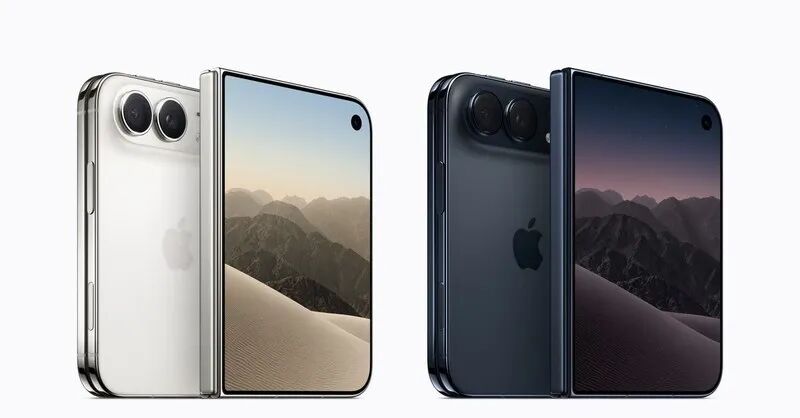
Image Source: Wired
In terms of hardware, the Duo boasts Apple's largest battery to date: with the inner screen fully operational, it supports up to 31 hours of video playback, 44 hours with only the outer screen active, and around 24 hours of mixed usage. For connectivity, it introduces Apple's proprietary C2 modem, supporting millimeter-wave 5G in the U.S., while the main chip is the same A20 Pro as found in the iPhone 18 Pro. The camera setup is relatively modest, featuring only two lenses on the back—a 48MP main camera and a 48MP ultra-wide camera, omitting a telephoto lens. On the front, there are two selfie cameras: a 12MP lens on the outer screen and an under-display lens on the inner screen. The software has been tailored accordingly: frequently used controls are now arranged vertically along the side, and even the dock bar has been reoriented vertically, enabling split-screen viewing and vertical selfies when unfolded. In essence, Apple has seamlessly integrated tablet and large-screen functionality into a single device.
Why Does Apple, Seven Years Late, Set Its Sights on 30% Market Share?
The most compelling aspect lies in market analysis. Nabila Popal, Senior Research Director at IDC, presents a set of figures: the foldable screen market has experienced a year-over-year decline of 13% for five consecutive quarters, representing only about 2% of the global smartphone market by year-end. However, with Apple's entry, it is projected to capture up to 30% of the foldable screen segment by the end of 2026. Her research also reveals that 60% of consumers express no interest in a foldable screen when upgrading their phones, but nearly one-third state they would definitely purchase one once Apple releases a foldable model. Priced at $1,999, it is not inexpensive, yet Popal asserts it is "destined to be a blockbuster"—reminiscent of how Apple's first phone priced over $1,000 was initially criticized as costly but still sold exceptionally well. For domestic readers, the implications are clear: Huawei's triple-folding phones, Samsung's vertical expansion, and models from Honor and OPPO have already established a mature market in China. Apple is now entering with its brand and ecosystem, vying not just for sales but also for pricing power in the high-end foldable screen category. This delayed pursuit is precisely Apple's strength—coming from behind to dominate.
To put it bluntly, foldable screens remain a niche segment, with a 2% market share indicating they cannot sustain Apple's core business but serve more as a tool for profit and brand enhancement. However, Apple's entry is significant because it often transforms a niche product that is well-received but not widely adopted into a mainstream necessity. Whether the Duo can replicate this history hinges on its durability and repair costs—Popal herself cautions that while foldable screens have improved in durability, repairability has not kept pace. For Huawei, Samsung, and other domestic foldable screen manufacturers, the real competitor is not just another new model but Apple's ability to redefine the pricing and perception of the entire category. Being seven years late may have allowed Apple to identify and avoid potential pitfalls.
Today's Insightful Quote
"Despite a five-quarter decline in the foldable screen market, accounting for only 2% of global phones, Apple aims to capture 30% upon entry. This delayed pursuit is precisely its strength—what it truly seeks is pricing power and mindshare in the high-end foldable screen market."
-
![]()
Cross-border Entry of Tech Companies: Partners or Disruptors? | Cover Story: 70 Years of Striving (Part Nine)
-
![]()
From Supporting Roles to Innovation Ecosystem: 70 Years of China's Auto Supply Chain | Cover Story: Seven Decades of Progress (X)
-
![]()
Apple Finally Releases Foldable iPhone: iPhone Duo Hits Market at $1,999, Seven Years Post Samsung and Huawei
-
![]()
Refusing Orders Worth 500 Million? Component Suppliers Seek to Escape the Automotive Black Hole
-
![]()
Is There Still a Need for Gasoline Vehicles When Everyone is Switching to Pure Electric Ones?
-
![]()
It's Official! Achieving These Will Make China a Global Automotive Powerhouse by 2030
-
![]()
Conventional Hybrid Cars: A Resurgence on the Horizon
-
![]()
Stellantis' Global Strategy Divided into Two Halves: Half North American Independence, Half Alliance with Leapmotor and Dongfeng