Doubao Mobile Phone Officially Launches: GUI as a Safety Net, AI Office as a Revenue Stream
 09/16 2026
 459
459
Author|Haotian
On September 14, 2026, Doubao unveiled the consumer edition of its mobile assistant, with the Nubia NaviX Ultra as the flagship model, slated for release on September 16.
In contrast to the technical preview released in late 2025, the consumer version prioritizes stability and security without scrapping the controversial 'mobile operation' feature. Leveraging this, Doubao Mobile Assistant can perform complex tasks across multiple apps based on user commands.
Owing to its divergence from traditional smartphones, the consumer version of Doubao Mobile Assistant has attracted significant market interest. As of the time of writing, the Nubia NaviX Ultra has secured approximately 380,000 pre-orders on JD.com. According to Jiemian News, the total inventory for the Nubia NaviX Ultra stands at around 200,000 units, hinting at another potential sell-out scenario upon launch.
However, even if all inventory is sold, a shipment volume of 200,000 units is relatively insignificant in the vast smartphone market. As a product aiming to disrupt the industry, tens of thousands of sales are merely the starting point. Only by achieving blockbuster status akin to the iPhone and establishing a self-sustaining commercial ecosystem can Doubao Mobile Assistant potentially herald a new era of AI-powered phones.
01 GUI Manipulates Third-Party Apps: The First-Generation Doubao Mobile Phone Faces Ecological Challenges
The technical preview of Doubao Mobile Assistant, aimed at developers, initially generated market excitement with its 'mobile operation' capability.
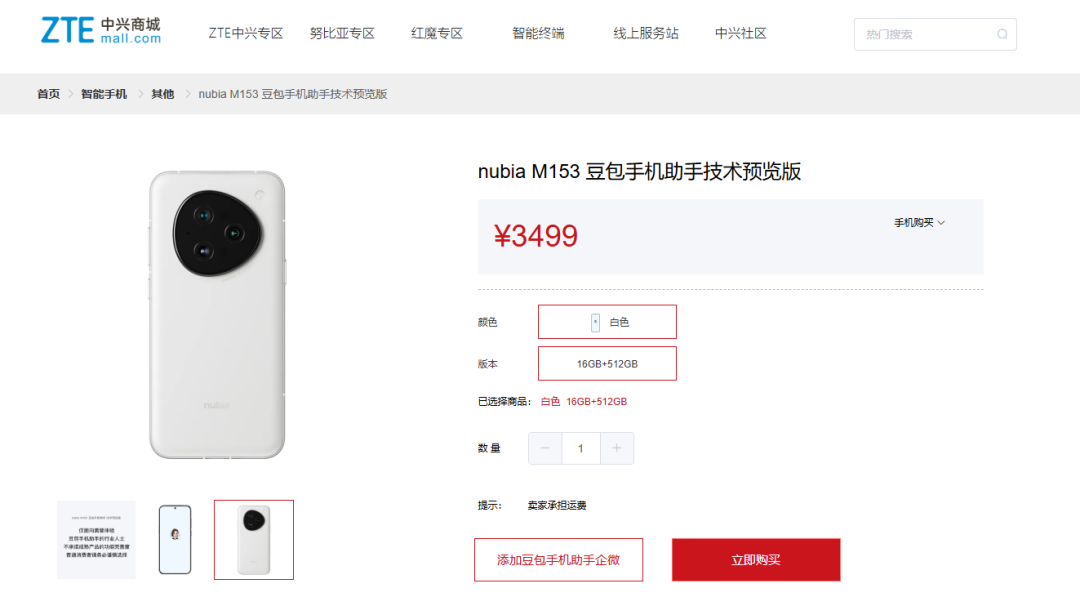
Image Source: Doubao
In December 2025, the Doubao team, in collaboration with ZTE, introduced the Nubia M153 engineering prototype, equipped with the Doubao Mobile Assistant technical preview. Utilizing GUI simulation clicking technology, it enabled cross-app automation and was priced at 3,499 yuan. It sold out within a day of its release, with prices on second-hand platforms skyrocketing to over 10,000 yuan.
One key reason Doubao did not immediately release a consumer version following the prototype's popularity was the GUI Agent's encounter with permission and security barriers within the app ecosystem.
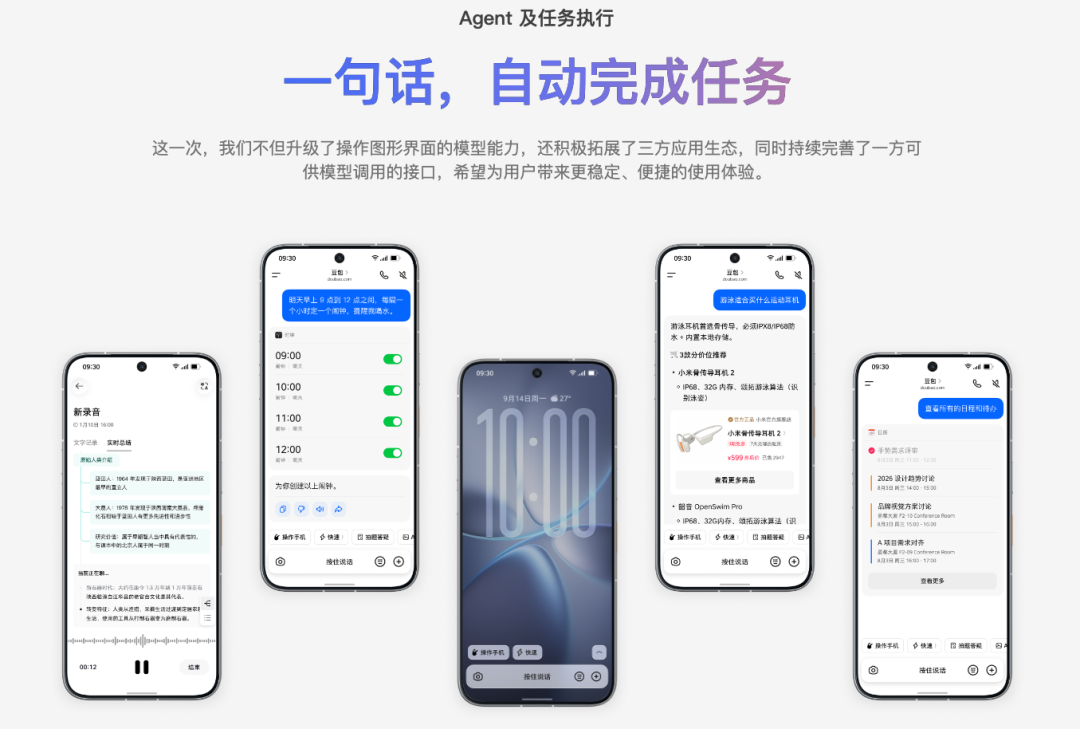
Image Source: Doubao
Instead of manipulating third-party software through official interfaces, Doubao directly identified UI components via GUI, bypassing the app's traffic entry points, data sovereignty, and security risk control mechanisms. Following the launch of the Doubao Mobile Assistant technical preview, it swiftly faced restrictions from WeChat, Taobao, and financial apps, compelling Doubao to disable automatic operation capabilities for certain apps.
In response, at the 2025 annual employee conference, Tencent's founder, chairman, and CEO Pony Ma stated that Tencent has consistently opposed the use of black-market plugins to record and transmit users' mobile and computer screens to the cloud, 'because it is extremely unsafe and irresponsible.'
After recognizing the numerous obstacles in the GUI simulation clicking technology route, Doubao proactively engaged in discussions with developers.
In January 2026, according to Intelligent Emergence, the Doubao Mobile team was in negotiations with mainstream app developers and had secured common permissions for internet products such as ride-hailing, food delivery, and ticket booking.
The latest consumer version of Doubao Mobile Assistant integrates services like Caocao Chuxing and maps, enabling 'one-phrase access' through standardized service interfaces.
However, not all developers are willing to open API interfaces to external AI tools. A case in point is Honor, which had previously focused on promoting protocol adaptations like MCP and A2A but faced sluggish ecological expansion due to low developer enthusiasm.
If Doubao Mobile Assistant passively awaits official data interface adaptations, its consumer version may struggle to differentiate itself.
02 Doubao Mobile Still Leverages GUI but Empowers Developers
As is widely acknowledged, since 2026, the AI industry's competitive focus has shifted from large models to Agents. Agents capable of executing tasks offer greater potential compared to Chatbots that merely provide Q&A services.
The same principle applies to the mobile phone industry. Beyond enhancing voice wake-up, memory, and screen recognition capabilities, the consumer version of Doubao Mobile Assistant retains the appeal of Agents and task execution.
However, as previously mentioned, with Honor serving as a cautionary example, relying solely on a limited number of developers to provide API interfaces makes it challenging for the consumer version of Doubao Mobile Assistant to achieve true 'one-phrase mobile operation'.
In light of this, the consumer version of Doubao Mobile Assistant adopts a 'dual-strategy' approach, executing tasks through official data interfaces while relying on system-level GUI Agents as a fallback.
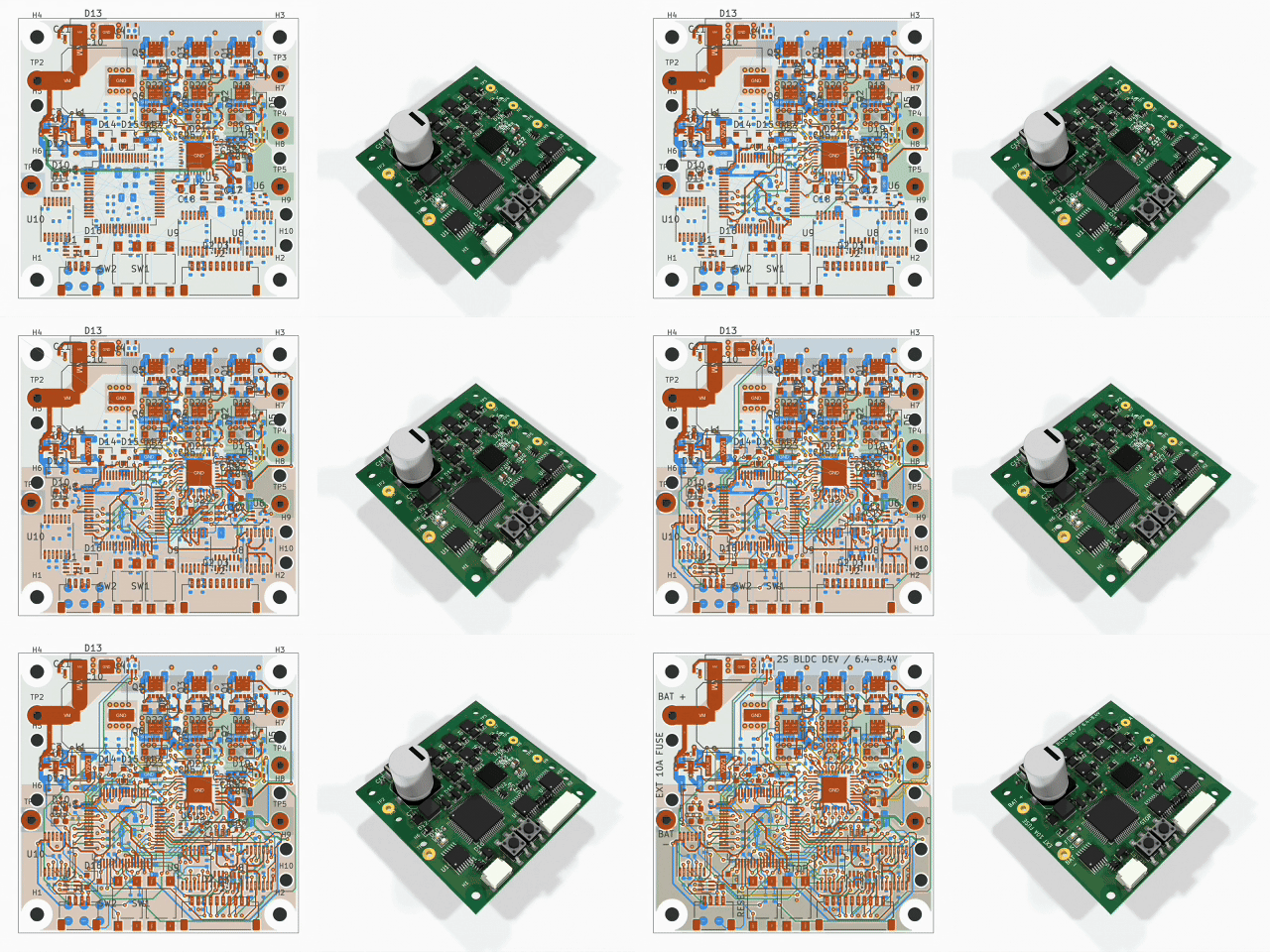
Image Source: OpenAI
Indeed, bolstering GUI manipulation capabilities is emerging as a key technological direction in the Agent industry. For instance, to enhance the Agent experience, OpenAI significantly improved the GUI manipulation capabilities of GPT-6 Astra, enabling PCB design with KiCad and house modeling in Blender.
The rationale is that after decades of technological advancement, there is a plethora of software applications, and not all developers are motivated or able to open interfaces. For long-tail software lacking standardized open interfaces, GUI serves as a crucial fallback solution to expand Agent operation boundaries.
However, unlike computer software, which predominantly possesses tool attributes and involves fewer information security concerns, many mobile apps are service-oriented products. Most mobile internet companies are averse to GUI simulation clicking technology.
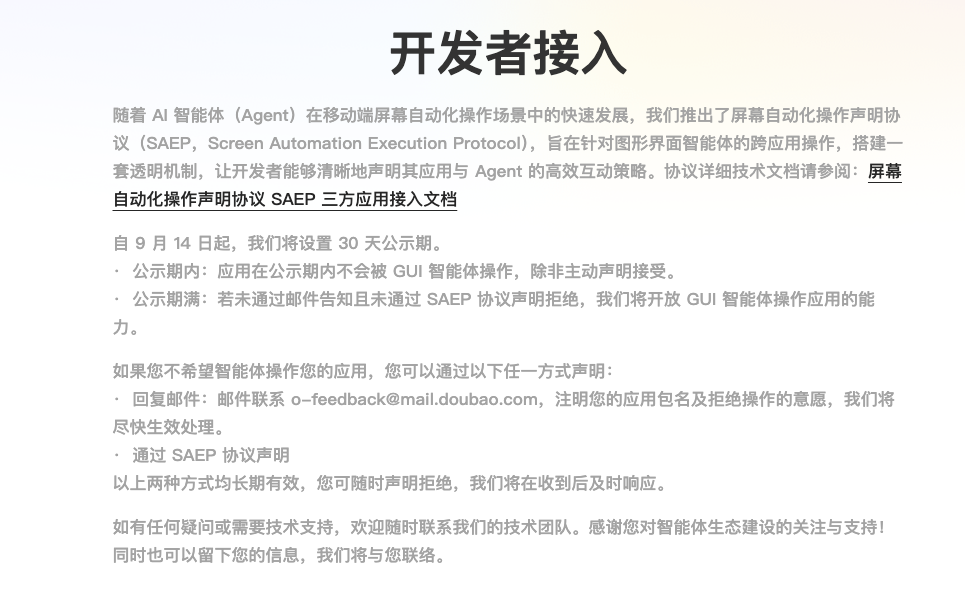
Image Source: Doubao
To preempt public controversy over being blocked by third-party apps, Doubao Mobile Assistant simultaneously launched the Screen Automation Execution Protocol (SAEP) and set a 30-day public notice period.
During this notice period, developers can independently declare whether to permit Doubao Mobile Assistant to operate their apps via GUI Agents. After the notice period expires, if developers do not notify via email or declare rejection through the SAEP protocol, Doubao Mobile Assistant will enable GUI Agent operation capabilities for users.
Subsequently, if developers wish to adjust their app's interaction strategy with Agents, they can communicate with the Doubao Mobile technical team at any time.
It is evident that compared to the technical preview version, the consumer version of Doubao Mobile Assistant has not significantly altered GUI simulation clicking technology. The key change is that Doubao has ceded control over permission openness to developers. Compared to waiting for developers to open interfaces one by one, SAEP substantially reduces the coordination costs of GUI Agent manipulation of third-party apps.
03 Doubao Mobile's Commercialization: Starting with AI Office?
While Doubao Mobile Assistant's initiative to launch the Screen Automation Execution Protocol is commendable, whether the product can instantly usher in the AI phone era warrants reconsideration.
Since 2026, the Agent competition has primarily centered on office scenarios. In these settings, users have a clear need for cost reduction and efficiency enhancement, and the benefits of Agents can be readily quantified.
Unlike PCs, which boast strong productivity attributes, smartphones primarily cater to entertainment, social, and lifestyle service needs. Currently, about 700 million people spend two hours daily browsing Douyin, 400 million on Kuaishou, and 200 million on Xiaohongshu. The extensive content consumption duration suggests that in the mobile internet landscape, users prioritize the 'emotional value' derived from content over faster operation efficiency.
In response, in November 2019, Alibaba's then-Chairman Jack Ma remarked, 'Every night, about 17 million people browse Tmall and Taobao but make no purchases. I'm unsure what these individuals are doing; they're merely aimlessly browsing. Thus, your website cannot solely focus on shopping; experience, fun, communication, and sharing are more crucial.'
The entertainment-centric preferences of mobile internet users pose two significant challenges for Doubao Mobile Assistant: firstly, the practicality of Agent functions is substantially diminished; secondly, commercialization becomes more arduous.
GUI Agents necessitate continuous screen recognition, operation path planning, and re-evaluation of interface states after each step, resulting in extended reasoning chains. Consequently, they consume more computational power than simply invoking standardized interfaces. In this context, since users lack an urgent need for efficiency enhancement, it is challenging for GUI Agents to establish a commercial closed loop by charging users.
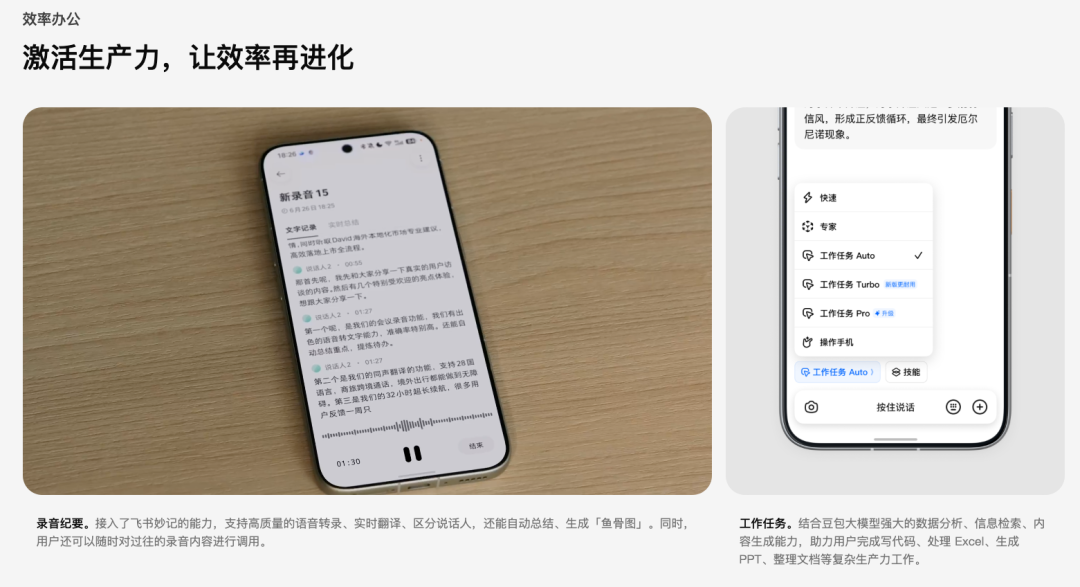
Image Source: Doubao
Perhaps cognizant of the structural contradictions in GUI Agent technology, the consumer version of Doubao Mobile Assistant emphasizes bolstering office capabilities, supporting functions like recording minutes and work tasks. Users can control Doubao Mobile Assistant via natural language to perform tasks such as information retrieval, data analysis, and content generation.
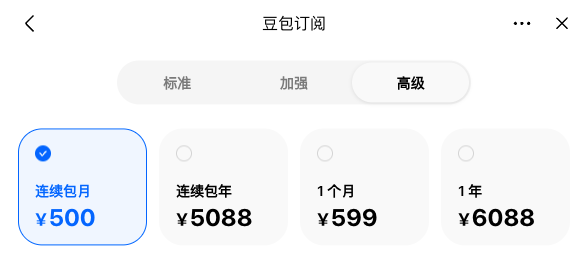
Image Source: Doubao
Indeed, charging users for office Agents is precisely Doubao's current focus. In June 2026, Doubao introduced a professional version with standard, enhanced, and premium subscription plans priced at 68 yuan, 200 yuan, and 500 yuan per month, respectively.
From this vantage point, what truly merits attention in the consumer version of Doubao Mobile Assistant is not merely enabling Agents to further gain 'mobile operation' capabilities but also simultaneously touching upon two crucial boundaries of AI phones: one is the capability boundary determined by GUI Agents; the other is the commercial boundary reliant on office scenarios.
Over the past few years, AI phones have failed to become disruptive products not solely due to insufficient model capabilities. A deeper issue is that to complete cross-app tasks, AI must breach the long-standing ecological barriers between apps. Moreover, when task execution requires continuous invocation of large models, visual understanding, and multi-round reasoning, the exorbitant computational costs deter manufacturers.
This is where the value of the consumer version of Doubao Mobile Assistant lies. GUI Agents based on SAEP can address interface fragmentation in a more gentle manner, while office functions attempt to find the first group of users willing to pay for premium Agent capabilities.
If both paths can succeed concurrently, AI phones could transition from a technological competition centered on models and functions into a scalable business.
Interactive Topic
Have you experienced an AI phone? What are your thoughts on Doubao Mobile?
This article is original content from Shijiao Farsight and is prohibited from reproduction without authorization.
-
![]()
After a 200 Billion Yuan Loss, Seres Reclaims Its 'Soul,' But Will Yu Chengdong Continue to Back AITO?
-
![]()
Will you still buy AITO after its prefix changes from 'HIMON Auto' to 'Seres'?
-
![]()
Atlas Paves the Way with 3D Reconstruction, Ushering in a New Measurable Era for World Models
-
![]()
Why Is AITO’s Shift to a ‘Light Asset’ Model a Strategic Boon for Seres?
-
![]()
Doubao Mobile Phone Officially Launches: GUI as a Safety Net, AI Office as a Revenue Stream
-
![]()
Doubao Mobile Phone Officially Launches: GUI as a Fallback, AI Office as a Support
-
![]()
iFLYTEK Launches AStudio in a 'Desktop Gateway' War It Cannot Afford to Lose
-
![]()
BYD Executive’s Clear Stance: The Era of Fuel Vehicles Is Over