An Apple Product Seven Years Late Enters a Market Where It Can't Set Prices
 09/17 2026
 474
474
Over the past two decades, Apple has followed a near-infallible playbook: enter late, wait for supply chains to mature, and leverage its brand for maximum profit.
This time, in the foldable screen market, Apple faces three simultaneous barriers: it cannot control costs, lacks control over the core user experience, and depends on its biggest rival for the most expensive components.
The iPhone Duo reveals not just a crack in Apple’s armor but also three fundamental shifts reshaping the consumer electronics industry.
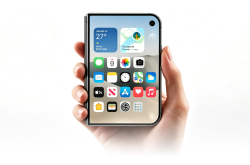
Priced at 15,999 yuan, the iPhone Duo marks Apple’s highest starting price ever. In the early hours of September 10, Apple unveiled its first foldable iPhone Duo at Apple Park: featuring a book-style inward fold, a 5.4-inch outer screen, a 7.6-inch inner screen, a titanium frame, an A20 Pro chip, side-mounted Touch ID, and a 256GB version priced at 15,999 yuan for the Chinese market. Pre-orders begin at 8 PM on October 16, with official sales starting on October 23.
This is Apple’s most expensive phone ever and the first product launch under new CEO John Ternus. Despite over a month until pre-sales begin, the market has already gone wild. JD.com alone has seen over 1.2 million pre-orders. On Dewu, two units of the 256GB Chinese version sold for as high as 49,999 yuan, with the lowest transaction price at 21,000 yuan. On Xianyu, some sellers have listed prices as high as 90,000 and 99,000 yuan.
To clarify, the 90,000-plus price tags have no record of actual transactions and are purely for scalper hype. The real market premium ranges from 5,000 to 20,000 yuan. Some scalpers plan to take out multi-million-yuan loans to stockpile devices, with pre-order deposits skyrocketing to 800 yuan, marked as 'non-refundable for cancellations.' The hype is real, and so is the bubble.
When a consumer electronics product yet to hit mass production commands prices nearing those of a compact car in the secondary market, this is no longer a product launch—it’s a leveraged gamble. And the underlying logic boils down to one word: scarcity. Complex hinge technology, a mass production yield of just around 65%, and daily output once limited to a few hundred units led Ming-Chi Kuo to forecast third-quarter assembly shipments of just 500,000 to 1 million units.
With supply severely constrained and demand skyrocketing, prices are inevitably distorted. This raises a more critical question: once production ramps up and premiums fade, can Apple sustain the 15,999 yuan price point? Over the past two decades, Apple’s playbook has rarely failed: enter late, wait for supply chains to mature, and leverage its ecosystem and brand for maximum profit. This time, it faces three simultaneous barriers.
01 Uncontrolled Costs: The Master Negotiator Starts to Concede
Apple’s most underrated strength over the past two decades has never been product design but supply chain pricing power. Its strategy can be summed up in eight words: short-term negotiations, multi-sourcing for lower prices. By negotiating with multiple suppliers simultaneously and using massive orders to extract the lowest bids, Apple awards contracts to the lowest bidder. A strict supplier certification system ensures that newcomers can always replace incumbents.
Apple has played this game for two decades with near-perfect success—until AI rewrote the pricing power in the storage industry. According to South Korea’s Economic Forum, Apple has likely signed a 3-to-5-year NAND flash memory supply agreement with Japan’s Kioxia, possibly without a price cap.
Zooming out, Apple’s concessions unfolded in three increasingly significant steps: in February, it accepted a roughly 100% increase in NAND procurement prices from Kioxia and shifted from fixed-price contracts to quarterly adjustments; around July, it ceded more pricing flexibility to Kioxia, prioritizing volume locks; by September, reports emerged of a 3-to-5-year contract without a price cap.
Apple voluntarily surrendered pricing authority to secure something more fundamental: supply certainty. It was forced to abandon the rules it had mastered for two decades. Another development underscores the issue.
Multiple media outlets report that Apple has begun testing Changxin Memory’s LPDDR5X DRAM chips for devices sold in the Chinese market—a classic Apple tactic: introduce a low-cost competitor to pressure Samsung and SK Hynix. But Changxin held firm, quoting prices no lower than Samsung and SK Hynix, with some models even higher.
Its confidence stems from its order book: domestic clients like Huawei, Xiaomi, Alibaba, and ByteDance have already locked in Changxin’s capacity through long-term contracts until the end of 2027. When a company known for driving down prices cannot negotiate lower rates from an emerging domestic supplier, it signals weakening pricing power. The reason is straightforward: AI data center clients are fiercely competing for storage capacity, willing to sign long-term contracts and pay hefty premiums.
Kioxia’s Q1 FY2026 financials show data center revenue surging over 5x year-on-year, NAND average selling prices rising ~70% quarter-on-quarter, and gross margins hitting 80%. The company expects NAND supply shortages to persist until 2027. Faced with such buyers, Apple risks losing access to supply without volume locks.
Pricing power in the storage industry is shifting from 'who buys more, who drives prices down' to 'who commits to long-term demand, who secures capacity first.' Uncontrollable costs ultimately get passed to consumers. TrendForce’s calculations reveal three striking figures: based on the 12GB+256GB version, the iPhone 18 Pro’s total BOM cost rises ~38% from the previous generation; storage’s share of BOM jumps from ~10% a year ago to 34% in Q3 2026; it is expected to exceed 40% by H1 2027, surpassing processors and displays as the top cost component. In other words, storage costs for the 256GB iPhone 18 Pro have nearly quadrupled in a year.
Apple has warned for multiple quarters on earnings calls about rising memory procurement costs, with its CFO stating that storage costs 'exceed' all explanations for the Q3 gross margin decline. This brings us back to the question: how much of the 15,999 yuan price reflects product value, and how much is cost pass-through? Amid the same cost storm, competitors offer a different answer.
On September 7, Huawei launched its triple-fold flagship Mate XT 2, starting at 19,999 yuan, with the 16GB+1TB version priced at 23,999 yuan. Yu Chengdong admitted at the launch: 'With storage costs up over 2,000 yuan, this price reflects significant sincerity.'
According to industry chain estimates, procurement costs for the mainstream 12GB+256GB flagship storage combination have surged from ~500 yuan to over 2,200 yuan in a year, a >300% increase. Yet the Mate XT 2’s base version starts at the same price as the 2024 first-gen Mate XT.
One passes costs to consumers; the other absorbs most of the pressure.
This is not about moral superiority but a genuine gap in pricing power.
02 Missing Core Experience: It Has Lost Definition Rights in China 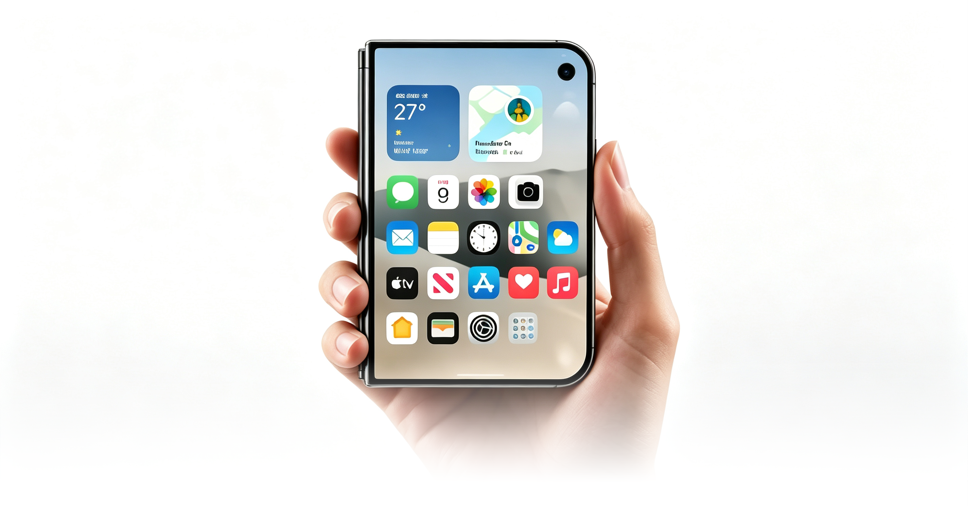
While cost pressures can be managed or passed on through pricing strategies, one issue Apple cannot resolve through supply chain negotiations is the lack of core user experience in its Chinese market offerings.
First, a factual correction: on July 15, the Cyberspace Administration of China announced that Apple Technology Development (Shanghai) Co., Ltd.’s 'Apple Intelligence' completed mobile-side generative AI service record-filing (filing) on July 8, with filing number Shanghai-AppleZhiNeng-202506160057. Huawei Xiaoyi, OPPO AndesGPT, vivo BlueLink, Xiaomi HyperAI, Samsung Galaxy AI, and Nubia Doubao also completed filings the same day. This makes Apple the last mainstream brand to complete end-side AI compliance certification.
But filing ≠ launch. The iOS 27 update pushed early on September 15 still did not enable full Apple Intelligence or Siri AI for Chinese iPhones. Apple’s official feature availability page states: 'Siri AI and new Apple Intelligence features are temporarily unavailable in mainland China. Apple is still advancing regulatory compliance work.' The overseas version’s cloud-based architecture does not meet domestic data and AI regulatory requirements and cannot be unlocked by changing Apple ID regions or languages.
The filings are complete, but the switch remains off. This interim period is Apple’s true dilemma.
Apple’s China strategy has long been 'global uniform experience, local adaptations as needed.' Chinese input methods, localized services, and payment integrations were tactical adaptations that did not affect core experiences. But Apple Intelligence involves foundational AI capabilities, and its absence structurally discounts the iPhone Duo—especially since foldables cannot rely solely on hardware: they need system-level large-screen adaptations, multi-window collaboration, cross-device workflows, and AI to transform that larger screen into genuine productivity.
Meanwhile, competitors have already completed a full cycle of iterations. HarmonyOS 7, launched on September 7, upgraded Xiaoyi into a system-level intelligent agent capable of perceiving over 200 system-level user data points, invoking over 2,100 system capabilities, and accessing 500+ partner-selected Skills and 2,000+ HarmonyOS intelligent agents. While Apple users await an uncertain rollout schedule, Huawei users have enjoyed a full year of end-side AI in the HarmonyOS ecosystem.
Another telling detail: the iPhone Duo supports only eSIM globally, eliminating physical SIM slots. This imposes additional operational costs for number porting, secondary SIM management, and dual-SIM users. More critically, international versions cannot install mainland China carrier eSIM profiles—eliminating the parallel import pathways scalpers once relied on for Hong Kong and U.S. versions. Even scalpers face technical barriers to stockpiling non-domestic models.
Consumers paying 15,999 yuan get a hardware-maxed device with locked intelligence.
03 Arrayed Competitors: Blue Oceans Enable Harvests; Red Oceans Force Hand-to-Hand Combat
Apple’s ability to 'enter late and harvest' relies on one condition: facing a blue ocean. The Apple Watch arrived three years after Android, capturing nearly 60% of global sales. AirPods, also three years late, pushed TWS penetration from under 5% to over 60%. When Apple entered the smartwatch market, penetration was under 5%, players were fragmented, and no brand had established true barriers. When AirPods launched, the TWS Headphones (TWS earphone) market was equally virgin territory.
Apple’s role was to wait for technology maturity and supply chain pricing to stabilize, then clear the field with its brand. The foldable market is far more complex. IDC data shows that in Q1 2026, Huawei dominated China’s foldable phone market with 60% share, Honor placed second at 21%, and OPPO, vivo, and Xiaomi held 6%, 5%, and 4%, respectively. The top brands command 96% combined, with Huawei alone holding 60%.
Notably, Huawei’s share dipped from 71.8% in Q1 2025, while Honor’s surged from 9.1% to 21%—not an opportunity for Apple, but evidence of ongoing market reshuffling that temporarily excludes Apple. 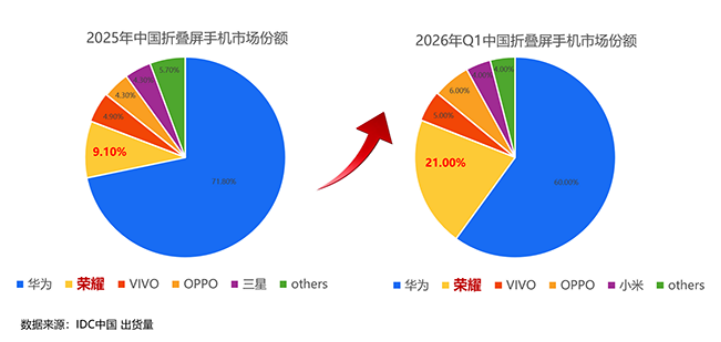
More critical is upgrade migration. QuestMobile data from June 2026 shows: 19.1% of iPhone users upgrading switched to Huawei, while 15.3% of Huawei users switched to iPhone. iPhone’s same-brand retention rate was 49.6%, with Huawei ranking second in attracting iPhone users. Both figures significantly exceed migration to other brands, but the net flow favors Huawei. 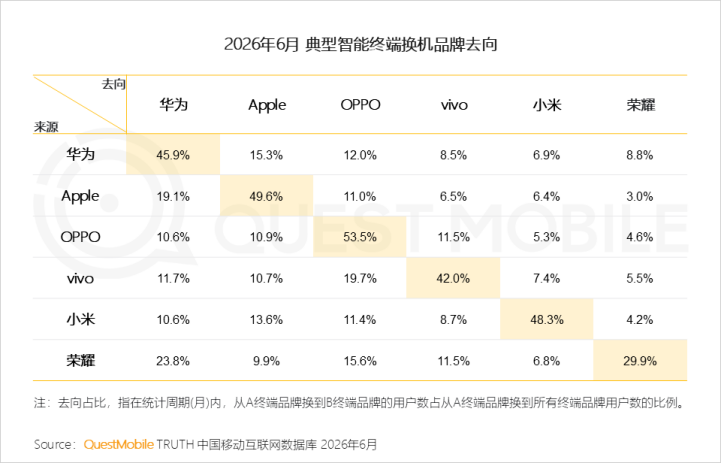
Why must Apple enter now? Because delaying further risks losing high-end users seeking foldable experiences to Huawei. But even more fatal than market share is the supply chain structure.
According to The Elec and other South Korean media, Samsung Display exclusively supplies flexible OLEDs for Apple’s first foldable, with a three-year exclusive (exclusive) deal covering the first three iPhone Duo generations. Samsung Display passed Apple’s certification with >80% yield (threshold: 70%), delivering ~3 million panels this year and planning to expand to 15 million by 2027. At ~$250 per panel, it is the most expensive component after the core chipset.
Samsung Display reportedly proposed this three-year exclusivity. Apple accepted due to a lack of viable alternatives. Meanwhile, Samsung is already the world’s largest foldable phone vendor. In other words: Apple’s most expensive foldable component depends on its biggest rival. The more Apple buys, the stronger its rival becomes.
Now consider Huawei. BOE is its core foldable panel supplier, with joint R&D on triple-fold flexible OLED solutions. At BOE’s 2024 Global Innovation Partner Conference, Chairman Chen Yanshun publicly stated that BOE and Huawei are 'more closely linked than ever' in foldables, with 'joint R&D.'
Huawei’s triple-fold supply chain is highly localized, with BOE, Lens Technology, and other listed companies as core suppliers. Huawei has nurtured a domestic foldable supply chain into a Main plan (mainstream solution) with seven years of orders; Apple’s only option is Samsung.
Apple’s vaunted high standards have locked its own Achilles’ heel for three years. This does not mean Apple should be underestimated. Counterpoint predicts iPhone Duo shipments could reach 6 million units in its first year, capturing 25% global share—second only to Samsung’s 38% and ahead of Huawei’s 22%.
IDC is blunter: from 2026 to 2030, Apple will drive 81% of foldable value growth and 71% of net shipment growth, remaining the category’s largest variable.
But a fundamental question lingers: when supply chain costs are uncontrollable, core experience switches depend on regulators, and the most expensive component relies on its biggest rival—how does Apple win? The answer lies not in iPhone Duo sales but in Apple’s supply chain strategy, AI implementation pace, and China market positioning over the next three years.
But if we simply interpret this as 'Apple facing difficulties,' we would be underestimating its significance.
The iPhone Duo truly reflects the threefold structural shifts occurring in the consumer electronics industry: a shift in pricing power—from 'who buys in bulk gets lower prices' to 'who commits to long-term demand gets priority access to production capacity'; a shift in supply chain dominance—from 'those who use the industrial chain' to 'those who nurture the industrial chain'; and a shift in entry barriers—from hardware specifications and brand premium to whether AI can achieve compliance and localization locally.
The first shift has been acknowledged by Apple itself through a long-term contract without a price cap; the second shift has been cemented by a three-year exclusive panel contract; and the third shift is evident in the gray, unusable feature entry in the China-specific iOS 27. These three shifts all point in the same direction: the most valuable capability of the past two decades—waiting for everything to mature and then reaping the rewards all at once—is being replaced by a slower, heavier, and more long-term capability.
That is, nurturing the industrial chain before others even start waiting. Apple was once the perfect executor of this logic. Now, for the first time, it has discovered that some things cannot be waited for: storage production capacity has been snatched up by AI, panel yield rates require time to improve, and compliance and localization have never been automatically granted just because of a strong brand. The foldable screen is merely the first mirror reflecting these cracks.
References:
QuestMobile, '2026 Smartphone Market Research Report,' September 8, 2026 (Apple/Huawei bidirectional switch flow 19.1%, 15.3%, statistical period June 2026).
IDC, 'IDC 2026 Apple Fall Event Hot Topic Analysis,' September 11, 2026 (net value increase 81%, net shipment growth 71% from 2026-2030).
China Securities Network / Xinhua News Agency, 'Apple's First Foldable Phone, iPhone Duo, Officially Released,' September 10, 2026 (starting at 15,999 yuan, specifications and release date).
Financial Associated Press, 'Apple Signs Long-Term NAND Supply Agreement with Kioxia, Possibly Without Price Cap,' September 8, 2026 (citing Korea's 'Economic Forum,' 3-5 year LTA).
TrendForce, 'Estimated iPhone 18 Pro Cost to Increase Nearly 40%, Apple May Adjust Gross Margin Strategy for Steady Shipments,' August 10, 2026 (BOM +38%, storage share 10%→34%→42%).
Cyberspace Administration of China, 'Announcement on the Release of Filing Information for Seven Mobile-Side Generative AI Services,' July 15, 2026 (Apple Intelligence filing number Shanghai-AppleZhiNeng-202506160057).
Securities Times Network, 'Seven Mobile-Side Generative AI Services Complete Filing, Alibaba's QianWen to Be Integrated into Apple Intelligence,' July 15, 2026.
Tencent News, 'Mate XT 2 Priced at Nearly 20,000 Yuan, Why Does Yu Chengdong Say It Shows Sincerity?' September 7, 2026 (starting at 19,999 yuan, storage cost per unit rises over 2,000 yuan).
Jiemian News / Science and Technology Innovation Board Daily, 'Samsung Display Obtains Apple's Foldable OLED Module Mass Production Certification, Three-Year Exclusive Supply,' June 23, 2026 (citing The Elec, yield rate 80%, first batch 3 million units).
Phoenix Technology, 'BOE Chairman Chen Yanshun Discusses Huawei's Triple Fold: Joint Development, Unprecedentedly Close Ties,' September 4, 2024.
Counterpoint Research, 'Global Foldable Shipments to Hit 100-Million Cumulative Milestone by End of 2026,' August 2026 update (Apple's first-year 25% share, 6 million units, second globally).
Apple official website iOS 27 feature availability page (Apple Intelligence / Siri AI temporarily unavailable in mainland China). Cyberspace Administration of China public notice on July 15, 2026, Apple Intelligence filing completed on July 8, 2026 (China.com / Sina).
-
Huawei Relinquishes AITO, Seres Assumes Control
-
Entering a New Phase of Auto Exports: BYD and Chery Pursue 'Vehicle Parity Growth'
-
Seres’ Ascendancy in AITO: A Journey Built Over Time
-
![]()
An Apple Product Seven Years Late Enters a Market Where It Can't Set Prices
-
![]()
2026 China Automotive Net Promoter Score (NPS) Index Research: Product Experience Fuels Word-of-Mouth, Brand Marketing Holds the Key to Breakthroughs
-
![]()
Beauty Joins In, ByteDance Ramps Up Investment Game
-
![]()
Jensen Huang Hits Back at Ray Dalio: Is AI the Next Big Financial Bubble?
-
![]()
Battle for the Gateway to the World Model: ByteDance Leans Left, JD.com Leans Right