Jensen Huang Hits Back at Ray Dalio: Is AI the Next Big Financial Bubble?
 09/17 2026
 411
411
 Image Source: Generated by AI, showcasing a real-world scenario
In 2026, the most pressing question in the global tech sphere will be: Is AI truly a bubble?
This query has ignited a fierce debate between two globally influential figures, capturing the attention of the entire world.
One is Ray Dalio, the founder of Bridgewater Associates, hailed as Wall Street's 'oracle' for accurately predicting the 2008 financial crisis.
He has publicly warned on multiple occasions that the AI market is displaying classic bubble characteristics, reminiscent of the eve of the 1929 Great Depression and the 2000 dot-com bubble.
The other is Jensen Huang, CEO of NVIDIA, the world's leading chip giant. In June 2026, at an event in Taipei, he directly retorted: Only a 'madman' would doubt the returns on AI investments, as this technology has already generated trillions of dollars in value.
One predicts an imminent bubble burst, while the other argues that doubting AI is the mark of a madman.
It appears they are discussing two entirely different realms.
This heated debate originates from Bridgewater Associates founder Ray Dalio's recent caution about the AI boom.
He contends that the current AI market has entered the early stages of a typical financial bubble. Although it is still far from the extreme frenzy witnessed around 1929 and 2000, warning signs have already surfaced.
Previously, he stated that the AI bubble he foresees is about 80% as severe as the peaks of those two historical bubbles.
Jensen Huang, however, does not subscribe to this viewpoint. His core rebuttal is that today's AI is not merely a collection of concept stocks lacking revenue support.
NVIDIA is delivering tangible chips, cloud service providers are constructing real data centers, companies are purchasing actual computing power, and AI is being integrated into software, customer service, R&D, and industrial processes.
Simply labeling AI as a bubble is tantamount to confusing genuine industrial demand with asset price fluctuations.
This debate has garnered attention because neither man is a novice in the field.
Ray Dalio excels at identifying risks through long-term cycles of debt, liquidity, and asset prices, while Jensen Huang stands at the forefront of global AI infrastructure development.
One monitors whether money will suddenly become scarce, while the other observes whether machines are still adequate. Though they seem to contradict each other, they are actually examining two facets of the same phenomenon.
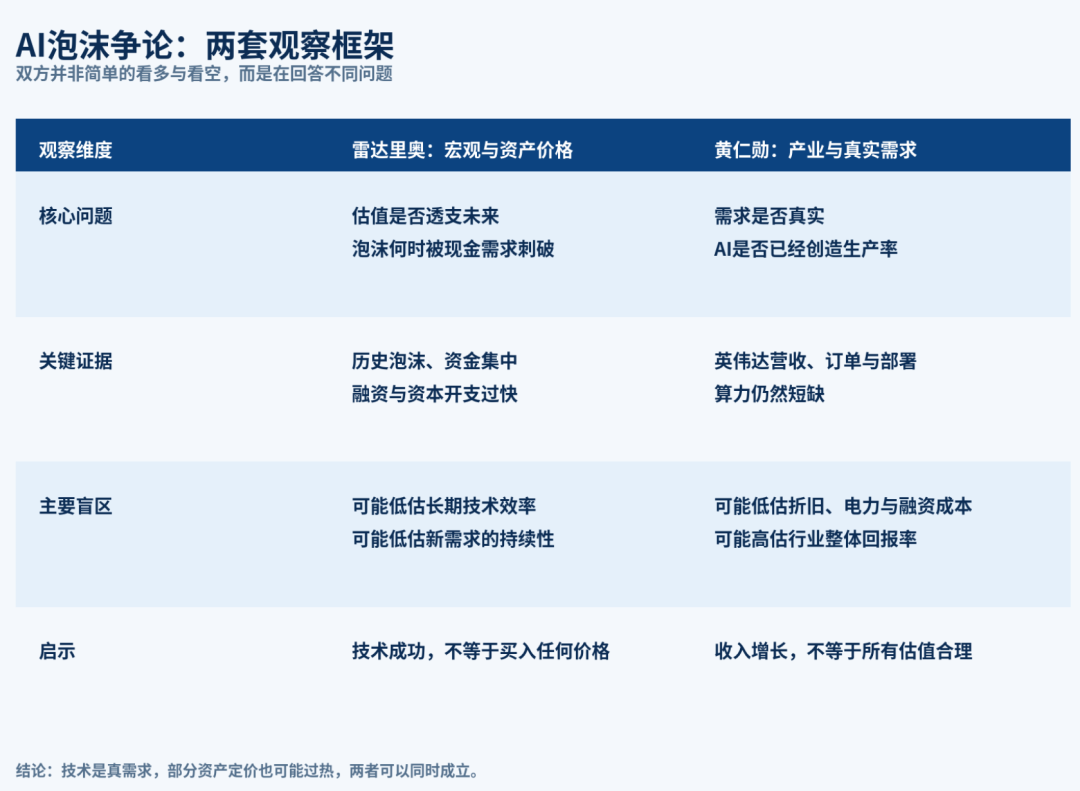

Ray Dalio's concerns do not stem from the belief that 'AI is useless.'
Many misinterpret Ray Dalio's stance as bearish on AI, which is inaccurate. What he truly alerts to is that technological value, company value, and stock prices are being increasingly conflated into a single narrative by the market.
Firstly, capital expenditures are escalating too rapidly. AI infrastructure is a capital-intensive sector, requiring substantial upfront investments in chips, servers, networks, land, power, and cooling systems.
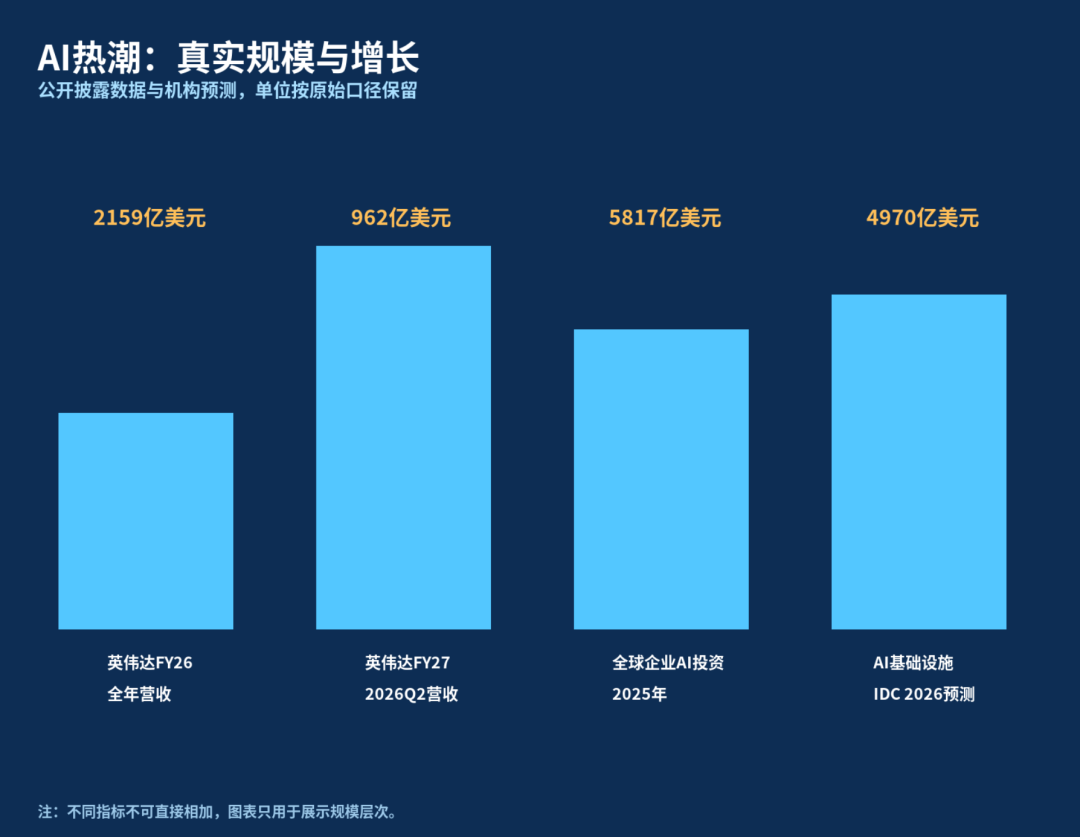
IDC estimates that global AI infrastructure spending will reach nearly $497 billion in 2026.
This figure indicates robust demand but also reveals that the industry has entered a high-investment phase. As long as model usage growth and enterprise spending can keep pace, investments will fuel expansion. However, if application revenue growth lags behind depreciation, electricity costs, and financing expenses, problems will shift from valuations to orders.
Secondly, capital is concentrating in a few key companies. NVIDIA's stellar performance does confirm that AI computing power demand has materialized, but not every company in the supply chain has experienced synchronized improvements in revenue, profits, and cash flow.
The market tends to extend credit to the entire sector based on the real growth of leading companies. Historically, the most perilous phases often occur not when technology fails to exist but when good technology is priced too high.
Thirdly, the AI industry risks 'mutual investment, mutual procurement, and mutual inflation of expectations.' Large model companies require chips and cloud services, cloud providers need models to attract customers, and capital markets assign higher valuations to related companies based on future orders.
This cycle can accelerate construction in the early stages but also necessitates end users to spend real money to close the loop. Otherwise, the supply chain may appear prosperous while cash flow thins out at the end.
Ray Dalio's most crucial reminder is not that 'a crash is imminent' but that bubbles typically do not end because everyone suddenly realizes the technology is fake.
More commonly, financing becomes costly, investors need cash, companies begin cutting budgets, and valuations sustained by high expectations suddenly lose their successors.
Why is Jensen Huang's rebuttal so forceful?
Jensen Huang's firm stance also carries industrial logic.
NVIDIA's data reveals that its fiscal year 2026 revenue reached $215.9 billion, up 65% year-over-year. In the quarter ending July 26, 2026, revenue hit $96.2 billion, up 106% year-over-year, with data center revenue reaching approximately $89 billion, up 117%.
These are not distant promises on a PPT but orders and revenue already reflected in financial statements.
For Huang, if the market labels AI as a bubble across the board, the first to be wronged are not projects without products but infrastructure companies actively delivering products and expanding capacity.
NVIDIA's business model has evolved from single GPU supply to systems, networks, software ecosystems, and complete machine platforms. It wants investors to see a continuously upgrading computing platform, not a one-time chip boom.
More importantly, AI computing power demand does not rely solely on chatbots.
Traditional data centers are transitioning from general-purpose to accelerated computing, generative AI brings new model training and inference demands, and intelligent agents transform one-time Q&A into continuous interactions.
Huang repeatedly emphasizes that these demands are occurring simultaneously, meaning the ceiling for the computing power market cannot be estimated solely by today's application volume.
However, Huang's stance also has inherent limitations. As one of AI infrastructure's biggest beneficiaries, he cannot evaluate his industry from the perspective of a macro investor.
While NVIDIA's high growth proves demand is real, it does not automatically justify the valuations of all AI companies, nor does it guarantee that every future dollar of capital expenditure will yield the same returns.
What is happening in the AI wave, and what is the market overlooking?
Data from Stanford University's AI Index shows that global enterprise AI investment reached $581.7 billion in 2025, up 130% year-over-year.
This indicates that AI has moved from labs into corporate budgets but also means the industry is shifting from 'Is there demand?' to 'Can demand generate profits?'
The details the market most easily overlooks are that AI's cost structure is increasingly resembling traditional industries.
Models do not cease functioning after deployment; they require continuous inference, storage, bandwidth, power, and maintenance.
Enterprises also do not automatically gain efficiency by purchasing a model. Data cleaning, process reengineering, permission management, and employee training all add real costs.
The second detail is electricity. The International Energy Agency points out that data center electricity consumption grew by about 17% in 2025. The rapid expansion of AI computing power is turning a technological issue into an energy issue.
The U.S. Energy Information Administration projects that total U.S. electricity consumption will rise from 4.195 trillion kWh in 2025 to 4.270 trillion kWh in 2026 and 4.349 trillion kWh in 2027, with data centers being a significant contributor to this growth.
AI's future depends not only on how fast chips can run but also on whether the power grid can keep up.
The third detail is the time lag in productivity realization. Chip manufacturers can recognize revenue upon equipment delivery, and cloud providers can recognize revenue upon computing power rental. However, efficiency gains for end-user enterprises often take several quarters or even years to materialize.
Upstream prosperity preceding downstream realization is the stage in technological cycles most prone to creating illusions.
This explains why the current AI market simultaneously exhibits two seemingly contradictory facts: NVIDIA's performance is exceptionally strong, and some AI startups have extremely high valuations. Meanwhile, investors are beginning to question model revenue, customer retention, inference costs, and free cash flow.
The former indicates industrial growth, while the latter shows that capital markets are demanding profitability to justify growth.

What deserves greater vigilance than the word 'bubble'
Labeling AI as a bubble easily leads people to assume the technology lacks value; claiming AI will never experience a bubble risks hiding valuation risks behind industrial enthusiasm.
A more objective judgment is that AI technology represents genuine demand, but AI asset pricing may be partially overheated.
NVIDIA's revenue growth holds merit, yet valuations of certain AI companies may still be stretched. Data centers do need more computing power, but some projects may face delays due to insufficient power, financing, or customers. AI can improve efficiency, but not every enterprise can convert efficiency gains into profits.
Ray Dalio's strength lies in reminding the market not to focus solely on growth curves but also on financing conditions, cash flow, and return on capital.
Jensen Huang's value is in reminding the market not to deny the ongoing technological revolution due to bubble fears. Neither voice alone should dictate investment decisions.
For enterprises, the truly important question is not 'Should we embrace AI?' but whether, for every dollar invested, they can clearly articulate which costs it will save, which revenues it will create, and within what timeframe it will recover.
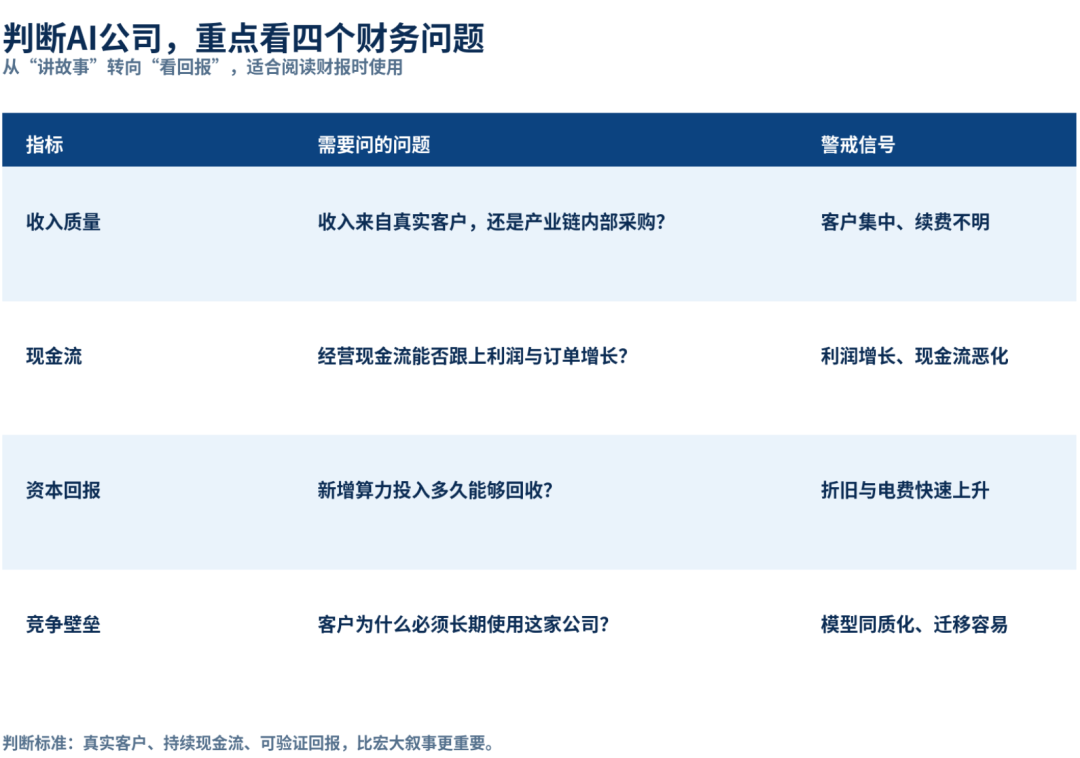
For investors, the truly important question is not 'Will AI change the world?' but where, after the world changes, the value will ultimately land on profit statements.
History does not repeat itself exactly, but it often rhymes.
Railroads changed the world, but that did not mean every railroad company deserved a high valuation. The internet reshaped commerce, but that did not guarantee all internet stocks would survive cycles.
AI may be the most significant technological wave in decades, but great technology and great investments have never been the same proposition.
Thus, the most memorable takeaway from this debate is: Do not deny technology because of bubbles, nor abandon valuation discipline because technology is real.
The companies that will truly survive the next adjustment are not those with the loudest voices but those with genuine customers, sustained cash flow, and verifiable returns.
-
![]()
Beauty Joins In, ByteDance Ramps Up Investment Game
-
![]()
Jensen Huang Hits Back at Ray Dalio: Is AI the Next Big Financial Bubble?
-
![]()
Battle for the Gateway to the World Model: ByteDance Leans Left, JD.com Leans Right
-
![]()
The Deeper Automakers Venture into Self-Developed Batteries, the More Apparent the Greatest Challenge Becomes
-
![]()
Seres No Longer Relies on Huawei for Growth
-
![]()
Good Stocks to Follow | AI Giant Calls for Slowdown, Goldman Sachs Bullish on SK Hynix Amid HBM Super Cycle Speculation
-
![]()
【Electric Equipment】Lingong's New Energy Mining Truck Project in Inner Mongolia Goes into Operation
-
![]()
Seres Steps into the Spotlight with AITO, Facing Its Own Set of Challenges