How Long Can Domestic Foldable Screen Smartphones Laugh After Apple's Entry?
 09/18 2026
 390
390
Original: Shenmou Finance and Economics (chutou0325)
The world had waited seven years for Apple's autumn product launch in early September.
When the new CEO, John Ternus, took to the stage in Cupertino with the foldable smartphone called the iPhone Duo, Apple finally delivered its first answer in this category. Priced starting at 15,999 yuan and topping out at 26,499 yuan, the device features a 7.6-inch inner screen when unfolded and is roughly the size of a passport when closed. This is Apple's most expensive iPhone ever. Rather than testing the market with 'cost-effectiveness,' it has placed its 'ultra-high-end' positioning for foldable screens on the table.
But before this, domestic manufacturers had already explored nearly every conceivable form factor for foldable screens.
Huawei has maintained its hold on the high-end market priced over 10,000 yuan with the Mate XT 2 (triple-fold) and Pura X series (wide-fold). Xiaomi has attempted to advance further into the high-end segment with the 18 Fold's 'medium-fold' form factor. Meanwhile, vivo and OPPO have focused more on the everyday experience of foldable screens: vivo has developed a dedicated system and large-screen efficiency, while OPPO has relentlessly pursued crease reduction in its hinge technology. In other words, domestic manufacturers have already completed several laps on the foldable screen track, while Apple is just now approaching the starting line.
So, what does Apple's entry signify at this moment? Has the foldable screen category truly reached the point of moving from niche early adopters to mainstream adoption?
01 First-Mover Advantage ≠ Ultimate Victory
The foldable screen race has been running for seven years, starting with the Samsung Galaxy Fold in 2019. However, only Huawei and Samsung have truly embraced it as a core strategy for brand premiumization. Apple's entry is less of a 'dimensional reduction strike' and more of a 'market validation.'
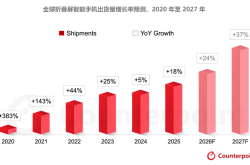
On September 7, Counterpoint Research released its latest forecast for the global foldable smartphone market: cumulative shipments are expected to surpass 100 million units by the end of 2026. Samsung's share is projected to decline from 40% in 2025 to 38%, while Apple is expected to capture 25% in its debut year, with Huawei maintaining around 22%.
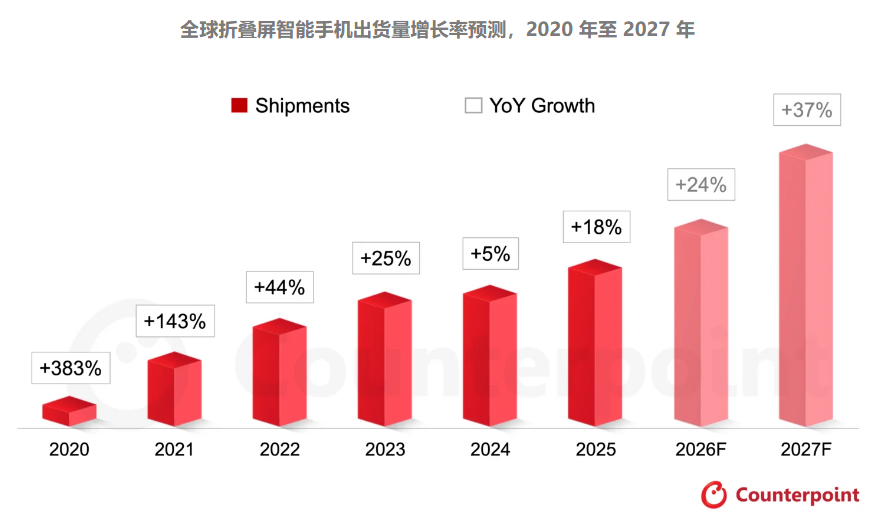
With these three companies accounting for over 80% of the market, foldable screens are no longer a category that 'anyone can try.' It is becoming a track (Chinese term meaning 'competitive arena') accessible only to manufacturers with strong premium brand power and deep supply chain integration capabilities. Apple's entry at this moment officially confirms foldable screens as a high-end category worth deep cultivation (Chinese term meaning 'deep cultivation').
In this category, the advantage of domestic manufacturers lies not in 'who did it first' but in the depth of their product matrices and the precision of their scenario positioning.
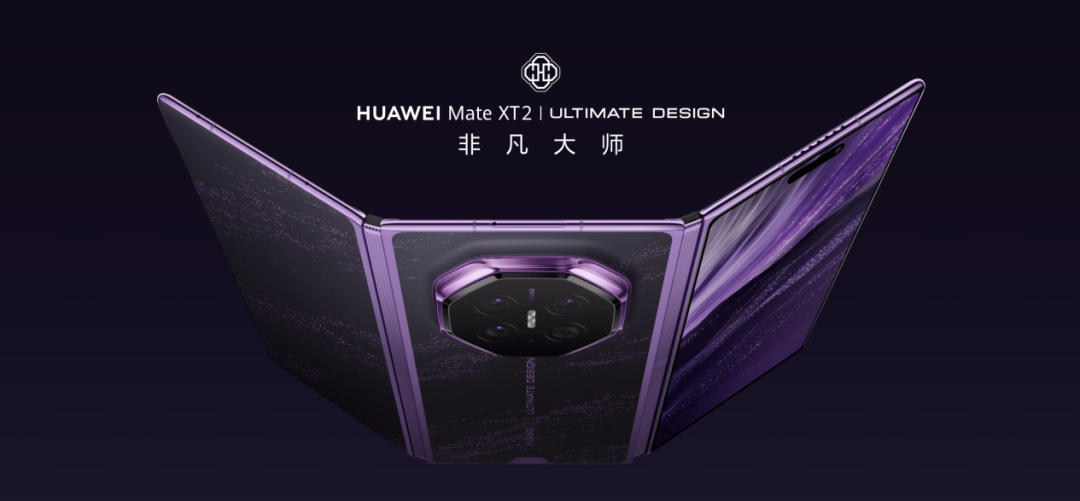
For example, Huawei released the Mate XT 2 Extraordinary Master (Extraordinary Master) triple-fold smartphone in September 2026, powered by the Kirin 9050 Pro chip and priced starting at 19,999 yuan, directly competing with Apple.
Xiaomi filled the 'medium-fold' market gap with the 18 Fold, priced starting at 10,999 yuan and equipped with its self-developed Xuanjie O3 chip and Changxin LPDDR6 memory. The OPPO Find N6 relentlessly pursued crease reduction in its hinge technology, becoming the world's first foldable flagship to pass TÜV Rheinland's '600,000 consecutive folds without visible creases' certification. The vivo X Fold6 focused on 'large screen + AI productivity,' featuring the OriginOS 6Fold system tailored for foldable large screens and the Blue Crystal x Dimensity 9500 Ultra flagship chip.
Each brand uses differentiated positioning to defend its price segments and scenarios. The accumulations of domestic manufacturers in foldable screens are no longer just about 'getting a head start' but have formed distinct technical paths in hinge design, system adaptation, and AI interaction.
The shelf life of this first-mover advantage depends on whether domestic manufacturers can transform 'being first' into 'being indispensable.'
One notable data point: IDC shows that OPPO's domestic foldable market share rose slightly from 4.9% to 6% in Q1 2026, ranking third. Despite the Find N6 becoming the best-selling new foldable that quarter, the share increase was limited.
In contrast, Honor doubled its domestic foldable market share from 9.1% to 21% during the same period, the only brand in the rankings to achieve such growth. The Honor Magic V6 drove this with its 7150mAh battery and near-bar-phone thinness, selling nearly 200,000 units in Q1.
This demonstrates that in the foldable screen category, 'being first' does not constitute an absolute barrier. Latecomers can rapidly double their share by finding breakthroughs in product definition.
Ultimately, how long the first-mover advantage of domestic manufacturers lasts depends not on when Apple enters but on whether they can retain users within their ecosystems before Apple makes foldable screens 'good enough.'
02 The Rise of Foldable Screens
Every industry reaches a stage where competition revolves around a core issue. Early in the new energy vehicle era, the focus was on range and charging speed; for smartphones during the iPhone 4 era, it was touch interaction and app ecosystems. Now, foldable screens are at such a turning point.
If the past seven years were about 'making the product,' starting in 2026, the focus may shift to 'making the product usable.' The first sign of this change is creases.
Creases were once the most criticized aspect of foldable screens and a major reason many hesitated to buy. However, manufacturers have invested far more effort into this than the outside world realizes.
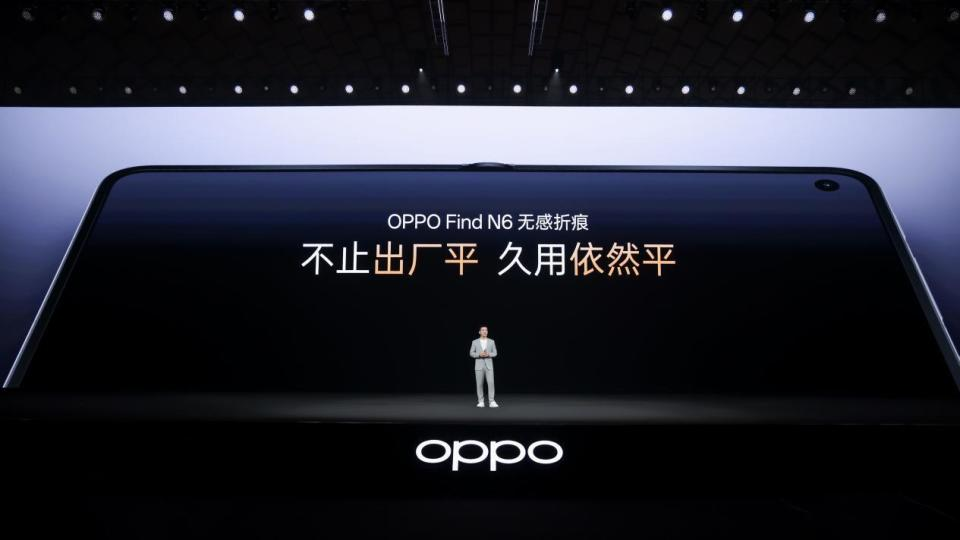
For example, the OPPO Find N6 reduced hinge surface undulation from 0.18mm to 0.1mm using a second-generation titanium alloy dome (Chinese term meaning 'dome') hinge and dome memory glass, improving bend resistance by 338% and achieving 99.9% shape self-repair after bending, much like a memory foam pillow.
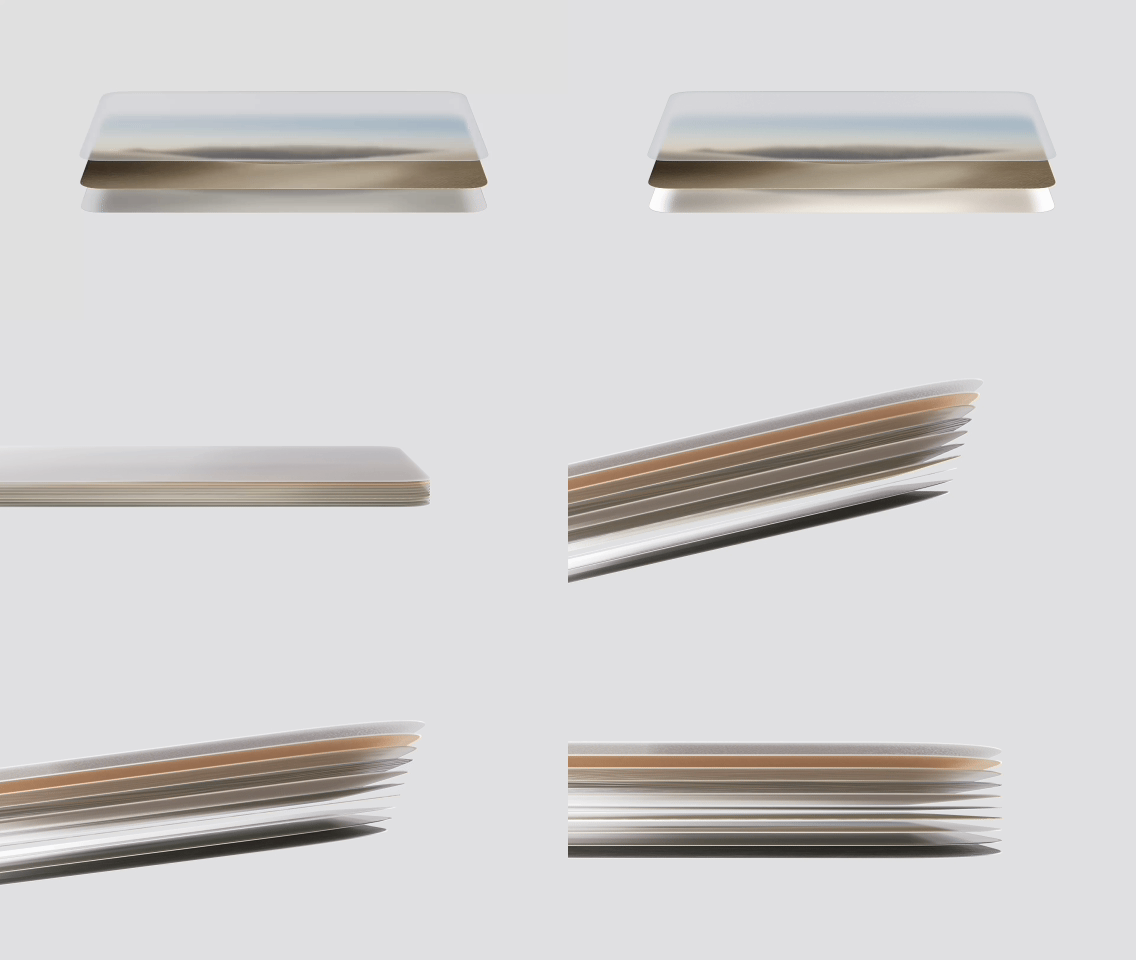
The Apple iPhone Duo's hinge consists of over 100 components, using multi-layer coatings and custom adhesives to allow independent movement of each layer during folding, reducing panel deformation.
While creases have not been entirely eliminated, they have transformed from a 'deal-breaker' for consumers to an 'acceptable engineering compromise.'
Once hardware-level foundational issues are gradually resolved, manufacturers can better focus on refining software and user experience, creating space for AI to become a new value anchor for foldable screens.
vivo VP Huang Tao mentioned at a launch event that despite continuous hardware improvements in foldable screens, many users still utilize the inner screen less than 30% of the time. This precisely shows that while large-screen hardware capabilities have arrived early, matching software ecosystems and AI interaction capabilities lag far behind.
Fortunately, many manufacturers have shifted the value proposition of foldable screens from hardware specifications to AI task-carrying capacity. Take the vivo X Fold6 as an example: it features the industry's first OriginOS 6Fold operating system tailored for foldable large screens, supporting 'Atomic Workbench' with five apps on one screen. Its Blue Crystal x Dimensity 9500 chip not only delivers high performance with low power consumption but also supports on-device AI experiences like AI Document Manager and AI Meeting Assistant.
Apple's introduction of the Apple Pencil into the iPhone ecosystem signals the same shift: the value anchor of foldable screens is moving from hardware specifications to 'how many AI tasks it can run simultaneously' and 'how many light office scenarios it can replace.'

Diversification of form factors is the third sign of category maturation, not market confusion.
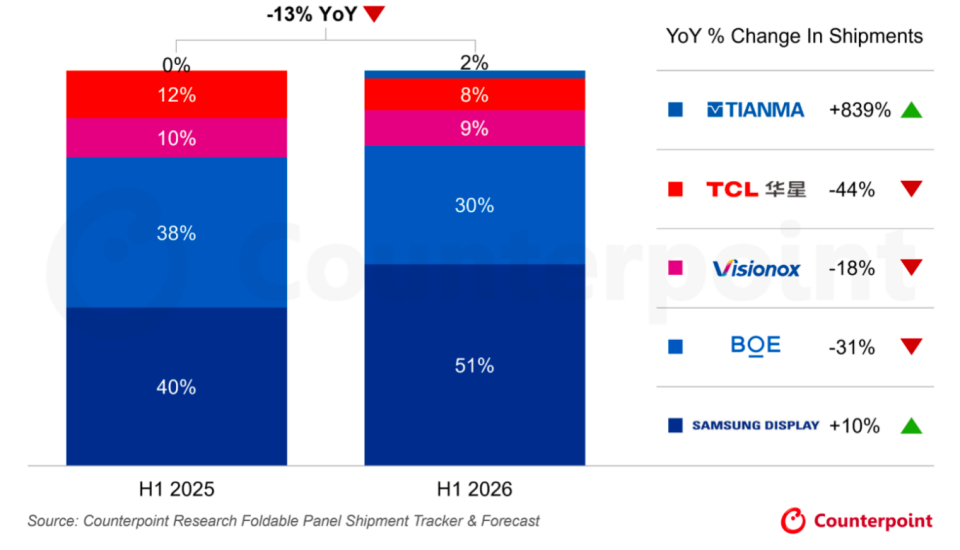
Vertical folds, horizontal folds, triple folds, wide folds—the variety of foldable screen form factors in 2026 is greater than ever. Counterpoint Research's latest report shows a 13% YoY decline in global foldable panel shipments in H1 2026. However, internal structural adjustments were dramatic: large-fold panel shipments grew 35% YoY, increasing their share from 50% to 78%; clamshell panel shipments plummeted 62%, falling to 21%. This differentiation in form factors indicates that manufacturers are no longer blindly following trends but making choices based on real user scenarios.
For example, Huawei carved out a differentiated path with the Pura X series' 'wide-fold' form factor, which has shipped over 2.9 million units cumulatively. The Pura X Max alone shipped over 1.2 million units within four months of launch. Unlike the triple-fold and Mate series, which appeal more to middle-aged businessmen, the Pura series primarily attracts female users due to its screen ratio perfectly matching 4:3 photos, displaying two extra lines of Xiaohongshu notes, and matching the text block width of a paperback book when reading e-books.

Xiaomi's 18 Fold takes a different 'medium-fold' approach. With a 219g body and a 7.58-inch inner screen close to A4 paper proportions, it targets users who find traditional large folds too heavy but don't want to compromise on performance and battery life with small folds. The medium-fold allows users to retain a truly usable inner screen while maintaining the feel of a daily primary device.
Evidently, behind the diverse form factors of foldable screens lie different usage scenarios and user demographics. A category with only one 'correct form factor' would be unhealthy.
With creases becoming a secondary concern, AI taking center stage, and form factor differentiation accelerating, the question for all manufacturers is no longer 'can it fold?' but 'what do you do after folding?'
03 The 'Coming-of-Age Ceremony' for Foldable Screens Is Not Over Yet
If we only look at the excitement of product launches, foldable screens seem to have reached their peak. However, when we shift our gaze from the stage to real market data, the situation becomes far more complex.
Behind the 10,000-yuan pricing lies cost pass-through from the entire supply chain, not 'price gouging' by manufacturers. Rising storage chip prices are the core reason for the general price increase of foldable screens in 2026.
Counterpoint reports that smartphone memory prices rose over 80% MoM in Q2 2026. Among flagship smartphones priced above $800 wholesale, DRAM surpassed SoC as the most expensive single component.
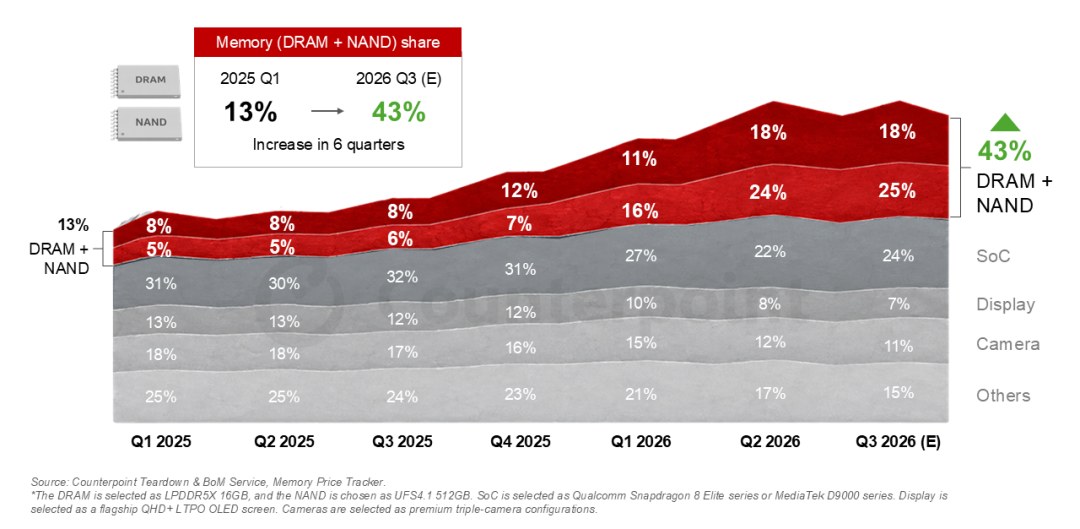
Meanwhile, material upgrades for foldable screens (e.g., displays, hinges, pivots) and synchronous price hikes for 3nm/2nm flagship processors have collectively pushed up prices. However, given the high base price of foldable screens, consumers are less sensitive to price increases than with mid-range and low-end models, providing manufacturers a relatively composed (Chinese term meaning 'calm') window for technological investment.
When cost pressures cannot be absorbed through price cuts, manufacturers' only option is to make the product 'worth the price'—which, in the long run, may not be a bad thing for the category's technological evolution.
Costs dictate that foldable screens 'cannot be cheap,' but what truly determines how far this category can go is how many units it can sell. Currently, foldable screen penetration remains in the single digits—both a reality and an opportunity.
TrendForce shows that global foldable shipments reached ~19.8 million units in 2025, with penetration at just 1.6%, nearly flat YoY. Counterpoint Research predicts that foldable phones will account for only ~2% of the overall smartphone market in 2026.
A category with single-digit penetration has already attracted nearly all major smartphone manufacturers to bet big. This not only highlights the category's strong appeal but also suggests its ceiling is far from reached.
More importantly, the influx of manufacturers brings not just competition but also a positive cycle for the supply chain.
According to New Express, Apple's entry has created expectations of tens of millions in incremental demand. Upstream panel makers and structural component suppliers are evaluating capacity expansions and process iterations, while developers are reassessing the ROI of large-screen adaptations. Complete machine terminal (Chinese term meaning 'complete device terminal') enthusiasm has translated into supply chain variables. For example, Samsung has reportedly restarted construction of its A7 plant in Asan, dedicated to flexible OLED production for foldable screens.
TrendForce predicts that with Apple's entry, foldable screen penetration could rise from 1.6% in 2025 to over 3% by 2027.
The growth rate is not aggressive, but the direction is clear: expanded capacity improves yield rates, higher yields reduce costs, lower costs enable more price segments to adopt foldable forms, a larger user base increases developer incentives for adaptation, further maturing the app ecosystem, and better app experiences attract more users from trying to regular usage.
04 Conclusion
Up to now, foldable screens have evolved over seven years. During this period, they have transitioned from technical validation of 'whether they can fold' to exploring scenarios of 'what to do after folding'. Apple's entry is not the finish line, but a new starting point.
For such a new category, its 'coming-of-age ceremony' has never been about a single product becoming a blockbuster hit, but rather about the entire industry chain beginning to make long-term investments in it. Only when supply chain companies are willing to invest in dedicated production lines and R&D resources for foldable screens can this category truly have the foundation for 'maturity'.
* The image is sourced from the internet. Please contact us for removal if there is any infringement.
-
![]()
Insta360 H1 Revenue Soars 50%, Yet Net Profit Plummets 90%; Nearly 2 Billion Yuan Spent on Memory Chip Procurement; Inventory Surges to 6.2 Billion Yuan Amid Negative Operating Cash Flow; Stock Price
-
![]()
Second-Generation Doubao Phone Hits the Shelves: The Moment of Truth for AI Agent Smartphones
-
![]()
Second-Gen Doubao Phone Hits Shelves: Can AI Agent Phones Step Up?
-
![]()
How Long Can Domestic Foldable Screen Smartphones Laugh After Apple's Entry?
-
From Rent Collection to Vehicle Management, Didi Land's Hong Kong Stock Market Journey Still Has the Second Half to Go
-
![]()
The 'AI Apocalypse' Drama Staged by Five Individuals
-
![]()
Doubao Mobile Phone II: Can Its 'Knock' Feature Secure 380 Million Monthly Active Users Amidst Ecosystem Openness and Scheduling Rights Challenges?
-
![]()
Can Doubao Mobile Phone II, Which Has Learned to 'Knock,' Exchange 380 Million Monthly Active Users for Ecosystem Openness and Scheduling Rights?