10 Questions I Care Most About Regarding Doubao Mobile Phone II
 09/20 2026
 499
499
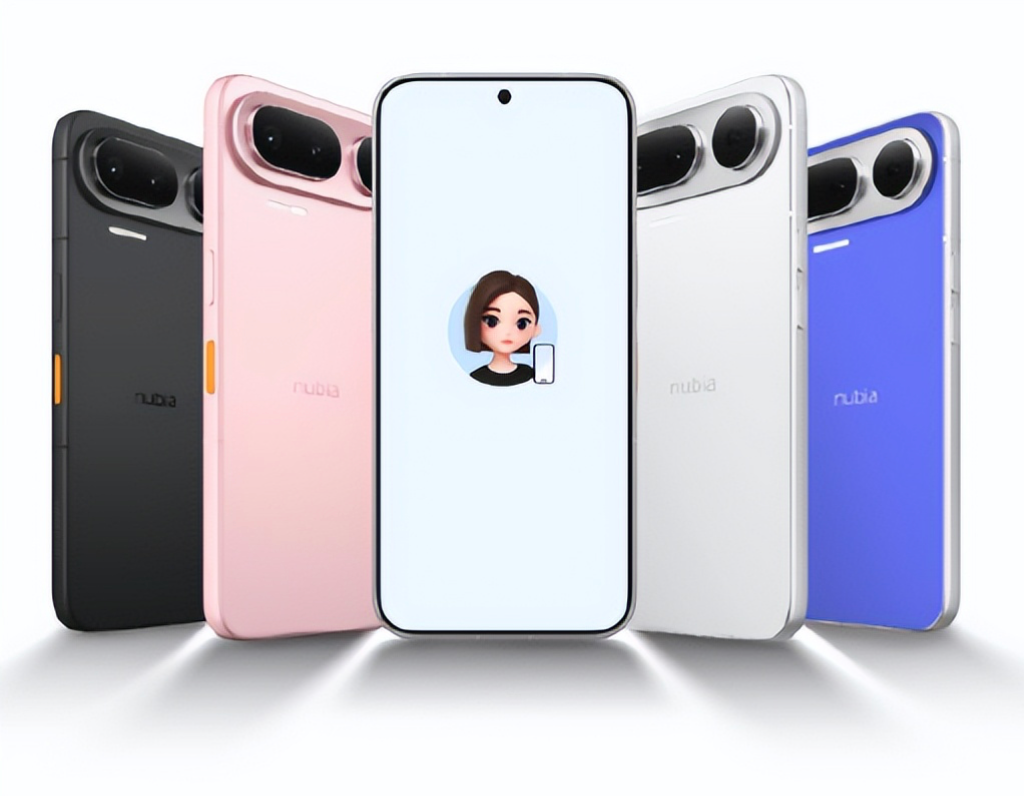
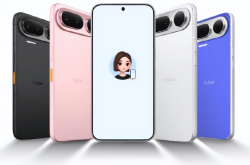
On September 16, the Nubia NaviX Ultra (hereinafter referred to as Doubao Mobile Phone II) officially went on sale, starting at 5999 yuan, equipped with the Doubao Mobile Assistant (Consumer Edition). It is defined as the first AI Agent smartphone, marking the transition of this category from engineering prototypes to mass production and commercial use.
In December 2025, the technical preview version of the Nubia M153, also known as the Doubao Mobile Phone I, was released in limited quantities, priced at 3499 yuan. The first 30,000 units sold out quickly, once driving ZTE's stock price to its daily limit.
Its core value lies in providing a feasible path for AI phones to achieve true 'deep intelligence' and is the first large-scale implementation of a GUI Agent (Graphical User Interface Agent) on real devices.
However, within days, the Doubao Mobile Phone I encountered the 'ecological barrier' of super apps, such as abnormal WeChat logins and successive risk control warnings from Taobao and banking apps. Doubao had to restrict financial and some sensitive operations, ultimately halting the 'fully automatic' phone.
Regarding Doubao Mobile Phone II, the 10 questions I care most about are answered below after reviewing various discussions and information.
The content is quite long, so feel free to jump to the sections that interest you using the subheadings.
01 How Many of the First Generation's Issues Have Been Addressed in the Second Generation?
The core controversy of the first generation was that the Doubao Mobile Assistant seemed like an external plug-in. Starting December 3, 2025, users operating WeChat via Doubao on the M153 were prompted with 'abnormal login environment' messages or even logged out. WeChat responded, stating, 'No special actions were taken; it might have triggered existing security measures.'
Doubao responded quickly, disabling WeChat operation capabilities that same night. Subsequent technical reviews pointed to the INJECT_EVENTS system-level permission, combined with screen reading and OCR, which WeChat identified as script/plugin-like automation.
The second generation clarifies its 'identity' legitimacy. First, Nubia's Doubao Mobile LLM completed end-side generative AI service registration alongside competitors like Apple Intelligence and Huawei Xiaoyi.
Second, Doubao introduced the SAEP (Screen Automation Operation Declaration Protocol) before the new phone's launch: a 30-day public notice period where consent is assumed if not explicitly denied, accompanied by operation log queries for third-party traceability. This marks a shift from covert operations to prior notification, a qualitative difference.
The second generation also fills gaps left by the first-generation engineering prototype. It is a fully retail product with network access, 24-month interest-free payments, and an 180-day replacement guarantee, with hardware upgraded to flagship standards. Whether the starting price of 5999 yuan is worthwhile is a fair assessment for each user.
Furthermore, the second generation's biggest difference from the first lies in its execution strategy, shifting from direct screen reading and simulated clicks to a protocol-first, simulation-fallback, and manual confirmation approach. The focus moves towards MCP (Model Context Protocol) and A2A (Agent-to-Agent), with GUI screen reading as a backup. Third-party apps can declare boundaries at three levels: page, business intent, and operation type.
This path converges with that of Apple, Huawei, Honor, Xiaomi, and other manufacturers, all attempting to bypass direct APP interface manipulation and shift towards system interfaces and Agent collaboration.
However, this creates a new challenge: the first generation's issue was 'Can I do it?' while the second generation's is 'Will others let me do it?' This raises a confusing perception for consumers: Can the Doubao Mobile Phone still be considered a Doubao phone after its technical realignment?
Several lingering issues remain unanswered in the second generation.
Several gaps from the first generation remain unfilled. The first generation explicitly stated in its 'Explanation on Adjusting AI Phone Operation Capabilities': ① Restrict score-brushing/incentive scenarios; ② Temporarily disable operations for banking and internet payment apps; ③ Restrict AI capabilities in competitive gaming scenarios.
These restrictions may not be lifted in the short term. Media tests on the second generation's launch day revealed that the voice-operated Agent could invoke ByteDance's ecosystem products and a few third-party services like Cao Cao Travel, but not external e-commerce apps like Taobao Flash Sales or JD.com.
Other reports indicated that WeChat only partially opened capabilities (voice messaging, audio/video calls), with payment transfers still requiring dual authentication. Taobao, Meituan, Alipay, and banking apps do not yet support direct AI operations.
Nubia's official website lists supported 'phone operation' ranges: system and ZTE apps, ByteDance apps, and some third-party apps (Cao Cao Travel, Maps, Qishui Music, Feishu Miaoji).
The second generation also ' lay mines ' (lays a trap) in token usage, with AI operations allegedly limited to daily free quotas, requiring additional fees for unlimited use. Some reviews note that 'AI operation functions have daily free limits, with unlimited use requiring extra payment.' If officially confirmed, this implies a critical experience gap, turning the core selling point into a paid feature.
02 What Does Mass Production Mean for Doubao, ZTE, and the AI Phone Sector?
For Doubao, it involves four key considerations:
First Layer: System-Level Identity. Previously, Doubao was just one of dozens of apps on a phone, with permissions limited to 'answering.' In the second generation, Doubao becomes a system-level role on the desktop, occupying a dedicated physical AI button with fingerprint authentication. Even its cloud service account system switches from Nubia to Doubao Mobile Assistant accounts. This is an identity upgrade beyond mere functionality.
Second Layer: Real Task Data. This is, in my view, the most underestimated aspect. App-based dialogues only reveal in-app behaviors; system-level Agents observe cross-app decision chains, such as what users want to buy, which prices they compared, and why they abandoned certain options. As China's largest AI application by user base, Doubao lacks precisely this 'user behavior chain' data, which fuels next-gen algorithm recommendations and advertising.
Third Layer: Transforming Tokens from 'Pricing Information' to 'Pricing Transactions.' Once Agents can execute orders, Doubao's monetization unit shifts from subscription fees or CPM advertising to commissions. For instance, rumors suggest Doubao is piloting commissions on lifestyle services, with a 12% hotel fee rate. While officially denied, substantive questions remain unanswered.
Fourth Layer: Execution Capabilities Expanding from 'Screens' to the 'Physical World.' This is Doubao's most overlooked ceiling. No matter how smart a GUI Agent is, it can only manipulate pixels—it can click buttons but cannot move objects.
Doubao is already expanding beyond phone screens to cars. On September 17, the Doubao Cabin Assistant was released, capable of sensing hundreds of vehicle signals and integrating thousands of atomic capabilities across vehicle control, navigation, assisted driving, and entertainment. A user command like 'Take a nap and wake me at 1' automatically adjusts seats, closes sunshades, reduces airflow, plays soft music, activates massage, and wakes the user with a schedule reminder.
Viewed holistically, Doubao aims beyond an 'AI phone gateway' to a cross-device execution and memory layer that follows users.
For ZTE, the brand's breakthrough value far exceeds financial gains.
Nubia falls under ZTE's consumer business, which reported 33.816 billion yuan in revenue in 2025, up 4.35% YoY. In H1 2026, consumer business revenue reached 18.629 billion yuan, up 8.09% YoY.
Nubia's sales volume is not separately disclosed by third-party agencies like IDC and is grouped under 'Others.' Thus, the Doubao Mobile Phone II's significance for ZTE lies in completing the consumer-end AI terminal piece of its 'Connectivity + Computing Power + AI for All' narrative while minimizing self-research risks to seize an industry-level breakthrough opportunity.
However, ZTE must remain sober. Even with 200,000 units rumored to be stocked at an average price of 6,000 yuan, revenue would peak at 1.2 billion yuan. Capital market reactions—from a daily limit surge for the first generation to a modest stock price gain for the second—indicate that emotional premiums from the first generation have been exhausted.
Ni Fei, Nubia's president, remains calm, stating, 'The first half of AI phones is adding AI features; the second half is using AI Agents to handle tasks for users' and predicting '2026 will be the first year of AI Agent phone proliferation.'
For the AI phone industry, Doubao's value may not be entirely positive. The first generation attempted to prove GUI Agents' viability but instead showcased super apps' resistance to 'wild intruders,' erecting higher barriers. As one commentator put it, Doubao I collided with 'ecological barriers built by internet giants over decades.'""The second generation retreats, seeking to formalize 'application processes' to enter super apps' walled gardens. SAEP essentially attempts to convert 'technical conflicts' into 'rule negotiations,' likened by many to the Robots Protocol of the AI era, with value exceeding the phone's sticker price.
03 Is Now the Best Window for Doubao Mobile Phone? How Long Will It Last?
Theoretically, yes.
First, the regulatory window is open. On July 15, the Cyberspace Administration announced the registration of seven end-side AI services, national standards for AI grading (with ~63 models reaching L3), and industry association protocols compatible with MCP and A2A.
Second, competitors have not yet established viable paths, all stalled at the same hurdle. Honor is the most aggressive in promoting AI phones, with MagicOS president Sun Jianfa confirming the completion of auto-execution development and verification but awaiting regulatory certification.
Apple remains incomplete in China, with Apple Intelligence registered but its revamped Siri still unavailable domestically. All stand at the same starting line, a rare scenario.
Third, the first generation has already opened the cognitive window for free. The 3,499-yuan price, 30,000 units sold, secondary market premiums, and 50–79 yuan/day rental businesses eliminate the need for the second generation to spend on marketing to explain 'AI handling phone operations.'
However, four Disadvantage (disadvantages) are compressing the second generation's window:
First, installation does not equal usage. QuestMobile data shows that in June 2026, AI app MAUs among phone manufacturers reached 755 million, up only 14.0% YoY, with 51.4 monthly uses per user. Meanwhile, AI-native app MAUs hit 499 million, up 85.4% YoY, with 92.7 monthly uses per user.
AI phones' 'preinstalled traffic pools' are far less active than 'actively downloaded native apps.' Another survey claims over 70% of users disable most AI features within six months of purchasing an AI phone.
Second, the memory supercycle is squeezing AI phone adoption. TrendForce data shows significant price hikes in conventional DRAM and NAND for phones since 2026, with Q1 prices rising 90%–95% and 55%–60% QoQ, respectively. Memory now accounts for 30%–40% of phone BOM costs, up from 10%–15%, forcing AI capabilities into high-end models while mid-range adoption lags.
Third, super apps have opened doors for everyone except Doubao. Take WeChat: in July 2026, Tencent confirmed to Caijing that it is collaborating with Huawei, Honor, Xiaomi, OPPO, and Vivo to launch A2A assistant capabilities, with Honor completing initial adaptations. Doubao is absent from this list.
Multiple Tencent sources state the company favors A2A over GUI for security and compliance, effectively choosing sides as ByteDance's traffic poses more threat than opportunity.
Fourth, the right to define the market is being seized by others. Some analysts argue '2026 marks the first year of Agent phones'; IDC predicts 147 million next-gen AI phones in China in 2026, accounting for 53% of the market. However, these are projections, not actual results, and depend on the entire phone industry, not just Doubao.
Based on this, I argue that Doubao Mobile Phone must seize a 12–18-month 'definition window,' not a 'sales window.' Three signals would indicate the window is closing:
Leading manufacturers complete 'self-developed end-side model + proprietary Harness' closures, eliminating the need for external Agents;
Super apps and top players finalize cost-sharing and commission agreements, locking in partnerships;
The memory cycle declines, bringing 12GB+ configurations back to mid-range prices.
At the current pace—Honor fully rolling out WeChat A2A, Huawei HMAF 2.0 open, and Xiaomi deploying multi-model scheduling—I believe Doubao's window will significantly narrow by H2 2027. The reason is not Doubao's technical shortcomings but that other manufacturers are nearing readiness.
04 Beyond AI Phone Gateways: What Is Doubao's Most Urgent Task in the Second Generation?
If merely competing for AI phone gateways, the first generation sufficed for testing.
Viewing cars and phones together reveals an easily overlooked detail: cars do not need SAEP.
A car's interior is like the owner standing at the doorway, with over 2,000 SOA interfaces proactively exposed by the vehicle. On phones, however, Doubao must draft agreements, explain it will not misuse others' resources, and provide 30-day notices, opt-out mechanisms, and traceable logs. The more comprehensive the agreement, the more it reveals that Doubao operates on borrowed execution environments.
Its true goal is to transform borrowed execution environments into default protocol layers with owned execution rights. ByteDance needs SAEP to establish system rules for Agent phones—what behaviors require declaration, to whom, and how long declarations remain valid.
Once this becomes industry standard, Doubao transitions from an AI app to an Agent-era OS, building its ecosystem.
In short, ByteDance sells phones to occupy 'the first touchpoint for intent' + 'standard execution protocols.'
Currently, Doubao's three most urgent tasks are:
First, elevate SAEP from a corporate standard to an industry standard. Now merely a 'self-restraint declaration' by Doubao, it lacks reciprocal value. Only by involving the China Academy of Information and Communications Technology (CAICT)/TAF, major apps, and at least one other terminal manufacturer can it evolve from 'polite knocking' to a 'value asset.'
Secondly, it needs to prove 'Why Doubao?' instead of just being the default assistant from manufacturers. While capabilities can be replicated, data and scheduling experience cannot. The official claim of 'end-to-end task success rate exceeding 80%' is based on laboratory benchmark data. However, third-party independent evaluations, such as the one conducted by Hexin in February 2026 on seven smartphone agents, showed an overall success rate of only about 20%, a significant gap from the manufacturers' self-reported figures. Doubao must provide real-world, verifiable success rates and time comparisons.
Thirdly, it needs to clarify its pricing rules. If the 'daily free usage limit' is true but not proactively disclosed, it undermines its most competitive selling point.
05 Why can Doubao Mobile 2nd Generation still capture the attention of half the industry, just like the 1st Generation?
Because it stands in a unique position that no one else has firmly established: it is the only player without its own operating system but has gained system-level permissions from others.
Huawei has HarmonyOS, Honor has YOYO Harness with 160 million monthly active users, vivo has integrated over 6,000 atomic skills, and OPPO has integrated Qianwen into Xiao Bu. These are all proprietary to the smartphone manufacturers. Only Doubao's mobile system permissions are 'borrowed' from Nubia.
The difference between a bargaining chip and an asset is that a chip can be taken back at any time. The industry is watching it half out of curiosity about how long these borrowed permissions will last, and half out of relief that it's not them hitting the wall first.
It has also done something useful for the entire industry: it has openly displayed the true attitude of super apps. This was tested by ByteDance using 30,000 engineering prototypes, providing a reference answer for the entire industry.
The real reason Doubao Mobile is drawing attention is that it has brought to the table a negotiation that everyone is hesitant to initiate but no one wants to start: Can AI operate other people's apps for me?
The first one to ask this question will naturally be watched by everyone. Perhaps it's not the strongest, but it's the only one standing in someone else's living room as a 'conspicuous presence.'
06 Is it necessary for ByteDance to continue making its own smart hardware as it did before?
ByteDance's track record in smart hardware is not impressive. The Smartisan phone was discontinued just two years after acquisition; Dali Smart Homework Lamp ended with layoffs and shutdowns; Pico made a big splash but didn't create much waves; the initial launch of Doubao AI glasses was halted before release, and the second generation was delayed with a change in contract manufacturer.
Their attitude towards self-developed terminals has consistently been one of denial, including in car manufacturing. In June this year, there were reports that ByteDance would enter the car manufacturing business. The official response quickly denied any such plans, clarifying that 'the cooperation between Doubao, Volcano Engine, and automotive industry partners mainly involves providing technical services such as the Doubao large model and smart cockpit to help partners enhance the in-car smart interaction experience.'
We can see that in the most typical 'incumbent dominator' battlefield, ByteDance's attitude is not about whether to try but clearly demarcates: don't touch where there's a dominator, and do it yourself where there isn't.
The reasons are not complex. Building a complete device tests supply chain, channels, after-sales, and inventory turnover—areas where ByteDance has no accumulation. Moreover, if ByteDance were to manufacture its own devices, Doubao would immediately become the public enemy of Huawei, Xiaomi, OV, and Honor, being kicked out of the system layer by all manufacturers.
This would be the biggest strategic risk. In fact, ByteDance already has a ready-made 'reference answer': Huawei's Smart Selection car model, which exports the soul without touching manufacturing. ZTE provides hardware engineering, supply chain, channels, and after-sales; ByteDance exports the large model, interaction layer, and protocol specifications.
However, 'not making phones' does not equal 'not making hardware.' The AI glasses, earphones, and Pico waveguide product lines that ByteDance is working on share a common feature: these categories do not yet have incumbent dominators.
07 Who are the representative players in the AI smartphone race? What technical routes do they represent?
Currently, there are nine representative players in the AI smartphone race:
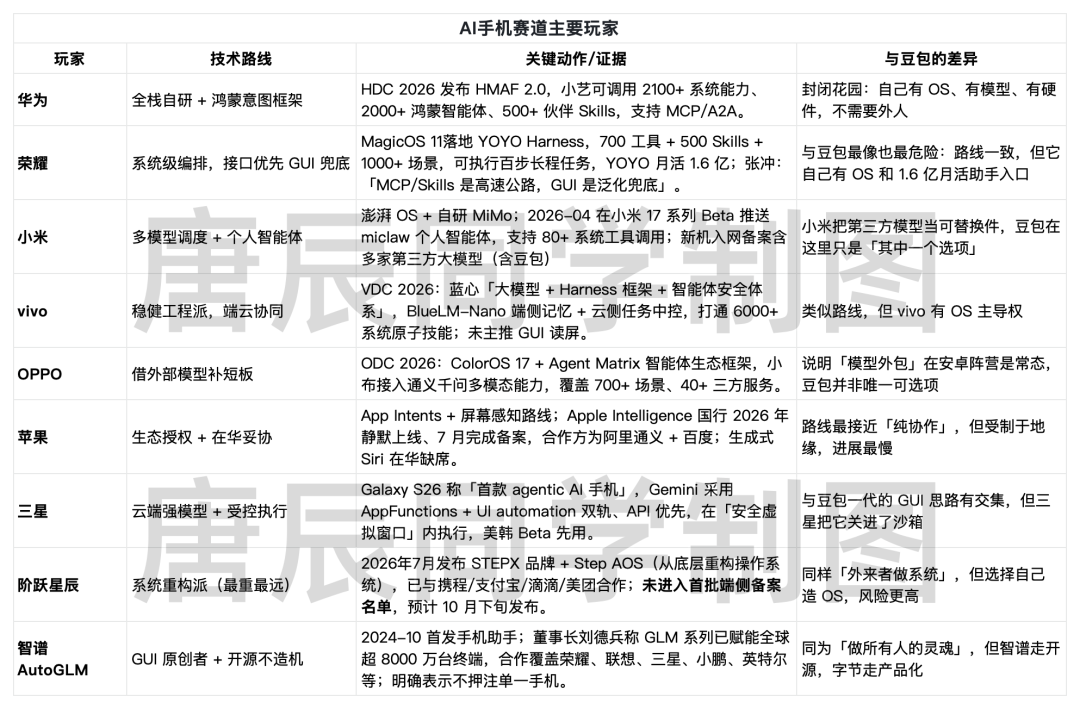
Key Players in AI Smartphones Source: Compiled by Tang Chen (Click to enlarge)
They can be divided into three categories:
The 'self-built house' category includes Huawei's full-stack self-research, Honor's system-level orchestration, Apple's App Intents, and Samsung's Gemini dual-track. The differences lie only in engineering preferences; the common point is that they built their own houses.
The 'outsourcing to fill gaps' category includes OPPO integrating Qianwen into Xiao Bu, indicating that model outsourcing is common in this camp. Doubao has never been the only option.
The 'outsider' category is the most interesting: StepFun is rebuilding the operating system from the ground up but has not yet made it to the first batch of filing lists; Zhipu AutoGLM, the original creator of GUI, has been installed in over 80 million terminals worldwide.
Doubao's position in this landscape is extremely unique; it is the only player without an OS but has gained system-level permissions from others. This is its entire advantage, but also its entire vulnerability.
For these three categories of players, only three things determine the gap: who owns the operating system, who owns the model, and who is willing to yield scheduling rights to the other.
We can also see from the previous comparison table that GUI Agent is not a technical belief but an alternative solution when there is no property rights. Whoever owns the complete ownership of the execution environment does not need screen reading. This directly answers the controversy of 'GUI vs. API.'
Looking back along this line of reasoning, the logic becomes clear: Huawei and others dare to prioritize interfaces because they have OS; AutoGLM became the original creator of GUI because it had nothing.
This also explains why few manufacturers are willing to open up. Those willing to open the door are often the ones lacking it. To paraphrase a common saying, the barefoot are not afraid of the shod.
08 What challenges does Doubao Mobile 2nd Generation face? What impact will they have on Doubao and Nubia?
The first challenge is the ecological wall. If the 2nd Generation cannot overcome it, the device will degenerate into a remote control with no alternative solution.
The second challenge is pricing and steady sales. Priced between 5,499 and 7,499 yuan, it directly competes with the main battlefield of domestic flagship phones, and the entire industry is raising prices in 2026. The signals on the launch day were not promising: over 395,000 pre-orders, but most versions were still in stock half an hour later; scalpers dropped from marking up prices to selling at original prices; the second-hand price of the 1st Generation has fallen below the issue price. The first sale tests curiosity, but steady sales test the actual business.
The third challenge is channels. The 2nd Generation is primarily online, facing off against hundreds of thousands of offline outlets. High-end phones rely heavily on offline experiences, making it difficult for a purely online approach to lay the foundation for subsequent large-scale shipments.
The fourth challenge is the most hidden one: homogenization. An executive from Honor mentioned that they have already caught up with Doubao in terms of automatic execution capabilities this year. When 'one-sentence execution' becomes standard, there will be no reason to pay thousands more.
These challenges have asymmetric impacts on Doubao and Nubia. Doubao's user base is in the hundreds of millions, so losses are limited and controllable. What it truly needs to worry about is the backlash from negative feedback: if OS manufacturers see that integrating Doubao is useless, they will be more determined to self-develop, which would be the final door being welded shut.
Nubia gained Topic Right (attention) with the 1st Generation and is using the 2nd Generation to test 'whether it can turn attention into business.' This is also its closest opportunity to 'brand leap' in recent years.
However, the risks are enormous. Even with a relatively small inventory, if it ends up with excess inventory, pricing collapse, and divided reputation, it will greatly dilute the value of the 'AI terminal' internal route. This is one of the few new stories Nubia can tell with a closed loop.
09 Will the path of AI smartphones change because of its success or failure? What is the trend?
The path of AI smartphones will not shift because of the success or failure of the 2nd Generation, but it will accelerate convergence during its process of filling in the gaps.
The reason is simple: the direction of Agent smartphones has been jointly confirmed by smartphone OS manufacturers (Huawei, Honor, Samsung, etc.) and super apps (WeChat A2A, etc.), and does not depend on Doubao. It is simply the first to hit the ecological wall and provide a 'rule-based answer.'
Doubao's real contribution is that it has prematurely ended the 'GUI vs. API' debate: GUI will not disappear but will permanently retreat to a fallback position. This path converges with Apple, Huawei, Honor, and Xiaomi.
Currently, three definitive trends in AI smartphones have emerged.
From 'can it be done' to 'who approves you to do it,' meaning the industry is entering a permission-based economy. From end-side filings, graded national standards to agent protocols, industry standards are becoming increasingly standardization (standardized). The next generation of Agent competition will first be a competition of compliance and standards.
Revenue sharing has become a core issue and is even more challenging than technology. Who pays the computing bills, whether recommendation neutrality will degenerate into a new form of bid ranking, and how to choose between traffic dependence and autonomy after platform integration—these three accounting issues are the real bottlenecks for the large-scale deployment of Agents.
The division of labor between hardware and models is solidifying, with crossovers being rare. Manufacturers stick to OS and sensing, model companies stick to inference and Agents, connected by protocols in between. There are only two types of crossovers: those who build their own OS (asset-heavy) like StepFun, and those who borrow others' systems (asset-light but borrowed) like Doubao. Neither path has been fully proven yet.
The biggest variable is end-side model capabilities. Zhang Chong from Honor predicts that 'the end side is expected to support models with 70B or 80B parameters in the next two years.' If this comes true, today's transitional form of 'cloud GUI + screen reading' will be replaced by stronger local execution, leading to another round of reshuffling.
This time point coincides with the narrowing window I predict (the second half of 2027). So what truly deserves attention is not whether Doubao Mobile succeeds but whether that protocol can become an industry standard.
10 Is Doubao Mobile a 'Doubao inside' appetizer or a showcase?
On September 17, the AI-native in-car assistant 'Doubao Cockpit Assistant,' jointly developed by Doubao and Volcano Engine, was officially released, and a cooperation agreement was reached with SAIC Motor. The first model to feature it, Roewe Jia Yue 07, will soon open for pre-sale, with related models from SAIC Audi set to debut within the year.
A larger chessboard for Doubao has emerged. Similar to Huawei's Smart Selection model, 'Doubao inside' may become a more imaginative technological solution. Compared to an appetizer, Doubao Mobile 2nd Generation is more like a trial-and-error room for 'Doubao inside,' with the in-car assistant being the true showcase.
Because the role of a showcase is to convince others that they can do it too. A scenario already with 7 million installations has far more persuasiveness (persuasive power) than a phone rumored to have a stock of 200,000 units.
The uniqueness of Doubao Mobile 2nd Generation lies in that it is a territory where it does not own the execution environment. In cars, someone invites it in; on phones, it has to knock on every door.
But Doubao is also clear that automakers are both environment owners and rule makers. Seven million installations do not equal an equal amount of control; 'Doubao inside' can be replaced at any time.
Back to Doubao Mobile 2nd Generation, on September 16, it learned to knock. But what truly determines its fate is not how many units this device sells in the end but how many super apps click 'allow' or 'reject' after the 30-day cooling-off period of the Doubao SAEP protocol ends in mid-October.
In this light, the 1st Generation hit a wall, while the 2nd Generation walks through a door. But this door has not opened yet; Doubao has merely fulfilled its obligation to notify: before I come in, I will knock first.
Compared to the 1st Generation, every progress of the 2nd Generation is not a victory in technology or capability. It is more like exerting effort within the scope of 'being allowed' and seeking a way out through compromise.
References:
21st Century Business Herald, 'AI Smartphones Go on Sale, Rules First: Doubao Mobile Assistant SAEP Protocol Launches Public Consultation'
AIX Finance, 'AI Smartphones 2.0: Doubao Has Learned to Be 'Well-Behaved' This Time'
Baobian, 'Is the 5999 Yuan AI Agent Worth It? The 2nd Generation Doubao Mobile'
36Kr, 'The 2nd Generation Doubao Mobile is Coming: Can It Bypass the 'Ecological Wall' It Hit with the 1st Generation?'
Jiemian News, 'Smartphone Manufacturers Launch Battle for AI Entry Points'
Yicai, 'One Sentence to Mobilize Dozens of Apps: Smartphone Manufacturers Compete for 'Scheduling Rights' in the AI Era'
-
![]()
Weekly Stock Review | Trump’s Concern Over AI Rivalry: The Auto Industry’s ‘Biggest Competitor’
-
![]()
FAW and GAC's Strategic Move: More Than Corporate Collaboration, a Pioneering Case of National Industrial Anti-Involution
-
![]()
Can the Long-Wheelbase Mercedes-Benz GLE SUV Tread in the Footsteps of the BMW X5?
-
![]()
From Netizens' Perspective, the XPENG G9L Still Seems Pricey
-
![]()
10 Questions I Care Most About Regarding Doubao Mobile Phone II
-
![]()
Quality Performance of China’s New Energy Vehicle Tri-Electric Systems in 2026: Experience-Centric Issues Take Center Stage, Range Remains Top Challenge
-
![]()
AIDrive’s Cooperation Model Undergoes Change: Is Xiaomi Pengcheng the Unexpected Winner?
-
![]()
FAW and GAC Make Moves: Will the "Greater Anhui Automobile" Dream Become Reality?