Negative Trends Surrounding iPhone Duo Flood Multi-Platform Searches, Marking Apple’s Annual Wave of Public Opinion
 09/20 2026
 561
561
Since the release of the iPhone 4 in 2010, Apple has held a dominant position in the smartphone market discourse. Over the past 16 years, the company has remained the undisputed leader in both sales and profits. Interestingly, about a month after each annual iPhone launch, trending searches become inundated with negative topics, with a new controversy—dubbed a “gate”—emerging every year. I once joked that Apple wasn’t releasing phones in September but “gates” instead... 
What’s even more striking is that after this initial month, these product issues mysteriously fade away—media coverage stops, and consumer complaints dwindle. Logically, if these problems were genuine, shouldn’t complaints rise as shipment volumes increase? Yet, absurdly, things often unfold this way. For instance, after the iPhone 5’s release, it was plagued by the “paint peeling gate,” earning it the nickname “scratch-and-win”... 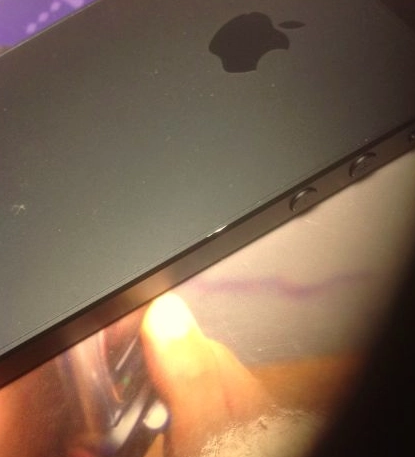
The iPhone 6 series faced the “bending gate”; the iPhone 7, after removing the 3.5mm headphone jack, sparked backlash, leading to the “headphone jack gate.” But after the outrage, how many current flagship phones still retain this port? The iPhone 8 had the “noise gate,” the iPhone SE 2 the “battery life gate,” the iPhone X the “notch gate,” the iPhone 11 the “rear camera layout gate,” the iPhone 12 the “charger gate”... Every release seems to bring a wave of negativity. Last year’s iPhone 17 launch was no exception, falling into the “color fading gate,” allegedly losing color with just a wipe. 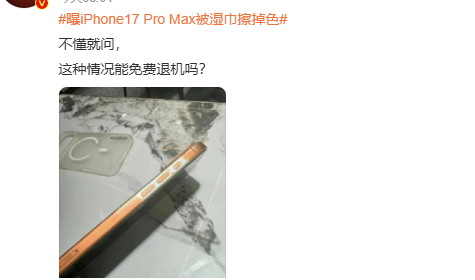
This issue trended for days, but across all cases I examined, only three images existed online. 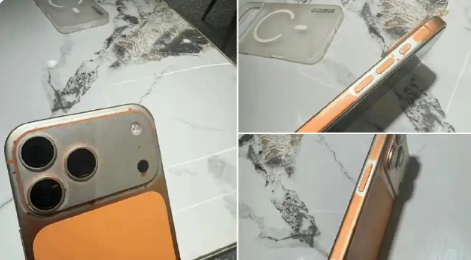
Yet every poster claimed it happened to their own phone, their own experience... 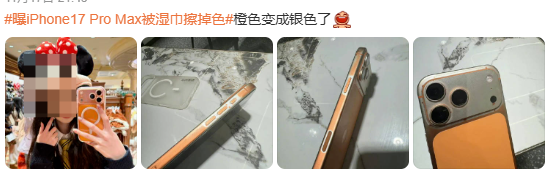
“Thought it was exaggeration—turns out it’s fact. Orange turned straight to silver.” 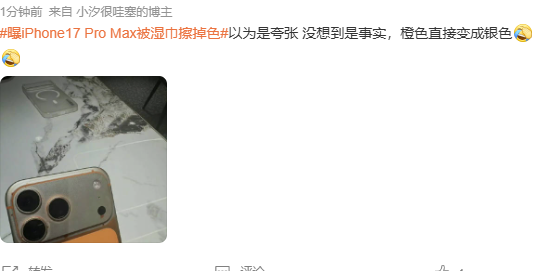
How absurd is this? For those interested, check out this article: iPhone 17 color fading trends again! But there are only three images online... Who’s the outlier? Well, a few days ago, with Apple’s new product release, the company once again found itself caught in its annual vortex of negative public opinion. This morning, as I browsed trending searches across multiple platforms, I found Apple’s negatives dominating the screen again. For example, on Baidu, a quick scroll revealed headlines like: “iPhone Duo repair costs 8,000 yuan,” “Apple’s most expensive phone fails before sales even begin.” 
On Weibo, a casual screenshot showed: “iPhone Duo overheating and screen flickering,” “After watching Film Storm’s review, I don’t want to buy it anymore,” “Just realized one iPhone could trade for 10,000 pounds of grain...” 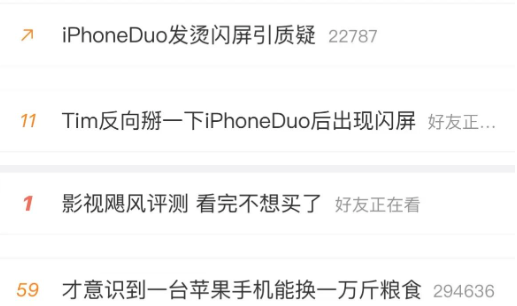
Similar topics dominated Toutiao. 
And as I wrote this draft, Bilibili popped up a notification: “iPhone Duo severely overheats under high loads...” 
After seeing these trending topics, what do you think? Does it feel like the world’s most powerful tech company is just a shoddy operation fleecing consumers, even comparing it to 10,000 pounds of grain? When such negative information gets amplified, potential buyers might hesitate. Some media even orchestrated topics like “iPhone Duo’s hidden starting price is 24,000 yuan.” 
What’s the background here? A media outlet interviewed a digital store owner who claimed: “The iPhone Duo starts at 15,999 yuan just for nostalgia. You’d better prepare 8,000 yuan for repairs, making the real starting price 24,000 yuan.” This math left me stunned! In this shop owner’s view, the iPhone Duo is guaranteed to break.
In other words, he believes the iPhone Duo’s yield rate is 0%. But we all know Apple has always taken a cautious approach in consumer electronics. If technology isn’t mature, it’d rather lag behind than rush products to market—the same with 5G, the same with foldables. Apple reportedly spent 15 years preparing the iPhone Duo. 
Yet here’s a product that, in this shop owner’s eyes, is doomed to fail. Such extreme smear tactics being used as media fodder—can there be any credible reason other than chasing clicks or paid smears? Let’s return to the iPhone Duo’s flood of negative trending topics. Most originated from a single video by Film Storm, but in this case, Film Storm became a pawn.
Unscrupulous media and even invisible hands distorted clips from Tim’s video, then amplified them using his influence. Here’s what happened: After Apple released its first foldable iPhone Duo, Film Storm founder Tim conducted a review. After recording ~3 minutes of 4K 60fps video, the area below the camera became “too hot to hold,” describing it as “freezing on one side, frying an egg on the other,” calling it “one of the hottest phones” he’s tested. 
Meanwhile, at Apple’s demo area, Tim gently bent the fully unfolded iPhone Duo backward. Nothing seemed amiss at the scene, but reviewing the footage later revealed screen flickering. He emphasized, “I definitely didn’t bend it hard.” 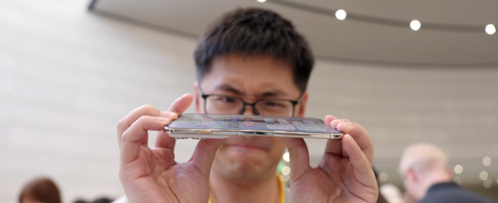
These clips went viral online. Some questioned Tim, like former Meizu executive Li Nan, who argued: “Industrial design and reliability testing should validate normal user scenarios. If it passes 180-degree hinge tests, why bend it backward? For product features or clicks?” 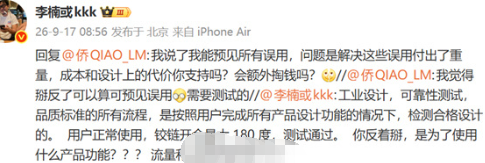
However, most used these clips to attack Apple. But what was Tim’s full video like? He acknowledged Apple’s efforts in industrial design, hardware innovation, and system optimization. The two viral clips represented extreme scenarios in his review, but the context was completely lost in transmission. 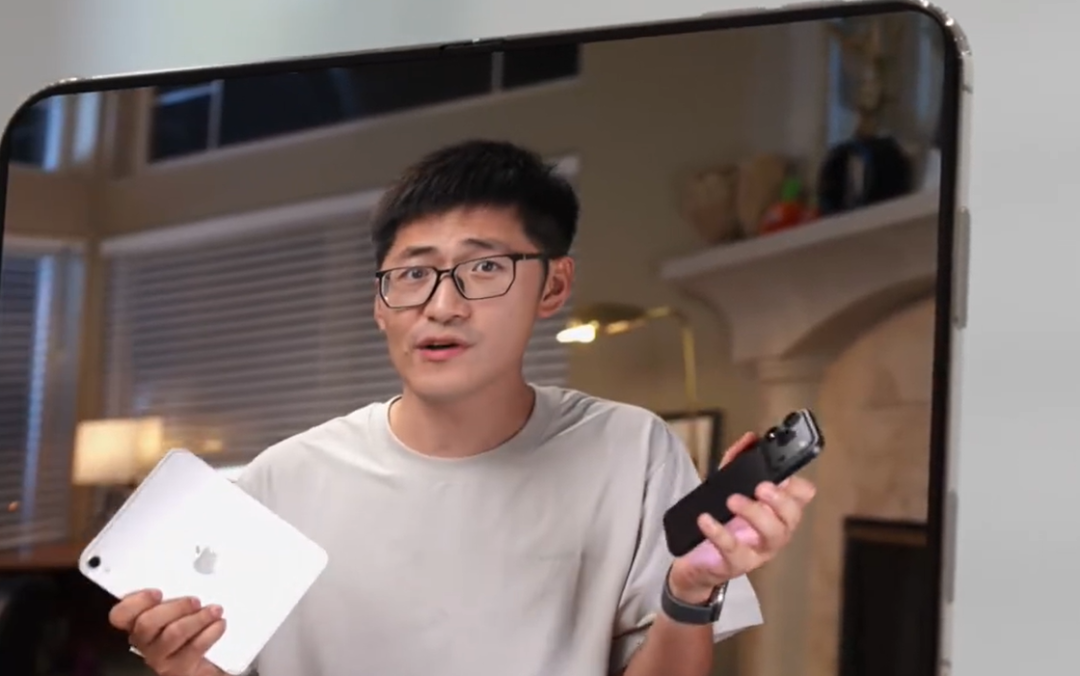
In response, Apple’s customer service stated that online influencers’ tests based on single devices are one-sided and recommended in-store experiences. Deliberate reverse bending causing damage would be considered user-inflicted and likely not covered by warranty. Notably, Wang Ziru also addressed the controversy in a video today. He believes the iPhone Duo’s overheating under high loads likely stems not from hardware power consumption but from incomplete software optimization during this pre-launch testing phase. 
Wang noted that the Duo’s camera is downgraded, so computational photography and hardware power consumption shouldn’t exceed the Pro Max. Thus, the heating issue likely relates to early-stage software optimization rather than hardware design flaws. He didn’t rule out slightly higher temperatures post-launch (like his Air gets mildly warm with prolonged use, but acceptably so), but deemed “egg-frying” levels unlikely after release.
Regardless, these claims fueled the barrage of negative iPhone Duo trending topics. So the ultimate question: Will these negatives hurt Apple’s sales? Decades of history suggest otherwise. No. As Apple’s first foldable, market expectations for the iPhone Duo remain highly optimistic. Multiple analyses indicate initial sales will be supply-constrained, not demand-constrained.
Jeff Pu revealed that 2026 iPhone Duo production is estimated at 6 million units, down from 7 million due to hinge manufacturing bottlenecks. Daily output initially dipped to hundreds of units. 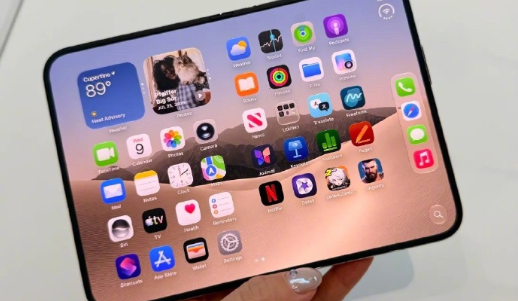
In actual sales, JD.com’s Apple store already has over 1.2 million reservations for the 15,999 yuan 256GB iPhone Duo. On platforms like Dewu, pre-sale orders reached 49,999 yuan—a 34,000 yuan premium over the official price. Second-hand listings even hit 90,000 yuan or more. Scalper service fees range from 200 to 1,000 yuan.
Meanwhile, institutional estimates for initial sales range from 5 million to 35 million units. What about the broader foldable market? Global foldable smartphone shipments reached ~20 million units in 2025. In 2026, Apple’s debut foldable is projected to capture 25% market share in its first year. Analysts also believe Apple’s entry will accelerate foldable adoption, boosting growth from 10% to 30%.
End
-
Three-Way Struggle for Market Share: BYD, Chery, and Geely Challenge Great Wall, Posing Immediate Risks to Wei Jianjun
-
![]()
The Reason Behind Valve's Headset Price Surge of 2400 Yuan: The End of an Era of Selling at a Loss
-
![]()
Decoding the '4S' Architecture | Report on Enterprise-Level AI Services in China
-
![]()
Li Auto Aims to Sell Three Technologies, First Buyers Unlikely to Be Major Automakers
-
![]()
Liu Zongcheng Declares Haste Makes Waste in Car Manufacturing, Yet Seres Seems to Be Rushing Headlong!
-
![]()
Did Trump Make Concessions? Chinese Automakers Are Invited to Establish Factories in the U.S., but Importing Fully Assembled Vehicles Is Off the Table
-
![]()
More Terrifying Than Runaway AI: The Tsunami of AI-Generated Vulnerabilities Has Arrived
-
AI Giants Hit the Brakes Collectively? They're Scared of Their Own Speed