Analysis of Competitive Strategies for Home Appliance Enterprises in the Stock Market: The 'Four Alls and One Diversification' Approach
 09/21 2026
 377
377
Introduction
As the third quarter of 2026 draws to a close, the year is nearing its end. With the tightening of national subsidy policies in terms of funding, product categories, and intensity, coupled with diminishing Pull effect (I'll use 'stimulus effect' for translation) and factors such as shrinking terminal consumer demand and high industry base figures from the previous year, the home appliance industry is under overall pressure. Data from AVC (All View Cloud) shows that from January to August, the retail sales of the entire home appliance industry in China (excluding 3C products) reached 547.7 billion yuan, a year-on-year decrease of 9.7%. However, the decline narrowed gradually in July and August, with September expected to see a recovery due to the low base in the same period last year. With the phasing out of national subsidies, shrinking demand, and intensifying competition, the industry has long entered a stage of 'stock competition.' Based on the 2026 semi-annual reports publicly disclosed by listed home appliance companies, AVC's research reveals that the competitive strategies of home appliance enterprises are continuously intensifying towards the 'Four Alls and One Diversification' approach, namely 'a full range of product categories, comprehensive price coverage, full-link services, a full matrix of marketing, and diversified channels.'
Strategy 1: Full Range of Product Categories - From Selling Individual Products to Selling Solutions
Whether it's new home renovations, old home renovations, or partial replacements, in both new and stock markets, users in these scenarized contexts demand hassle-free solutions, hoping to address all home appliance needs, installation, and after-sales issues in a 'one-stop' manner. Therefore, a full range of categories is not simply about expanding product lines but represents a leap from selling individual products to providing 'whole-house integrated solutions.' Haier: In July 2026, Haier established the Smart Life Appliances (Major White Goods) Industrial Platform and the Smart HVAC Industrial Platform, respectively, to coordinate business lines such as refrigerators, kitchen appliances, washing machines, as well as residential air conditioners, commercial air conditioners, heat pumps, water heaters, and water purifiers. By breaking down category barriers and amplifying resource scale effects through unified scheduling and coordinated operations, Haier accelerates its transition to the TC model and implements one-stop smart home integrated solutions. Midea: Midea builds and enhances its capabilities in non-standard design delivery and whole-house smart system integration. It streamlines the entire process from business opportunities to service, design, construction, and acceptance, constructs professional offline store services, continuously improves terminal transaction rates and average transaction values, upgrades store displays to be more systematic, scenarized, and intelligent, and focuses on whole-house intelligence and user experience stratification. As of the first half of 2026, it has completed intelligent renovations of 1,700 stores. Gree: Gree upgraded from 'Good Air Conditioners from Gree' to 'Good Appliances from Gree,' with its three major brands—Gree, TOSOT, and Jinghong—covering products such as air conditioners, refrigerators, washing machines, water heaters, kitchen appliances, and environmental appliances. In the first half of 2026, the sales of its lifestyle appliances segment increased by over 20% year-on-year.
Strategy 2: Comprehensive Price Coverage - Not Missing a Single User
In the stock market, user segmentation is evident: high-end users continue to upgrade, mid-range users value cost-effectiveness, and users in lower-tier markets (I'll use 'lower-tier markets' for translation) are price-sensitive but show increasing brand loyalty. Home appliance companies are not only continuously increasing R&D investment to drive product structure upgrades through differentiated innovation but are also gradually building a complete pyramid structure to precisely reach users at every level. Specifically, the paths to achieving comprehensive price coverage among different home appliance companies can be mainly divided into two types: multi-brand coverage across different price bands and single-brand internal price band supplementation.
Haier Smart Home: In the Chinese market, it covers high-end, mainstream, and niche market segments through Casarte, Haier, and Leader, respectively. In the U.S. market, it covers various segments from high-end to low-end through six brands: Monogram, Café, GE Profile, GE, Haier, and Hotpoint. (Multi-brand coverage across different price bands)
Midea Group: It covers high-end, mid-to-high-end, mainstream, and cost-effective market segments through COLMO/Toshiba, Little Swan, Midea, and Hualing, respectively. Among them, COLMO is positioned as AI-powered tech home appliances, promoting deep integration of system appliances and whole-house intelligence. The Toshiba brand is positioned as 'artistic home appliances,' becoming a new choice for high-end consumer groups in China. (Multi-brand coverage across different price bands)
Hisense Home Appliances: Its HVAC business covers high-end, mainstream, and cost-effective market segments through Hitachi, York, Hisense, and Kelon, respectively. Its ice wash kitchen business covers mainstream market segments through Hisense and Ronshen. (Multi-brand coverage across different price bands)
Flyco Electric Appliance: It covers mid-to-high-end and cost-effective market segments through Flyco and Poree, respectively. Among them, Flyco primarily drives product premiumization through technological innovation and high-appeal design to achieve brand upgrades. Poree is positioned as pursuing extreme cost-effectiveness with high quality and low cost. In the first half of 2026, the sales proportion of the Poree brand increased to 24.92%, up 5.44 percentage points from the previous year. (Multi-brand coverage across different price bands)
Gree Electric Appliances: In the first half of the year, it explicitly 'optimized its offline product structure'—capturing the market with high-quality and cost-effective 'Yue Qingliang' wall-mounted units at low price points to Perfect (I'll use 'improve' for translation) its low-end market layout. It also introduced mid-to-high-end products such as 'AI Qingliang Wang' wall-mounted units, 'AI Yueliang Nvshen,' and 'AI Lengjing Wang' cabinet units. (Single-brand internal price band supplementation)
Strategy 3: Full-Link Services - Extending the Endpoint of Marketing from 'Transaction Completion' to 'Service Commencement'
In the stock market, user repurchases and referrals have become the core sources of sustained growth for enterprises.
Therefore, leading home appliance companies are shifting from 'product delivery' to 'user full lifecycle operations,' extending the boundaries of service from 'after-sales' to every touchpoint in the 'pre-sales, in-sales, and after-sales' full link.
Specifically: Midea Group: It continuously iterates its membership rights system, deepens its 'fan-pleasing' strategy, and adds 'whole-house protection, worry-free after warranty' rights to address home appliance repair issues after the warranty period.
Haier Smart Home: It builds a unified warehouse TC customer platform and a user full lifecycle experience management platform to achieve transparency and visibility throughout the entire user journey from interaction, purchase, delivery, installation, use, maintenance, to replacement.
Gree Electric Appliances: After taking the lead in the industry by introducing a 'ten-year free repair' policy for domestically sold residential air conditioners in 2021, Gree launched a unified national 95082 official after-sales hotline in 2025 to continuously strengthen its after-sales commitments. Vatti Corporation: It quantifies and upgrades its service standards to '1.5-hour response, 48-hour fast and accurate installation, 72-hour repair completion,' and transforms dealers from single salespersons to comprehensive 'sales + service' operators.
Strategy 4: Full Matrix Marketing - AI Empowerment and Expansion of Omnichannel User Touchpoints
Today, the attention of users in the stock market is highly fragmented, rendering marketing through a single channel, form, or touchpoint ineffective.
Leading home appliance companies have constructed a 'full matrix marketing' approach covering brand exposure, product seeding, content interaction, conversion transactions, and private domain precipitation, deeply embedding AI capabilities into every link (I'll use 'link' for translation).
Haier Smart Home: It drives precise customer acquisition and user mindset precipitation through a model of 'brand big events + influencer seeding + three-level account linkage.' Its marketing system embeds AI tools throughout the entire journey of 'insight - content - placement - review - precipitation,' with a business scenario penetration rate of 80%.
Hisense Home Appliances: It launches six major marketing intelligent agents, including product selling point packaging, AI sales champion assistant, and AI intelligent data analysis, and initiates an integrated online-offline World Cup marketing campaign. Midea Group: It deeply applies new AI capabilities such as AI content generation, AI precision marketing, AI customer service, and AI digital human live streaming in online channels, exploring a full-link AI application model.
Gree Electric Appliances: It conducts omnichannel marketing by linking the 'Gree Dong Mingzhu Store' online mall, offline self-operated channels, and a multi-platform live streaming matrix, forming a closed-loop marketing ecosystem that combines brand effectiveness.
Flyco Electric Appliance: It conducts content operations through content social media platforms such as Douyin, Kuaishou, WeChat, Weibo, Xiaohongshu, Bilibili, and Dewu during emotional holidays like 'Valentine's Day,' 'Mother's Day,' '5.20,' and 'Father's Day,' continuously carrying out warm brand communication and emotional promotion activities online and offline.
Beiding Co., Ltd.: It covers channels such as Taobao, JD.com, WeChat, Douyin, Bilibili, Weibo, Xiaohongshu, Xiachufang, YouTube, Instagram, and TikTok through various methods such as live streaming e-commerce, short videos, communities, and KOL collaborations, continuously expanding omnichannel user touchpoints.
Strategy 5: Diversified Channels - Exploring Overseas Markets for Incremental Growth and Capturing Stock in Pre-installation
Data from the General Administration of Customs shows that from January to August 2026, China's cumulative export value of home appliances (in USD) increased by 6.8% year-on-year. Home appliance companies are obtaining incremental market space through globalization. Meanwhile, facing the domestic stock market, leading home appliance companies provide full-category immersive experiences by upgrading/opening new specialty stores. They capture front-end market traffic by cooperating with pre-installation channels such as home renovation and old renovation. They also Layout (I'll use 'deploy' for translation) instant retail by cooperating with platforms like Meituan and Flash Purchase, increasing touchpoints for high-frequency categories.
Specifically:
Midea Group: Focusing on 'smart system operations' and 'whole-house renovation solutions,' it deeply expands cooperation with channels such as home renovation, home furnishings, building materials, and design to strive for (I'll use 'secure' for translation) front-end traffic. It explores new 'in-store + home delivery' business scenarios such as instant retail and new retail, creating a full-scenario service closed-loop of 'online shopping + offline experience' for consumers. It accelerates the development of new online channels such as Pinduoduo, Douyin, Kuaishou, and Xiaohongshu. In the first half of 2026, overseas sales accounted for over 40% of the company's total sales. Gree Electric Appliances: It builds high-standard scenarized stores through 'Dong Mingzhu Health Home,' shifting from selling single air conditioner products to outputting whole-house health home appliance solutions. It creates immersive whole-house smart scenarios and successively launched flagship stores in regions such as Xi'an, Inner Mongolia, and the Shenzhen Greater Bay Area in the first half of 2026, with over 1,500 stores nationwide. It reached a three-year strategic cooperation agreement with JD.com for 10 million AI product units, jointly creating channel-exclusive AI hit products and launching multiple exclusive air conditioner models that achieved hot sales upon their debut.
Hisense Home Appliances: In the first half of 2026, it opened 1,272 new specialty stores and achieved a 15% year-on-year increase in store efficiency for newly opened stores through optimizing merchant selection, site selection, and store operations. Its kitchen appliance segment connect through (I'll use 'bridges' for translation) pre-installation channels such as home renovation, old renovation, and fine decoration, creating differentiated competitiveness through full home appliance system sales. It rapidly advances the construction of a Douyin live streaming room matrix, driving double-digit year-on-year revenue growth in the Douyin channel in the first half of the year.
Robam Appliances: Its engineering channel continues to deepen the 'cabinet-appliance integration' strategy, focusing on breakthroughs in high-end projects and optimizing customer structure to enhance its capability in providing whole-house kitchen appliance system solutions. Vatti Corporation: It strengthens the promotion of systematized products by linking regional chain stores and home renovation designer channels. It deepens strategic cooperation with platforms such as Meituan and Gaode Maps, empowering its dealer system through resource integration and data sharing, and bridging a complete closed-loop of 'online coupon collection, offline experience, and home delivery and installation.' Flyco Electric Appliance: It continues to promote the expansion and upgrading of offline experiential retail image stores and IP image retail terminals and actively deploys new business formats such as instant retail.
Supor: In first- and second-tier markets, it deepens cooperation with platforms such as Meituan Flash Purchase, JD.com Home Delivery, and Taobao Flash Purchase, expands unmanned warehouses, and accelerates the development of instant retail business. In third- and fourth-tier markets, it vigorously promotes refined operations of internet sink (I'll use 'lower-tier' for translation) (O2O) channels. TCL Smart Home: Overseas revenue accounts for nearly 85%, with a year-on-year increase of 16.01%, becoming a core growth engine.
Roborock Technology: It newly partners with mainstream platforms such as Shopee and Lazada overseas, consolidates its advantages on existing platforms like Amazon, enters mainstream retail systems such as MediaMarkt and Carrefour in Europe, and breaks through incremental channels such as Costco in North America. Conclusion There is no 'one-trick pony' solution in the stock market. The 'Four Alls and One Diversification' approach is not a simple sum of five strategies but a systematic combat plan. Behind each strategy lies a core capability that requires long-term investment: 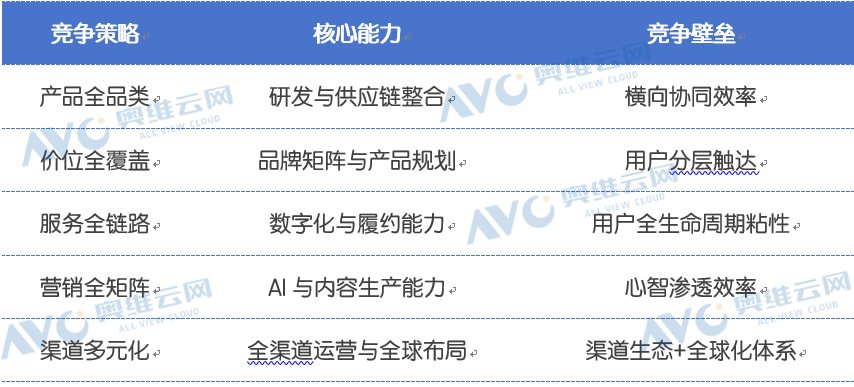
This race under pressure has accelerated the transition of the home appliance industry from 'policy-driven' to 'internally driven' growth: When the tide recedes, the real competition lies in who can meet diverse needs with a full-category matrix, target every consumer tier with a full-price layout, transform 'one-time transactions' into long-term trust with full-link services, precisely reach users amid fragmented traffic with a full-matrix marketing approach, and bring products closer to users with diversified channels. The only constant is change itself. Only those who adapt to change will survive.
This is an original article by AVC. Any unauthorized use of its content for training AI large models or other purposes is prohibited.
-
Apple Finds Itself in a Tight Spot: iPhone18 Pro's Camera Trails Behind Huawei's Year-Old Model
-
![]()
Li Xiang's Investment Ambitions: Becoming Second Largest Shareholder of Sunwoda and 'Sweeping Up' Robot Companies
-
![]()
Why Has OPPO Slowed Down When the Entire Industry is Rushing into AI?
-
![]()
BYD Plans to Construct 20,000 Stations, Sunwoda Aims for 10,000 Stations: The Boom of Flash Charging in China
-
![]()
Chinese Computing Power Expands Its Global Reach in ASEAN
-
![]()
Analysis of Competitive Strategies for Home Appliance Enterprises in the Stock Market: The 'Four Alls and One Diversification' Approach
-
![]()
Gross Margin Dips Below 10%, Li Auto Temporarily Sets Aside Its 'Competitive Edge'
-
YC's Latest Insight: Harness Matters More Than the Model