September's Flagship Chips Split into Four Paths: A20 Pro and Dimensity 9600 Pro Break Same-Series, Same-Chip Tradition
 09/28 2026
 442
442
In September 2026, the main SoC market featured mass-produced 2nm flagships (Apple A20 Pro, MediaTek Dimensity 9600 Pro), Qualcomm's Standard and Super dual-tier strategy, and Xiaomi's Xuanjie O3 and Huawei's Kirin covering foldable and wide-screen form factors. The old rule of same-series, same-chip is broken—series names alone are no longer enough; which chip tier matters most!
Produced by Zhineng Zhixin
September saw a collective generation shift in flagship chips: Apple stuck to full-stack self-development, Qualcomm pushed Oryon CPU to 5GHz, MediaTek went all-in on 2nm all-big-core for ultra-premium, while Xiaomi and Huawei expanded self-developed chips across more product lines.
Flagship 2nm mass production, on-device agent permanence, self-developed chip expansion, and multi-tier same-series chips.
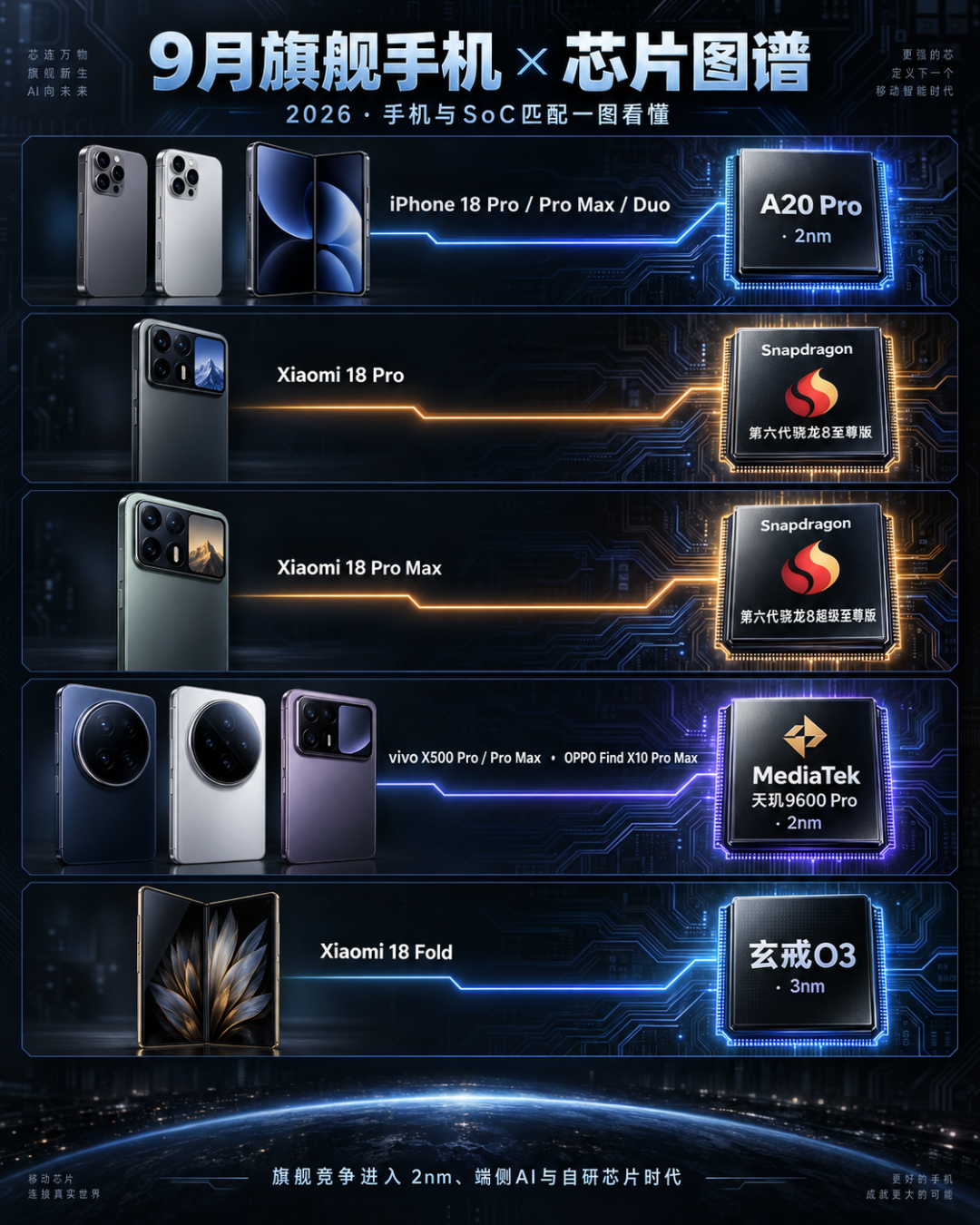
Main chips released and launched by September (as of September 26): Honor Magic9 is set for September 28 release, confirmed to debut MagicOS 11, but chip unannounced.
Part I · Two 2nm Flagships Land First
1. Apple A20 Pro: 2nm Rewrites Packaging
The A20 Pro is Apple's only publicly announced flagship main chip for new devices this year, shared across the iPhone 18 Pro, 18 Pro Max, and iPhone Duo, serving as the performance foundation for these high-end models.
2nm, 6-core CPU, 7-core GPU, dual 16-core Neural Engines totaling 32 AI cores, memory bandwidth 50% higher than A19 Pro, GPU peak performance up 40%.
Apple reconfigured packaging and heat dissipation paths: the chip and memory sit side-by-side, preventing memory from blocking heat transfer between the chip and vapor chamber. How much performance remains after minutes of high load matters more than peak benchmark scores. The iPhone Duo uses the same A20 Pro, but its foldable body, dual-screen engine, and dual batteries deliver different sustained performance. Identical chips don't guarantee uniform gaming performance across all three models—experience differences stem more from body design and scheduling than the chip itself.
The A20 Pro's strengths remain vertical integration, single-thread performance, video capabilities, and long-term adaptation.
2. Dimensity 9600 Pro: MediaTek's Most Aggressive Ultra-Premium Push
The Dimensity 9600 Pro is September's most widely adopted 2nm flagship, powering the vivo X500 Pro, X500 Pro Max, and OPPO Find X10 Pro Max—MediaTek's most direct assault on the ultra-premium segment.
Architecture: 2nm, 2+3+3 all-big-core CPU, two Arm C2-Ultra cores up to 4.55GHz, dual NPU, LPDDR6, UFS 5.0. Optimized for always-on and agent-based AI tasks. MediaTek matched Qualcomm's frequencies for the first time: two C2-Ultra cores in the 2+3+3 all-big-core setup hit 4.55GHz, key to its premium ambitions.
Dual NPU: one handles large models and high-load inference, the other manages low-power always-on tasks. Mobile AI doesn't just activate on demand—it continuously perceives, organizes, and schedules in the background without draining the battery quickly.
CPU single-core +17%, multi-core +15%, multi-core efficiency up to +61%.
Paper specs now top-tier.
Part II · Tiering and 3nm
1. Qualcomm Splits Flagships into Standard and Super Editions
The Snapdragon 8 Supreme (6th Gen) debuts with the Xiaomi 18 Pro, using a self-developed Oryon CPU up to 5GHz. Generational improvements: CPU +10% performance, +37% efficiency; GPU +35% performance, +40% efficiency; NPU +14%; integrated X105 5G modem, supports Wi-Fi 8.
Qualcomm emphasizes "Perception Hub" over peak NPU: low-power processors, sensors, and always-on cameras understand user states, enabling on-device agents to run continuously without frequent main CPU wake-ups.
The Snapdragon 8 Supreme Ultra debuts with the Xiaomi 18 Pro Max, sharing Oryon, Hexagon NPU, X105, and FastConnect 8800 with the Standard edition but targeting higher positioning. Enhancements include Adreno matrix cores, AI upscaling/interpolation, advanced ray tracing, 8K 60fps/4K 240fps video, and APV encoding.
Both Xiaomi 18 Pro models belong to the same series, but the Pro Max monopolizes higher-spec chips for gaming, video, and extreme performance.
Qualcomm's two-tier flagship SoC strategy raises ultra-premium pricing and invalidates the "same performance across a series" purchasing logic.
2. Dimensity 9600M and 9500s: 3nm Supports Tiering
The Dimensity 9600M powers the vivo X500 and OPPO Find X10: 3nm, 1+3+4 all-big-core CPU, Mali-G1 Ultra GPU, NPU 990 + low-power NPU, LPDDR5X, UFS 4.1. Supports up to 8K 60fps decoding and 8K 30fps encoding.
This is a devolved version of the Dimensity 9600 Pro. All-big-core, dual-NPU, and AI graphics architecture remain, but process, CPU, GPU, memory, and storage are more conservative. The vivo X500 and OPPO Find X10 use the same chip yet offer entirely different selling points: vivo emphasizes Zeiss imaging and dynamic video, while OPPO focuses on Hasselblad and system scheduling.
ISP tuning, algorithms, cooling, and scheduling determine the final experience.
The Dimensity 9500s powers the OPPO Find X10 E, a 3nm sub-flagship released in January 2026. OPPO uses it to widen the price gap between the E, Standard, and Pro Max variants. Few flagship series this year use "same-chip across all tiers": E models target entry-level, Standards use current sub-flagships, and Pro Max adopts the latest 2nm ultra-flagship. Seeing "Find X10 series" no longer implies uniform performance tiers.
3. Same-Series, Same-Chip is Disappearing
Multiple series show clear tiering this year: OPPO Find X10 spans 9500s, 9600M, and 9600 Pro; vivo X500 goes from 9600M to 9600 Pro; Xiaomi 18 Pro from Snapdragon 8 Supreme to Supreme Ultra; Apple's September new devices all use A20 Pro.
Future phone selections must go beyond series names and suffixes—confirm the specific SoC.
4. Cooling and Memory Increasingly Define Experience
The same chip in different phones can perform vastly differently. Evaluate vapor chamber area/thickness, memory specs/bandwidth, vendor tuning, battery, and surface temperature limits, plus whether gaming/camera systems optimize for the chip.
Part III · Self-Developed Camps and Always-On AI
1. Xuanjie O3 and Kirin Embrace Form Factor Synergy
The Xiaomi 18 Fold uses Xuanjie O3: 3nm, 10-core all-big-core CPU, 16-core G2-Ultra NX GPU, quad-core NPU, ~200 TOPS AI performance, supports LPDDR6. Xiaomi placed it in foldables rather than slab flagships for two reasons: foldables showcase integrated chip, screen, hinge, and multitasking capabilities; the $1,000+ cost space absorbs high R&D and manufacturing costs for new chips.
Foldables face tighter cooling constraints than slabs. O3's peak specs matter less than sustained performance, modem efficiency, gaming compatibility, and imaging quality in testing maturity.
The Xuanjie O3's strategic value exceeds unit sales—it represents Xiaomi building Apple-like integration capabilities, but ecological maturity requires more generations to verify.
The Huawei Kirin 9050 Pro powers the Mate XT 2 Extraordinary Master ("Logical Fold τ Chip"), optimized for triple-fold synergy: distributed cooling across three bodies, cross-hinge heat conduction, multi-form screen scheduling, HarmonyOS 7 large-screen multitasking, and satellite/Star Flash connectivity. Overall performance improves 42% over the previous generation, but process, CPU, or GPU architectures remain undisclosed—absolute rankings can't rely solely on official claims.
The Kirin 9030S powers the Pura X View (16:9.5 wide-screen), with undisclosed process/architecture. Huawei emphasizes HarmonyOS 7 synergy, background app retention, gaming scheduling, and satellite communication, with a 28% overall performance gain. The chip's highlight is Huawei's use of different Kirin variants to cover triple-fold, wide-screen, and traditional flagship form factors, prioritizing versatility over peak specs.
2. Competition Shifts from Benchmarks to Always-On AI
Nearly all new flagships emphasize low-power always-on NPU, on-device large models, agent-based cross-app execution, local knowledge/context, and AI imaging/upscaling. Traditional CPU/GPU smoothness is sufficient—sustained AI operation introduces new power, memory, and cooling pressures.
The next competition core is AI endurance. For full-stack integration, video, and long-term experience, choose A20 Pro; for Android's top energy efficiency and all-big-core performance, Dimensity 9600 Pro; for hardcore gaming, ray tracing, and pro video, Snapdragon 8 Supreme Ultra; for near-flagship experience at lower cost, Dimensity 9600M; for self-developed chip evolution, Xuanjie O3 and Kirin 9050 Pro; for daily use and imaging priority without extreme performance needs, Dimensity 9500s or Kirin 9030S aren't shortcomings.
Summary: Phones are too expensive this year—looking at chips alone might suffice.
-
![]()
Doubao Marginalizes Doubao
-
A Unique Leader with Opportunities 10 Times Greater Than Tesla and BYD: The Journey Has Just Begun!
-
![]()
Apple Ordered to Pay $5.7 Billion in Damages
-
![]()
September's Flagship Chips Split into Four Paths: A20 Pro and Dimensity 9600 Pro Break Same-Series, Same-Chip Tradition
-
![]()
Starting from 279,800 Yuan! Yijing X9 Emerges as a Strong Contender in the 300,000 Yuan Home SUV Market | Mingjing Pro
-
![]()
US Large Models Also Start a Price War
-
![]()
How Should Consulting Firms Position Themselves in the Era of Large Language Models?
-
![]()
Luo Yonghao Publicly Takes Aim at Dongfang Zhenxuan