Transsion Holdings: Leveraging 1.6 Billion African Consumers as the Foundation for China's Energy Storage Market
 09/30 2026
 523
523
On September 25, Transsion Holdings passed the listing hearing of the Hong Kong Stock Exchange, with CITIC Securities acting as the sole sponsor. According to IFR, the company plans to raise $400 million to $500 million. Seven years after listing on the STAR Market, the "King of African Mobile Phones" is set to secure dual AH listing status.
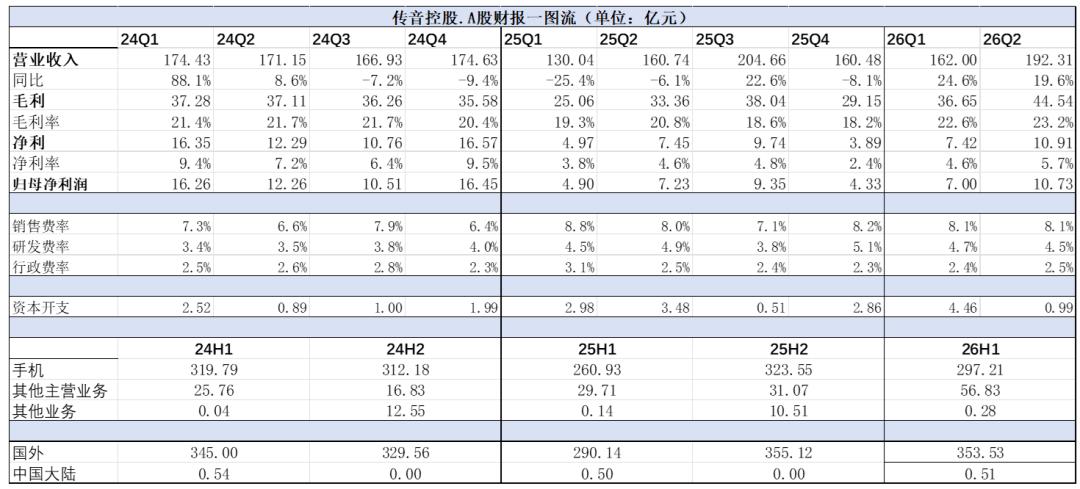
Just over a month ago, on August 17, Transsion released its semi-annual report. Revenue reached RMB 35.431 billion, up 21.85% year-on-year; net profit attributable to shareholders was RMB 1.773 billion, up 46.22% year-on-year; gross margin was 22.63%, up 2.54 percentage points year-on-year.
(The financial summary is shown in the figure below, Source: Wind, compiled by Financial Report Chronicles)
Amid widespread struggles in the smartphone industry during the same period, rising memory chip prices have wreaked havoc on profit margins across the sector. Xiaomi's gross margin for smartphones fell by about 2.6 percentage points in the first half of the year, while Transsion's profit margins increased.
Based on the financial report, our assessment is that Transsion's improvement in the first half of the year was partly due to the timing advantage from rising storage costs and partly due to its strategic bet on continuing to capitalize on the storage cycle.
Furthermore, considering Transsion's capital moves and its expansion into energy storage as a second growth curve, we believe Transsion's narrative of building a business around 1.6 billion African consumers is clear and logically sound. Pricing the company solely as a mobile phone manufacturer would be a misjudgment by the buyer's market.
01 Rising Storage Costs Elevate Transsion's Status
Let's first examine revenue. Transsion's first-half revenue reached RMB 35.431 billion, up 21.9% year-on-year, slightly exceeding market expectations. The core reason for this growth is "price increases."
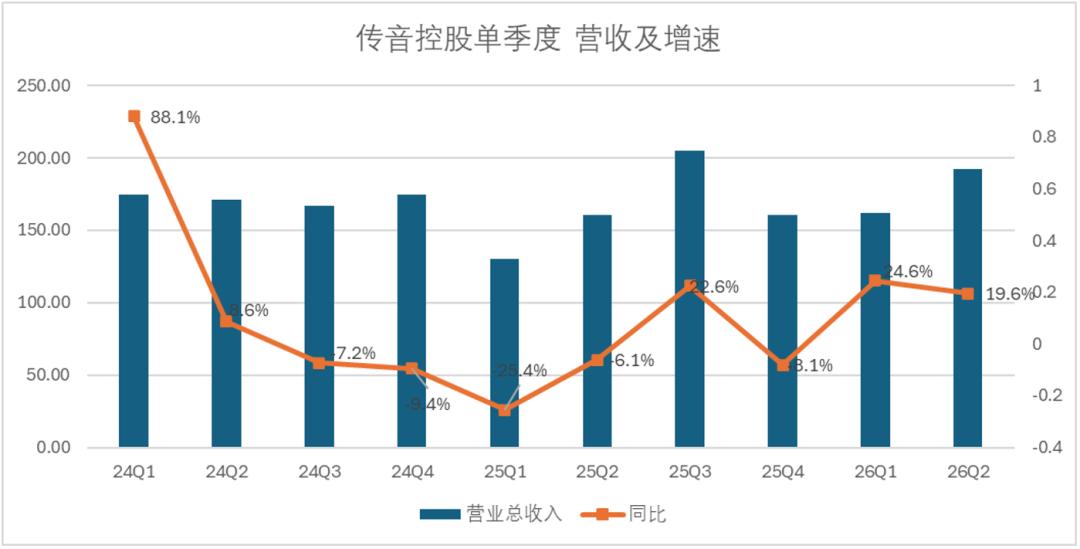
According to IDC, Transsion held a 7.1% share of the global smartphone market in the first half of 2026, shipping approximately 40 million units; in the same period last year, its share was 7.9%, with shipments of about 47 million units, representing a year-on-year decline of about 14%.
The direct driver of the average selling price (ASP) increase is storage. Data from third-party research platform CFM shows that DRAM and NAND prices rose by 386% and 207%, respectively, in 2025. Counterpoint estimates that LPDDR4 and LPDDR5 prices will roughly triple in the second quarter of 2026 compared to the fourth quarter of 2025.
Transsion's African market, caught in this wave of rising storage costs, has not been spared. Omdia data shows that the average selling price of smartphones in Africa rose by $41 to $202 in the second quarter of 2026, up about 25% year-on-year. Transsion's management has stated that it will adjust its product mix, reducing the proportion of products priced below $100 and driving growth in higher-price segments.
In terms of financials, the smartphone business, which accounts for nearly 80% of revenue, generated RMB 28.177 billion, up 15.54% year-on-year. With fewer units sold but higher revenue, the price-volume gap was nearly 30 percentage points. By this calculation, the ASP rose from about RMB 520 to about RMB 700, an increase of over 30%.
In other words, revenue growth was primarily driven by price increases. Against the backdrop of a strong storage cycle, even Transsion, known for its affordable models, has been "passively elevated."
02 Gross Margin Improvement Driven by Timing
In the first half of this year, Transsion's gross margin reached 22.63%, up 2.54 percentage points year-on-year. From a quarterly perspective, gross margins remained high in both the first and second quarters of this year.
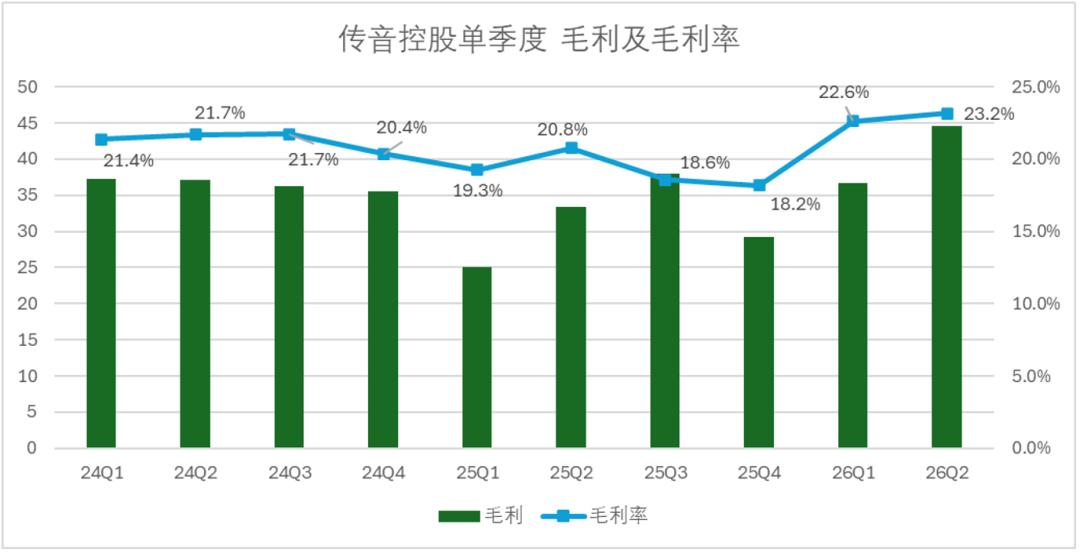
Transsion's explanation in its semi-annual report is straightforward: product prices were adjusted based on cost changes and market competition strategies, leading to an increase in the average selling price of smartphones. On the cost side, due to the impact of historical inventory, cost increases lagged, thus improving gross margins.
In simpler terms, selling prices rose first, but the recorded costs remained at the lower prices of old inventory. Before the inventory was depleted, profit margins naturally looked good. This improvement was driven by timing, similar to the case of Lenovo.
Another contributing factor was the product mix. Other business revenue in the first half was RMB 5.683 billion, with an estimated gross margin of about 29%, higher than the smartphone business's approximately 21%. The proportion of accessories, home appliances, and mobile internet services is gradually increasing. This is the proactive part, though currently still small in scale.
Extending the timeline provides a clearer picture of the recovery. In the first half of 2024, Transsion's net profit attributable to shareholders was RMB 2.852 billion. In the first half of 2026, revenue was 2.5% higher than in the same period of 2024, gross profit was 7.8% higher, but net profit attributable to shareholders was still 37.8% lower. While profit margins have recovered, absolute profit levels still lag.
The primary reason for this is that Transsion continues to ramp up investments in its core business.
03 High Inventory Levels Show Transsion's Continued Commitment
In the first half of the year, Transsion's net cash flow from operating activities was negative RMB 5.861 billion, compared to a net inflow in the same period last year. Inventory doubled from RMB 8.903 billion at the beginning of the year to RMB 18.935 billion, an increase of more than 100%.
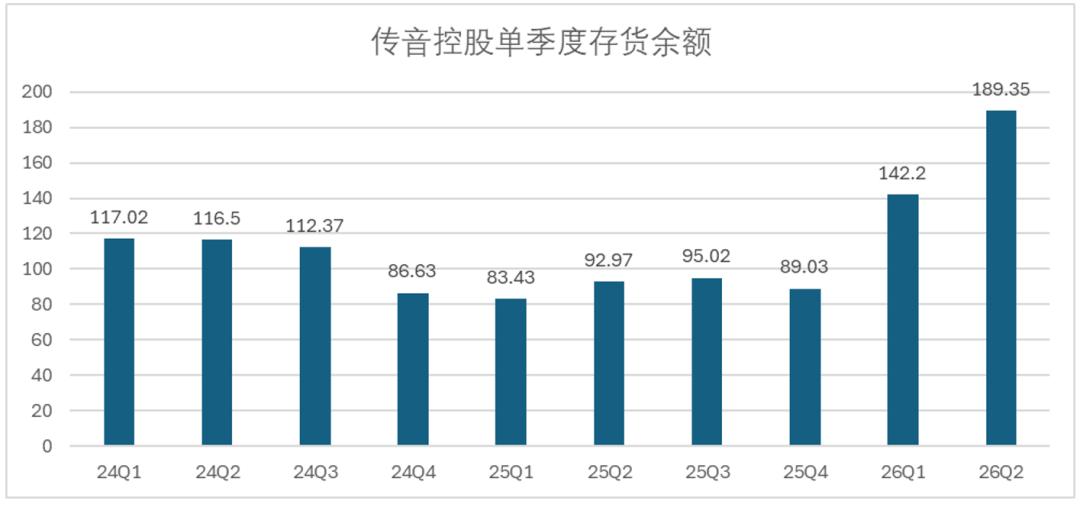
Breaking it down, raw material inventory increased from RMB 3.810 billion to RMB 10.069 billion, a net increase of about RMB 6.3 billion, while the increase in finished goods inventory was only about RMB 1.7 billion.
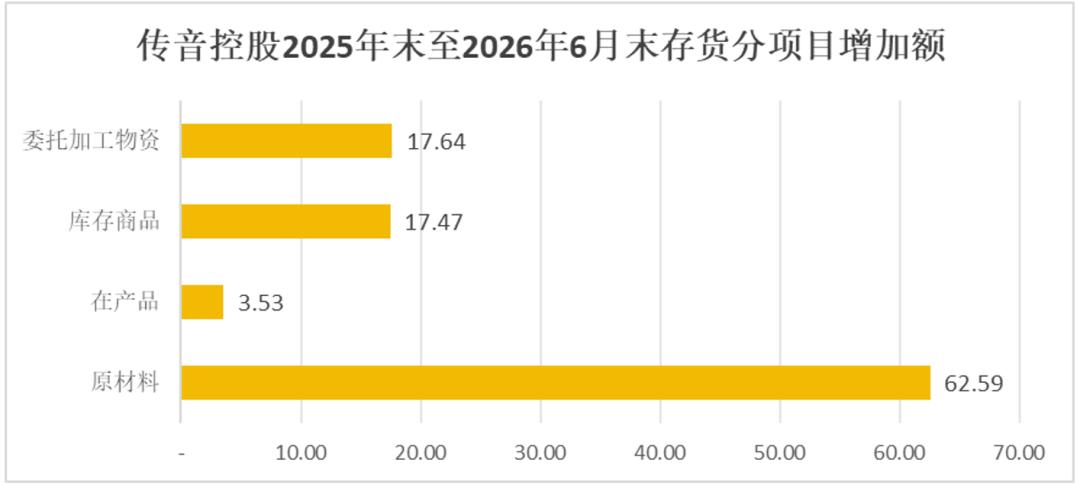
In other words, Transsion's inventory growth was not due to blocked sales leading to excess product inventory but rather due to proactive stockpiling of more raw materials.
In previous years, raw materials typically accounted for about 40% of Transsion's inventory value, with the rest being work-in-progress, finished goods, and consigned processing materials. In comparison, raw materials usually account for about 25% of Xiaomi's inventory. Clearly, Transsion's inventory structure has changed since the first half of this year.
At least in Transsion's view, this round of the storage cycle has not yet peaked.
Changes in expense ratios were minimal. The selling expense ratio increased from 8% to 8.10%, up 10 basis points; the administrative expense ratio remained unchanged; and R&D expenses declined by 40 basis points year-on-year. Overall, the three expense ratios decreased by 30 basis points.
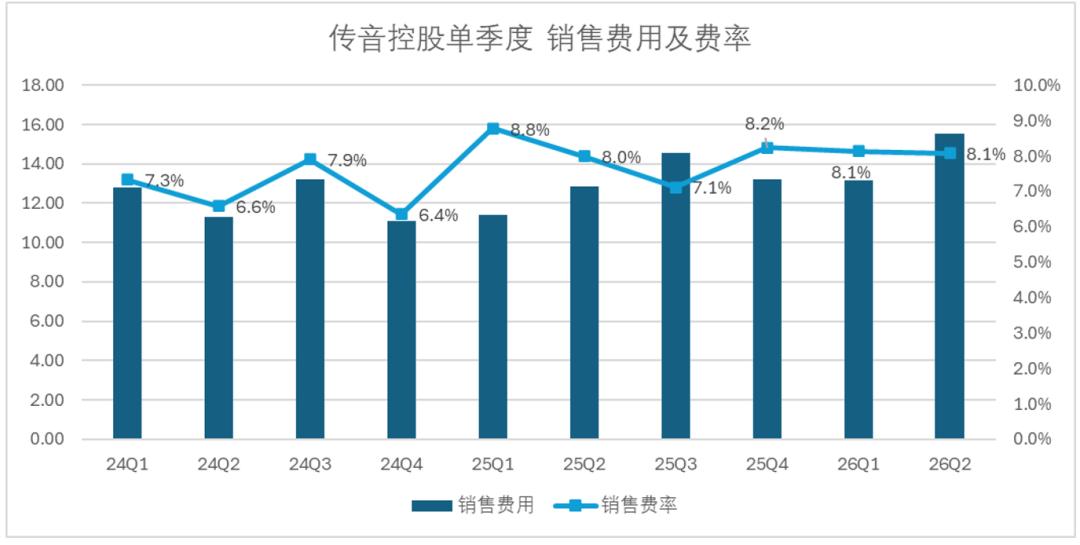
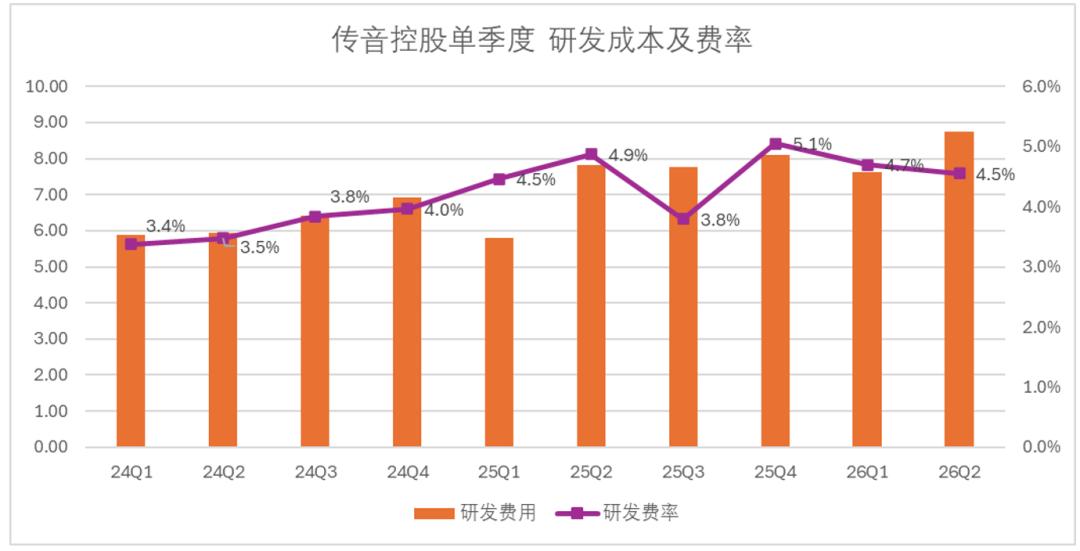
However, in absolute terms, selling, administrative, and R&D expenses actually increased by 21%, 12%, and 17%, respectively. Over a longer timeline, expenses have grown relatively significantly compared to the same period in 2024, and they remained at relatively high levels in the first half of this year.
Overall, both inventory levels and expense ratios indicate that Transsion continues to invest heavily in the consumer market and is actively seeking transformation.
04 Focusing on 1.6 Billion Consumers is Transsion's True Value
Let's summarize. Revenue, gross margin, and net profit all trended upward in the first half of the year, amid rising storage costs and industry-wide challenges. Transsion's performance is commendable.
Breaking it down: price increases were implemented first, while recorded costs remained at the lower prices of old inventory. Combined with raw materials locked in at earlier low prices, the misalignment of these three timelines created a strong financial showing for the first half of the year. However, this benefit is temporary. Once inventory is depleted and cost increases are fully reflected, financials will return to normal.
Transsion's management is well aware of this. Hence, the company swiftly initiated the Hong Kong listing process. As of the end of June this year, Transsion had over RMB 16.7 billion in cash and equivalents on hand but still plans to raise $400 million to $500 million.
The prospectus only outlines broad categories for fund usage—AI R&D, marketing and brand building, mobile internet, and IoT—without disclosing project-level details. The intention is clear: Transsion needs more capital to shift its growth engine:
(1) The "Copy China to Africa" story in the mobile phone industry won't last much longer
From a purely mobile phone industry perspective, Transsion's growth ceiling is evident.
As of early 2026, Africa had about 1.32 billion mobile connections for a population of approximately 1.5 billion, meaning mobile penetration is nearing saturation. Sub-Saharan Africa has 89 mobile phones per 100 people, while South Africa has 167 per 100. The market for "having a phone" is largely saturated.
Omdia predicts that African smartphone shipments will decline by 23% year-on-year in 2026. After a high base of 84.4 million units shipped in 2025 (up 13% year-on-year), combined with rising component costs and pressure on entry-level demand, short-term penetration growth will slow.
Moreover, market competition is intensifying. When Transsion entered Nigeria with TECNO in 2007, its only competitor was Nokia. However, Omdia data shows that in 2025, Xiaomi's smartphone shipments in Africa grew by 27%, Honor's by 144%, while Transsion's grew by only 7%.
The mobile phone industry's growth has peaked, which is why Goldman Sachs and UBS have assigned low ratings to the sector. However, Transsion has much more to offer.
(2) There's plenty of business to be done with 1.6 billion people
C.K. Prahalad, in *The Fortune at the Bottom of the Pyramid*, argued that success in bottom-of-the-pyramid markets lies in redesigning every detail around the real constraints of low-income consumers, rather than simply dumping outdated products. Transsion is the most thorough practitioner of this philosophy.
The story of Transsion as the "King of African Mobile Phones" has been told many times, so we won't repeat it here. Behind the story lies Transsion's true strength: nearly two decades of accumulated localization capabilities, including channel (channels), market understanding, and more.
For example, Transsion's second growth curve—energy storage—is merely a carrier (vehicle) for these capabilities.
Africa's energy landscape is even more primitive than its mobile phone market was in 2007. According to the IEA, about 600 million Africans lack access to electricity, with four out of every five people without power living in Sub-Saharan Africa. Despite holding 60% of the world's best solar resources, Africa accounts for only 1% of global installed solar capacity. Grid construction takes decades, making distributed solar-plus-storage the only viable solution to keep pace with population growth.
On the supply side, the infrastructure is already in place. According to EVTank, global energy storage battery shipments reached 651.5 GWh in 2025, with Chinese companies accounting for 94.4% of the market. The top ten shippers were all Chinese companies, with 64% of output consumed domestically and the rest needing to go overseas.
Domestic energy storage systems are already engaged in a fierce price war, yet solar-plus-storage devices in Africa sell for about 30% more than in China. This mirrors the smartphone market dynamics of the past: excess capacity in China and shortages in Africa. Transsion is well-positioned to repeat its success, though the scale is still nascent, and capital markets have yet to price this in.
This includes the potential AI narrative and light electric mobility stories in the prospectus, all of which essentially represent Transsion leveraging its localization capabilities to retell the "Copy China to Africa" story.
Currently, capital markets value Transsion at 17-19x PE, slightly lower than better-performing Chinese go overseas (overseas-focused) companies like Anker and Ugreen, and on par with Xiaomi. Essentially, it is still being priced as a mobile phone company.
-
![]()
New-Type Battery '15th Five-Year Plan' Launched! All-Solid-State Batteries on Track for Vehicle Integration by 2027, with Lithium Sulfide Pricing as the Last Barrier
-
![]()
China Launches the Narrative of Space-Based Computing Power: Over 1,000 Satellites to Form a ‘Data Center’ in the Sky
-
Meta Launches Enterprise Version of Muse, Prompting CEO of $10 Billion Listed Company to Make the Switch
-
【Insight】Black-light Optoelectronic Tweezers Can Be Used in the Development of Antibody Drugs, with Xinguang Biotechnology as a Representative Enterprise in China
-
![]()
AMD Bets $8.2 Billion on Fei-Fei Li, ByteDance is Also 'Creating Worlds,' Is XR About to Change?
-
![]()
Huawei Qiankun ADS 5 Integrated: The 2027 Zongheng G700 Makes a Bold Statement
-
It’s Quite Surprising: Just Three Days Post-Launch, iPhone 18 Pro Catapults Apple to the Top, Outpacing Huawei and Xiaomi
-
![]()
Price Soars 30-Fold: Are Internet Cafes Making a Comeback?