New-Type Battery '15th Five-Year Plan' Launched! All-Solid-State Batteries on Track for Vehicle Integration by 2027, with Lithium Sulfide Pricing as the Last Barrier
 09/30 2026
 323
323
Seven departments have outlined plans for new-type batteries, targeting vehicle integration of all-solid-state batteries in 2027 and widespread adoption by 2030. The critical challenge remains reducing lithium sulfide costs.
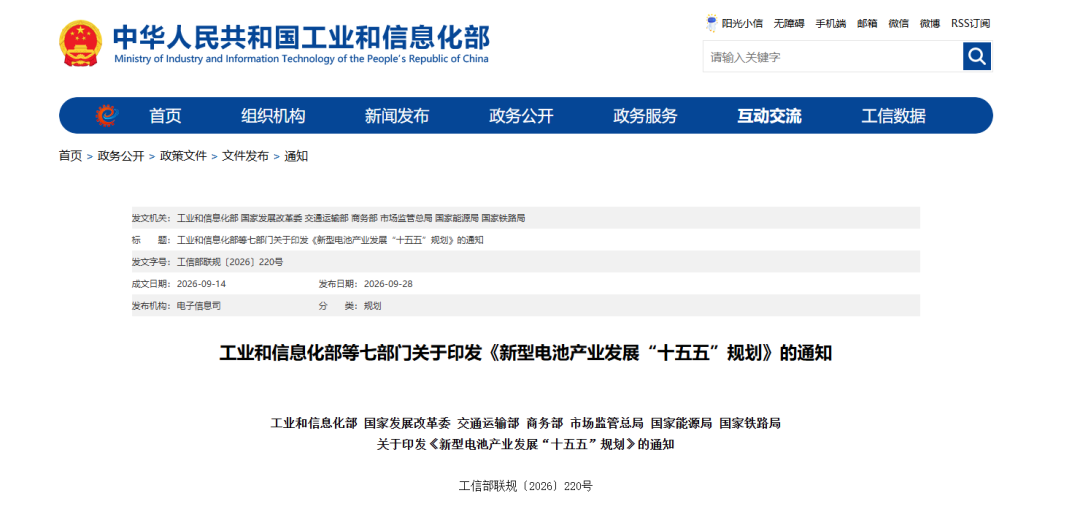
Foreseen Energy reports that on September 28, 2026, seven departments, including the Ministry of Industry and Information Technology, jointly released the '15th Five-Year Plan for the Development of the New-Type Battery Industry.' The plan explicitly sets a goal for the preliminary widespread adoption of all-solid-state batteries by 2030, with long-life lithium batteries achieving a cycle life of 15,000 times and leading companies attaining a product defect rate at the PPB (parts per billion) level. It also emphasizes boosting the mass production capacity of high-conductivity, high-performance solid electrolytes and enhancing the industrialization capabilities of all-solid-state batteries.
The widespread adoption of all-solid-state batteries has been incorporated into the main body of the national industrial plan, and the countdown has commenced. However, the plan's original text employs the phrase 'preliminary widespread adoption.' The interplay between 'preliminary' and 'widespread' is where the true intrigue lies.
Industry actions are outpacing the plan. Geely aims for small-scale industrialization and the deployment of 1,000 demonstration vehicles by 2027, Chery plans to initiate vehicle validation in the same year, and CATL has confirmed small-scale production in 2027. Gotion High-Tech's Jinshi all-solid-state battery has achieved an energy density exceeding 400Wh/kg, with a 2GWh production line currently under construction. On the surface, the timelines appear synchronized. Yet, beneath this uniformity, each company's progress varies significantly.

Automakers Aim for 2027, but Supply Chain Discrepancies Persist
According to CATL Chairman Zeng Yuqun's public statement at Davos, the current technological maturity of all-solid-state batteries stands at Level 4 on a scale of 1 to 9, indicating that it has just completed laboratory-scale principle validation of small samples. Progressing from Level 4 to mass production at Level 9 involves three major hurdles: engineering validation, production line debugging (commissioning), and yield enhancement.
Automakers are targeting small-scale vehicle integration by 2027, but battery companies have even earlier timelines. Gotion High-Tech's 2GWh all-solid-state production line has completed its design, aiming for small-scale mass production by the end of 2026. Tinci Materials has established and commissioned a hundred-ton-scale lithium sulfide and solid electrolyte pilot production line, maintaining close collaboration with mainstream downstream cell manufacturers and automakers. Zhenhua New Materials' solid electrolyte pilot line equipment installation is nearing completion. Yahua Group's lithium sulfide pilot line has entered the demonstration and design phase, receiving positive feedback from sample customers.
Battery companies are a year ahead of automakers, but this extra year exposes the greatest uncertainty: the supply chain is not yet prepared to match this accelerated pace.
Media reports indicate that multiple solid-state battery suppliers have noted a shortage of core equipment supply, with some materials required for cell production still at the laboratory preparation stage in vacuum gloveboxes, not suitable for mass production. A vacuum glovebox is a sealed transparent chamber where operators insert their hands into rubber gloves to conduct experiments under inert gas protection, with daily output measured in grams. The transition from grams to tons, and from tons to tens of thousands of tons, represents a significant leap at each stage.
This accurately reflects the current state of the all-solid-state battery industrial chain: downstream demand is urgent, while upstream is still conducting experiments in gloveboxes.

Lithium Sulfide Price Declines from 2 Million to 500,000, but the Calculation Is Complex
Cost remains an unavoidable obstacle.
As of September 2026, the average price of battery-grade lithium sulfide is approximately 1.3 million yuan/ton, a significant decrease from 2 million yuan/ton at the beginning of the year, but still more than double Gotion High-Tech's target of 500,000 yuan/ton. The average price of solid electrolyte LPSC is about 3,400 yuan/kilogram, or 3.4 million yuan/ton. The current cost of all-solid-state battery cells ranges from 1.6 to 2.2 yuan/Wh, while lithium iron phosphate battery cells have dropped to 0.39 to 0.5 yuan/Wh.
At current prices, the material cost of all-solid-state batteries is 3 to 5 times that of lithium iron phosphate batteries. If calculated based on lithium sulfide's historical peak of 4.8 million yuan/ton, this multiple once reached around 7 times. Lithium sulfide production line construction is accelerating, but cost reductions are not keeping pace with capacity expansion.
The root of this contradiction lies in the production process. Lithium sulfide preparation requires an inert atmosphere, with stringent demands for equipment sealing, material purity, and batch consistency. Guanghua Technology is one of the few domestic companies to achieve mass production of battery-grade lithium sulfide and is currently planning a 3,000-ton expansion. However, the industry's transition from ton-scale to thousand-ton-scale production requires not just simple capacity amplification but the reconstruction of entire engineering systems.
Gotion High-Tech's strategy is to delve into the upstream material sector, self-developing and producing lithium sulfide using a 'gas-liquid-solid three-phase reaction method' that triples preparation reaction efficiency and reduces energy consumption by 40%. The company plans to establish annual production capacities of 50,000 tons of lithium sulfide and 100,000 tons of solid electrolytes within five years.
This goal is ambitious, but achieving 50,000 tons of lithium sulfide capacity in five years means expanding from the current hundred-ton scale to the ten-thousand-ton scale, a more than 500-fold increase. Manufacturing capacity expansion is never linear—yield enhancement, equipment commissioning, and customer validation can all delay plans.

The Solid-Solid Interface Challenge: Tougher Than Cost Reduction
If cost is a solvable issue through time and scale, the solid-solid interface presents an entirely different challenge.
In simple terms, the solid-solid interface refers to the junction formed when two different solid materials come into contact. In liquid batteries, the electrolyte permeates every gap in the positive and negative electrodes like water, ensuring a sufficient contact area. In solid-state batteries, solids adhere to each other, but microscopically, it resembles two pieces of frosted glass stacked together, filled with air and gaps. The resistance to ion movement in solids is orders of magnitude higher than in liquids. Moreover, during charging and discharging, electrode materials expand and contract, causing the solid-solid interface to crack under repeated mechanical stress, leading to rapid battery performance degradation.
Chinese Academy of Engineering academician Lian Yubo identifies this issue as the core bottleneck in the 'critical stage' of all-solid-state battery industrialization. Chinese Academy of Sciences academician Ouyang Minggao predicts that test vehicles may emerge around 2027, but large-scale mass production will require an additional 3 to 5 years.
Technical route divergence is also noteworthy. Currently, the industry is converging toward sulfide systems, with CATL, BYD, Gotion High-Tech, and Toyota all betting on the sulfide route due to its highest ionic conductivity, closest to liquid electrolyte performance. However, sulfides have poor thermal stability, and safety remains unverified. The oxide route offers good stability but suffers from prominent interface impedance issues, with mass production processes differing significantly from liquid batteries.
Route divergence isn't entirely detrimental, but prolonged divergence is. Every additional day means equipment investment, material capacity, and talent reserves are scattered across multiple paths, preventing cost amortization. The Ministry of Industry and Information Technology subsequently released 10 draft industry standards for solid-state batteries, continuing to advance standard development in key areas of all-solid-state batteries. The direction is correct, but a significant gap remains between standard implementation and industrial chain maturity.
Returning to the September 28 plan, the goal of preliminary widespread adoption of all-solid-state batteries by 2030 is not overly ambitious within the industrial cycle. The real focus should not be on the 2030 deadline but on which companies can enhance pilot line yields, which material suppliers can scale from ton-level to ten-thousand-ton-level capacities, and which equipment manufacturers can shorten isostatic pressing equipment delivery cycles from 18 months to 6 months between now and 2030. Whether the cost curve for lithium sulfide can drop from 1.3 million yuan to 500,000 yuan as scheduled is the critical variable determining whether the plan becomes a reality. These issues won't appear in any planning document's main text, but they will determine whether the goals outlined in the plan materialize as numbers or facts.
-
![]()
New-Type Battery '15th Five-Year Plan' Launched! All-Solid-State Batteries on Track for Vehicle Integration by 2027, with Lithium Sulfide Pricing as the Last Barrier
-
![]()
China Launches the Narrative of Space-Based Computing Power: Over 1,000 Satellites to Form a ‘Data Center’ in the Sky
-
Meta Launches Enterprise Version of Muse, Prompting CEO of $10 Billion Listed Company to Make the Switch
-
【Insight】Black-light Optoelectronic Tweezers Can Be Used in the Development of Antibody Drugs, with Xinguang Biotechnology as a Representative Enterprise in China
-
![]()
AMD Bets $8.2 Billion on Fei-Fei Li, ByteDance is Also 'Creating Worlds,' Is XR About to Change?
-
![]()
Huawei Qiankun ADS 5 Integrated: The 2027 Zongheng G700 Makes a Bold Statement
-
It’s Quite Surprising: Just Three Days Post-Launch, iPhone 18 Pro Catapults Apple to the Top, Outpacing Huawei and Xiaomi
-
![]()
Price Soars 30-Fold: Are Internet Cafes Making a Comeback?