Flagship Phone Showdown: Xiaomi's 'Navigation Error'
 09/30 2026
 507
507
Source | Benyuan Finance
Author | Li Youshan
In 2026, the price of memory chips spiraled out of control, with upstream cost pressures being passed down to downstream terminals, intensifying competition within the smartphone industry and raising the threshold for consumers to purchase new phones.
Changes in the market environment have raised the "impulse threshold" for consumers to upgrade their phones. Within just ten days, the four major Chinese smartphone brands—vivo, OPPO, Xiaomi, and Honor—successively released their autumn new products, with surprisingly consistent keywords: price hikes and imaging capabilities.
OV continues to focus on photography, Honor is addressing shortcomings to boost sales, but it is Xiaomi that stands out the most with a sense of dissonance.
For this new product release, the standard version is temporarily absent, and the starting price of the Xiaomi 18 Pro series has been directly set at 5,999 yuan, with the Pro Max top-tier version approaching the 10,000 yuan mark, tearing off the "cost-effectiveness" label it has held for over a decade.
According to third-party observation data, on the first sales day, the SO absolute value of the Xiaomi 18 Pro series was the highest, but it decreased by about 25% year-on-year for the entire series and about 30% for the Pro series, which is not optimistic. At the press conference, Lu Weibing advised consumers to "buy earlier for more discounts," and the "privacy screen" design further placed it at the center of public opinion.
From a macro perspective, Xiaomi has managed to rank among the top three global smartphone brands, but its brand premium still lags significantly behind high-end competitors like Apple and Huawei. Amidst the flagship phone showdown, is Xiaomi, eager to ascend to the high-end market, deviating from its own "course"?
Smartphone Innovations Abound
The domestic smartphone market has entered a delicate period of stagnant growth: the total number of active mobile internet terminal devices has reached 1.282 billion, with the average user replacement cycle extending to over 40 months. Consumers are becoming increasingly cautious in their decision-making, with "if it works, don't replace it" becoming the mainstream consumer mindset.
Data from the China Academy of Information and Communications Technology also confirms the market's downturn: from January to June 2026, domestic smartphone shipments were 133 million units, a year-on-year decrease of 5.5%, with continued weakening growth momentum in the overall market. With hardware and software parameters (hardware and software parameters) having reached their limits, smartphones have entered a fascinating era of "morphological innovations."
Apple introduced the iPhone Air, sacrificing specifications for a lighter and thinner design; Honor designed the robot phone, incorporating a mechanical arm gimbal into the phone; OPPO's sub-brand, realme, offered four decorative piece assembly options for the camera module; and all brands introduced concert telephoto lens accessories.
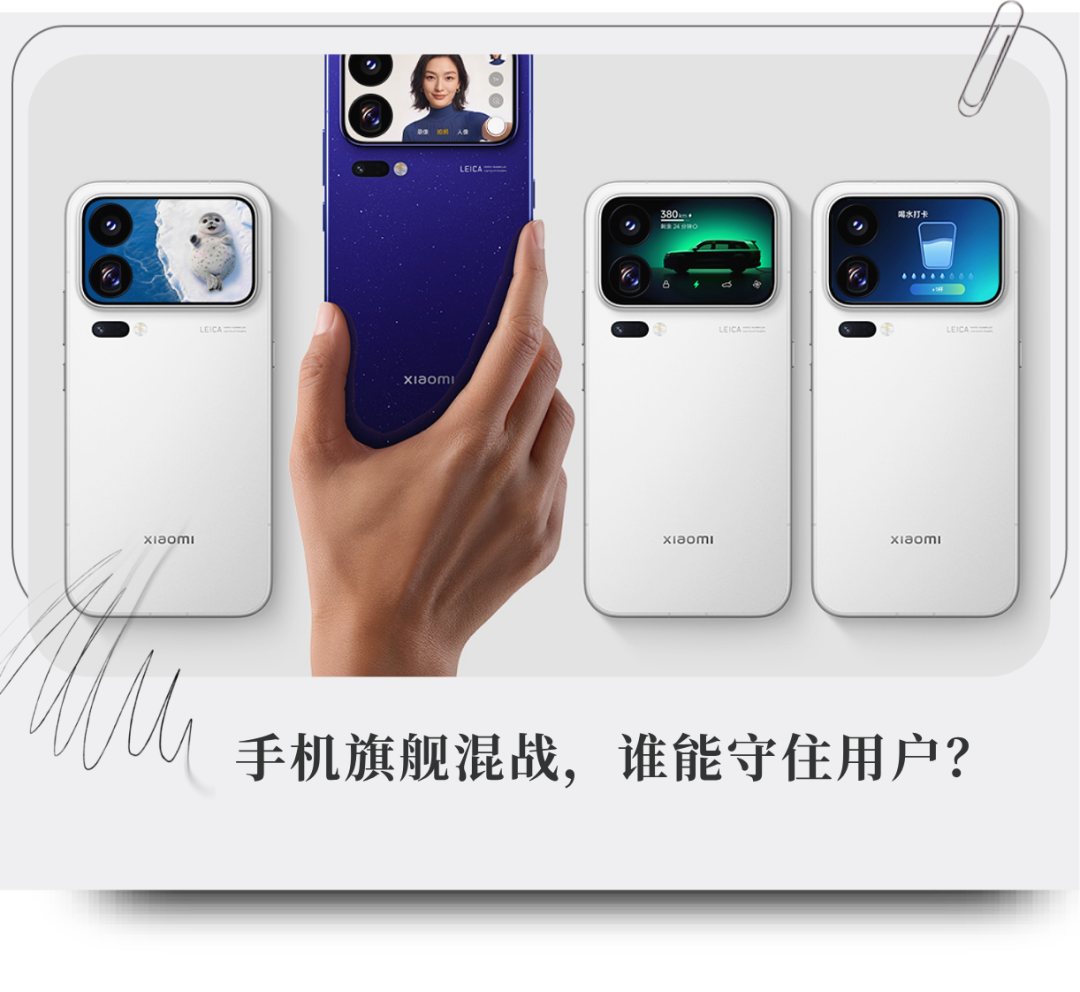
Xiaomi has been the most diligent in innovation. Last year, it introduced the Miaoxiang back screen, which, regardless of practicality, provided ample emotional value; this year, not only has it flattened the camera and back screen, but it has also unveiled a brand-new "hardware-level privacy screen," which comes standard on all Xiaomi 18 Pro series models. The global debut of the hardware-level privacy screen was on the Samsung Galaxy S26 Ultra, followed by Huawei's Mate XT2 Extraordinary Master ( Extraordinary Master Mate XT2), with Xiaomi being the third brand to adopt it, indicating its high aspirations.
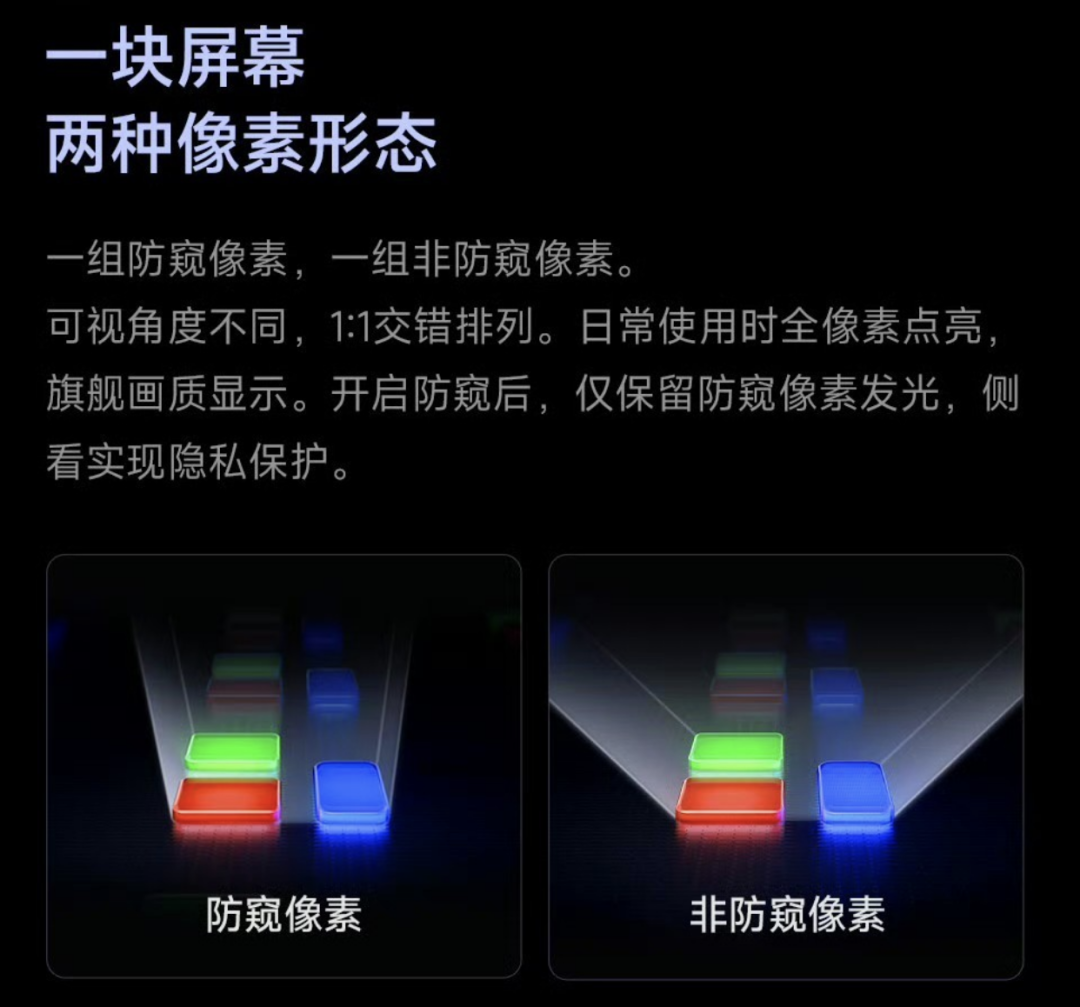
The hardware privacy screen has been met with mixed reviews since its inception, with significant differences in technical routes, completion levels, and costs. Taking Huawei as an example, it integrates two independent and complete RGB light-emitting units within the same pixel unit, resulting in the highest cost but also relatively good user experience.
Xiaomi continues to emphasize specifications in its marketing, officially calling this a "bottom-layer technological innovation at the screen pixel structure level," adopting "Super Pixel 2.0 technology" and claiming "flagship-level picture quality when the privacy screen is off." However, due to the AB pixel interleaved structure and cost constraints, compromises have been made in basic display brightness, viewing angles, and picture clarity.
From user feedback, there is brightness attenuation and color shifting when the screen is tilted. Before writing this article, we also had hands-on experience. Xiaomi's privacy screen structure is only implemented on the left and right sides of the pixels. When activated, there is indeed a sacrifice in side brightness, especially under strong light, where readability decreases.
In normal mode, the peak brightness of the Xiaomi 18 Pro is about 4,000 nits, an improvement over its predecessor's 3,500 nits. Store sales staff also admitted to us that compared to OPPO and vivo's new flagship models, Xiaomi's screen brightness peak is 500 nits lower.
The mere experience gap is not enough to spark public opinion. The fact that a unique feature like the privacy screen has sparked mixed reviews precisely reflects the mismatch between Xiaomi's user base and the rigid demand for privacy screens.
The privacy-conscious demographic generally consists of specific groups in specific scenarios, such as financial professionals, corporate executives, and government personnel handling confidential information. In contrast, Xiaomi's primary consumer base exhibits distinct characteristics of "mass tech consumption," with a high proportion of students and young white-collar workers. Their phone content is mainly social media, entertainment, and gaming, and they are highly price-sensitive, making purchasing decisions based on parameter cost-effectiveness.
Compared to Huawei and Samsung's strategy of only equipping top-tier flagship models with high-end privacy screens, Xiaomi's approach of "mandatory standard equipment across all models, with no ordinary screen option" has thrust the contradiction (conflict) to the forefront.
By prioritizing specifications over user experience, this means ordinary users who do not need privacy screens are forced to accept display compromises, while a small number of users with needs feel that Xiaomi's privacy solution is less complete than Huawei's and Samsung's, ultimately resulting in polarized evaluations: "rigid users find it not good enough, non-rigid users find it redundant."
Farewell to the Low-Price Era
You may not have yet enjoyed the convenience brought by AI, but the soaring demand for AI servers has driven up costs, which are being passed on to everyone. With memory and chip prices rising, smartphone BOM (Bill of Materials) fluctuations naturally lead to price hikes by manufacturers, who share and transfer costs to consumers.
Taking Xiaomi as an example, in 2019, the starting price of the Xiaomi 9 was closely aligned with the cost-effectiveness threshold of 2,999 yuan. In 2020, with the advent of 5G, the starting price of the Xiaomi 10 increased to 3,999 yuan. Over the next three years, despite a decrease in chip and OLED screen costs, prices did not revert because it was not just about brand perception but also about competing for high-end users and profit margins. Last year's Xiaomi 17 series had a starting price of 4,499 yuan, while this year's Xiaomi 18 series jumped to 5,999 yuan.
From the pricing strategies of the four domestic manufacturers this year, they generally follow a "control prices in the mainstream segment, test prices in the high-end segment" approach.
For the 16G+512G mainstream configuration: the Pro Max series pricing for vivo, OPPO, Xiaomi, and Honor is 8,499 yuan, 7,999 yuan, 8,999 yuan, and 7,499 yuan, respectively. Among them, Xiaomi has the highest price, with the top-tier version priced at 9,999 yuan, testing the 10,000 yuan ceiling for straight-screen phones. The foldable-screen Xiaomi 18 Fold, released in the same month, has a starting price of 10,999 yuan, but the sales volume still relies on straight-screen flagships like the 18 Pro.
IDC data shows that in the first quarter of 2026, Xiaomi fell out of the top five in the Chinese market; in the second quarter, Chinese smartphone market shipments were about 66.01 million units, a year-on-year decrease of 4.3%. During the same period, Xiaomi's global smartphone shipments decreased by about 26.5%, with ASP (Average Selling Price) reaching a record high of 1,351 yuan, but gross margin dropped from 11.5% to 8.5%, indicating significant pressure.
Unable to rely on the mid-to-low-end market for scale and profit, Xiaomi is both proactive and anxious. After balancing shipments, profits, and supply, it has chosen to proactively reduce entry-level and mid-range models, shift its structure upwards, and focus on the high-end market, concentrating its initial resources on the 18 Pro and 18 Pro Max, similar to Apple's strategy.
While prices can align with Apple and Huawei, accumulated product strength and brand power are not easily acquired.
QuestMobile data shows that as of June 2026, Huawei and Apple had 276 million and 268 million monthly active devices, respectively, while OPPO, vivo, Xiaomi, and Honor had 233 million, 212 million, 129 million, and 100 million monthly active devices, respectively.
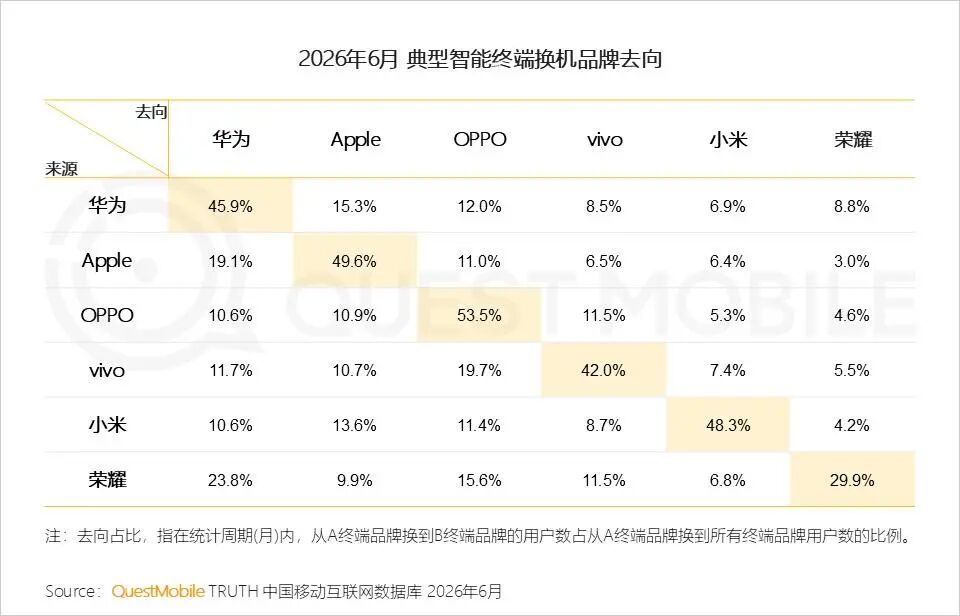
The moats between brands are significant. Huawei and Apple are mutually penetrating, OPPO and vivo are mutually penetrating, Honor has lost 23.8% of its users to Huawei, while Xiaomi's lost users are evenly distributed among Huawei, Apple, and OPPO.
This year, the iPhone 18 Pro series, with a starting price increased to 9,999 yuan, sold nearly 1.3 million units in China within seven days of release, reaching 1.15 times the sales volume of the previous generation during the same period. The collective price hikes of domestic flagship phones have instead stimulated consumers to choose Apple.
Globally, Apple captures over 80% of the industry's profits with less than 20% of global shipments; in the Chinese market, Huawei leverages its brand barriers and pure HarmonyOS ecosystem to capture a 23% market share in the second quarter of 2026.
With the overall market shrinking and high-net-worth users drifting away, it is not easy for Xiaomi to secure its position in the high-end ecosystem; it cannot afford to lose.
From competing on "ultimate cost-effectiveness" to competing on "product definition rights," we take pride in the rise of a national brand but also feel apprehensive about its choice of this high-end path.
Three Axes Each Bear Their Responsibilities
Xiaomi has the confidence to compete in the high-end smartphone market, with five years of 105.5 billion yuan in R&D, 21 billion yuan in chip manufacturing, and three self-developed chips, all representing significant technological investments.
Charles Handy once said, "The secret to sustained growth is not to extend the first curve but to start a new one before the first one ends. The first curve is survival; the second curve is rebirth."
Xiaomi is not just about isolated smartphone terminals; it fights with three axes: smartphones, IoT, and automobiles.
According to Xiaomi's semi-annual report, the smartphone business remains Xiaomi's largest revenue source, followed closely by IoT and lifestyle consumer products. However, as mentioned earlier, smartphones cannot keep up with cost increases, and price-for-volume exchanges are under significant pressure, shifting their role from the protagonist to a connectivity hub for the entire ecosystem.
The IoT ecosystem is Xiaomi's core competitiveness, distinguishing it from other pure smartphone manufacturers, with 1.16 billion connected devices forming a massive user traffic Entrance (entry point) and scenario coverage. After the phase-out of trade-in subsidies, IoT business revenue decreased by 23.7% year-on-year in the first quarter and 19.2% in the second quarter, but it still contributes significant gross profit.
The automotive and AI innovation business segments generated 44.8 billion yuan in revenue in the first half of the year, with a combined operating loss of about 5.7 billion yuan. The automotive business, which carries more growth expectations, delivered about 180,000 units in the first half of the year, achieving only 30% of the annual target of 550,000 units set at the beginning of the year. This means monthly deliveries must exceed 60,000 units in the second half of the year to meet the target. Currently, from April to August, monthly deliveries have been stuck at around 30,000+, making execution challenging.
The three axes converge at the group level: adjusted net profit for the first half of the year decreased by 42.8% year-on-year, with the overall gross margin dropping to 20.87%.
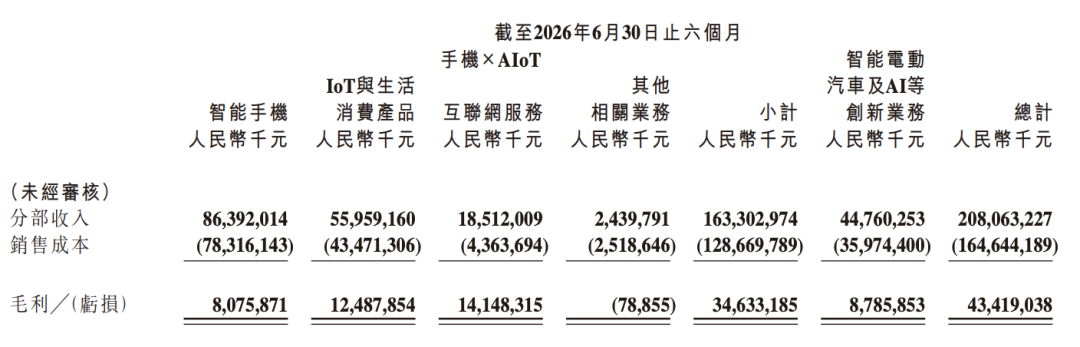
Compared to the structural upward shift in smartphone prices, Xiaomi's automotive strategy is the opposite, with prices continuing to decrease.
The average revenue per vehicle in the second quarter decreased from 253,700 yuan in the same period last year to 229,300 yuan, with the main models being the SU7 and YU7.
In July 2026, Xiaomi officially released the Kunlun technology architecture and introduced its first extended-range SUV, the Xiaomi Pengcheng series, with a market price two to three thousand yuan lower than the pre-sale price, and the entry-level N70 Pro priced below 210,000 yuan.
The Pengcheng N series features large batteries and spacious interiors, targeting the Ideal L series and Seres M series. Launched in September, it will shoulder the annual target and face the tests of production ramp-up and real delivery rhythms.
Finally, reviewing Xiaomi's entire autumn press conference, we also noticed that Lei Jun, the pillar of the company, did not take the stage but sat in the audience as a spectator.
In the past, Lei Jun served as Xiaomi's founder, CEO, and Chief Marketing Officer, achieving god-like status in both the smartphone and new energy vehicle waves, to the extent that "Lei Jun = Xiaomi" in some ways.
In over a decade since Xiaomi's founding, Lei Jun has been a model CEO, personally taking the stage for product launches, following up on new car tests, live-streaming for over ten hours, and even weathering public opinion storms.
As mentioned in "Inside Xiaomi," "Whenever Lei Jun personally oversees a product line, it becomes a hit. But no one's energy is unlimited, and the product lines he lets go often encounter bottlenecks."
Standing at the pinnacle, we may begin to observe the beginning of a "Lei Jun ≠ Xiaomi" era after this press conference.
Operations/Yu Shuya Design/Yanweier
*All rights reserved, unauthorized reproduction prohibited
end
-
Survival Game of New Energy Vehicles Accelerating Industry Reshuffle
-
![]()
Why Doesn't a 58% Gross Profit Margin Lead to Growth? The IPO of an Optical Industry Giant
-
Qijing GT7 Fails to Make a Breakthrough, Liu Jiaming’s Debut Ends in Disappointment: GAC Group’s Premium Push Hits Another Snag
-
Sales Plummet Over 40% Again: Can Qian Yang’s JiaYue 07 Revive Roewe?
-
![]()
Flagship Phone Showdown: Xiaomi's 'Navigation Error'
-
Peugeot and Jeep Embrace Innovation: Momenta’s Solution Takes the Spotlight
-
![]()
Chinese Tech Giants Face a Tough Decision: Follow or Ignore Muse's Move
-
Foldable Screens Enter the 'Besieged City' Era