Why Doesn't a 58% Gross Profit Margin Lead to Growth? The IPO of an Optical Industry Giant
 09/30 2026
 375
375
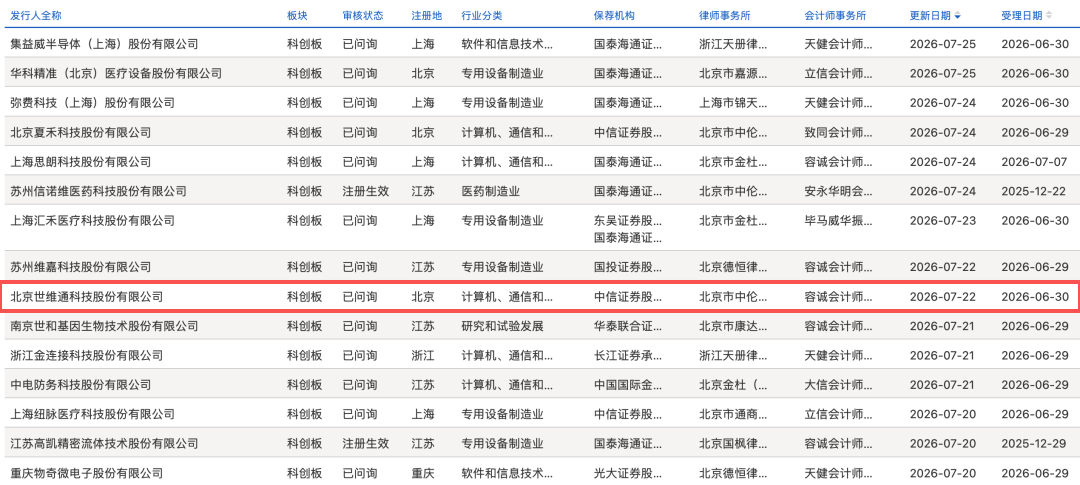
Recently, the Initial Public Offering (IPO) of Beijing Swit Technology Co., Ltd. (hereinafter referred to as "Swit") on the STAR Market has once again captured public attention. In fact, its IPO entered the inquiry phase on July 22, 2026. As a national-level specialized and sophisticated "little giant" enterprise, Swit plans to raise 793 million yuan, with CITIC Securities acting as the sponsor.
Swit is approaching the capital market with an impressive comprehensive gross profit margin of 58% and has maintained the top domestic market share in lithium niobate multifunctional optical devices for several consecutive years. However, behind these gleaming profit figures lies the reality that the company's revenue has hovered around the 300 million yuan mark for three years.
From a financial standpoint, from 2023 to 2025, Swit's revenue stood at 296 million yuan, 297 million yuan, and 333 million yuan, respectively, with year-over-year growth rates of approximately -0.34%, 0.34%, and 12.12%. In terms of net profit, the figures for the same three years were 107 million yuan, 92.5073 million yuan, and 112 million yuan, respectively. It's worth noting that the net profit attributable to the parent company in 2024 was 90.372 million yuan, which differs from the overall net profit figure, primarily due to the profit and loss of minority shareholders.
In stark contrast to this sluggish growth is a gross profit margin that significantly surpasses the industry average. During the reporting period, Swit's comprehensive gross profit margins were 59.54%, 56.87%, and 58.75%, respectively. In comparison, the average for comparable companies in the same industry during the same period was only 37.39%, 33.54%, and 35.21%, respectively, with Swit exceeding the industry average by over 20 percentage points.
The primary driver behind this disparity stems from technological scarcity, but it's not the sole factor. Zhu Keli, the founding president of the National Research Institute for New Economy, pointed out that Swit's high profitability is a result of the combination of market access barriers and product technology premiums. It cannot be simply attributed to the access thresholds of the downstream military industry.
Regarding the product itself, Swit's main Y-waveguide modulator serves as the core chip of fiber-optic gyroscopes, and there are very few domestic manufacturers capable of stable mass supply. Against the backdrop of import substitution, downstream customers place greater emphasis on the reliability and batch consistency of devices, with relatively lower price sensitivity. This has allowed Swit to transform technological scarcity into tangible premiums. This product has been successfully utilized in a series of major aerospace projects, such as the Beidou navigation system, Long March rockets, and space stations, breaking overseas embargoes and blockades in this product field.
From the perspective of revenue structure, new businesses are emerging as significant contributors to performance growth. The optical fiber current sensor for strong electromagnetic environments generated revenue of 60.9186 million yuan in 2025, with its proportion increasing from 7.87% in 2023 to 18.32%. Based on the Faraday magneto-optic effect, this product is primarily used for precise current measurement in extreme strong electromagnetic scenarios, such as ultra-high voltage DC transmission and controlled nuclear fusion devices. It has been successfully applied in projects like the ±500kV Zhangbei flexible DC transmission demonstration project and the ±800kV Jinshang DC project and has been exported to overseas markets, including Brazil and Saudi Arabia.
However, the current revenue volume of this new business is just slightly over 60 million yuan, accounting for less than 20% of total revenue. Whether it can support the company in breaking through the 300 million yuan revenue ceiling remains a core variable to watch.
The rationale behind raising funds for expansion also faces market scrutiny. Of the funds raised this time, 642 million yuan will be invested in the optoelectronic chip and device manufacturing base project. Swit states that its existing production lines are operating near full capacity, and the expansion will meet incremental order demands from the military equipment, ultra-high voltage, and cutting-edge scientific research sectors. However, the capacity utilization rate of the company's core product, the optical waveguide modulator, has decreased from 93.60% in 2023 to 82.23% in 2025.
At the same time, the company has a relatively substantial amount of monetary funds and wealth management products on its books, and its asset-liability ratio is at a low level. There were also cash dividends distributed during the reporting period, which necessitates a more thorough explanation for the narrative of "insufficient capacity and urgent need for fundraising." Given the mere 12% revenue growth rate, even considering factors such as changes in product structure, whether the market can effectively absorb the capacity expansion will directly impact the return on investment of the fundraising projects.
Swit's unique characteristic lies in demonstrating the authenticity of technological and market access barriers with a 58% gross profit margin. However, whether it can break through the growth ceiling depends on its market expansion speed in emerging application fields and its ability to diversify its customer and product structures. These factors will be key variables determining its valuation logic.
-
Survival Game of New Energy Vehicles Accelerating Industry Reshuffle
-
![]()
Why Doesn't a 58% Gross Profit Margin Lead to Growth? The IPO of an Optical Industry Giant
-
Qijing GT7 Fails to Make a Breakthrough, Liu Jiaming’s Debut Ends in Disappointment: GAC Group’s Premium Push Hits Another Snag
-
Sales Plummet Over 40% Again: Can Qian Yang’s JiaYue 07 Revive Roewe?
-
![]()
Flagship Phone Showdown: Xiaomi's 'Navigation Error'
-
Peugeot and Jeep Embrace Innovation: Momenta’s Solution Takes the Spotlight
-
![]()
Chinese Tech Giants Face a Tough Decision: Follow or Ignore Muse's Move
-
Foldable Screens Enter the 'Besieged City' Era