As AI Heats Up, Computer Sales Face Challenges
 10/13 2026
 335
335
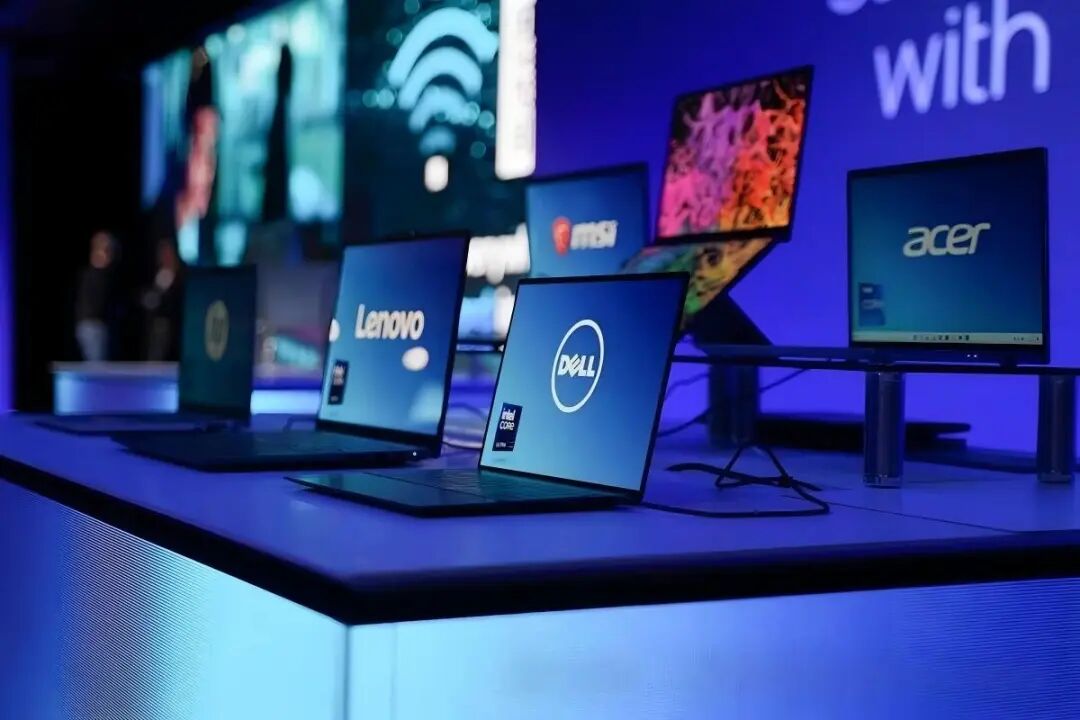

Computer Sales Are Becoming Tougher
Image Source | Internet (Please contact for deletion if there is any infringement. Partially AI-generated)
Over the past two years, AI has undoubtedly emerged as the most talked-about term globally. The pace of large model development has been astonishing, with intelligent agents popping up everywhere, and the demand for computing power soaring.
Logically, as AI becomes more popular, computers—the hardware that supports AI—should see a corresponding boost.
But the reality is quite the opposite.
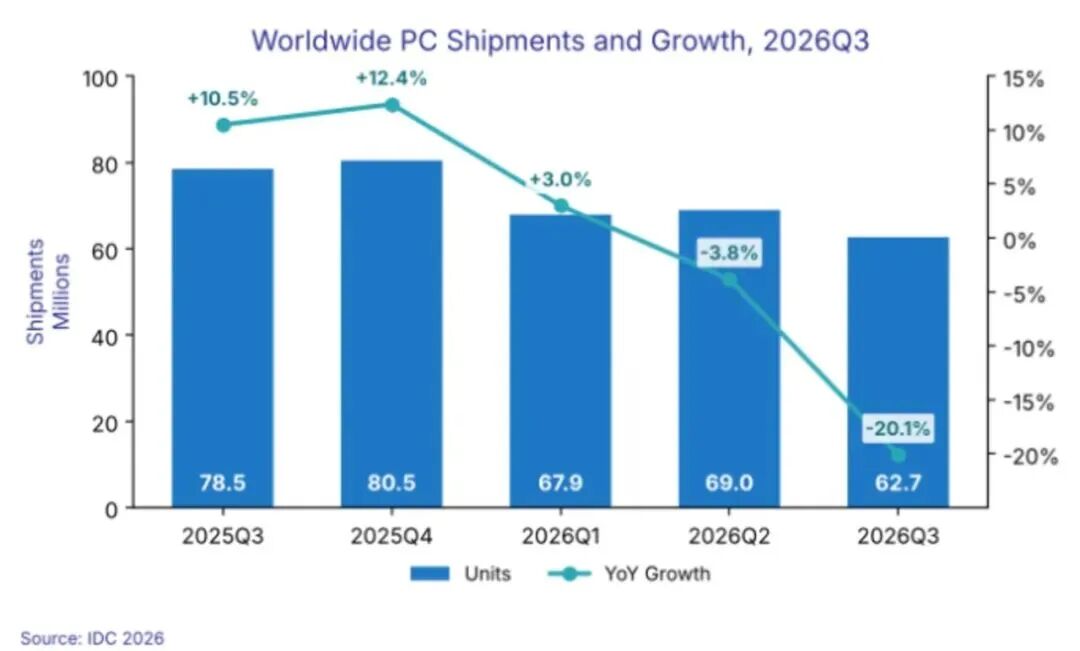
The latest IDC data reveals that global traditional PC shipments in the third quarter of 2026 reached only 62.7 million units, a staggering 20.1% decrease year-on-year.
Just a year earlier, during the same period, shipments stood at 78.5 million units—a significant drop of 15.8 million units in a single year.
What's even more concerning is that this marks the second consecutive quarterly decline, with the drop widening from 4.9% in the second quarter to a full 20%.
The traditional sales boost during the back-to-school season in the third quarter completely failed to materialize this year.
So, what exactly is going on?

Overstocking in the First Half, Paying the Price in the Second Half
Let's rewind the clock by a year. Starting in the second half of 2025, memory chip prices began to rise steadily. PC manufacturers quickly realized that instead of waiting for prices to climb further, they should stockpile early.
So, in the first half of 2026, nearly all mainstream brands went on a buying spree, with Lenovo, HP, and Dell leading the way.
This early stockpiling made the shipment data for the first half look quite impressive—market data showed a 2.5% year-on-year growth in the first quarter.
But the downside was that demand was brought forward. Those who would have bought computers in the third quarter had already seen devices pushed into the market by manufacturers in the first half.
By the third quarter, the market was saturated with inventory, and there was little incentive for retailers to place new orders. The supposed peak season turned into a sluggish period for clearing stock.
In simple terms, the "prosperity" of the first half was borrowed against future sales, and the third quarter was paying back that debt.
This raises a deeper question: Why did memory chip prices surge like this? The answer is clear.
In this boom, AI is clearly taking a bite out of the computer market's share.
The root of this PC cost crisis lies not in the PC industry itself but in the upstream memory chip manufacturing sector.
Samsung, SK Hynix, and Micron—the three giants dominating the global memory market—are shifting more and more capacity to HBM, a high-bandwidth memory designed specifically for AI training and inference. HBM has far higher unit prices and profit margins than traditional DRAM.
HBM uses special packaging processes with much lower unit wafer output efficiency than traditional memory. Shifting to HBM isn't just a production line adjustment but a physical capacity contraction.
To put it in perspective: originally, a plot of land could grow 100 jin of ordinary wheat, but now, growing high-value organic varieties yields only 40 jin—yet the unit price has quintupled.
For memory manufacturers, this calculation makes perfect sense. But for PC manufacturers, the availability of traditional memory shrinks while prices soar.
The numbers speak for themselves. The share of memory chips in PC material costs skyrocketed from 15% in early 2025 to 30%—doubling in just one year.
For mainstream notebooks, DRAM and SSD costs combined once accounted for nearly 68% of material expenses. DRAM contract prices rose by 58-63% quarter-on-quarter in the second quarter of 2026, while NAND flash memory surged even more dramatically at 70-75%.
With costs rising like this, manufacturers had two choices: absorb the costs themselves or pass them on to consumers.
Unsurprisingly, most chose the latter. The result: Lenovo raised prices across its product line by 5-10%, HP increased some models by RMB 300-500, Dell's high-end business notebooks jumped by 20-25%, and Apple's MacBook Pro cost USD 200-400 more than its predecessor.
The problem? Fewer people were willing to pay those prices.

The Smarter Agents Get, the Less You Need a New Computer
This is where things get truly intriguing.
If AI had only made computers more expensive, it would still be just a cost issue. But AI is simultaneously changing how people use computers—and whether they even need a new one.
In early 2026, agent frameworks like OpenClaw suddenly gained widespread popularity. They broke through the "chatbot" mold of large models, becoming "AI digital employees" capable of writing code, coordinating tools across applications, reading files, and completing closed-loop tasks.
This triggered exponential growth in token consumption: China's mainstream large models saw daily token usage surge from 100 billion in early 2024 to 180 trillion by February 2026.
But where is most of this computing power being consumed? Almost entirely in the cloud.
Agents' reasoning, decision-making, and tool invocation run in data centers on cloud-based GPU clusters.
User devices increasingly function as mere "input/output terminals"—you input requests, the cloud returns results, while the truly compute-intensive processes have little to do with your local device.
This creates a subtle psychological shift: when AI does the work primarily through the cloud, why upgrade to a new computer for "stronger local computing power"?
More critically, mobile device computing power is rapidly catching up. Qualcomm has already deployed 30 billion-parameter MoE models on its sixth-generation Snapdragon 8 platform, achieving over 330 tokens/s in pre-filling throughput.
Honor's YOYO agent achieved 91.8% accuracy in comprehensive tasks, supporting over 100 consecutive operations.
CNNIC reports show that 36.1% of netizens now use built-in mobile AI assistants, while 35.5% use mobile AI applications.
When phones can handle emails, generate documents, manage schedules, and even run complex agent tasks, many people are rethinking: Do I really need a new computer?
The data already provides answers. Gartner predicts that by late 2026, rising costs and changing usage habits will extend personal PC replacement cycles by 20%.
In other words, what used to be a three-year replacement cycle now stretches to nearly four years.

The Other Side of PC Manufacturers
At this point, you might wonder: Are PC manufacturers doomed?
Quite the opposite. This may be 2026's most counterintuitive tech industry phenomenon: while PC shipments plummet, leading manufacturers' stock prices and earnings are hitting record highs.
Lenovo's fiscal year 2025/26 revenue reached USD 83.1 billion, up 20.3% year-on-year, with AI-related business doubling year-on-year to account for 38% of revenue.
Dell's AI server revenue surged 757% year-on-year to USD 16.1 billion, with backlog orders hitting a record USD 51.3 billion and full-year AI revenue guidance raised to USD 60 billion.
By the end of May 2026, Lenovo's stock price had risen nearly 160% year-to-date, while Dell's surged over 150%.
Notice something? These companies are still "PC manufacturers," but their biggest profits no longer come from PCs.
The AI-driven computing arms race has made servers and data center businesses the true profit engines.
Dell's ISG infrastructure group revenue soared 181% year-on-year, while Lenovo's infrastructure solutions business achieved record operating profits for the first time.
These numbers are far more impressive than selling a few notebooks.
So, rather than saying "AI is making life hard for PC manufacturers," it's more accurate to say "AI is helping PC manufacturers find more profitable businesses."
PC's weight in their revenue mix is declining, with AI infrastructure becoming the new narrative.

A Silent Reset of Industrial Logic
Connecting the dots reveals clear underlying logic:
AI's explosion created massive computing demand, but nearly all of it is absorbed by data centers.
Memory chip manufacturers prioritize capacity allocation to the more profitable AI server market, forcing the PC industry to absorb cost increases.
Meanwhile, users realize that agents' core capabilities run in the cloud, making their local devices "good enough," while the motivation to upgrade weakens.
PC manufacturers themselves are shifting their strategic focus from selling hardware to selling computing power.
This represents a reset of industrial logic. PCs are transforming from "computing centers" to "interaction terminals," from "must-upgrade productivity tools" to "durable consumer goods that last when good enough."
For ordinary consumers, this isn't necessarily bad news.
Your old computer may be more durable than you think, while most AI conveniences can be enjoyed without buying new hardware.
But for the entire PC industry, the days of regular upgrade cycles every few years may truly be over.
The question now isn't "how to make people buy new computers," but "when computers are no longer a must-have, what will sustain this industry?"
This question is far more serious than a 20% shipment decline.
-
![]()
The Computing Power Price War Hits Silicon Valley
-
![]()
The AI Office Sector is Forming a 'Three-Pillar' Landscape
-
![]()
The 'Proxy War' Ignited by Meta Muse Has Both ByteDance and Tencent on Edge
-
![]()
As AI Heats Up, Computer Sales Face Challenges
-
Explosive News: DeepSeek Poised to Finalize Second Round of Financing Worth 100 Billion!
-
![]()
So, Is It All Due to Incorrect Braking by Some?
-
![]()
From $2.7 Billion to $20 Million: Three Lessons from the 'Funeral' of Character.AI
-
![]()
Geely Auto Insures 183,000 Vehicles in September, with Exports Hitting 107,000 Units