The AI Office Sector is Forming a 'Three-Pillar' Landscape
 10/13 2026
 549
549


Has the Hype Around AI Office Faded?
Image Source | Internet (Please contact us for removal if infringement occurs) Partially AI-generated
In the spring of 2026, the most talked-about topic in the tech circle was 'shrimp farming.'
Geeks from all walks of life flooded social media with their experiences using desktop agents, as an efficiency revolution sparked by OpenClaw swept in.
More than half a year has passed, and the initial 'Warring States era' of fierce competition has come to an end.
Tencent WorkBuddy, Alibaba QianWen Office, and ByteDance Doubao have nearly simultaneously completed organizational consolidation and product integration, centralizing their AI office products under single brands.
In its 'AI Platform Development Research Report' released in September 2026, QuestMobile made a judgment on the AI office sector: the office agent track (literally 'track') is showing signs of a 'three-pillar landscape.'
But while 'three-pillar landscape' is an easy phrase to toss around, the actual situation is far more complex than imagined.

The Real Competition Behind 100 Million Monthly Active Users
No discussion about AI office can avoid a set of data.
As of July 2026, the monthly active user base in the AI efficiency office sector reached 102 million, with approximately 1.387 billion total monthly uses, a year-on-year increase of 112.4%.
More notably, while user frequency doubled, the entry points underwent structural shifts. Monthly active users on native AI office apps grew by 261.1% year-on-year, while PC clients saw a 340.6% increase.
This data sends a clear signal: users are moving AI from 'chatboxes' to 'workstations.' Web-based dialogue solves 'asking a question,' while desktop clients solve 'getting it done.'
The former is curiosity-driven; the latter represents a genuine productivity need.
But 102 million monthly active users only reflect the sector's overall scale. When it comes to individual products, the data discrepancies are staggering.
In August, Tencent claimed WorkBuddy had 20 million MAUs, Alibaba said QianWen Office had 30 million total users, and ByteDance reported 382 million for Doubao. These numbers are incomparable when placed together.
Breaking it down: ByteDance's 382 million represents overall MAUs for the Doubao app, not independent data for Doubao Work; QianWen Office's 30 million came from cumulative new users during its first public test month, including many trial users attracted by bonus points, with actual MAUs in August at just 1.5829 million.
WorkBuddy's 20 million represents cross-platform total MAUs. More critically, it's the only one among the three to disclose paid metrics, with 3,000 to 7,300 enterprise paid customers, approximately 140,000 paid seats, and enterprise paid retention nearing 80%.
Scale is the facade; payment rate is the substance.
While all three are burning money to scale, only one has revealed its substance—a signal worth noting. Of course, it's too early to declare a winner.
The industry still has about 20x growth potential, with approximately 120 million white-collar workers in China and a large pool of potential users yet to be reached.
At this stage, calling it a 'three-pillar landscape' is less accurate than saying the three are building different styles of structures on different foundations.

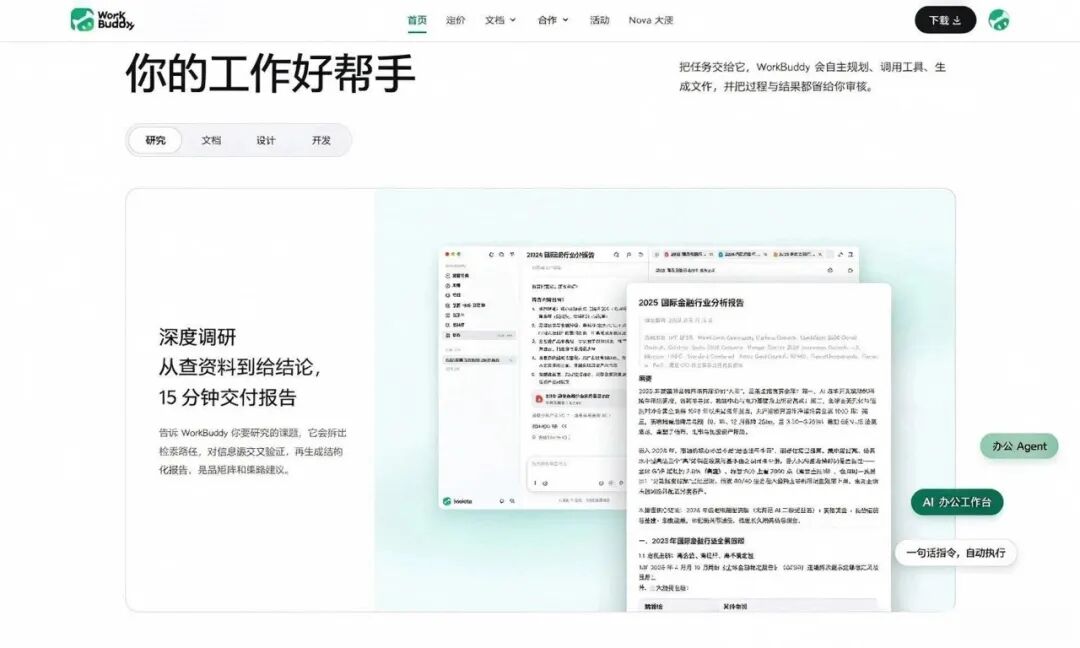
Tencent WorkBuddy: The Early Mover's 'Ecosystem Play'
Tencent was the first to enter this race. On March 9, WorkBuddy launched fully, and on its first day, the team had to expand computing power tenfold due to unexpectedly high user influx. Pony Ma called it 'breakthrough user growth' in his Q2 2026 earnings speech.
How valuable is this first-mover advantage? Data shows WorkBuddy ranked first with 20.97 million monthly visits in June, exceeding the sum of the second and third places.
In July, WorkBuddy's PC client had 6.582 million MAUs, with users averaging 19 uses per month—the highest frequency among the three.
The author believes WorkBuddy's core competitiveness (literally 'competitive edge') lies not in technical capability but in Tencent's ecosystem barriers.
Images from WeChat chats can be smoothly dragged into WorkBuddy but not directly into Doubao Work or QianWen Office. This seemingly minor experience difference directly reflects the 'walls' between major companies' ecosystems.
More noteworthy is WorkBuddy's open strategy. On September 2, the WorkBuddy Open Platform officially launched, introducing over 100 initial ecosystem partners, from smart hardware like Rokid, iFLYTEK, and Anker to applications like GF Securities, Weimob, and Beisen, covering over 20 industries including finance, law, healthcare, and education.
This is the first platform in China's AI agent sector to simultaneously connect hardware, applications, and developers across three ecosystem layers. Tencent also released nine co-branded smart hardware products.
In other words, WorkBuddy isn't just building a 'tool to help you work'—it aims to be a foundation layer, enabling other hardware and applications to connect and serve their users with Tencent's agent capabilities.
This logic mirrors WeChat Mini Programs: instead of doing everything itself, it lets others build on its foundation.
But WorkBuddy's weaknesses are also evident. Tests show its capability execution is 'just passing,' focusing less on capability ceilings than lowering usage barriers.
A notable detail: WorkBuddy's human-machine co-writing feature currently supports only Word, Excel, PPT, and MD files. PDFs cannot be directly edited, nor can local files in the knowledge base be AI-edited.
For a product targeting office scenarios, these limitations become apparent in complex workflows.

Alibaba QianWen Office: An Enterprise-Grade 'Deep Dive' Approach
While WorkBuddy competes for personal desktop entry points, Alibaba's QianWen Office takes a different path—directly targeting the enterprise market.
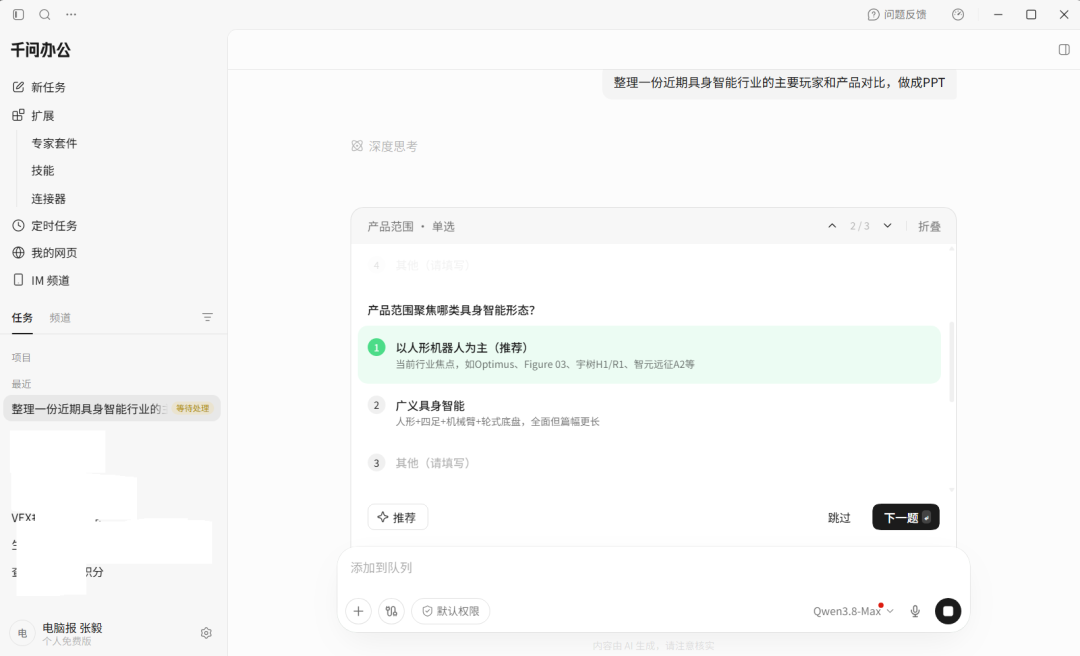
On August 3, QianWen Office officially launched its public beta, integrating three previously separate products—QoderWork, Wukong, and MuleRun—into the industry's first product supporting desktop agents, cloud agents, and enterprise collaboration agents simultaneously.
By September 4, it had over 30 million total users, with enterprise users accounting for more than half, spanning energy, automotive, finance, aerospace, and other industries.
QianWen Office's confidence stems from Alibaba's unique 'four-piece suite': the Qwen model at the top, Alibaba Cloud and BaiLian platform in the middle, and DingTalk's years of accumulated organizational relationships, messages, documents, and workflows at the bottom. This combination allows QianWen Office to penetrate deep into enterprise operations.
Take a concrete example: After Changan Automobile integrated QianWen Office across its 'R&D-Production-Supply-Sales-Service' chain, a 55-year-old logistics packaging administrator taught himself to use QianWen Office, breaking down the packaging review process—which connects hundreds of suppliers nationwide and involves thousands of parts per project—into automated scripts, achieving automatic data capture and delay warnings while reducing workload by over 90%.
This represents more than efficiency gains in dialogue boxes—it's a systemic transformation embedded in business processes.
QianWen Office also shines technically. Its standard mode runs on the Qwen3.8-Flash model, boosting single-task generation speed by ~100% while reducing token consumption by an average of 75%.
In an international benchmark organized by Alibaba Cloud, QianWen Office ranked first overall and was the only agent product to score above 90 in all evaluation dimensions.
However, QianWen Office's weaknesses are equally prominent. In-depth testing reveals 'mediocre, even underwhelming' performance. For example, in marketing scenarios, its competitor analysis webpages lacked depth, with minimal industry-wide analysis. In creative video production, outputs resembled 'dynamic posters' with obvious template traces.
Its desktop experience for individual users still lags behind WorkBuddy and Doubao Work.
Alibaba's issue isn't technical capability but strategic priority. QianWen Office targets enterprises, not individuals.
This path's commercial value is undeniable—after all, DingTalk's 2025 revenue exceeded 4 billion yuan, with enterprise customers showing far higher payment willingness and stickiness than individual users.
But enterprise markets require long expansion cycles and heavy customization, meaning QianWen Office will struggle to match rivals in user scale short-term but may surpass them in revenue quality later.

ByteDance Doubao Work: The Traffic Giant's 'Multimodal' Breakthrough
ByteDance entered latest but acted most urgently.
On July 30, ByteDance launched a major reorganization, merging the Feishu and Doubao product teams into a new Doubao product team. On August 25, Doubao Work officially launched.
On September 15, ByteDance CEO Liang Rubo made a rare appearance at Feishu's annual conference to publicly endorse Doubao Work. From reorganization to product launch to CEO endorsement, the entire process took less than two months—unprecedentedly fast in ByteDance's history.
Doubao Work's core advantages lie in two areas: the massive traffic base of the Doubao app itself and its deep integration with Feishu.
Doubao App already penetrates nearly 50% of business office users, with nearly 290 million users and significantly higher per-capita usage frequency and duration than the market average—an Innate advantage (literally 'inborn advantage') the other two lack.
In testing, Doubao Work's multimodal capabilities impress. For marketing competitor analysis, it automatically invoked multi-agent parallel processing, having sub-agents investigate separately before delivering both web and Feishu Document versions, using charts to compare key data and timelines to track competitor dynamics—the most intuitive presentation among the three.
When tasks extended to video production, Doubao Work proactively invoked a dedicated video generation model, creating a 15-second teaser video with a complete storyline, camera movements, background music, and narration—qualitatively superior to the other two.
However, Doubao Work faces significant concerns. Early paid users reported numerous issues: quotas depleted too quickly ('the so-called 5x free version ran out in a day'), poor instruction understanding in office task modes (messy layouts for tasks like calligraphy practice sheets), and persistent AI hallucination problems (factual errors in complex industry research analyses, inaccurate image analysis).
A notable detail: During voice meeting recordings, Doubao Work repeatedly inserted keyword ads mid-recording, sparking strong user backlash against commercialization disrupting experience.
For an office tool, users demand far higher 'reliability' than entertainment products—any error could cause actual work damage.

Nevertheless, given the current state of AI office, all three giants face the same core challenge.
QuestMobile data shows that while AI office sector MAUs exceed 100 million, personal efficiency gains haven't directly translated into organizational productivity growth.
The CEO of QianWen Office mentioned a phenomenon at the Yunqi Conference: an employee proficient in AI might compress 8 hours of work into 30 minutes, but organizations lack both incentive mechanisms for rapid experience sharing and product features to absorb these efficiencies.
This creates a strange paradox: efficiency remains at the individual level—some people work faster, but teams don't.
This precisely represents the most critical disconnect in AI office's evolution from 'personal efficiency' to 'organizational efficiency.' As the Feishu CEO put it: When textile mills in 1890 replaced steam engines with electric motors, productivity didn't immediately change. Only after redesigning production lines for electricity two decades later did efficiency truly rise.
Today's enterprises are also going through a similar phase. Integrating large models into office software is just the first step; redesigning task allocation and knowledge flow mechanisms represents a much larger endeavor.
At least from the current perspective, a “tripartite balance” pattern in the AI office sector has begun to take shape.
However, much like the “three major portals” of early internet portal websites, today's landscape may not be the same tomorrow.
What truly determines the outcome is not whose technology is stronger or whose traffic is greater, but more importantly, who can make users genuinely willing to entrust their workflows to AI.
This requires not only product capabilities but also a profound understanding of users' work methods, as well as the confidence that users will still trust AI when it makes mistakes.
After all, when it comes to office work, the margin for error is too low.
-
![]()
Has the Brake Pedal of JAC Motors Really Broken? The Market Will Teach Every Automaker with 'Fatal Flaws' a Lesson
-
![]()
Changsha’s Emerging Powerhouse in Computing: Cancels RMB 3 Billion Contract!
-
![]()
Production Capacity Can’t Keep Up with Orders! This Optical Enterprise Soars 449% on Debut
-
![]()
Q3 Report | Yuanjie Technology's Net Profit Expected to Surge Fivefold, Transitioning from 'Shortage Dividends' to 'Delivery Challenges'
-
![]()
The Computing Power Price War Hits Silicon Valley
-
![]()
The AI Office Sector is Forming a 'Three-Pillar' Landscape
-
![]()
The 'Proxy War' Ignited by Meta Muse Has Both ByteDance and Tencent on Edge
-
![]()
As AI Heats Up, Computer Sales Face Challenges