Lenovo Outpaces Apple in Both Shipments and Revenue: Lenovo's PCs and Tablets Gain Ground Through AI—What Lies Ahead?
 11/19 2026
 408
Sales volume declined, yet revenue climbed.
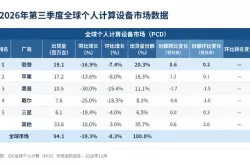
Recently, market research firm IDC released market data for global personal computing devices (PCD) in Q3 2026. Under IDC's definition, personal computing devices encompass desktop computers, laptops, workstations, and tablets—essentially, PCs plus tablets.
Strikingly, Lenovo ranked first in both shipments and sales, ahead of brands such as Apple. Moreover, contrary to Leitech's (ID:leitech) established impression, overall shipments in the PC and tablet market have been declining, yet Lenovo has now achieved counter-trend revenue growth. This shift is clearly tied to the pronounced AI trend in PCs and tablets.
Shipments Are Falling, Revenue Is Rising
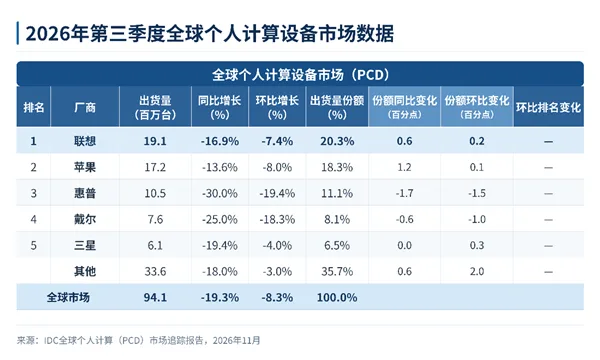
Let's first examine IDC's PCD shipment data. The top five brands in Q3 were Lenovo, Apple, HP, Dell, and Samsung, with shipments of 19.1 million, 17.2 million, 10.5 million, 7.6 million, and 6.1 million units, respectively.
Total market shipments reached 94.1 million units, down 19.3% year over year. All top five brands saw shipment declines, although Lenovo and Apple still held market shares of around 20%, maintaining an edge over other brands. Clearly, the PC and tablet industry is generally weak in market performance, and even leading brands cannot escape the downturn.
(Image source: IDC)
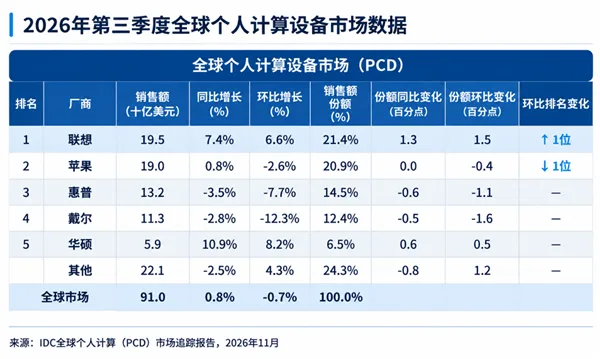
Turning to revenue data, the top five brands in Q3 were Lenovo, Apple, HP, Dell, and Asus, with sales of 19.5 billion, 19 billion, 13.2 billion, 11.3 billion, and 5.9 billion U.S. dollars, respectively.
Notably, the global PCD market's overall revenue in Q3 reached 91 billion U.S. dollars, up slightly by 0.8% year over year. Among the top five brands, Lenovo, Apple, and Asus all achieved revenue growth. In terms of market share, both Lenovo and Apple exceeded 20%, capturing the largest share of revenue in the entire market.
(Image source: IDC)
The most direct factor behind declining sales but rising revenue is that unit prices of PCs and tablets have increased. The reasons are not hard to grasp. On the one hand, rising storage prices have clearly affected the pricing of PCs and tablets, pushing their prices higher. On the other hand, storage pressure has led manufacturers to focus on high-end products, reducing low-end entry-level offerings and increasing the share of sales from high-priced devices.
Judging from the current market situation, the volume-driven approach in the PC and tablet market is already difficult to sustain. How to persuade consumers to pay for higher-priced devices and maintain revenue and profit is something manufacturers need to focus on. To sustain high product premiums, playing the "victim card" over rising storage prices is clearly not enough. In today's AI wave, enhancing the AI attributes of products has become key to building competitiveness for PCs and tablets.
Everyone Is Betting on AI, but Lenovo and Apple Have Taken Different Paths
Whether for PCs or tablets, AI integration is the major trend today, but actual implementation plans differ among brands.
For Lenovo, its implementation plan for AI on hardware devices is "one agent, multiple devices," meaning one AI agent and multiple terminals. The user's agent is bound to their personal account, but to ensure data security, the user's personal knowledge base is stored locally. If the user changes devices, Lenovo provides an "AI device migration" function to transfer local AI data.
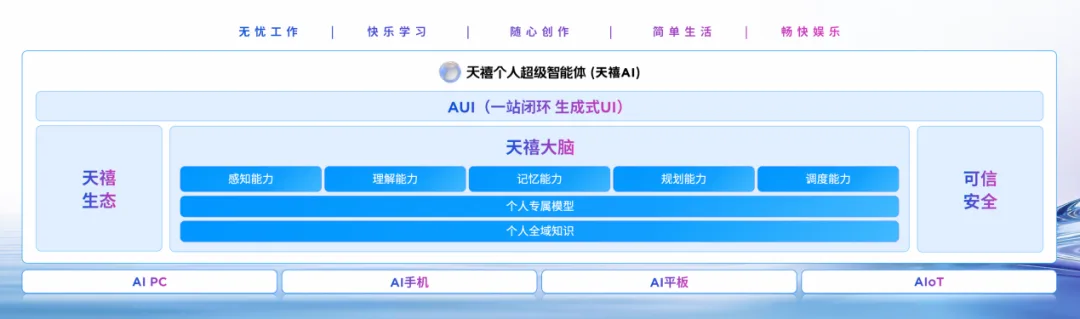
At present, Lenovo's main offering on devices in China is the Tianxi personal super agent, which adopts an end-cloud hybrid architecture and a cross-device personal knowledge base, and can call data accumulated by users on PCs, tablets, phones, and other devices. In overseas markets, Lenovo has also launched Lenovo Qira, positioned similarly as a cross-device personal super agent.
At the underlying hardware level, Lenovo's AI devices adopt a heterogeneous computing solution, fully utilizing the performance and computing power of the CPU, GPU, and NPU. Among them, the CPU is responsible for global scheduling, especially for agent tasks involving cross-software calls; the NPU uses its own computing power for low-power AI inference; and the GPU handles high-load content generation. On the software side, Lenovo's hardware devices are equipped with various AI applications, including the system-level agent Lenovo Xiaotian, which can provide AI office assistance functions similar to WorkBuddy.
(Image source: Lenovo)
According to data disclosed by Lenovo itself, AI has boosted shipments of its PCs. In Q2 2025, Lenovo AI PCs already accounted for more than 30% of its total personal computer shipments. In Q3 this year, Lenovo AI PCs reached a 25% global market share, ranking first. In the domestic market, AI PCs account for more than 50% of Lenovo's notebook sales. In addition, AI has also had a positive impact on Lenovo's tablet sales. In the domestic tablet market in Q3, Lenovo ranked third in shipments, and sales also grew.
By comparison, Apple's approach is still relatively preliminary. First, Apple has not created a targeted AI solution for devices such as PCs and tablets; they basically use the same Apple Intelligence framework and features as the iPhone. Second, the implementation of Apple Intelligence itself has been bumpy, and Apple AI in China only recently entered the testing phase.
Apple's hardware AI solution is also generally end-cloud integrated: on-device models handle simple tasks without uploading data; complex tasks rely on external support, based on GPT cloud models in overseas markets and through Alibaba Qwen in the mainland market. For core productivity scenarios on devices such as Mac and iPad, Apple AI can still do relatively little. Functions such as photo editing, document polishing, and visual recognition appear to be available, but actual performance still lags behind other brands.
Of course, when it comes to Mac products specifically, Apple has still benefited from the AI boom. Based on Q3 data this year, Mac brought Apple more than 10 billion U.S. dollars in revenue, up 29% year over year.
Mac's ability to ride the AI wave mainly stems from its hardware architecture and system, which are naturally suited to running agent tools and some locally deployed models. Most AI users buy Macs not because they value Apple's AI solution, but because of the higher cost-performance and stability of local computing power. By comparison, iPad saw declines in both revenue and sales in Q3, and Apple's own AI features are not very attractive.
Why Have the AI Paths of PCs and Tablets Also Diverged?
With the further development of AI technology, the AI paths of PCs and tablets will also diverge more clearly, since their product forms, usage scenarios, and computing power characteristics are all different. To support more complex AI and agent capabilities, the hardware ecosystem at the underlying level, including CPUs, GPUs, and storage, is changing.
From the perspective of computing power, heterogeneous computing has basically become a consensus, and all hardware resources involved in AI operation will be fully utilized. Future AI PCs will rely more on refined allocation of computing power: CPUs will handle global scheduling of system-level agents and cross-software coordination; GPUs will provide high-load computing power for local large models and complex image and video generation; and NPUs will become low-power AI engines for real-time online device functions, handling background tasks such as knowledge base updates and screen visual perception.
Of course, the local computing power of most consumer devices still cannot support large-parameter models, so end-cloud integration will remain mainstream. When ordinary users use various agent tools for office work and productivity tasks, they will still need cloud computing power.
(Image source: Leitech)
Storage is also key to determining the AI experience. The core reason for the continued rise in storage prices this year is the massive data processing demand brought by the AI boom. To smoothly run large models locally and build a cross-device personal knowledge base, large-capacity memory is essential. At the same time, high-frequency AI prompt caching and vector database retrieval also place higher demands on the random access speed of solid-state drives.
On such a hardware foundation, the AI evolution paths of PCs and tablets will show clear differences:
For PCs, the core direction in the future is heavy productivity and automation. Thanks to the stronger computing power and performance support of PC chips, PC-side agents will obtain higher system permissions and be able to operate directly across applications like humans, for example automatically scraping web data, deeply analyzing long financial reports and generating charts, and taking over part of workflow processing, becoming true digital employees.
Tablets, by contrast, will focus on light AI scenarios. Limited by size and power consumption, the local computing power of tablets ultimately cannot compare with PCs, so they will focus more on lightweight, high-frequency AI functions such as real-time subtitles, meeting recording transcription, and document summarization.
At the same time, as part of each brand's own hardware ecosystem, tablets can "borrow" computing power from other devices through multi-device collaboration, for example handing off heavy AI generation tasks to a PC under the same account. In this case, tablets can become an entry point in the AI interaction system.
Overall, Lenovo's ability to achieve revenue growth in the weak PC and tablet market in Q3 and secure a relatively high AI PC share is precisely because it laid out a complete AI implementation plan earlier and handled AI interconnection between devices well.
In the future hardware market, manufacturers will no longer be selling just a set of configurations and specifications; they will need to provide AI implementation capabilities. Whoever does this well will gain more initiative in the next device replacement cycle.
Source: Leitech
Images in this article are from: 123RF licensed image library Source: Leitech
-
![]()
Why Did LG Sell 2 Million Clothes Care Machines in 15 Years? Where Do Chinese Brands Fall Short?
-
![]()
Lenovo Outpaces Apple in Both Shipments and Revenue: Lenovo's PCs and Tablets Gain Ground Through AI—What Lies Ahead?
-
![]()
At the APEC Meeting in Shenzhen, Wang Chuanfu, Lei Jun, Zeng Yuqun, and Li Yanhong Discuss the Future of Automotive Mobility
-
![]()
Tencent Sues PowerChina Huadong: 73 Court Hearings in a Single Year—Why Is the 45.4 Billion Yuan General Contracting Champion Sitting in the Defendant's Seat?
-
Gathering in Shenzhen: What Chinese Solutions Do Entrepreneurs Bring to the APEC Business Summit?
-
![]()
Chicago School District Takes on Google: Bundled AI Is Worse Than No AI at All
-
The Data Annotation Business Behind AI Music
-
![]()
Qwen, Tencent Hunyuan, and Kimi Tie for First Place in the Latest Chinese Large Model Rankings