Revenue Soars, Stock Price Halved! How Did Lenovo Get Here?
 11/24 2026
 511
A book loss of US$640 million, an adjusted profit of US$9.1 billion: Lenovo's jarring financial report has left the market scratching its head. At midday on November 19, Lenovo released two sets of numbers: record revenue of US$30.238 billion, and a net loss attributable to shareholders of US$640 million.
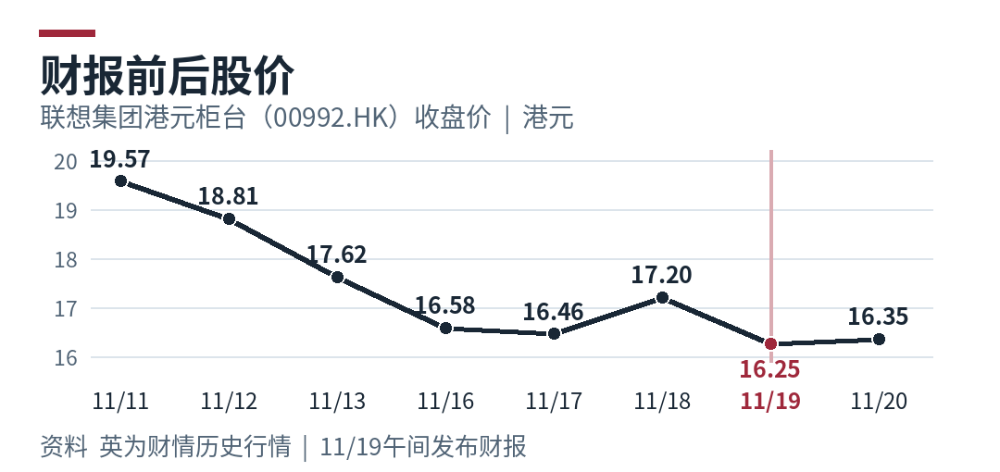
In the afternoon, the stock price hit an intraday low of HK$14.92 before closing at HK$16.25, down 5.52%. From November 12 to 17, Lenovo's Hong Kong-listed shares fell for four consecutive trading days, accumulating a decline of roughly 16%.
They rebounded on the 18th, fell again on the 19th when results were released, and edged up 0.62% on the 20th to close at HK$16.35. The rebound recovered only a sliver of the previous day's losses.
The broader market was also falling on the 19th, with the Hang Seng Index down 1.95% and the Hang Seng Tech Index down 2.33%. Lenovo fell more sharply, with trading volume of about 254 million shares, 2.4 times that of the previous trading day. The index set the backdrop for the day, but Lenovo's own story has to be found in its financial report.
Measured against the year's high on September 18, the drawdown exceeds 60%. A financial report that Goldman Sachs called "broadly beating expectations" was met with a nearly vertical bearish candlestick on the chart.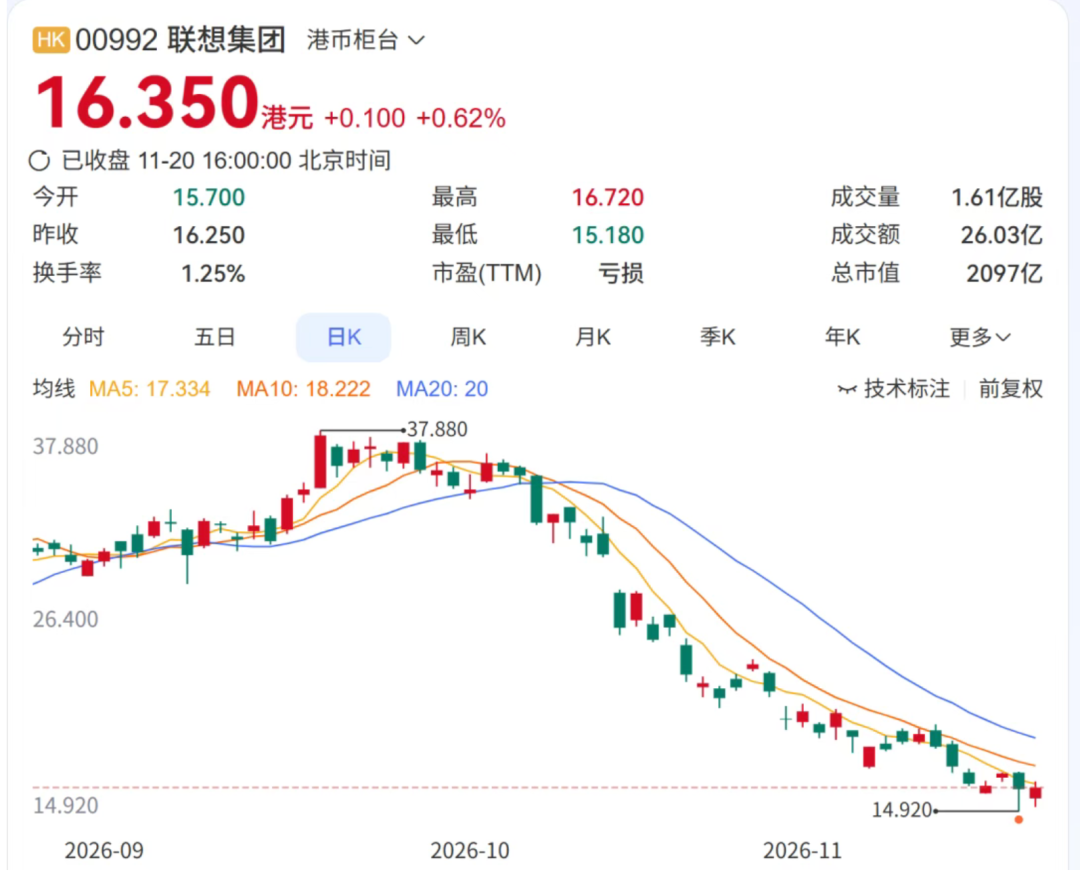

Warrants Weigh on Profit
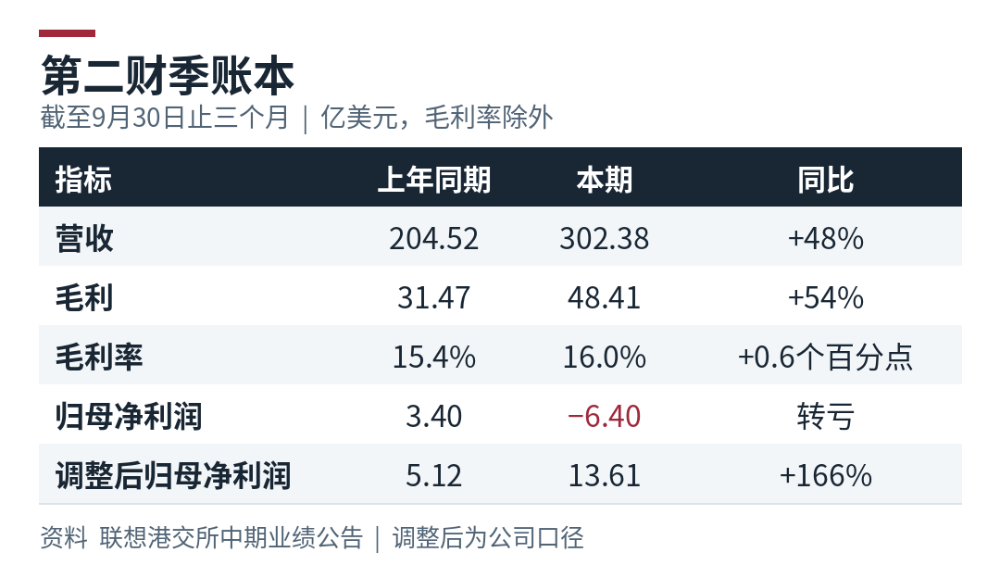
What was announced this time is Lenovo's FY2026/27 interim report, covering the second fiscal quarter ended September 30. In this quarter, Lenovo booked US$30.238 billion in revenue, up 48% year-on-year.
The revenue estimate from six analysts cited by Reuters was US$27.6 billion, so the actual figure came in more than US$2.6 billion higher. In the same report, net profit attributable to shareholders swung from US$340 million in the prior-year period to a loss of US$640 million.
On Lenovo's disclosed adjusted basis, net profit attributable to shareholders for this quarter was US$1.361 billion, US$849 million more than the same period last year. The two sets of numbers differ sharply; the first thing to examine is the warrants.
Warrants give holders the right to buy shares under agreed conditions. Lenovo must periodically value this financial liability, with changes recorded in profit or loss. This quarter, revaluation produced a loss of US$1.906 billion, totaling US$3.596 billion for the half-year.
This revaluation itself does not involve a cash outflow of the same magnitude. Adjusted profit excludes items such as warrant revaluation and notional interest on convertible bonds, making it easier to compare operating performance.
As for how much return existing shareholders can actually receive, that also depends on changes in share capital. Quarterly adjusted basic earnings per share were 11.00 US cents, or 8.59 US cents on a diluted basis. Setting this revaluation aside, look at how much was earned from selling goods.
Quarterly gross margin rose from 15.4% to 16.0%, with gross profit up 54%. During the same period, operating expenses excluding warrant revaluation and other non-cash items rose only 22%. After deducting the added expenses from the gross profit increment, adjusted operating profit was pushed higher.
Extending to the half-year, Lenovo's revenue was US$57.180 billion, up 46% year-on-year, with gross margin rising to 16.3%, 1.2 percentage points higher than the same period last year. The announcement mainly attributed the half-year gross margin improvement to the recovery in infrastructure profitability. Servers are already redrawing the group's profit map.
Servers Take the Lead
Lenovo's largest revenue segment remains smart devices. ThinkPad, ThinkBook and Legion computers, plus tablets and Motorola phones, occupy the procurement lists of consumers and enterprises alike.
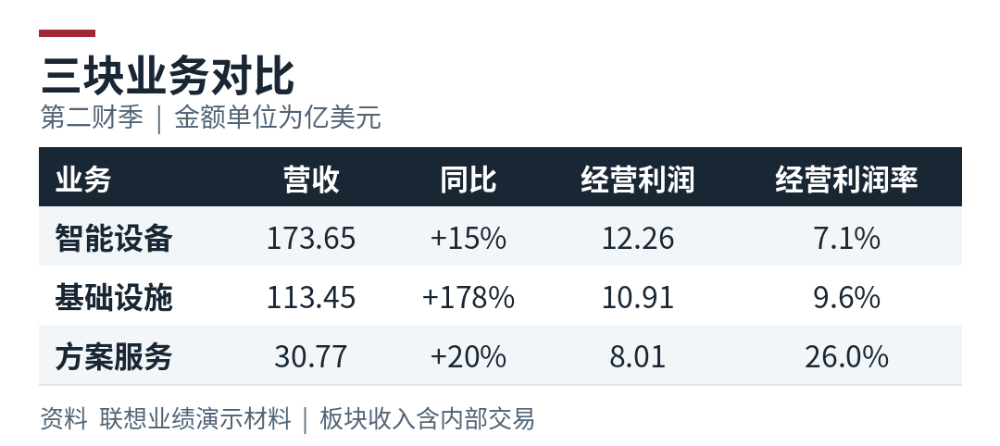
This segment makes money through procurement scale, product pricing and channel turnover. Smart devices revenue this quarter was US$17.365 billion, with operating profit of US$1.226 billion. The company offset volume pressure by raising average selling prices, with high-end PCs already accounting for 63% of its PC shipments.
However, the device profit margin slipped from 7.3% to 7.1%. Price increases protected revenue, but margin pressure remains. The fastest-growing segment is infrastructure. This division grew quarterly revenue from US$4.087 billion to US$11.345 billion in a single year.
Operating profit turned from a loss of US$32 million to a profit of US$1.091 billion, with margin rising to 9.6%. How long it can stay at this level depends on the coming quarters.
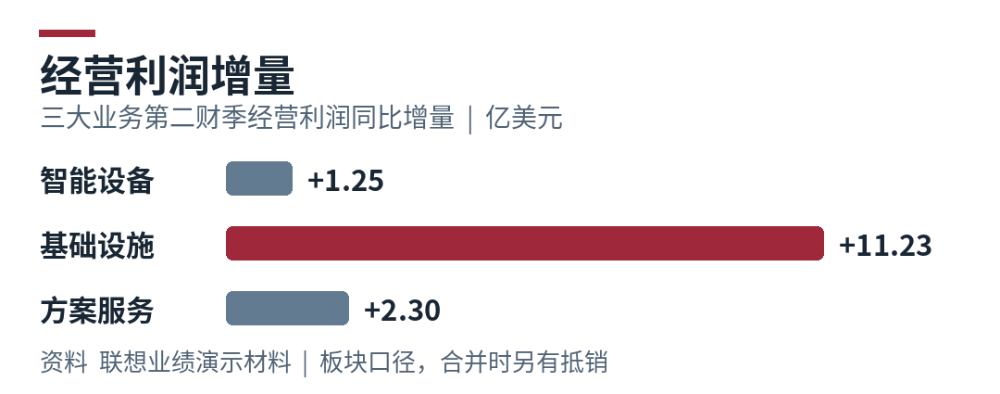
 Looking at the operating profit of each of the three business segments, infrastructure and services combined rose from about one-third in the same period last year to about 60% this quarter. These ratios are calculated based on the sum of profits from the three businesses; the group report also includes expenses and eliminations.
Server orders and computer sales orders are difficult in different ways. ThinkSystem servers, storage and Neptune liquid cooling can go into the server room together.
A complete delivery carries a higher price tag, and upstream component arrival, on-site installation and acceptance all need to be coordinated within the same project. The services division earns a different kind of money.
Device deployment and transformation can be charged per project, ongoing operations and maintenance have their own service contracts, and TruScale also offers usage-based payment plans. Services revenue this quarter was US$3.077 billion, with an operating margin of 26%, significantly higher than the other two segments. That 26% deserves closer scrutiny.
Lenovo disclosed that operations and maintenance plus project solutions together account for 63% of services revenue. Operations and maintenance can generate recurring revenue, while project revenue follows deliveries. Lumping both into the same number makes it difficult for investors to judge how much can still be earned from the same group of customers next year.
Big Orders Still Need Collecting
Lenovo disclosed quarterly AI-related revenue of approximately US$10.8 billion, up 79% year-on-year, accounting for 36% of group revenue. It includes computers and phones with neural network processors, servers equipped with GPUs, and AI services together.
Using this number to measure server revenue would inflate the scope. Even easier to misread is the US$80 billion figure. The company's English materials say pipeline, referring to potential business opportunities, up 48% from the previous quarter. The Chinese announcement calls it order backlog.
For the sales department, this is business being pursued. For shareholders, contracts, deliveries and collections must still be awaited one by one. AI server revenue grew more than 300% this quarter. As this business expands, Lenovo first has to put up funds to stock inventory.
Large projects require advance orders, GPUs and memory have delivery cycles, and customer acceptance also takes time. The moment equipment is delivered, the money may not yet have returned to Lenovo's accounts. At the end of September, Lenovo's inventory was US$20.591 billion, about 76% more than at the end of March.
During the same period, trade receivables, lease receivables and notes receivable totaled US$19.862 billion, up about 37%. Looking at cash flow, half-year net cash inflow from operating activities was US$1.990 billion, lower than US$2.762 billion in the same period last year.
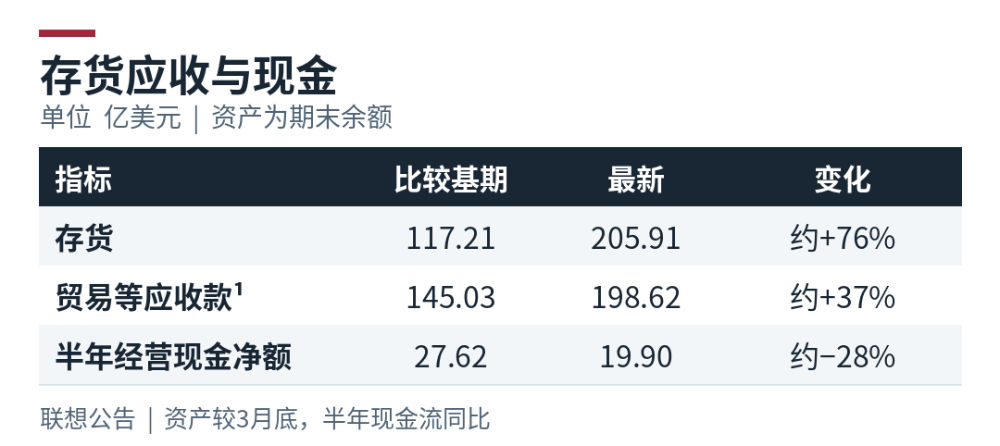 Including trade receivables, lease receivables and notes
Operating cash flow disclosed for the single quarter was about US$1.6 billion, and free cash flow about US$1.2 billion. The latest quarter has already improved. Half-year cash flow is still lower than the same period last year.
Using one quarter to judge the quality of deliveries and collections makes it easy to mistake quarter-end changes for a long-term trend. There is also a sum of money that is easy to miss. Within the half-year, Lenovo's provision for credit losses on trade receivables, net of reversals, increased by US$175 million, compared with about US$24 million in the same period last year.
The company said some related receivables are covered by credit insurance. Inventory stocking speed and customer payment quality need to be examined together. Lenovo has disclosed that it introduced third-party financial institutions to support customer financing and prudently sets payment terms for non-investment-grade customers.
Looking ahead, whether customer prepayments can cover upfront procurement and how much capital extended payment terms will consume determine how much cash can be retained from the same amount of sales. The stock price falling when revenue beats expectations can have multiple explanations.
My personal judgment is that record revenue is already in plain sight, but what investors find harder to estimate is how much more can be delivered, how much profit can be retained and how much money can be collected in the coming quarters. These three numbers determine whether the current quarter's high growth has staying power.
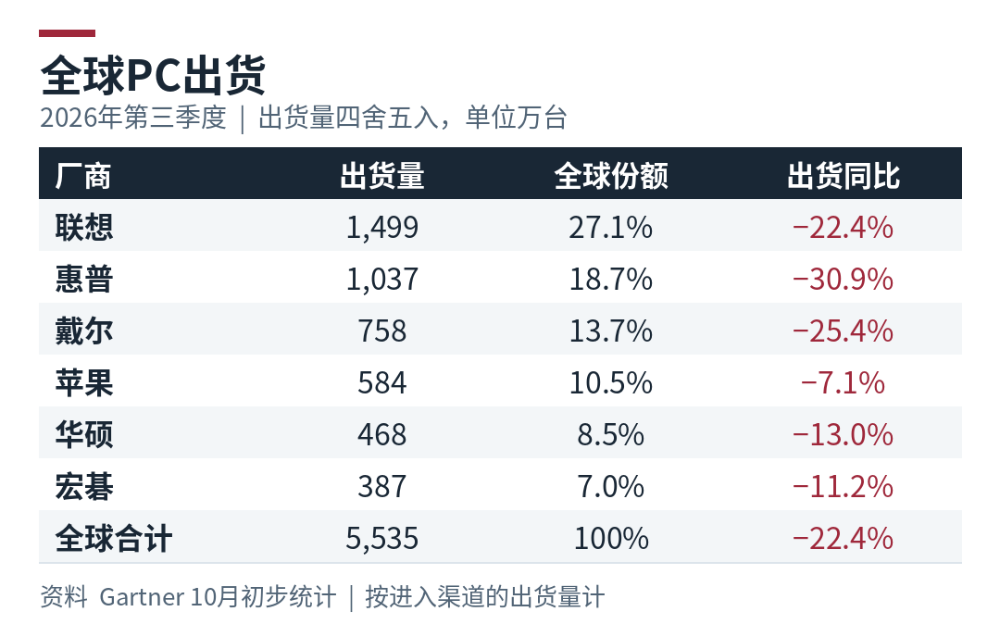
Computers and Server Rooms Gartner's preliminary statistics show that global PC shipments in the third quarter of 2026 were about 55.35 million units, down 22.4% year-on-year.
Lenovo shipped about 14.99 million units, also down 22.4%, with its share maintained at 27.1%.
HP and Dell still ranked second and third, while Apple had the smallest decline among the top six.
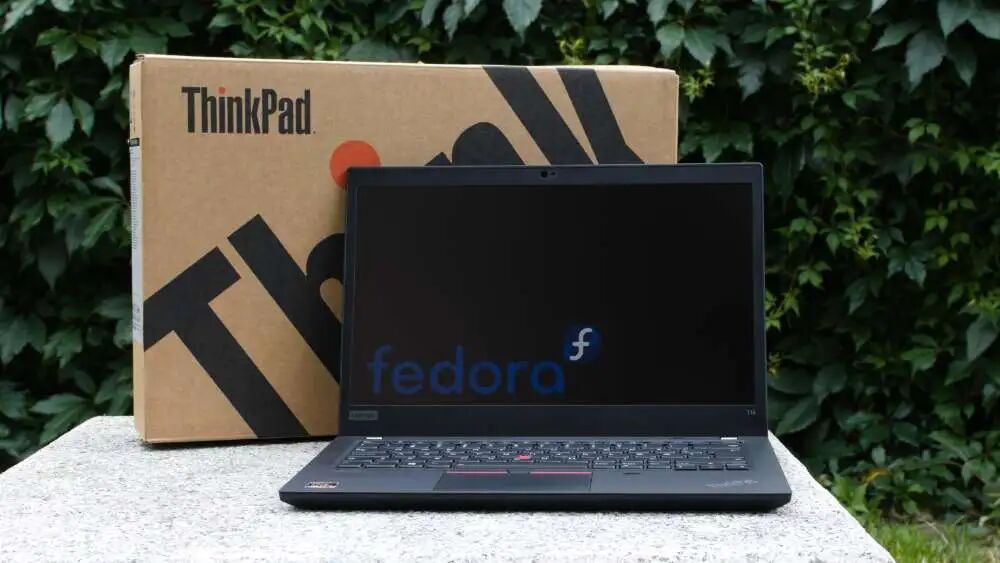
ThinkPad T14 historical product image | Daniel Aleksandersen · CC BY-SA 2.0
These figures count the number of computers manufacturers ship to channels, which is different from Lenovo's smart devices financial revenue. In the commercial market, HP and Dell are direct competitors. In the high-end consumer market, Apple and ASUS are also in the mix.
On the phone side, Motorola also has to compete for users of brands such as Samsung and Xiaomi. When memory and storage prices rise, large manufacturers can stabilize supply through procurement scale, but at the retail end, customers may postpone device upgrades.
High-end devices can sell for several hundred yuan more, but may also mean selling fewer machines. Lenovo's PC share advantage must be proven through successive upgrade cycles to translate into profit. In the server room, Dell puts servers, storage and services into the same procurement list.
Hewlett Packard Enterprise is working on enterprise private AI, and Super Micro is promoting liquid-cooled rack-scale systems. Lenovo can deliver equipment to various locations, but it also needs to show convincing results in deployment speed, server room energy consumption and subsequent maintenance.
Dell separately discloses new AI server orders, recognized revenue and backlog in its financial reports.
This approach is worth Lenovo's reference. Only by presenting potential market projects, confirmed contracts and current-period revenue separately can readers see how far growth has been realized.

First, Do the Cash Math
The next thing Lenovo should change is how it takes orders. PCs rely on scale and turnover, while the data center business must first get the cash math clear.
For large projects, negotiate delivery schedules and prices together, and also put prepayments, acceptance, and payment terms on the table. The bigger the deal, the more valuable the funding terms. The revenue structure can also move one step further.
After servers are sold, customers still need capacity expansion, storage management, and operations and maintenance. Only by incorporating these needs into the initial proposal can hardware sales have a chance to connect with follow-up services. Renewal rates and customers' additional purchases will say more about customers' willingness to renew than the name of the solution.
This quarter Lenovo proved it can earn operating profit from servers. Next quarter I will first check three things: how much of the goods on hand were delivered, how much money was collected from customers, and how much O&M was renewed. The ability to sell goods is already written into the income statement, but the money collected still has to show up in cash flow.
Servers are not PCs, and AI infrastructure is not consumer electronics. The valuation logic of this track does not reward "No. 1 in shipments"; it only rewards "how much profit can be retained from every dollar of revenue."
The stock has tumbled 60%, and sentiment has largely been flushed out. How much ground it can recover from here hinges on whether ISG's operating margin can keep climbing beyond 9.6%, and on how many quarters it will take Lenovo to close in on Dell's 15% benchmark.
Time will indeed prove some things.
But before time delivers its verdict, the market first needs to see expectations, confidence, and hard evidence.
What's your take on this hot topic? We welcome your thoughtful and civil comments in the message section below.
Disclaimer: This article offers a professional analysis of trending financial topics only. The data and materials cited are drawn from public sources, company announcements, and Tonghuashun iFinD. The views expressed are for reference only and do not constitute any investment or consumption advice.
#FinancialHotTopics #InDepthInterpretation #BusinessFinance #InvestmentBankingCircle #ListedCompanies #PrimaryMarket #YangYuanqingMocksMusk #AI #LenovoHoldings #YangYuanqing
Thank you for reading. If you found this valuable, please feel free to hit "Wow".
-
![]()
AI Hasn't Taken Over Yet, Games Are Still Carrying NetEase — Is Ding Lei Shifting the Blame to Short Dramas?
-
Sales Up 78.3%, Net Profit Down 73.3%: Leapmotor Can't Escape the "Gravity of Low Prices"
-
![]()
Revenue Soars, Stock Price Halved! How Did Lenovo Get Here?
-
![]()
Apple Intelligence Launches Before "Dawn": Huawei Races to Release New AI Phone Brand "Starlight"
-
![]()
Chongqing Post-80s Entrepreneur Makes a Fortune with AI Short Dramas: Rakes in 1.4 Billion Yuan in Nine Months
-
![]()
10 Million Smell Tags Feed an AI Nose, Perfume Companies Place Orders First
-
![]()
Major Automotive Stamping Player's Run of Strong Growth Comes to an End
-
![]()
Anthropic Pulls Off the Largest IPO in History at $81.3 Billion