Major Automotive Stamping Player's Run of Strong Growth Comes to an End
 11/24 2026
 507
Hit "Short, Quick Commentary" to follow us. For tips, please @ the editor.
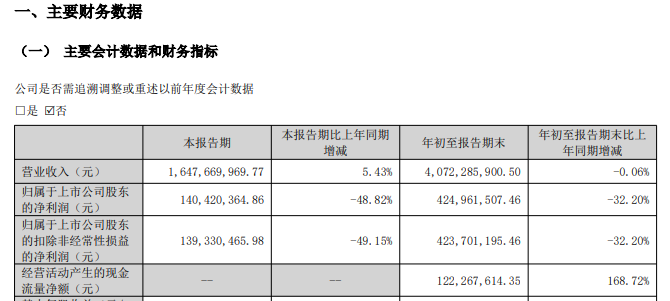
As a major player in domestic automotive stamping, Bojun Technology has grown rapidly in recent years, with performance gains far outpacing many of its peers. That momentum, however, did not carry over into 2026. In the first three quarters, the company posted operating revenue and net profit attributable to the parent company of RMB 4.072 billion and RMB 425 million, respectively—down 0.06% and 32.2% year on year. Whether it can recover over the full year remains to be seen.
Although Bojun Technology's growth has been relatively brisk in recent years, its operating quality leaves something to be desired. Operating cash flow has fluctuated sharply, the debt-to-asset ratio has generally trended upward, and interest-bearing debt is not insignificant. Improving operating quality and reducing leverage need to be put on the agenda.

Automotive Production and Sales Both Fall; Performance Turns Down
Performance turned down in the first three quarters. From 2021 to 2025, Bojun Technology grew rapidly, posting operating revenue of RMB 806 million, RMB 1.391 billion, RMB 2.6 billion, RMB 4.227 billion, and RMB 5.808 billion, respectively—a compound annual growth rate of roughly 64%. Net profit attributable to the parent company came in at RMB 84 million, RMB 148 million, RMB 309 million, RMB 613 million, and RMB 844 million, respectively—a CAGR of about 78%.
Entering 2026, the company failed to sustain that high-growth momentum. In the first three quarters, it achieved operating revenue and net profit attributable to the parent company of RMB 4.072 billion and RMB 425 million, respectively, down 0.06% and 32.2% year on year. A closer look shows that quarterly revenue improved over the course of the year, at RMB 1.008 billion, RMB 1.417 billion, and RMB 1.648 billion, respectively; Q1 fell 8.34% year on year, while the other two quarters grew 0.32% and 5.43%, respectively. Net profit attributable to the parent company, however, saw its decline widen, at RMB 129 million, RMB 155 million, and RMB 144 million, respectively—down sharply by 13.37%, 23.6%, and 48.82% year on year.
Stamping Business Revenue Turns Down
Bojun Technology is principally engaged in the R&D, design, production, and sale of automotive precision components and precision molds. Stamping is its core business, covering precision component products for Tier 1 automotive suppliers (including frame-type, transmission-type, and other products), body modular products for vehicle manufacturers, and the corresponding production molds.
The automotive stamping market offers ample room but is highly fragmented—a fully competitive industry with a domestic market size of approximately RMB 300 billion. As a major player in automotive stamping, Bojun Technology holds a relatively modest market share (based on RMB 2.3 billion in revenue from this business in 2023, its share is roughly 0.8%), yet it has grown rapidly, far outpacing many peers.
From 2023 to 2025, the stamping business generated revenue of RMB 2.319 billion, RMB 3.86 billion, and RMB 5.254 billion, respectively—up 102.37%, 66.49%, and 36.1% year on year. Gross margins fluctuated significantly, at 20.5%, 22.59%, and 19.58%, respectively.
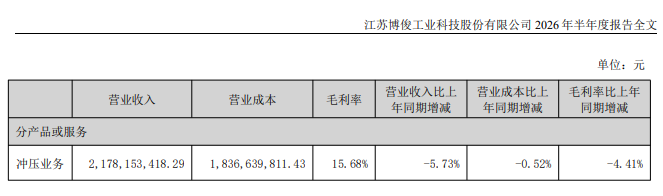
Entering 2026, the stamping business contracted, generating revenue of RMB 2.178 billion, down 5.73% year on year, with a gross margin of 15.68%, down 4.41 percentage points year on year. The decline in revenue and profitability of the core business is the key factor behind the year's weak performance.
Other Businesses Contribute Relatively Little Revenue
Beyond stamping, Bojun Technology's businesses also include commodity molds, injection molding, body-in-white, and high-pressure die-casting, among others. The revenue scale of these businesses, however, is relatively limited. In 2025, for example, revenue from the commodity mold business and the injection molding business was RMB 758,900 and RMB 84.7021 million, respectively—down 4.31% and 60.84% year on year—while revenue from other businesses totaled RMB 468 million, up 69.5% year on year.
In the first half of 2026, other businesses, the injection molding business, and the commodity mold business generated revenue of RMB 224 million, RMB 21.6688 million, and RMB 526,100, respectively—changes of approximately 29%, -20%, and 56% year on year.
Automotive Production and Sales Fall, with Passenger Vehicles Hit Harder
Bojun Technology's revenue comes mainly from the domestic market, which accounted for RMB 5.684 billion, or 97.86%, of revenue at the end of 2025. The domestic automotive industry faces enormous challenges. According to the China Association of Automobile Manufacturers, from January to June, automotive production and sales reached 14.993 million and 15.017 million vehicles, respectively—down 4% and 4.1% year on year. Domestic sales totaled 9.921 million vehicles, down sharply by 21.1% year on year, while exports totaled 5.096 million vehicles, up 65.3% year on year—a striking contrast between cooling domestic demand and booming exports.
Even the relatively buoyant new energy vehicle segment has seen growth slow markedly, with production and sales of 7.438 million and 7.446 million vehicles from January to June, respectively—up 6.7% and 7.3% year on year.
By category, from January to June, passenger vehicle production and sales reached 12.721 million and 12.72 million vehicles, respectively—down 5.9% and 6% year on year—of which domestic passenger vehicle sales were 8.288 million vehicles, down 24.3% year on year.
Bojun Technology has high customer concentration, with its top five customers accounting for 60.72% of revenue. Its customers include Li Auto, Seres, Geely, Changan, BYD, XPeng, Leapmotor, Chery, Changan Ford, BAIC New Energy, and many other passenger vehicle manufacturers. Given the sharp decline in domestic passenger vehicle sales in the first half of the year, it stands to reason that the company's core stamping revenue is under pressure, which in turn weighs on overall performance.
Operating Quality and Leverage Warrant Attention
Five-year R&D investment exceeds RMB 500 million. From 2021 to 2025, Bojun Technology's R&D expenses grew steadily, at RMB 31 million, RMB 51 million, RMB 85 million, RMB 161 million, and RMB 201 million, respectively—cumulative investment of more than RMB 500 million over five years. R&D expense ratios all remained above 3%, at 3.85%, 3.66%, 3.27%, 3.82%, and 3.47%, respectively.
In the first three quarters of 2026, R&D expenses rose further to RMB 146 million, up sharply by 32.05% year on year, with the R&D expense ratio rising to 3.58%. This was mainly due to continued increases in R&D investment during the reporting period, including growth in R&D personnel and direct material investment.
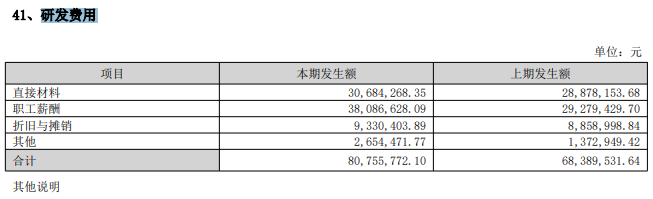
Employee compensation is a major component of R&D expenses, accounting for RMB 38 million, or 47.16%, in the interim report. At the end of 2025, the company had 790 R&D personnel, accounting for 16.58%, of whom 192 held bachelor's degrees and 4 held master's degrees—together less than 25%. Clearly, most R&D personnel have relatively low educational qualifications. As of the end of the first half of 2026, the company owned 116 patents, including 24 invention patents—invention patents accounting for approximately 21%—with the remainder mostly utility model patents.
According to disclosures, Bojun Technology has mastered key production processes and technologies including mold design and manufacturing, stamping, laser welding, injection molding, thermoforming, laser cutting, integrated die-casting, and assembly. In addition, the company has strong independent mold development capabilities, with developed molds including progressive dies, tandem lines, multi-position transfer dies, automated in-line single-action dies, and thermoforming molds.
The company is a national high-tech enterprise and a national-level specialized and sophisticated "Little Giant" enterprise. It has also been recognized as a "Jiangsu Province Recognized Enterprise Technology Center," a "Jiangsu Province Private Technology Enterprise," a "Kunshan City Science and Technology R&D Institution," the "Suzhou Bojun High-Precision Automotive Stamping Mold Engineering Technology Research Center," a "Jiangsu Province Enterprise Graduate Workstation," the "Jiangsu Province Demonstration Smart Workshop—Automotive Steering System Laser Welding Workshop," the "Jiangsu Province (Bojun) Automotive Steering System Components Engineering Technology Research Center," and a "Jiangsu Province Specialized and Sophisticated SME."
Operating quality needs improvement; leverage needs optimizing. Although Bojun Technology's growth has been relatively strong in recent years, its operating quality needs further improvement. From 2021 to 2025, operating cash flow fluctuated significantly, at RMB 14 million, -RMB 89 million, RMB 193 million, -RMB 63 million, and RMB 433 million, respectively, with net profit cash content of 16.84%, -60.1%, 62.63%, -10.31%, and 51.29%, respectively.
In the first three quarters of 2026, the company's operating cash flow was RMB 122 million, up sharply by 168.72% year on year, with net profit cash content of only 28.77%, compared with -28.39% in the same period last year. The full-year picture will not be clear until the annual report is released.
Beyond operating quality, Bojun Technology's debt-to-asset ratio also warrants attention, at 47.26%, 58.66%, 64.84%, 64.65%, and 61.18% from 2021 to 2025, respectively, rising further to 66.11% in the first three quarters of 2026.
Analysis shows that current assets at the end of the third quarter were mainly accounts receivable, notes payable, and inventory, at RMB 1.165 billion, RMB 281 million, and RMB 1.934 billion, respectively—accounting for approximately 71% of current assets—while monetary funds stood at only RMB 655 million. By comparison, interest-bearing debt is a significant part of liabilities. At the end of the first three quarters of 2026, short-term borrowings and long-term borrowings were RMB 1.334 billion and RMB 1.865 billion, respectively—up sharply by 32% and 163.5% year on year. Non-current liabilities due within one year (mainly long-term borrowings due within one year) and bonds payable were RMB 176 million and RMB 203 million, respectively—amounts that cash flow cannot cover, indicating considerable debt repayment pressure.
Stock Price Falls Sharply; Buyback Underway
Along with its earnings growth, Bojun Technology's total dividends have increased in recent years, with dividends of RMB 41.8244 million, RMB 62.9125 million, and RMB 95.5504 million from 2023 to 2025, respectively. The dividend payout ratios, however, were not high, at 13.56%, 10.26%, and 11.32%, respectively, and dividend intensity needs further enhancement.
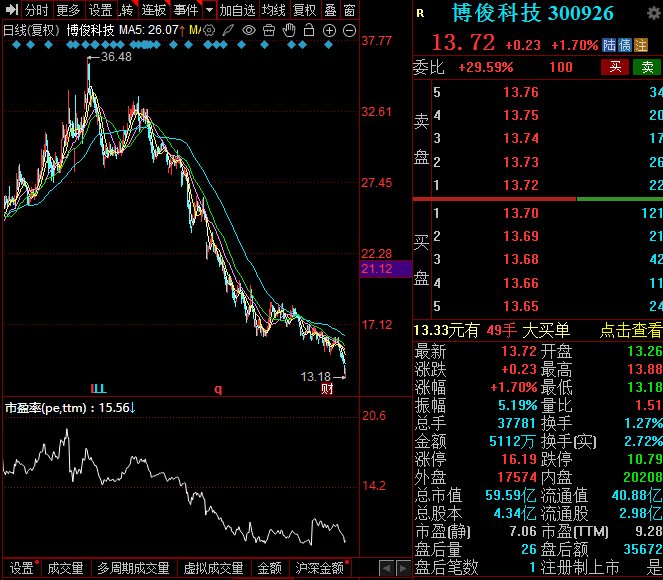
In the secondary market, the company's share price began to decline after reaching a high of RMB 36.48 per share (forward-adjusted; same below) in October 2025, touching a low of RMB 13.18 per share. It closed at RMB 13.72 per share on November 23—a decline of more than 60% from the high—with a total market capitalization of RMB 5.959 billion, a TTM price-earnings ratio of 9.28 times, and a valuation that is not particularly high.
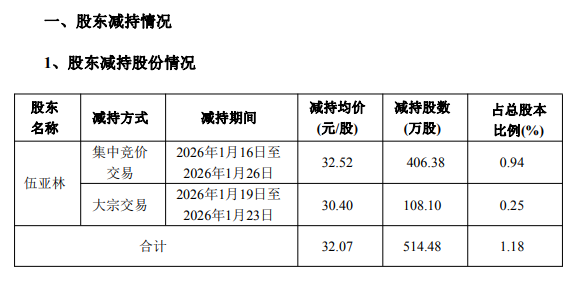
Analysis reveals that the share price decline is related to share reductions by the controlling shareholder and actual controller. In October 2025, Wu Yalin planned to reduce his stake due to personal funding needs, with the reduction not exceeding 8,686,288 shares, or 2% of the company. The reduction was completed in February this year, with 5.1448 million shares sold at an average price of RMB 32.07 per share, cashing out approximately RMB 165 million.
The company's share price did not rise after Wu Yalin's reduction ended; instead, it continued to fall. Against this backdrop, the company announced a buyback plan in August, with a total buyback amount of RMB 80 million to RMB 150 million, and the repurchased shares to be used for equity incentive plans or employee stock ownership plans. As of October 31, a cumulative 2,130,000 shares had been repurchased, for a total transaction amount of RMB 34.15 million (excluding transaction fees).
(Short, Quick Commentary—original work. Please do not reproduce without permission! PS: If this article infringes on any rights or contains inaccurate data, please contact us promptly for correction.)

-
![]()
Major Automotive Stamping Player's Run of Strong Growth Comes to an End
-
![]()
Anthropic Pulls Off the Largest IPO in History at $81.3 Billion
-
![]()
P/S and O/E: Two Fundamentally Different Naming Systems Describing the Same Polarization State
-
![]()
Too "Involutionary"—Even a Foot-Washing Basin Gets Into the Car?
-
![]()
November Auto Market: Penetration Rate Spikes as Retail Contracts — How to Make Sense of It?
-
![]()
Nissan in China: Seeking the Next Round of Growth
-
![]()
Musk Delivers on His Promise! Tesla FSD V15 Makes a Blockbuster Debut: Stock Surges Over 11% Overnight
-
![]()
Outpaced by Chinese Brands, Japanese Automakers Opt for Their Quietest Strategy Yet