Breaking Down Xiaomi's Q3 Report: Higher Phone Prices, but Where Did the Profit Go?
 11/26 2026
 360
Lu Weibing summed up the just-concluded third quarter in six words: "the hardest since I started working."
After reading Xiaomi's latest Q3 report, I was struck by two figures. The average selling price of a phone was over 400 yuan higher than the same period last year. Yet across the entire phone business, gross profit was over 900 million yuan lower.
Phones sold at higher prices—so how did the whole business earn less? Start by counting how many fewer units shipped. Xiaomi's phone shipments this quarter fell by about 12.6 million units, while memory and other components continued to rise in price. The higher selling prices had to fill these gaps first.
On November 24, Xiaomi released its Q3 2026 report. Group revenue was 107.240 billion yuan, adjusted net profit 4.884 billion yuan, down 56.8% year-on-year.
In the same quarter, vehicles delivered over one hundred thousand units, yet vehicle revenue fell nearly twenty percent year-on-year. In this report, I want to dig into two things. What can make up for the phones not sold?
After new cars are delivered to buyers, how much money can they leave for Xiaomi?

After 100 Billion Revenue
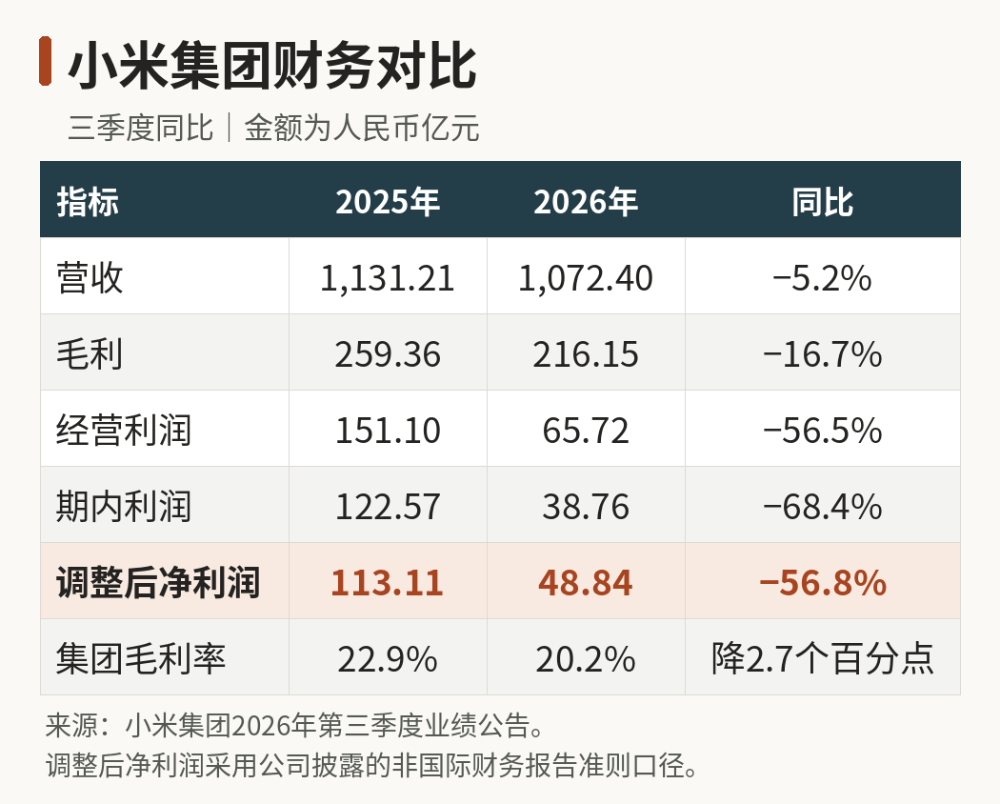
Revenue fell 5.2% year-on-year, gross profit fell 16.7%. For every one hundred yuan of revenue, Xiaomi kept 2.7 yuan less in gross profit than the same period last year. R&D, selling, and administrative expenses still had to be deducted from gross profit.
Further down the income statement, gains from changes in fair value of financial instruments were about 1.8 billion yuan less, and net financial expenses were about 1.8 billion yuan more. According to Xiaomi's explanation, the latter mainly came from changes in the value of financial liabilities payable to fund investors.
Accounting items amplified the profit decline. Adjusted net profit was still down 56.8% year-on-year and down 21.5% quarter-on-quarter. Extending to the first three quarters, revenue fell 7.4% year-on-year and adjusted net profit fell 47.7%.
Profit contraction has persisted for some time. We can also break down the revenue gap. The group had about 5.9 billion yuan less year-on-year, of which about 5.1 billion yuan came from the new energy vehicle and AI and other innovative business segment.
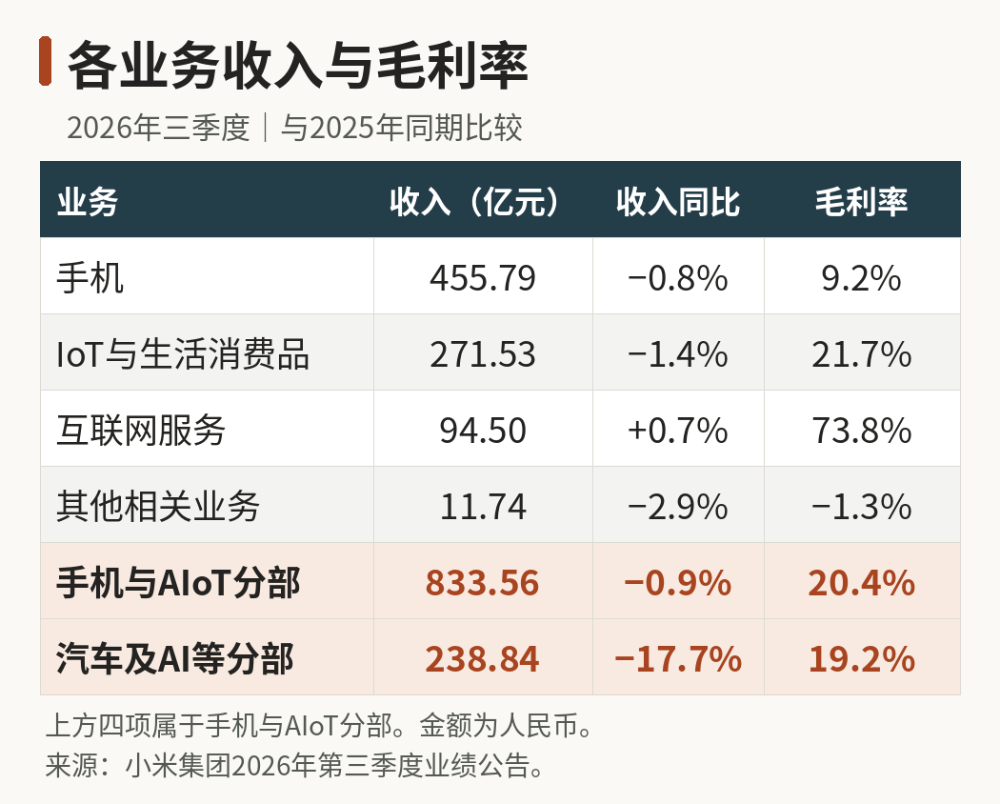
This segment accounted for over twenty percent of revenue but contributed nearly ninety percent of the revenue decline. Looking at gross profit, the innovative business segment had about 2.8 billion yuan less, accounting for about 65% of the group's gross profit reduction. The heaviest pressure, from the revenue statement to the gross profit statement, still comes from this segment.
Phones Sold at Higher Prices, Yet Gross Margin Fell
According to Omdia, global smartphone shipments in Q3 were 254.7 million units, down about twenty percent year-on-year—the lowest for the same period since 2013. Omdia noted that rising prices suppressed purchase demand, and channels became more cautious.
Xiaomi's self-disclosed shipments were 30.7 million units, down 29.1% year-on-year, a deeper decline than the global market. By Omdia's measure, Xiaomi's shipment share rose quarter-on-quarter for three consecutive quarters to 12.1%, still below 13.6% in the same period last year.
Xiaomi proactively reduced low-end phone shipments, and the share of mainland China in shipments also increased, together pushing the average selling price to 1,486.1 yuan. Shipments fell nearly thirty percent, yet phone revenue fell only 0.8%; the average price indeed propped up revenue.
Xiaomi is also testing higher prices. The foldable flagship launched in September starts at 10,999 yuan. The report cited third-party data saying that in Q3, Xiaomi's volume share in the mainland China 6,000 yuan and above price segment rose to 4.4%, up 1.2 percentage points year-on-year.
Once the price stands higher, gross margin still has to clear the cost hurdle. Phone gross margin fell from 11.1% to 9.2%, which Xiaomi mainly attributed to rising prices of key components.
Dividing phone business gross profit by shipments for the same period, the rough estimate of gross profit per unit rose from 118 yuan to 136 yuan.
Each phone left about 18 yuan more in gross profit, but shipments fell by about 12.6 million units, so the phone business's gross profit still moved downward. How many low-priced phones to keep, what price to set for flagships—every market has to be calculated.
Home appliances and lifestyle consumer products were also absorbing costs. Revenue from laptops, smart large appliances, and overseas tablets grew, filling part of the gap, but the entire segment's revenue still fell 1.4%.
Factoring in component price increases and category mix changes, gross margin fell to 21.7%. Internet services, meanwhile, are a fat-margin business in Xiaomi's hands. It generated less than ten percent of the group's revenue but contributed about one-third of gross profit.
Global monthly active users are still growing, and advertising revenue is also growing, but pre-installation revenue contribution declined, and services gross margin dropped by more than three percentage points. One quarter of lower phone sales may not show its impact on services in the same quarter.
Existing users are still using their phones, and ads are still being watched. When these users reach upgrade time, whether Xiaomi has suitable models on hand will determine how many people use this business going forward.
One Hundred Thousand Cars Sold
Xiaomi delivered 100,975 vehicles in Q3, down 7.2% year-on-year and down 3.1% quarter-on-quarter. Vehicle revenue was about 22.7 billion yuan, down 19.9% year-on-year.
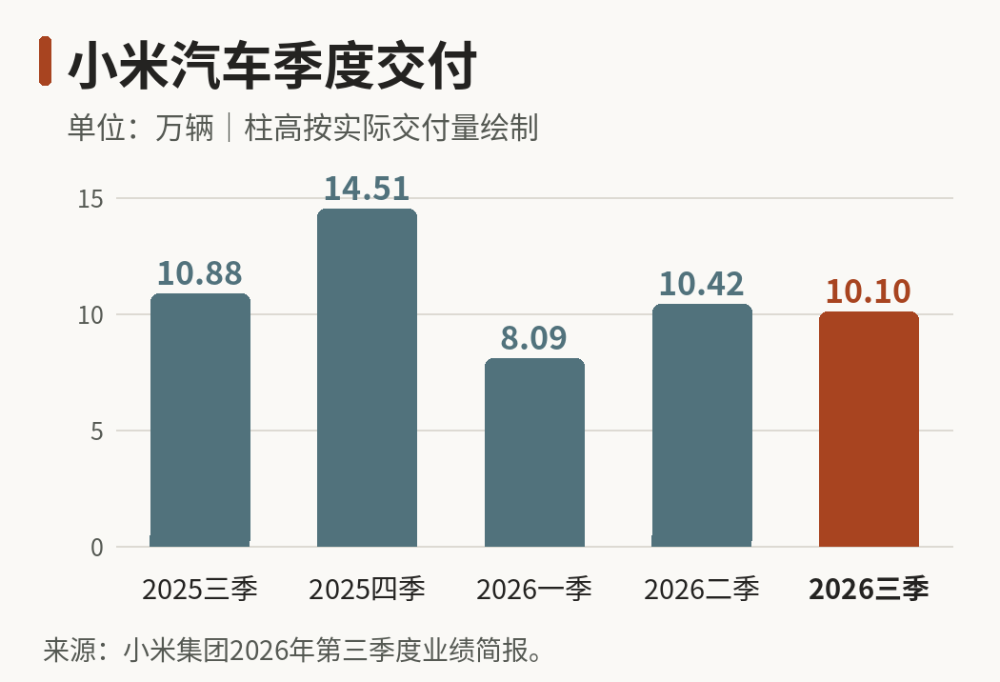
Revenue fell faster than deliveries. Xiaomi noted in its announcement that the SU7 Ultra's contribution to deliveries decreased. Dividing vehicle revenue for the two periods by deliveries for the respective quarters, the rough estimate fell from about 260,000 yuan per vehicle to 225,000 yuan. This rough estimate is suitable for observing the relationship between quarterly revenue and deliveries. How much each model actually sold for still needs to be looked at separately.
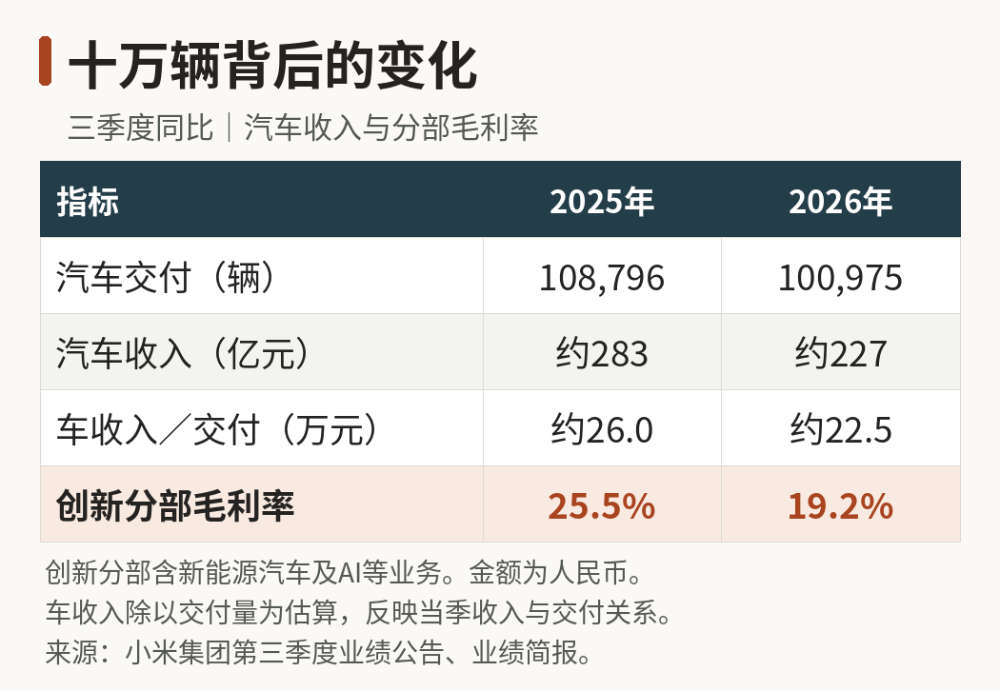
Changes in model mix, rising prices of key components, and increased AI business costs together dragged down the segment's gross margin. The segment's operating expenses also increased 18.6% year-on-year to about 8 billion yuan.
Squeezed at both ends, the entire innovative business segment had an operating loss of about 3.4 billion yuan. The extended-range option brought Xiaomi new orders. The extended-range SUV launched in September has four configurations, starting at 209,900 yuan.
The company disclosed that locked orders from September 7 to October 7 exceeded 70,000 units, and actual deliveries of this series in Q3 exceeded 10,000 units.
Locked orders first show that people are willing to place orders. After the first batch of customers take delivery, whether daily sales can still stabilize prices and orders needs a few more months to observe. By then, it will also be easier to judge how much gross profit the new deliveries brought to the segment. The car market also tests new models.
Data from the China Passenger Car Association showed that in October, domestic passenger vehicle retail fell 27.1% year-on-year, and new energy passenger vehicle retail also fell 13.7%. Penetration rose to 67.5% because new energy vehicles took a larger share of a shrinking market.
Making both pure electric and extended-range vehicles, Xiaomi can compete for families with different charging conditions. With more models, procurement, production scheduling, and after-sales also become more complex.
One hundred thousand vehicles is certainly worth watching, but which car the stores sell and which car the factories build determine what kind of account these one hundred thousand vehicles ultimately become.
Where Did the R&D Money Go?
In the first three quarters, Xiaomi's R&D expenses were about 27.4 billion yuan, up 16.5% year-on-year. For Q3 alone, R&D expenses were about 9.2 billion yuan. The announcement mainly attributed this quarter's R&D increase to new energy vehicles and AI and other innovative businesses, especially AI investment.
XRING O3 has already been installed in the 18 Fold and Pad 9 Pro Max, and Xiaomi has also open-sourced the MiMo V2.6 series models. Looking at these moves together, Xiaomi intends to let the chips and models it makes first be used in its own hardware.
By the end of September, the AIoT platform connected about 1.204 billion devices, excluding phones and tablets. By the same measure, users with at least five connected devices numbered 25.6 million, up 18.7% year-on-year.
These users already manage multiple devices on the same platform, so Xiaomi has the conditions to let them try cross-device features first. For example, a person in the car wants to turn on the air conditioner at home in advance.
Using it occasionally and being willing to use it every day are two different things. Whether R&D can become business depends on whether these features can make users use one more device, or still choose Xiaomi at their next upgrade.
Vehicle overseas expansion tests execution even more. Xiaomi plans to enter the European market in 2027 and has signed memoranda of understanding with eight German auto dealership groups.
Brand awareness accumulated from phones is useful, but vehicle delivery, repair outlets, and spare parts supply still have to land in city after city. The pace of expansion must return to cash flow.
In Q2, operating activities were still a net inflow; in Q3, they were a net outflow of 23.034 billion yuan. The main adjustment item disclosed by the company was an increase in inventory of about 25.4 billion yuan.
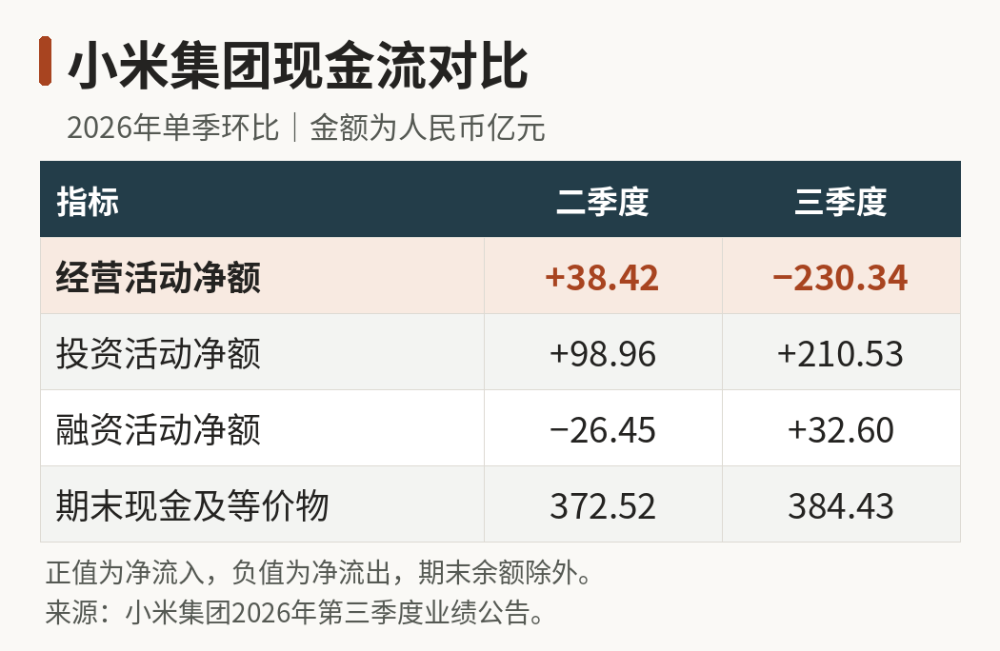
At the end of Q3, the balance of cash and cash equivalents was nearly 1.2 billion yuan more than at the end of Q2. In the same period, investing activities had a net inflow of 21.053 billion yuan, mainly from a net decrease in time deposits and some short-term investment balances.
Stockpiling may be to stabilize supply, or to support new product launches; the certain information given in the announcement is the increase in inventory. If goods sell slowly, collection still has to wait, and promotions may also eat into gross profit.
Next quarter, whether inventory has fallen and whether operating cash has returned are best looked at together.
What to Watch Next Quarter?
Xiaomi had several bright spots this quarter worth noting. Flagship phones propped up part of phone revenue, internet services still left relatively thick gross profit, and the new extended-range vehicle also won first-sale orders.
The pressure is also specific: total gross profit in the phone business shrank, the innovative business segment lost money, and stockpiling tied up cash. My personal view is that Xiaomi now needs more to adjust its pace according to actual sales.
Phone pricing depends on local demand, and vehicle production scheduling must follow orders and deliveries. After R&D money is spent, it also depends on whether products can be mass-produced and whether users use them frequently.
In the next financial report, I will first look at whether the phone business's gross profit has stabilized, then at the innovative business segment's losses, inventory, and operating cash flow. Xiaomi can already roll out new products to many places.
With the market changing so fast, only by retaining profit after selling can there be room for expansion.
What do you think of Xiaomi's latest financial report? We look forward to your civilized and rational comments in the message area.
Disclaimer: This article is only a financial hot topic analysis from a professional perspective. Data and materials are cited from public queries, company announcements, and Tonghuashun iFinD. The views are for reference only and do not constitute any investment or consumption advice.
#FinancialHotTopics #InDepthInterpretation #BusinessFinance #InvestmentBankingCircle #ListedCompanies #PrimaryMarket #IPO #XiaomiFinancialReport #Xiaomi #XiaomiNetProfitDecline
Thank you for your patient reading, and welcome to click "Wow" casually.

-
![]()
Wei Jianjun's Tone Has Softened
-
![]()
Politicized Channels: How Many Cards Does DJI Have Left to Play?
-
![]()
a16z Leads $90 Million Round in Agent Infrastructure Company Valued at $1 Billion
-
![]()
Deepal's October Domestic Retail Sales Hit 20,901 Units, with S05 Alone Accounting for 55%
-
![]()
MG October Domestic Sales: 32,059 Units, MG4 and 07 EV Account for 83%
-
![]()
Cars Enter the Era of Diseconomies of Scale
-
![]()
Breaking Down Xiaomi's Q3 Report: Higher Phone Prices, but Where Did the Profit Go?
-
Apple Is Very Proud: I Sold 710,000 Fewer Phones, Yet Revenue Increased by 55 Billion!