Xiaomi's Profit Halved in First Three Quarters—Has the "Toughest Quarter" Passed?
 11/27 2026
 366
Produced by Radar Finance | Text by Ding Yu | Edited by Meng Shuai
"This third quarter feels like the toughest quarter the smartphone industry has ever experienced—at least in my career," Xiaomi Group partner and president Lu Weibing said with a sigh at the company's third-quarter earnings call on November 24.
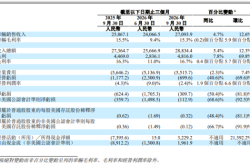
According to the latest financial report Xiaomi disclosed that day, the company posted revenue of 315.3 billion yuan in the first three quarters of this year, down 7.4% year-on-year; net profit of 18.1 billion yuan, down 48.4% year-on-year; and adjusted net profit of 17.2 billion yuan, down 47.7% year-on-year.
In the third quarter alone, revenue came in at 107.2 billion yuan, down 5.2% year-on-year but still firmly above the 100 billion yuan threshold. Net profit, however, was only 3.9 billion yuan, plunging 68.4% year-on-year. Adjusted net profit was 4.9 billion yuan, also down 56.8% year-on-year, with the decline widening further from 42.6% in the second quarter.
Citi noted in its latest report that Xiaomi's third-quarter adjusted net profit was broadly in line with expectations, and it maintained its target price of HK$33.2. Xiaomi's smartphone gross margin came in at 9.2%, better than expected, as the company benefited from a better product mix and higher average selling prices despite rising material costs.
Despite cost pressure, management believes the electric vehicle business can still maintain a healthy gross margin, supported by product competitiveness and platform capabilities.
As of the close on November 26, Xiaomi Group's stock price stood at HK$26.6 per share, down more than half from its historical high, with a latest market capitalization of about HK$684.7 billion.
Automotive Revenue Declines; AI Investment Drags Down Segment Profitability
According to the latest financial report Xiaomi disclosed, the company's gross profit in the third quarter was 21.6 billion yuan, a decrease of 4.3 billion yuan (16.7%) year-on-year.
Of this, the innovative businesses—new energy vehicles and AI—recorded gross profit of 4.6 billion yuan for the quarter, a decrease of 2.8 billion yuan year-on-year. This accounted for 64.8% of the total gross profit decline and was the main factor behind the company's gross profit contraction in the third quarter.
After deducting operating expenses, the segment's operating loss reached 3.4 billion yuan, continuing to widen from the 2.6 billion yuan operating loss in the second quarter. In the third quarter of last year, this business achieved profitability for the first time at 700 million yuan, but it has now turned to a loss.
During the Q&A session of the earnings call, Lu Weibing specifically explained the core reason for the expanded loss: this segment includes multiple modules such as automobiles, AI, and chips, and the company significantly increased its AI investment this quarter.
In the third quarter, revenue from Xiaomi's innovative businesses—new energy vehicles and AI—decreased 17.7% year-on-year to 23.9 billion yuan, and its revenue share fell from 25.6% in the same period last year to 22.3%.
Specifically, Xiaomi's new energy vehicle revenue decreased 19.9% year-on-year to 22.7 billion yuan, mainly due to lower vehicle deliveries and changes in product mix (including a decline in the delivery share of Xiaomi SU7 Ultra).
During the same period, revenue from other related businesses under this segment increased 68.9%, from 700 million yuan in the third quarter of last year to 1.2 billion yuan, mainly due to higher after-sales service revenue related to the new energy vehicle business and higher AI business revenue.
In the third quarter of 2026, the passenger vehicle market in mainland China was under overall pressure, with retail sales falling 24% year-on-year. Xiaomi delivered about 101,000 new vehicles this quarter, down 7.2% from 108,800 vehicles in the same period last year.
It is worth noting that Xiaomi launched its first extended-range new energy vehicle, the Pengcheng series, in September this year, with sales concentrated in September and afterward. In October, Xiaomi Auto's monthly deliveries exceeded 50,000 units, a clear increase from the average of more than 30,000 units per month in the third quarter.
According to Lu Weibing, after the launch of Pengcheng, SU7 sales did not fall but rose instead. Among extended-range vehicle owners, users over 35 accounted for more than 50%, family users accounted for 87.8%, and users replacing gasoline vehicles accounted for 50.3%.
In addition, thanks to strong performance in overseas markets, leading automakers such as BYD and Geely can alleviate the pressure of declining domestic vehicle sales to some extent. Xiaomi Auto, however, has not yet started sales overseas, and its overseas expansion strategy is still being advanced.
In September this year, the company officially announced that Xiaomi Auto would enter the European market in 2027. At the 2026 Berlin International Consumer Electronics Show (IFA 2026), Xiaomi Auto signed memoranda of cooperation with eight leading German automobile dealers, laying the foundation for entering the European market.
In early November, Xiaomi Auto underwent a major organizational restructuring: it established an International Business Department and appointed Yu Liguo, vice president of the automobile department, concurrently as general manager of the International Business Department, reporting on two lines to group CEO and automobile department president Lei Jun and group president Lu Weibing.
In addition, under Xiaomi Auto's International Business Department, an Automobile International Market Department was set up, with related work reporting on two lines to Yu Liguo, general manager of the International Business Department, and Xu Fei, group vice president and CMO. The department also has a GTM Department, Sales Department, Network Development Department, Delivery and Logistics Department, User Service Department, Comprehensive Management Department, and overseas regional departments, with related work reporting to Yu Liguo, general manager of the International Business Department.
At the third-quarter earnings call, Lu Weibing also revealed that Xiaomi Auto has already set up an R&D and design center in Germany, and its overseas models will go to Sweden, Germany, Spain, and Italy, and complete high-speed and functional validation at seven major test grounds.
Smartphone Business "Cuts Volume and Raises Prices"; Storage Price Increase Pressure Remains
Tianyancha shows that Xiaomi Group listed on the Hong Kong Stock Exchange in 2018. As a large company that started with smartphones, Xiaomi's smartphone business has long served as the company's "cash cow" and is also one of the most directly affected points in this round of the company's performance contraction.
In the third quarter of this year, the company's "smartphone x AIoT" segment revenue was 83.4 billion yuan, down 0.9% year-on-year; gross margin was 20.4%, down 1.7 percentage points year-on-year.
Of this, smartphone revenue decreased 0.8% year-on-year to 45.6 billion yuan, mainly due to lower smartphone shipments, partially offset by higher smartphone ASP (average selling price).
Xiaomi noted in its financial report that in the third quarter, costs of core components such as storage continued to rise, the smartphone industry as a whole was under pressure, and global smartphone shipments fell 20% year-on-year.
Facing industry headwinds, Xiaomi chose to proactively optimize its product structure and pricing strategy and adjust its shipment pace. During the period, the company's smartphone shipments decreased 29.1% year-on-year to 30.7 million units.
At the same time, Xiaomi continued to advance its premiumization strategy and actively optimized its sales mix. In the third quarter, smartphone ASP increased 39.8% year-on-year to 1,486.1 yuan, setting a record high.
Although the average selling price rose significantly, the gross margin of Xiaomi's smartphone business failed to outpace cost increases. In the third quarter, the gross margin of the company's smartphone business was 9.2%, down 1.9 percentage points year-on-year. On a quarter-on-quarter basis, however, the segment's gross margin increased 0.7 percentage points, exceeding market expectations.
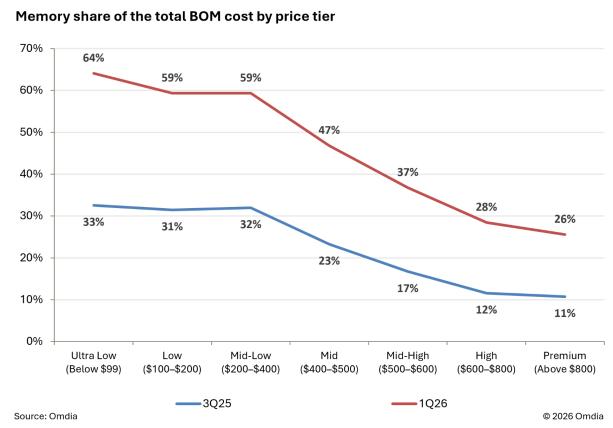
According to a report released by Omdia in July this year, DRAM and NAND prices rose sharply in recent quarters and are expected to continue rising.
In the first quarter of this year, for smartphones priced between US$100 and US$200 (about 670 yuan to 1,330 yuan), memory costs accounted for as much as 59% of total bill of materials costs, nearly double that in the third quarter of last year. In the third quarter of last year, Xiaomi's smartphone ASP was 1,062.8 yuan, falling exactly within this range.
"The rapid rise in storage costs has become the biggest disruptive factor for the smartphone business since the second half of last year," Lu Weibing said at the earnings call, adding that Xiaomi is responding through volume-price balance, product matrix optimization, and product innovation.
He also judged that the smartphone industry winter caused by high memory costs may continue for some time, but through reasonable pricing of products and differentiation as well as product structure optimization, "our own response capabilities have been verified and strengthened."
Inventory Surges by 27.3 Billion Yuan, with Nearly 200 Billion Yuan in Cash Reserves
In the third quarter of this year, Xiaomi's operating cash flow was -23 billion yuan, compared with 5.5 billion yuan in the same period last year, turning from net inflow to net outflow year-on-year.
On the balance sheet, as of the end of the third quarter, Xiaomi's inventory had increased by 27.3 billion yuan from the end of last year to 108.3 billion yuan.
By business segment, as of the end of the third quarter, inventory in Xiaomi's "smartphone x AIoT" segment was as high as 98 billion yuan, an increase of 23.3 billion yuan from the end of last year; inventory in innovative businesses such as new energy vehicles and AI was 10.3 billion yuan, an increase of 4 billion yuan from the end of last year.
By inventory type, Xiaomi's raw material inventory surged from 24 billion yuan at the beginning of the year to 58.9 billion yuan at the end of the third quarter, an increase of nearly 1.5 times.
Lu Weibing said that in recent quarters, Xiaomi Group has had relatively good inventory of memory costs, providing a good "buffer" for the company to cope with memory cost increases.
However, Lu Weibing emphasized that although the rise in memory costs has slowed, it is still at a very high level. As for how to absorb the cost impact, Lu Weibing said the key is to use product innovation to offset costs: "We cannot simply raise product prices; we must use product structure upgrades to stabilize gross margin."
It is worth mentioning that the financial report shows that for the three months and nine months ended September 30, 2026, Xiaomi made impairment provisions of approximately 1.6 billion yuan and 6 billion yuan for inventory, respectively.
Despite considerable cost pressure, Xiaomi still has ample funds on its books. As of the end of the third quarter, the company's cash and cash equivalents were 38.4 billion yuan, an increase of 11.5 billion yuan from the end of last year; cash reserves (including cash and cash equivalents, restricted cash, time deposits, and various investments) were 196.9 billion yuan.
During the same period, the company's short-term borrowings and long-term borrowings were 17.5 billion yuan and 27.9 billion yuan, respectively, totaling 45.5 billion yuan; the asset-liability ratio was 48.99%, a slight increase of about 1.4 percentage points from the end of last year.
Radar Finance will continue to follow Xiaomi Group's subsequent development.
-
![]()
Why Is There No "Pinduoduo Narrative" in the AI Era?
-
![]()
Wall Street's "Big Short" Investor Suddenly Boosts Chinese Holdings -
![]()
Memory Price Hikes, Spec Cuts, and Incremental Upgrades: The Smartphone Spec War Hits a Memory Wall
-
AI Is Rewriting the Pricing Logic of Office Software — Kingsoft Software's Bid for the Enterprise Productivity Entry Point
-
![]()
Priced from Over 300,000 Yuan with L3 Architecture: Is the Xiangjie V8 Gunning for the Tengshi D9's Lunch?
-
![]()
How Will Automakers Fight the Final Battle in a Tough 2026?
-
![]()
Automakers Burdened by Collective Debt Double Down on AI Investment
-
![]()
Li Auto to Launch Only 1–2 New Models in 2027