iPhone Duo Makes AppleCare+ Great Again
 10/28 2026
 498
Baker Street Detective

Store Staff: 'If you're not considering AppleCare+, we suggest not buying the iPhone Duo.'
For consumers eagerly anticipating Apple's foldable phone, the iPhone Duo was supposed to be a standout product. After all, foldable screens are no longer a novel black technology. After years of development, the industry has accumulated considerable technical experience. Apple, a pioneer in promoting full-screen touch-controlled smartphones for mass production, has been late to the foldable screen race, and its product quality is concerning.

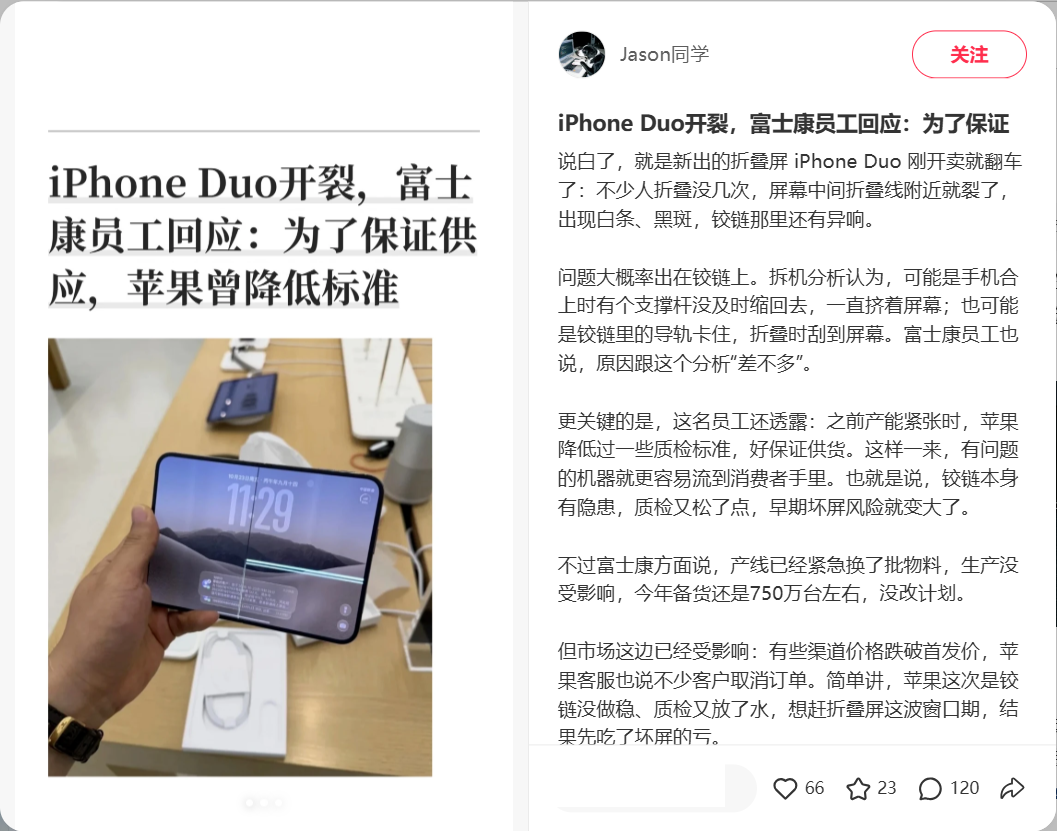
Since the development of foldable screens, consumers have never just expected to fold their phones; they hope the technology can be made more mature and reliable, reducing their concerns and providing more peace of mind. However, soon after the iPhone Duo's release, issues such as inner screen explosions, black lines, or display abnormalities emerged, easily turning consumer expectations into disappointment.
From a consumer perspective, foldable screens can be expensive, but they shouldn't make buyers feel anxious; the technology can be complex, but it shouldn't leave consumers with usage risks and high repair costs.
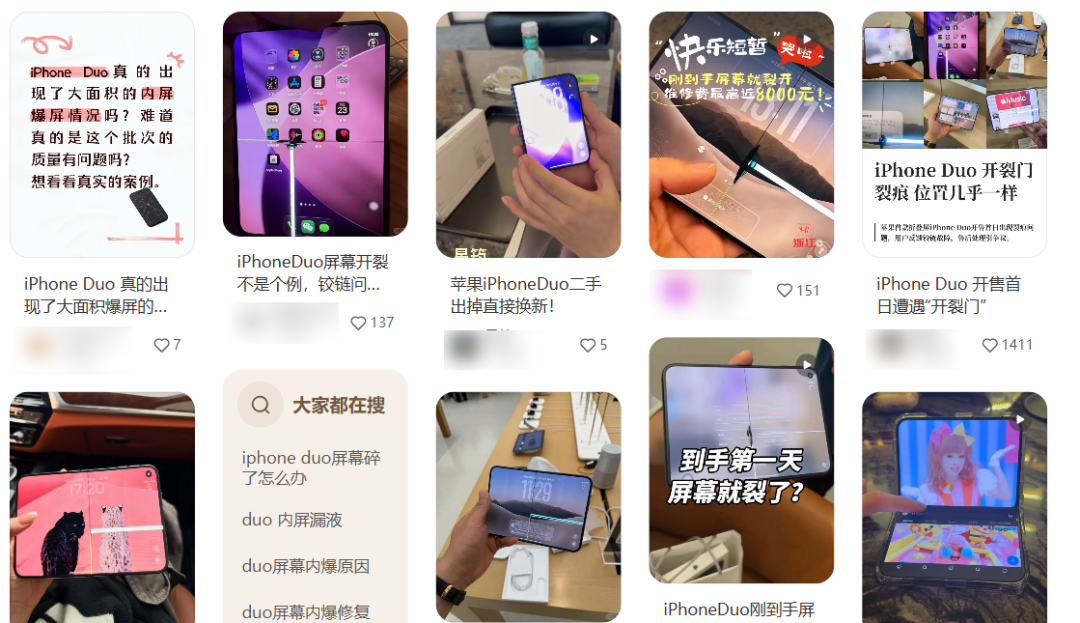
Although a definitive conclusion about the iPhone Duo's inner screen explosions cannot be drawn without verified disassembly, repair records, and fault statistics, it is still possible to discuss, from an industry perspective, the common technical challenges faced by foldable phones and what to consider when diagnosing specific faults.
01 The Hinge Remains the Most Critical Component
Many people believe that the screen is the most crucial part of a foldable phone. In reality, the hinge is equally vital. The hinge not only allows the phone to open and close but also controls how and where the screen bends, as well as the amount of force each position should withstand during bending.
If the screen is an athlete, the hinge is the coach who arranges the movement trajectory. Only with a reasonable movement design can the athlete train long-term; an unreasonable trajectory may cause even the best physical condition to fail. Therefore, for foldable screens, a smooth hinge does not guarantee screen safety; if the hinge is poor, the screen will be even less safe.
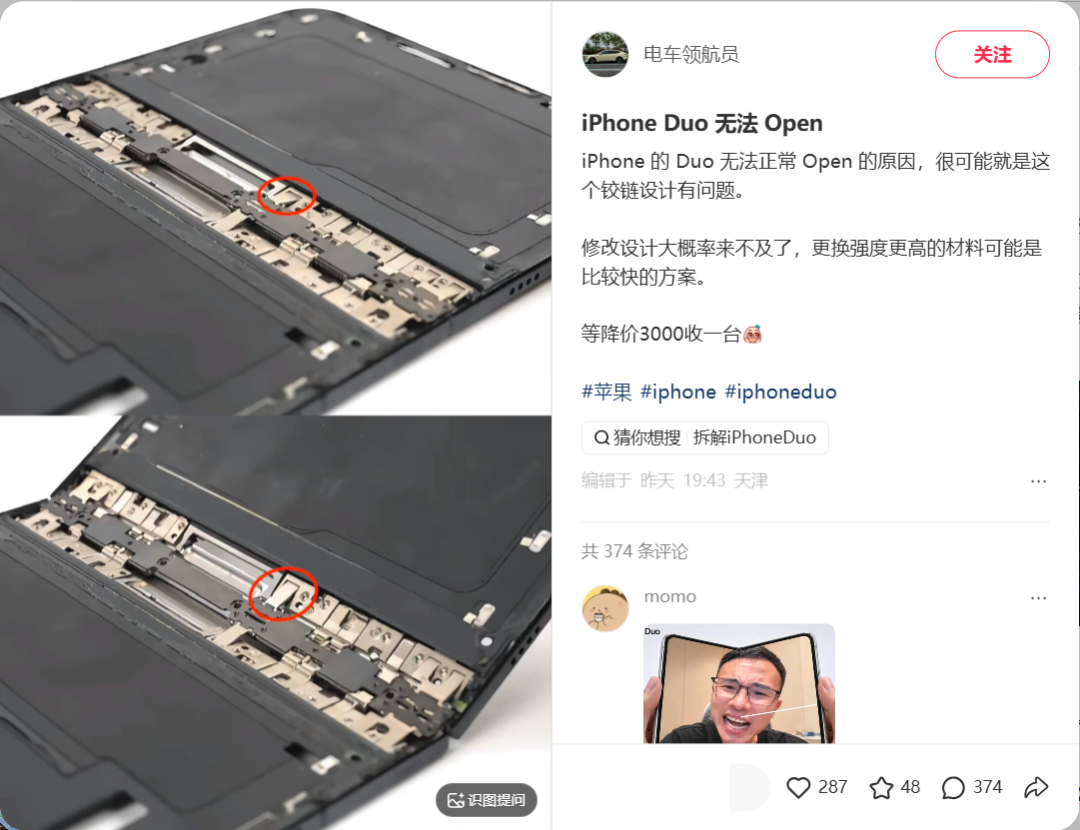
Because even if a hinge opens and closes smoothly, it does not mean the internal forces on the screen are evenly distributed. For example, the screen relies on a support structure to maintain its shape when unfolded. If support is insufficient in a certain area or if the screen's bending trajectory deviates from the design, it may cause additional stress on local materials.
Such situations may not immediately cause failure, but over long-term use, the repeated accumulation of stress may increase the risk of material fatigue. More troublingly, there is not always a one-to-one correspondence between screen damage and hinge abnormalities.
Some issues stem from design, some from part assembly, and others may be caused by foreign objects, external forces, or the material itself. Simply concluding that the hinge design is flawed because the screen cracked near the fold is insufficient.
Another possibility is that hard foreign objects enter the gap between the screen and the body and become trapped when closed, creating localized pressure. For flexible display structures, such pressure can damage the protective layer and even affect internal display components. In other words, even a single grain of dust can cause a screen explosion, but it does not mean all foldable screens are easily damaged by dust. The specific risk also depends on the product's protective design and the location of foreign object entry.
Therefore, to achieve a reliable foldable screen, two issues must be addressed simultaneously: first, allowing the screen to fold smoothly, and second, ensuring its safety during the folding process.
Finally, on the manufacturing side, if the hinge determines how the screen moves, the manufacturing process determines the screen's condition when it leaves the factory. A foldable phone is a system composed of many materials and parts. The screen undergoes multi-layer material lamination, the hinge requires precise assembly, and the support structure must cooperate with the screen, with each step potentially affecting the final performance.
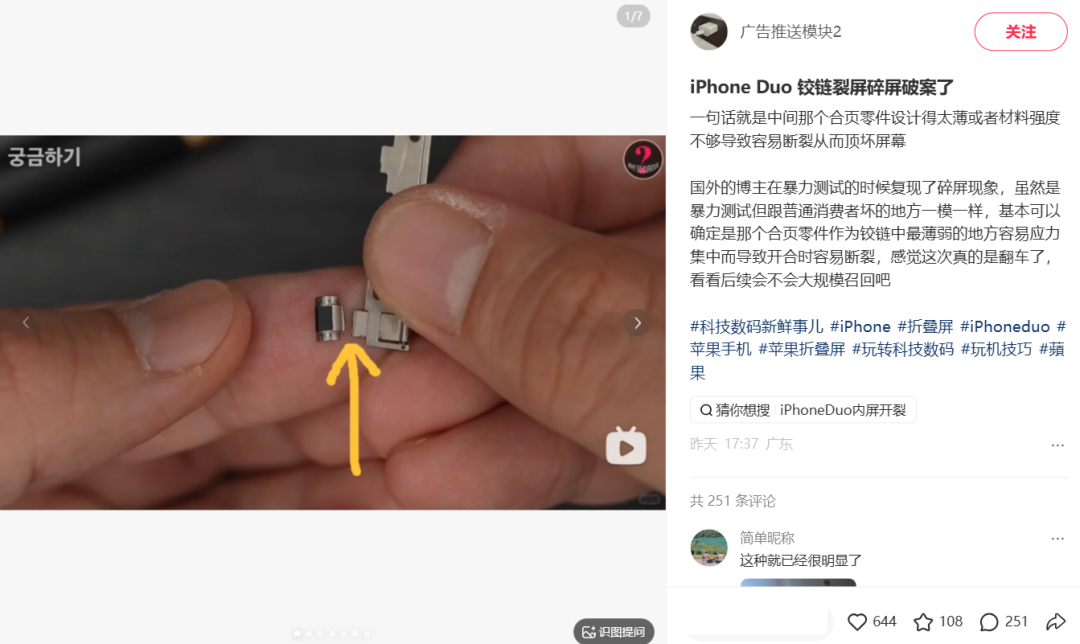
Even if all suppliers provide qualified products, the Duo still cannot guarantee complete reliability because a crucial concept in precision manufacturing is assembly tolerance. Simply put, each part's dimensions and positions are allowed to deviate within a certain range.
Individually, each part may meet standards. However, when the screen, hinge, and support components are assembled, these deviations may accumulate, affecting the final fit. For ordinary straight phones, some minor deviations may not have a significant impact. For foldable screens, the situation may be more complex.
Because the screen must move along a relatively fixed trajectory each time it opens and closes. If there are issues with support positions, connection gaps, or part fit, it may alter local forces.

Image Source: Xiaohongshu
However, it is worth noting that the existence of tolerances does not mean the product is defective. What truly needs to be determined is whether the relevant parts exceed the allowable range and whether this deviation has a causal relationship with the fault.
Suppose a phone develops inner screen cracks. It could be due to accidental compression, localized damage caused by foreign objects, or involve material defects or assembly issues. Looking at just this one device, it is difficult to draw a direct conclusion. However, if a large number of devices experience similar failures in similar locations, the situation warrants further investigation.
At this point, it is necessary to compare the damage locations, usage times, appearance conditions, and manufacturing batches of different devices, then check whether the faults share common patterns. If stable common features can be identified and other factors ruled out through professional testing, there is reason to further discuss design or manufacturing issues.
Truly valuable quality analysis does not involve counting how many people say their screens are broken online but determining whether these faults have a common cause. Online cases can provide clues but cannot directly replace fault rate statistics and professional testing.
02 Repair Costs Without AppleCare+ Reach Up to 7,998 Yuan
For users whose iPhone Duo screens have already exploded, the repair cost is likely their top concern.

Before confirming who bears the repair cost, determining responsibility is crucial. When a new phone suddenly develops black spots, bright lines, or cracks, and after-sales claims it is user-induced damage while the user insists they did nothing, it often turns into a dispute. To resolve this issue, the focus should not be on who speaks louder but on the evidence.
If the screen develops black spots, colored lines, or localized blackouts, it may involve the display panel, driver circuitry, or related connection components; if cracks appear near the folding axis, further inspection of the bending area, screen support structure, and hinge state is needed; if there are obvious localized indentations, puncture points, or depressions, it is necessary to check whether they were caused by sharp objects, foreign object intrusion, or concentrated pressure.

Image Source: Cover News
However, these are just directions for investigation. A black screen does not necessarily indicate internal cracks, cracks near the fold do not necessarily indicate a defective hinge design, and appearance damage does not necessarily explain all display faults. Fault manifestations only tell us where to start investigating, not the final answer.
Moreover, for consumers, the most frustrating thing is that 'just because it broke without being dropped does not necessarily mean it is a quality issue,' a conclusion that may seem unreasonable but is understandable to anyone who has had a phone repaired.
When facing the manufacturer, the user's lack of recollection of drops or collisions is indeed noteworthy information but cannot alone prove a product defect. A phone sitting in a back pocket, being squeezed by hard objects in a backpack, or even having foreign objects trapped when closed can create localized forces that the user may not notice.
Conversely, scratches do not necessarily mean the screen fault was inevitably caused by the user. The key is whether there is a reasonable causal relationship between appearance damage and internal faults. For example, if inspectors find obvious indentations in a certain area and discover that internal damage extends from the corresponding location, then external pressure may be a significant factor.
If no external force traces that can explain the fault are found, and the fault is concentrated in a specific structural area, it is necessary to further investigate other possibilities. However, the final conclusion still requires supporting evidence from testing.
At this point, the most important thing for ordinary users seeking to protect their rights is to preserve evidence.
If the screen suddenly fails, it is recommended to do four things first. First, take photos and videos to document the screen, body, hinge, and fault display status; second, record the context in which the fault occurred, such as whether it was normally unfolded at the time, whether any compression occurred, and whether there were any abnormal sounds beforehand; third, stop repeatedly folding and pressing the screen, and do not continue operating it to verify the cause; fourth, back up data promptly and request a clear inspection conclusion from the repair agency.
If after-sales determines the damage is user-induced, ask for their basis, such as what specific appearance traces were found, how these traces explain the internal fault, and whether the hinge, support structure, and screen components were inspected. This is more useful than directly arguing 'I didn't drop it.'
If there are still doubts about the inspection conclusion, save the report, photos, and repair records and seek further review. After all, a user who can spend five figures on a new phone certainly does not just need an after-sales statement of 'user-induced damage' but a reasonable explanation for the fault.
Because behind 'user-induced damage,' consumers are left to bear repair costs of nearly 8,000 yuan. Not knowing why they have to pay this amount means they may face additional repairs later.
This brings us to the most practical issue with foldable screens: Why does a single crack often end up costing a large sum? Why does a small screen damage result in a repair quote that is painfully high?
Because what consumers see is the area of the crack, while repair agencies face the entire display structure.
The inner screen of a foldable phone is not just an ordinary piece of glass but a display component composed of multiple layers of materials. If only the external protective layer is damaged, there may be a relatively independent replacement solution. However, if the damage affects the OLED display layer, internal circuitry, or encapsulation structure, it cannot be resolved by simply filling the crack. Even if the screen temporarily resumes display, it does not mean the internal structure has been restored to a reliable state.
Therefore, in some cases, replacing the entire display component is easier to ensure repair quality than partial repairs, which includes the aforementioned critical part: the hinge.
Although the highly anticipated iPhone Duo has been a dismal failure, foldable screens remain an attractive product direction, as they can genuinely meet people's real needs: they want their phones to be portable while also having a large enough screen.
However, these two needs inherently conflict because the larger the screen, the more complex the structural design; the need for repeated folding means materials and mechanical components must take on more tasks.
What manufacturers need to do is not just make the phone foldable but also ensure it is reliable enough for daily use, that faults can be reasonably detected, and that repair costs are as transparent as possible. Regarding the discussion of the iPhone Duo's inner screen explosions, there is no need to dwell on the declining design and manufacturing capabilities of Apple Inc., as netizens' complaints about the iPhone Duo continue previous issues with paint peeling and dust in the lens across various models. Instead, the focus should be on the screen explosions and extend to the details.
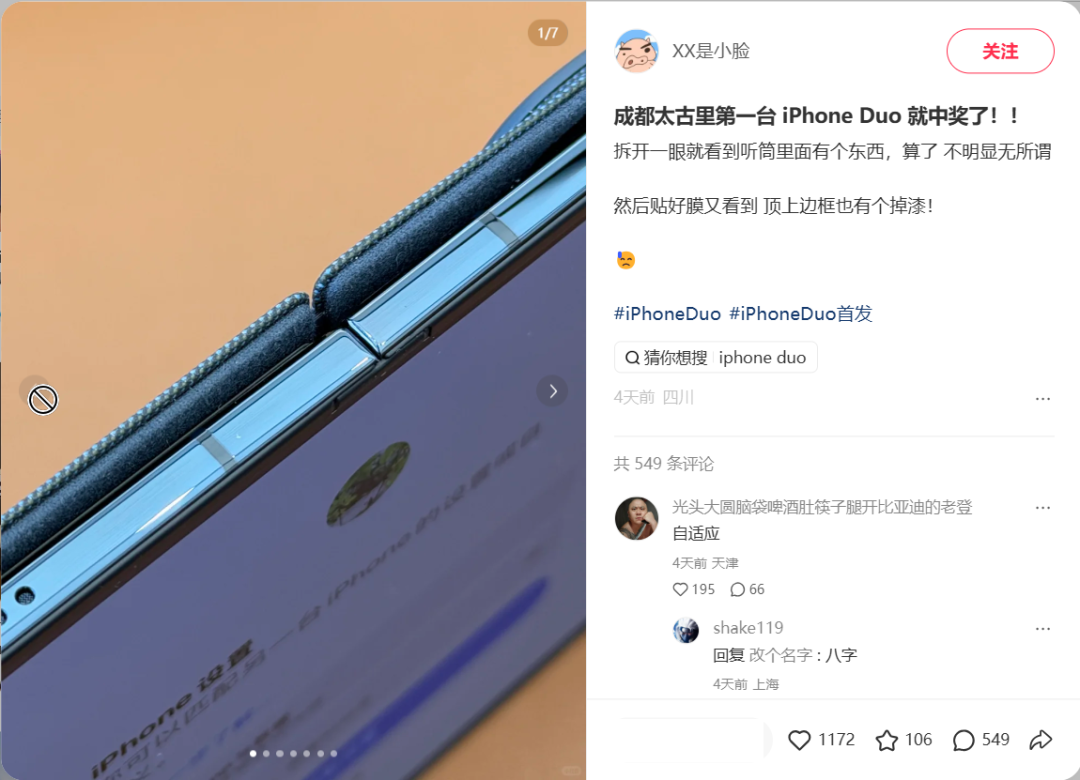
Regarding the screen explosions, we only need to consider three questions: First, at which stage did the fault occur? It is worth noting that if the screen explosion was caused by the user's habits during the opening and closing process, it can also be seen as a failure in the design and manufacturing stages. After all, Apple is not the first phone manufacturer to launch a mass-produced foldable screen and has no right to educate the market.
Second, consider whether similar faults share a common cause. If they do, it further confirms issues in the design and manufacturing stages; finally, when a product fails, can consumers receive a clear and reasonable explanation and repair plan?
Conclusion
Without sufficient physical evidence, we cannot directly assert that a particular product has systemic defects. However, the foldable screen industry cannot simply rely on the number of folding cycles and hinge feel to prove product maturity.
THE END
All materials are sourced from official public information
This article does not constitute any investment advice.
This article is original to Baker Street Detective. Please do not reprint without permission.
The image is sourced from public information. If there is any infringement, please contact us for deletion. For more articles, click the official account below. Thank you for your attention!
-
When Safety Is No Longer a Unique Advantage, Who’s Still Buying Volvo?
-
![]()
iPhone Duo Makes AppleCare+ Great Again
-
The Wildest AI Prospectus in History: Revenue Surges 13x, with a Whopping $80.7 Billion Loss in Just Six Months
-
ByteDance's Agent Awaits the East Wind
-
![]()
Q3 Report | Shannon Semiconductor’s Revenue Tops 100 Billion, Net Profit Soars Nearly 14-Fold Amid Storage Business Expansion
-
AI-Driven Computing Power Propels Segment Leader’s Q3 Net Profit Up by 160.77%
-
Anthropic Unveils IPO Prospectus, Reveals $16.3 Billion in H1 Revenue
-
![]()
The Largest IPO in History is Imminent: Tencent, Alibaba, and ByteDance Compete for Cards as Anthropic and Chinese Giants Go All-in on Computing Power