The Largest IPO in History is Imminent: Tencent, Alibaba, and ByteDance Compete for Cards as Anthropic and Chinese Giants Go All-in on Computing Power
 10/27 2026
 463

Anthropic is racing towards the largest IPO in history, with its prospectus highlighting computing power investment and supply risks. Tencent, Alibaba, and ByteDance are splurging $35 billion to snap up cards, while Kimi apologizes to users for rapid quota depletion... As AI Agents take on increasingly complex tasks, inference demand, computing costs, and commercial returns are becoming intertwined challenges.
Author | Xingzhi
Editor | Dr. Qi
The more capable AI Agents become, the faster users may burn through their quotas.
On October 24, Moonshot AI released Kimi K3.1 Pro, the first model in the K3.1 series with 3 trillion parameters, supporting 1 million Token contexts. The company emphasized its capabilities in programming, 3D creation, and long-term Agent tasks. However, after the new model launched, some paid users found their quotas nearly depleted before completing tasks.
On October 26, Moonshot AI publicly apologized, acknowledging throttling and "unnecessary quota consumption" for Kimi members using K3.1 Pro, and compensated subscribers with 25% of their monthly quota.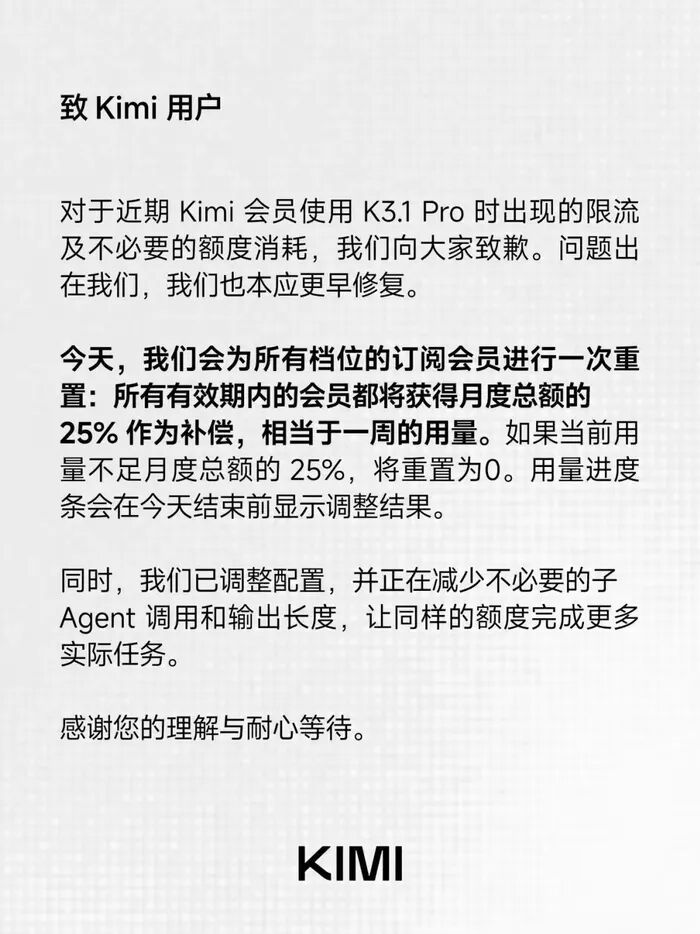
What went wrong? When a user issues a command, multiple sub-Agents may activate in the background to handle task decomposition, parallel retrieval, material analysis, result checking, and output summarization. What users see as a single task may involve a series of model calls. The more complex the task, the more Tokens and computing resources are consumed in the background.
Similar complaints have surfaced in Claude's user community.
One Reddit user reported that Claude Opus 5.5 automatically launched 12 peer sub-Agents while organizing 87 text materials, exhausting a 5-hour quota in just 5 minutes. Another user said processing code tasks with Opus 5.5 triggered the 5-hour limit in under 30 minutes.
While these cases may not be widespread, complaints about rapid quota depletion highlight a real issue with Agent products: How much do backend calls increase computing costs, and what actual benefits do they deliver to users?
Yesterday, Anthropic filed for an IPO with the U.S. Securities and Exchange Commission, listing access to sufficient computing resources and ongoing investment in computing infrastructure as key operational and risk factors in its prospectus. It also disclosed its use of various computing resources, including AWS Trainium, Google TPU, NVIDIA GPU, and AMD GPU.
Users care about quota sufficiency, while model companies must consider how much computing power is needed to support complex tasks and whether it can yield sufficient commercial returns.
A potential procurement order recently revealed by Reuters has brought this supply-demand pressure to a broader industrial scale.
According to Reuters, citing sources familiar with the matter, ByteDance, Alibaba, and Tencent have placed combined orders for over 3 million NVIDIA RTX PRO 5500 cards, valued at approximately $11,400 each, translating to potential orders exceeding $35 billion. However, NVIDIA cannot guarantee full fulfillment, and actual deliveries may fall far short of intended orders.
While $35 billion in potential orders and user complaints about rapid quota depletion seem like unrelated issues, both are tied to growing inference demand. As AI shifts from answering questions to executing complex tasks, computing resource consumption rises, and pressure extends from users to model companies and the chip supply chain.
How much has inference computing demand grown? Why are Chinese internet giants concentrating their purchases on an NVIDIA card that underperforms top-tier data center chips? How will this card-buying spree impact the commercialization of domestic chips?
Why are even workstation cards in high demand? What are the tech giants anxious about?
A year ago, products like the RTX PRO 5500 might not have drawn such attention.
According to previous Reuters reports, when NVIDIA launched restricted products like the RTX 6000D for the Chinese market, some large tech companies showed little interest, deeming the chips overpriced for their performance. They also hoped the U.S. government would allow more powerful products back into the Chinese market.
This wait-and-see approach yielded no definitive results. U.S. chip export restrictions to China persist, with products like the H200 requiring special licenses and higher-performance models like the B300 barred from sale to China under current rules. Meanwhile, AI models and applications continue to expand, requiring ongoing deployment of new models and service scaling, but computing supply struggles to keep pace with business needs.
In this supply-demand environment, available and deployable computing power matters more than ideal chip specifications.
What can the RTX PRO 5500 do? Positioned as a professional workstation GPU under NVIDIA's Blackwell architecture, it features 84GB of GDDR7 memory, ~1,398GB/s memory bandwidth, and a maximum power consumption of 600W. NVIDIA targets it at professional workloads like Agentic AI, physics-based AI, simulation, and graphics processing.
With 84GB of memory and corresponding compute power, it can handle some AI inference tasks. Unlike consumer-grade GPUs, professional workstation GPUs offer design and support tailored to professional scenarios.
However, it should not be confused with high-end data center chips like the H200 or B300, which are designed for large-scale data center clusters, high-intensity AI training and inference, and heavy model workloads through massive interconnectivity. The RTX PRO 5500 is more akin to a workstation GPU capable of professional computing and some AI inference tasks.
Whether a model can run efficiently depends on its size, quantization method, parallel deployment, software compatibility, and actual throughput.
While it can address some computing needs, it cannot simply replace high-end data center GPUs based solely on its 84GB memory. Reuters, citing sources, said Chinese companies are purchasing these cards primarily for AI inference.
Inference occurs after model training: a user question, code generation, enterprise knowledge base query, or even an Agent executing multiple model calls during a task all generate inference computing demand.
Training is like concentrated construction, while inference is like daily water supply. Model training typically aggregates computing power for parameter updates over a relatively short period. Inference follows product usage—the more users, frequent calls, and complex tasks, the more sustained computing supply is needed.
As Agents shift from "answering questions" to "executing tasks," inference volume multiplies. A single user request may involve retrieving materials, decomposing tasks, calling tools, generating results, and checking outcomes. Companies now focus on "whether models can run continuously, stably, and economically" rather than "whether they have enough cards for training."
This explains why a product underperforming top-tier data center chips is still in high demand among tech giants.
What are these cards specifically used for? We sought clarification from Tencent and ByteDance on procurement volumes, deployment scenarios, and alternatives. Tencent said it was unaware, while ByteDance and Alibaba had not responded by press time.
Existing information is insufficient to break down this order into specific business plans for the three companies: it cannot be confirmed that ByteDance's purchase is solely for Doubao, Alibaba's for QianWen, or the exact volumes, deployment locations, or whether they will be paired with domestic chips. What can be confirmed is the industrial application direction. Theoretically, these cards could support online services for small-to-medium-scale models, some enterprise internal AI applications, Agent task execution, and professional computing workloads with memory requirements. Specific tasks would require evaluating parameter sizes, quantization schemes, concurrent requests, and latency requirements. Some applications may use multi-card deployments, but efficiency and costs cannot be directly inferred from single-card specs.
Inference does not entirely exclude training. Workstation GPUs can be used for development, testing, and light fine-tuning, but Reuters points to AI inference as the primary use in this procurement. Without further evidence, it should not be interpreted as the companies stockpiling top-tier pre-training computing power.
The lack of a complete shift to domestic chips stems from software ecosystems, existing clusters, migration costs, and deployment efficiency. Purchasing NVIDIA cards does not preclude the use of domestic chips; they may simply supplement existing computing infrastructure. The more pressing questions are how much companies are willing to pay for accessible inference computing power and how they forecast future demand to scale.
It is also important to clarify that the $35 billion order figure does not equate to confirmed revenue for NVIDIA.
According to Reuters, Chinese clients have requested over 6 million cards, but NVIDIA expects global RTX PRO 5500 production to reach no more than 3 million by 2027. The company must also balance other product lines and allocate more capacity to its next-gen Rubin platform.
Even if all procurement intentions materialize, deliveries will be constrained by production capacity. For buyers, locking in supply secures future resources. Even if final deliveries fall far short of initial requests, obtaining some cards could support computing expansion or adjust existing cluster workloads.
The value of locked-in supply depends on contract terms, final transaction prices, actual delivery volumes, and whether products can be deployed as planned. For capital markets, these are the key details to track when assessing order value.
For NVIDIA, this order demonstrates that despite export restrictions on some high-end products, the Chinese market still values its product ecosystem and computing capabilities. However, translating demand into actual revenue depends on subsequent deliveries.
For the industry, supply capabilities now influence the speed of AI service deployment. While chip performance remains important, procurement and delivery uncertainties have become real variables in computing competition.
Card purchases are just the beginning—the commercial math of AI inference is the real challenge
While the $35 billion procurement intention reflects tech giants' expectations for future computing demand, it does not directly prove that China's AI inference market is facing across-the-board supply shortages.
IDC data shows that in the first half of 2026, China shipped approximately 2.008 million AI accelerators, with NVIDIA accounting for 34% (678,000 units) and Huawei 28% (572,000 units). Alibaba's T-Head held 7%, Cambricon 5%, Baidu Kunlunxin 4%, and Hygon 3%.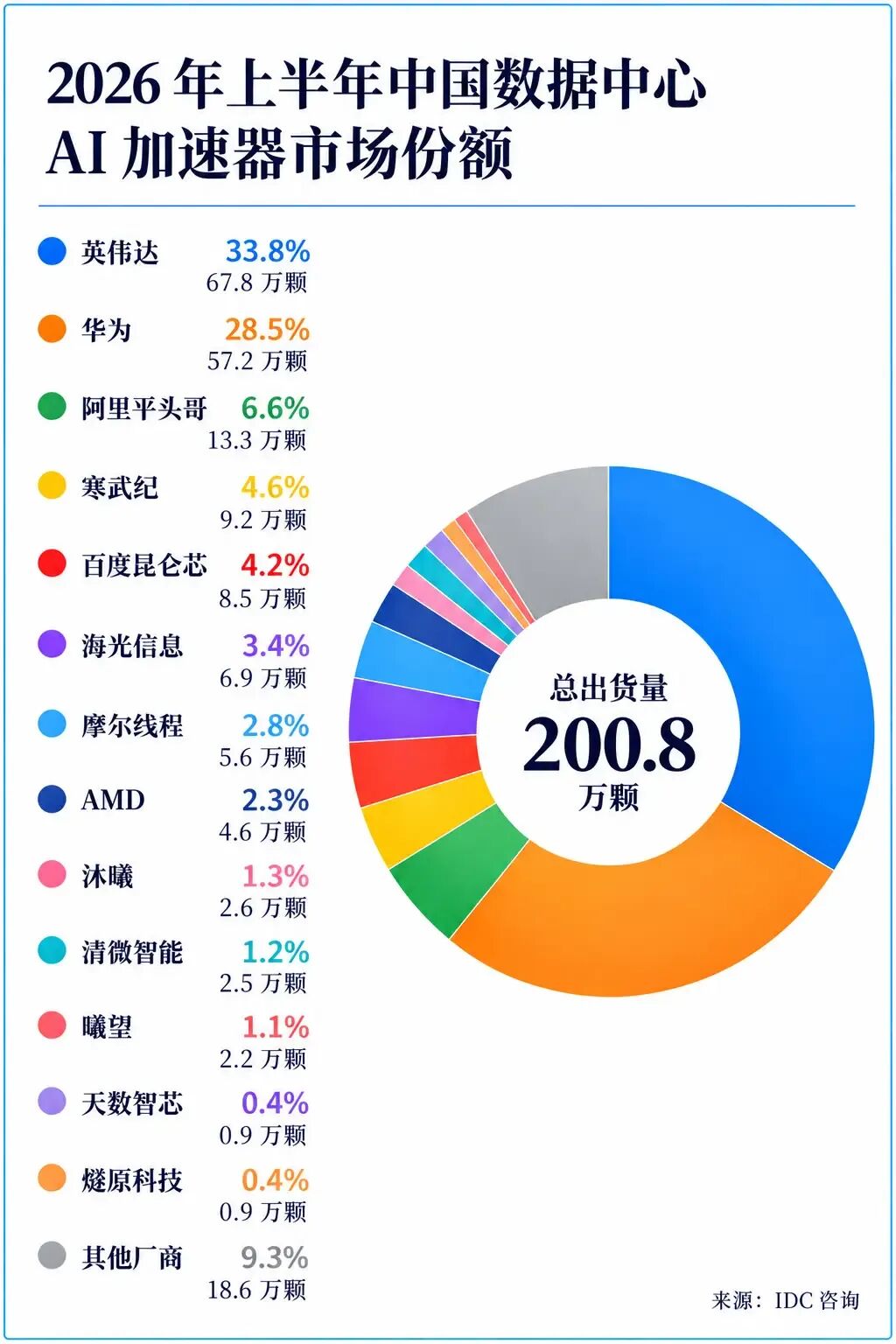
During the same period, China's GPU shipments declined 26% year-on-year to ~991,000 units, while other AI accelerator shipments surged nearly 80% to ~1.016 million units, surpassing GPUs. IDC projects that China's total AI accelerator shipments will grow 19% in 2026, with GPU shipments potentially declining 9%.
Demand for AI computing resources continues to rise, but the supply structure is shifting. Beyond GPUs, other AI accelerators are gaining market share, boosting shipments for domestic vendors.
Thus, this card-buying spree cannot be simplified as a shortage of all computing types. What companies truly need is computing resources that can run target models, meet concurrency and latency requirements, and be deployed promptly.
A chip's memory, bandwidth, compute power, and software support affect whether a model can run and its efficiency. In actual operations, servers, networking, scheduling, and maintenance must also be considered. Even if two chips have similar theoretical compute power, their actual throughput, response latency, and total costs may vary significantly.
For companies needing to launch model services quickly, procurement timing is also critical. After chips arrive, model adaptation, system deployment, and business testing require additional investment. If migrating existing systems demands extensive engineering overhauls, time and costs will influence final decisions.
This explains why NVIDIA products remain attractive. Its long-established CUDA ecosystem, operator libraries, and development tools offer engineering convenience, allowing companies to leverage existing development and maintenance experience and reduce uncertainty during migration.
However, even if chips arrive smoothly, companies must consider whether new computing power can generate sufficient revenue.
Assuming the entire order is fulfilled at $35 billion, amortizing equipment costs over five years would still imply ~$7 billion in annual expenses. This calculation illustrates the investment scale but does not represent the actual procurement contracts, payment schedules, or accounting treatments of the three companies.
Moreover, chips are just one part of AI infrastructure costs. Servers, networking equipment, data centers, power, cooling, and maintenance all incur expenses. If equipment utilization is low, unit computing costs may rise. If model services charge low fees or have poor user payment rates, new computing power may not generate sufficient revenue.
Conversely, if a company's AI services already have a large number of paying users, or if the addition of new computing power can significantly improve service quality and expand usage scale, then investment in computing power may also help the company establish new revenue streams.
Therefore, determining whether this procurement is cost-effective requires examining several operational metrics: the comprehensive cost per million Tokens, the effective throughput per card, computing power utilization, the volume of paid AI service calls, and whether related business revenue can cover depreciation and operational expenses.
The return paths vary among different companies. Cloud providers can directly generate revenue by selling computing power and model services; platform companies with consumer-grade AI products may indirectly achieve returns by improving user retention and driving advertising or transaction conversions. The commercial value of the latter may not be directly reflected in the revenue from AI products, but it still needs to be validated through actual operational data.
From procurement intentions to chip delivery, and then to the realization of business revenue and profit, the $35 billion investment gains clearer commercial significance.
How will the computing power dividends of domestic substitution materialize amid the rush for chips?
This order occurred during a period of ongoing adjustments to U.S. chip export policies toward China. Sales restrictions vary across different products, and understanding these rules is essential to grasp why major companies are rushing to acquire chips and the competitive environment faced by domestic chips.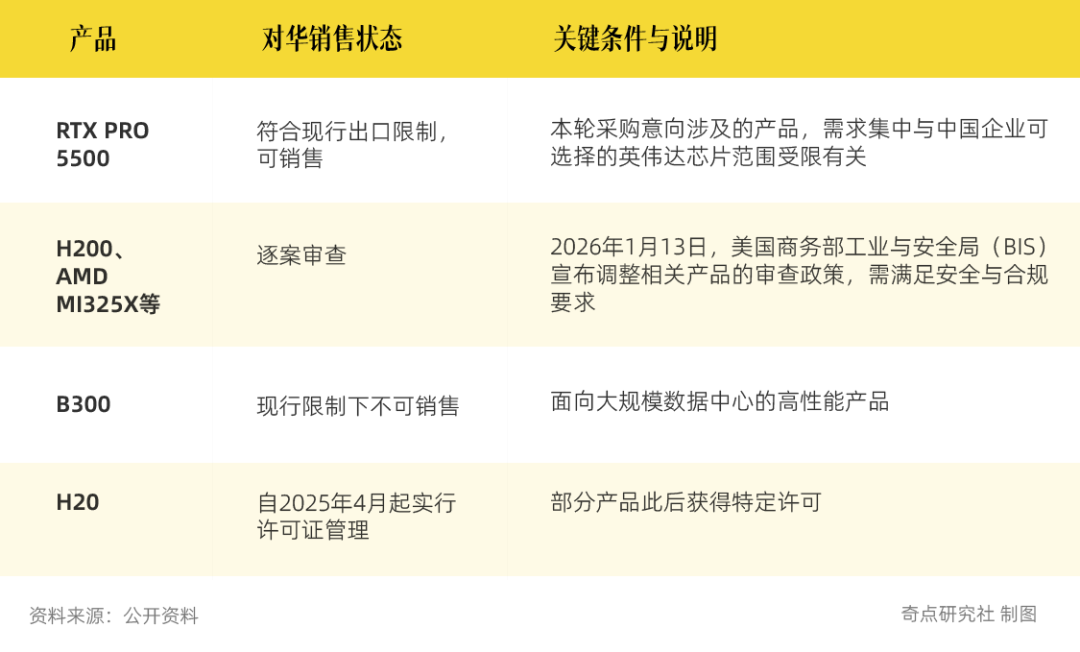
(Note: As of October 2026, specific sales and deliveries remain subject to relevant licenses, supply arrangements, and import policies.)
In its 2026 regulatory filings, NVIDIA disclosed that despite the approval of licenses related to the H200, restrictions imposed by the Chinese government on imports still affected the actual sales of some products, preventing the company from selling all licensed products.
This means that whether chips can enter the Chinese market depends not only on U.S. export approval but also on the qualifications of the purchaser, supply arrangements, and China's import policies. For procuring companies, compliance with export restrictions is just the starting point; timely delivery and deployment in business operations are equally important.
If NVIDIA can stably provide more compliant products in the future, some companies may readjust their procurement plans. For clients already deeply using NVIDIA's software ecosystem, continuing to procure compatible products can reduce migration and adaptation costs; domestic chip manufacturers will face more direct competition.
However, the restoration of imported supplies does not mean that domestic substitution will lose its opportunity. According to IDC data cited by Reuters, in the first half of 2026, Huawei accounted for 28% of China's AI accelerator market in terms of shipment volume; domestic suppliers such as T-Head, Cambricon, Kunlunxin, and Hygon also secured certain market shares. Domestic manufacturers are expanding their shipments and accumulating experience in software adaptation and cluster operations through actual deployments.
For major companies like Tencent, Alibaba, and ByteDance, the stability of computing power supply is increasingly important. Training, inference, and cloud services all require continuous investment in computing resources, and policy or production risks associated with a single supply channel may affect business expansion. Therefore, companies are motivated to evaluate different chip solutions and configure computing power according to task requirements.
NVIDIA's supply constraints have opened a market window for domestic chips. Whenever news of large-scale computing power procurement is released, the capital market searches for potential beneficiaries. However, from procurement intentions to the performance of listed companies, multiple steps still need validation.
Server and system integrators may benefit from subsequent deployments, but the RTX PRO 5500 is a workstation GPU, and its deployment method differs from that of large-scale data center GPU clusters. Merely relying on procurement volume cannot estimate server demand, let alone directly determine corresponding rack, network, and cooling solutions.
Power supply, cooling, and data center infrastructure companies may also see incremental demand, with the specific scale depending on chip deployment methods, power consumption configurations, and whether existing facilities can accommodate them. High-speed interconnects such as optical modules require more cautious judgment. Large AI clusters may drive demand for high-speed networks, but this procurement round does not equate to data center interconnect orders of the same scale. Whether related companies benefit depends on whether specific projects and equipment procurement can materialize.
Domestic chips and their supporting ecosystems also have the opportunity to meet some of the new demand, but it still takes time from customer testing to large-scale deployment and then to revenue recognition by listed companies. To assess the extent to which specific companies benefit, their product capabilities, customer orders, mass production delivery, and financial contributions should be further verified.
Procurement demand, chip delivery, infrastructure construction, orders for listed companies, and final revenue are five distinct steps. While the computing power concept is associated with this order, it does not mean that related companies will necessarily benefit; only by identifying specific business connections can investment logic be supported.
Conclusion
The $35 billion procurement intention reflects the expectations of leading companies regarding future inference demand, while also exposing practical issues such as supply constraints for imported chips and the need for continuous validation of domestic solutions.
For procuring companies, securing computing power resources is a prerequisite for business expansion. Subsequent steps include deployment, controlling inference costs, and ensuring that the additional computing power serves actual business needs.
For domestic chip manufacturers, supply gaps provide opportunities, but long-term competitiveness still depends on product capabilities, software ecosystems, and delivery capabilities. For the capital market, order volume cannot replace judgments about actual projects and performance.
The ultimate industrial impact of this chip rush depends on who can stably acquire computing power and convert it into lower costs, better services, and sustainable revenue.

Editor: Muren
Reviewer: Zhang Wenxin
Producer: Rui Zong
-
![]()
Q3 Report | Shannon Semiconductor’s Revenue Tops 100 Billion, Net Profit Soars Nearly 14-Fold Amid Storage Business Expansion
-
AI-Driven Computing Power Propels Segment Leader’s Q3 Net Profit Up by 160.77%
-
Anthropic Unveils IPO Prospectus, Reveals $16.3 Billion in H1 Revenue
-
![]()
The Largest IPO in History is Imminent: Tencent, Alibaba, and ByteDance Compete for Cards as Anthropic and Chinese Giants Go All-in on Computing Power
-
“Scoring High” Doesn’t Equate to “Deliverability”: AI Leaderboards Are Undergoing a Credibility Reassessment
-
![]()
Jiemei Technology Unveils Massive 2.684 Billion Yuan Investment to Boost Optical-Grade BOPET Film and High-End MLCC Release Film Production!
-
![]()
Physical AI Fuels Optical Components! Yongxin Optics Reports 37.43% Surge in Q3 Net Profit
-
![]()
Raising 1.3 Billion Yuan, Former Doubao Leader Embarks on New Journey: Developing an AI Assistant, Yet Profitability Still a Hurdle