Q3 Report | Shannon Semiconductor’s Revenue Tops 100 Billion, Net Profit Soars Nearly 14-Fold Amid Storage Business Expansion
 10/27 2026
 531
Author|Ren Tianqin
Editor|Chen Xiaoran
Own-Brand Business Emerges as a New Driver of Profit Growth
On the evening of October 26, Shannon Semiconductor (300475.SZ) released its Q3 financial report for 2026.
Against a backdrop of rising global memory chip prices and growing demand for AI servers, the company has achieved remarkable growth in both revenue and profit.
Rapid Performance Expansion
According to the latest financial report, Shannon Semiconductor’s performance in the first three quarters of 2026 demonstrated significant growth.
For the first three quarters, the company’s operating revenue reached 106.426 billion yuan, marking a year-on-year increase of 303.14%. Net profit attributable to shareholders stood at 5.34 billion yuan, up 1386.13% year-on-year, while net profit excluding non-recurring items reached 5.293 billion yuan, a year-on-year rise of 1385.34%.
In Q3 alone, Shannon Semiconductor reported operating revenue of 46.221 billion yuan, a year-on-year increase of 398.27%. Net profit attributable to shareholders was 1.699 billion yuan, up 743.02% year-on-year.
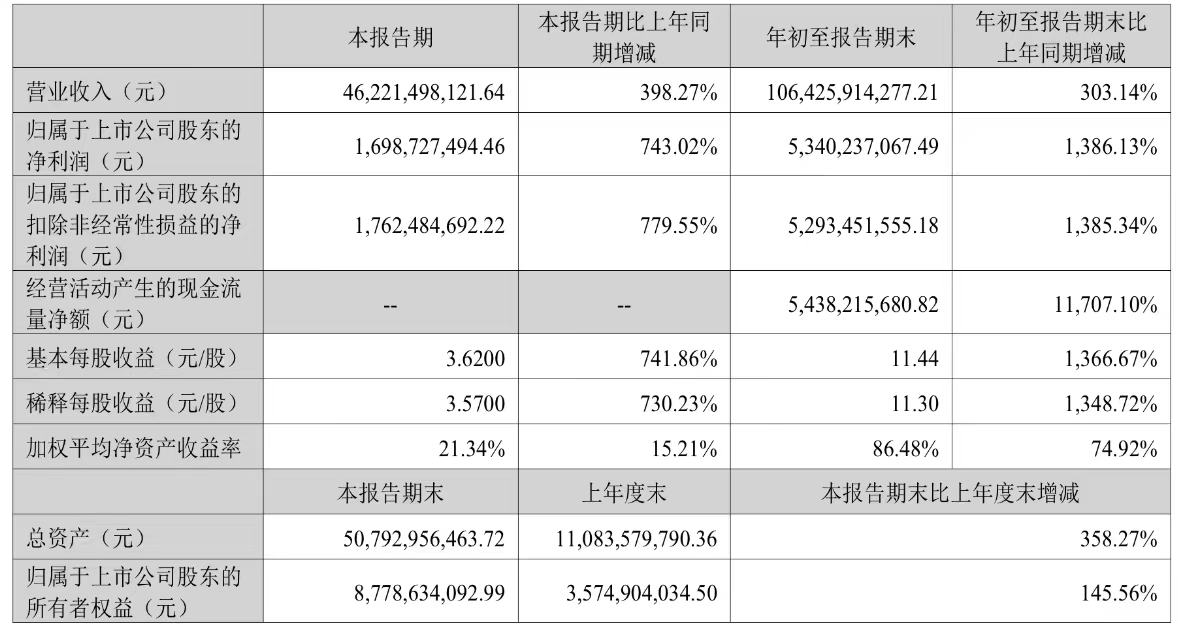
Image Source: Shannon Semiconductor Announcement
Notably, despite a nearly fourfold year-on-year increase in Q3 revenue, net profit attributable to shareholders declined month-on-month (by approximately 26.6%) compared to the second quarter’s 2.314 billion yuan.
This suggests that even during a period of rising memory chip prices, changes in sales revenue and profit do not always align perfectly.
From a profitability standpoint, Shannon Semiconductor’s net profit margin attributable to shareholders for the first three quarters of 2026 was approximately 5.02%. While this figure may appear low, it is important to consider that Shannon Semiconductor’s core business is semiconductor distribution, which involves large revenue volumes and high product procurement costs. Therefore, the substantial growth in net profit remains noteworthy.
In terms of cash flow, the net cash flow generated from operating activities in the first three quarters of 2026 was 5.438 billion yuan, representing a year-on-year increase of 11707.1%.
However, for semiconductor distribution companies, improvements in operating cash flow must be evaluated in conjunction with procurement settlement methods. The company’s previous semi-annual report indicated that some procurements were settled using letters of credit, with related margins counted as cash outflows from financing activities. Consequently, it is not possible to conclude that all operating funding pressures have been alleviated based solely on the growth in operating cash flow.
As of the end of September 2026, Shannon Semiconductor’s total assets reached 50.793 billion yuan, a 358.27% increase from the end of the previous year. As the business scale expands, the importance of procurement, inventory, and capital turnover management becomes increasingly critical.
The company previously disclosed that the year-on-year increase in product sales prices was a significant factor driving the substantial revenue growth. Changes in storage market prices are directly impacting its operating performance.
Simultaneous Growth Across Two Business Segments
Shannon Semiconductor’s current main business is divided into two segments: electronic component distribution and own-brand storage products.
Electronic component distribution remains the primary revenue source, primarily conducted through its subsidiary, United Innovation Technology.
United Innovation Technology holds product agency resources from semiconductor manufacturers such as SK Hynix, supplying storage chips and other products to downstream customers in cloud computing, data centers, servers, and other electronic products.
This business model differs from that of chip design and manufacturing companies.
Distributors primarily rely on upstream supply resources, customer channels, procurement capabilities, and capital turnover to generate revenue. When memory chip prices rise, higher product selling prices expand revenue scale, while changes between procurement costs and sales prices directly impact profitability.
According to the company’s 2026 semi-annual report, the electronic component distribution business achieved revenue of 56.402 billion yuan, a year-on-year increase of 239.44%, with a gross profit margin of 8.89%.
In contrast, the growth of the own-brand Hype Storage business is particularly noteworthy.
In the first half of 2026, Hype Storage achieved revenue of 3.626 billion yuan, a year-on-year increase of 996.19%, with a gross profit margin of 53.51%, significantly higher than that of the distribution business.
Hype Storage primarily targets the data center and server markets, offering products such as enterprise-grade DDR4 and DDR5 memory, as well as PCIe Gen4 enterprise-grade solid-state drives (SSDs).
These products must meet stringent server requirements for performance, stability, compatibility, and continuous operation capabilities, often requiring platform adaptation and customer verification.
It is important to clarify that Hype Storage’s own-brand business does not imply that Shannon Semiconductor has acquired DRAM or NAND Flash wafer manufacturing capabilities. Its primary value lies in storage product research and development, solution integration, adaptation testing, and customer service.
According to the semi-annual report, the profit contribution of Hype Storage’s business to the company’s net profit attributable to shareholders increased by 17.76 percentage points year-on-year.
This indicates that, in addition to the traditional distribution business benefiting from rising storage prices, Shannon Semiconductor’s own-brand business is emerging as a new and significant contributor to profit growth.
Shifts in Storage Demand
The industry backdrop for Shannon Semiconductor’s performance growth is the sustained increase in demand for AI servers and changes in the global memory chip supply structure.
Historically, the primary demand for memory chips came from smartphones, personal computers, and traditional servers, with industry prices significantly influenced by end-user consumption and inventory cycles.
Today, AI infrastructure construction is driving new demand.
Large-scale model training requires high-bandwidth memory to support data processing, while the expansion of inference applications has also increased the use of server memory, data caching, and enterprise-grade SSDs.
At the same time, storage manufacturers such as Samsung, SK Hynix, and Micron continue to allocate some of their advanced process capacity toward high-value-added products like server DRAM and HBM, further impacting the supply of other storage products.
According to a forecast released by TrendForce on September 30, 2026, contract prices for general-purpose DRAM are expected to rise by 10% to 15% quarter-on-quarter in Q4 2026, while contract prices for NAND Flash are expected to increase by 15% to 20%.
Among these, demand for enterprise-grade SSDs is particularly notable.
TrendForce expects contract prices for enterprise-grade SSDs to rise by 23% to 28% quarter-on-quarter in Q4. Increased procurement by North American cloud service providers and AI applications’ demand for large-capacity, high-efficiency data storage are the primary driving factors.
A notable aspect of this round of changes is that AI’s impact on the storage industry is expanding from high-end HBM to a broader range of server memory and enterprise-grade SSD markets.
For Shannon Semiconductor, its existing memory chip distribution channels enable it to participate in the global storage market’s demand growth, while the development of Hype Storage’s business provides the company with opportunities to further expand its own-brand presence and increase product value-added.
However, the cyclical nature of the storage industry cannot be overlooked.
Rising storage product prices may boost revenue and profit, but price declines can also bring risks such as inventory write-downs, declining gross profit margins, and adjustments in customer procurement.
Additionally, the distribution business has high requirements for upstream suppliers, core customers, and capital turnover capabilities. Expanding revenue scale does not necessarily mean sustained improvement in profitability.
Shannon Semiconductor’s operating performance in the first three quarters reflects the improved market sentiment in the memory chip sector and the positive impact of the company’s business scale expansion.
Looking ahead, Shannon Semiconductor’s ability to sustain growth will depend not only on global memory chip prices and supply-demand changes but also on whether Hype Storage can further expand product sales and improve the stable profitability of its own-brand business.
For investors, in addition to monitoring short-term performance changes driven by rising storage prices, the profitability of the distribution business, the proportion of own-brand revenue, and operating capital turnover efficiency are also important indicators for assessing the company’s long-term value.
-
![]()
Q3 Report | Shannon Semiconductor’s Revenue Tops 100 Billion, Net Profit Soars Nearly 14-Fold Amid Storage Business Expansion
-
AI-Driven Computing Power Propels Segment Leader’s Q3 Net Profit Up by 160.77%
-
Anthropic Unveils IPO Prospectus, Reveals $16.3 Billion in H1 Revenue
-
![]()
The Largest IPO in History is Imminent: Tencent, Alibaba, and ByteDance Compete for Cards as Anthropic and Chinese Giants Go All-in on Computing Power
-
“Scoring High” Doesn’t Equate to “Deliverability”: AI Leaderboards Are Undergoing a Credibility Reassessment
-
![]()
Jiemei Technology Unveils Massive 2.684 Billion Yuan Investment to Boost Optical-Grade BOPET Film and High-End MLCC Release Film Production!
-
![]()
Physical AI Fuels Optical Components! Yongxin Optics Reports 37.43% Surge in Q3 Net Profit
-
![]()
Raising 1.3 Billion Yuan, Former Doubao Leader Embarks on New Journey: Developing an AI Assistant, Yet Profitability Still a Hurdle