MIIT Approves 6G Ministry-Province Collaborative Pilot in 8 Provinces and Municipalities: A Comparative Analysis of Regional Industrial Advantages
 11/19 2026
 380
Recently, the Ministry of Industry and Information Technology (MIIT) issued reply letters approving Beijing, Hebei, Shanghai, Jiangsu, Zhejiang, Anhui, Hubei, and Guangdong to carry out 6G innovation and development ministry-province collaborative pilot work. The strategic goal of this pilot is to foster a nationally coordinated approach to 6G innovation, guide localities to leverage their comparative advantages, explore distinctive and complementary development paths, and avoid homogeneous competition.
The pilot work will focus on the following areas:
Technology research collaboration: Strengthen research on 6G frontier technologies and convergent technologies such as AI and satellite internet.
Industrial R&D collaboration: Promote the R&D and cultivation of related industries such as 6G base stations, core networks, chips and devices, new terminals, and operating systems.
Application cultivation collaboration: Explore 6G applications for potential scenarios such as immersive communications, industrial manufacturing, the low-altitude economy, embodied intelligence, and smart oceans.
Project layout collaboration: Systematically lay out key tasks such as technology research, standards development, and product R&D, and coordinate national and local projects.
Drawing on the Huoshi Xinglan Industrial Intelligence Agent desktop, this article analyzes the 6G industrial foundations of the eight provinces to provide a reference for regional industrial layout.
01
National 6G Industrial Foundation
On the national 6G industry map, the entire industrial chain presents a typical "thick upstream, thin downstream" structure. Most linked enterprises (referring to main businesses in the industrial chain) are concentrated in upstream components and materials, accounting for nearly two-thirds; the midstream ranks second, accounting for about 30%; the downstream and support guarantee systems are limited in scale.
Broken down to the third-level segments, concentration is even higher. Upstream "6G high-frequency materials, packaging interconnect and common chips" and "terahertz communication devices and transceiver front-ends" together account for nearly 80% of total upstream enterprises. Midstream thickness is concentrated in the antenna and networking segments, with roughly equal numbers of enterprises but marked differences in technological quality: high-tech enterprises account for over 70% in the ultra-large-scale antenna and reconfigurable intelligent surface segments, while the high-tech share in the space-air-ground integrated fusion and network architecture segments is less than half—a difference of nearly twofold.
Overall, current chain participants are still dominated by device and material suppliers, while entities responsible for new radio, integrated sensing and communication, standards setting, and test verification have yet to take shape. This is consistent with the stage characteristics of 6G being in the standards development window, and is a matter of industrial development rhythm.
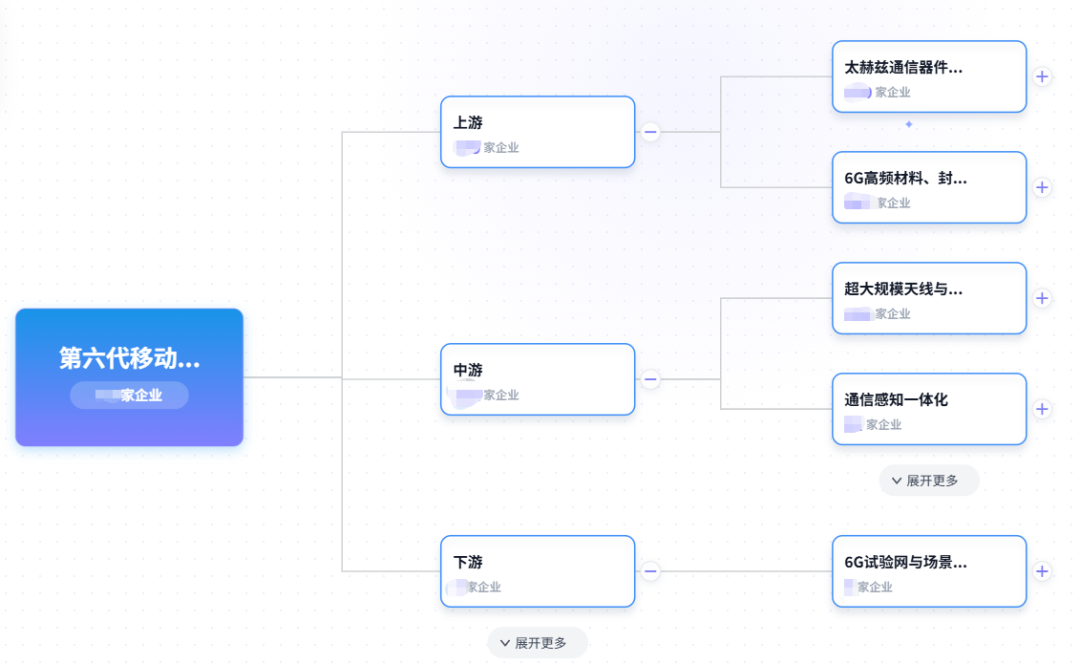
Figure: 6G Industrial Chain Map
Source: Huoshi Xinglan Industrial Intelligence Agent
[Note] Linked enterprises are main businesses in the industrial chain. The upstream of the industrial chain includes terahertz communication devices and transceiver front-ends, 6G high-frequency materials, packaging interconnect and common chips; the midstream covers ultra-large-scale antennas and reconfigurable intelligent surfaces, integrated sensing and communication, 6G new radio technologies and AI-native communications, space-air-ground integrated fusion and 6G network architecture; the downstream is 6G test networks and scenario verification; the support segments cover 6G test instruments and test systems, 6G standards, spectrum and intellectual property, 6G international cooperation and competition landscape, etc.
02
Industrial Foundations of Each Province
According to the 6G industrial chain map of the Huoshi Xinglan Industrial Intelligence Agent, the eight provinces and municipalities together account for about 70% of the national total of linked enterprises, with each province having its own strengths.
Beijing: Standards Setter, Test Platform Organizer
Beijing's advantage lies in the dense concentration of standards, test networks, and national platforms. The headquarters of the three major operators—China United Network Communications Group Co., Ltd., China Telecom Corporation Limited, and China Mobile Communications Corporation—are all linked to the midstream 6G segment, and Beijing has the largest number of downstream enterprises among all provinces.
In terms of national-level carriers, the IMT-2030 (6G) Promotion Group was established under the leadership of the China Academy of Information and Communications Technology, and its 6G AI Ad Hoc Group and Non-Terrestrial Network (NTN) Working Group are both based in Beijing. MIIT has approved the 6GHz band (6425–7125MHz) 6G trial frequency license to the Promotion Group. In terms of field verification, the Beijing Huairou test field has completed test cases for multiple technical directions; China Mobile has built a 6G field verification environment in Beijing and achieved multi-node connectivity with Hong Kong, Peng Cheng Laboratory, Xiong'an, and others; the Beijing 6G Application Innovation Laboratory has been established in Changping District.
At the policy level, Beijing was the first in the country to release the "6G Science and Technology Innovation and Industrial Cultivation Action Plan (2024–2030)," and the Beijing Economic-Technological Development Area has also issued special support measures. Accordingly, Beijing's role in the pilot is "task organizer + verification site," and its industrial transformation can rely on scenario division of labor with Tianjin and Hebei.
Guangdong: Complete Chain, Advantages in Network Architecture and Complete Equipment
Guangdong is one of the provinces with the most complete industrial chain coverage among the eight, with a significant proportion of midstream enterprises and a dense concentration of upstream high-tech enterprises. Representative enterprises include Huawei, ZTE, and Sunway Communication.
Guangdong ranks among the top of the eight provinces and municipalities in the number of linked enterprises in segments such as space-air-ground integrated fusion and 6G network architecture, integrated sensing and communication, and test instruments. Scientific research progress is likewise concentrated at the system level—Peng Cheng Laboratory released the world's first 6G semantic communication base station prototype based on a semantic knowledge base, which has achieved application verification in scenarios such as high-orbit satellite and intelligent machine communications; its jointly declared project "Key Technologies for Terahertz Fundamental Wave Devices and Integrated Chips for Ultra-High-Speed Communications" was selected as one of the "Top Ten Scientific and Technological Advances in Information and Communications in 2025" by the China Institute of Communications. ZTE has formed multiple 6G key technologies and released the industry's first 256TR 6G prototype in the U6GHz band, achieving breakthroughs in multi-user peak rates.
Jiangsu and Zhejiang: Moats in Upstream Materials and Mass-Production Devices
The advantages of both provinces are concentrated upstream, with relatively weak network-side and downstream segments. Jiangsu ranks among the top of the eight provinces and municipalities in the number of linked enterprises in segments such as 6G high-frequency materials, packaging interconnect and common chips, terahertz communication devices and transceiver front-ends, and ultra-large-scale antennas and reconfigurable intelligent surfaces. High-tech enterprises account for more than half of upstream enterprises, and the test instrument segment also ranks among the top of the eight. However, Jiangsu has relatively little layout in segments such as space-air-ground integration and network architecture, and integrated sensing and communication.
Zhejiang's structure is more concentrated, with the vast majority of enterprises located upstream and a high density of specialized, refined, distinctive, and innovative "little giant" enterprises. Representative enterprises include SMIC Integrated Circuit (Ningbo), Yongsi Electronics, Zhenlei Technology, and Chengchang Technology, concentrated in the fields of compound semiconductors and RF chips.
The common shortcoming of both provinces is weak layout in network architecture, integrated sensing and communication, and downstream segments. This means that in the pilot assessment, if scored on system verification and scenario implementation, both provinces need to strengthen network-side entities.
Shanghai: Test Instruments + Satellite Internet Route
Among Shanghai's linked enterprises, the support guarantee system is relatively prominent, including the Shanghai Satellite Internet Research Institute, Chuanyuan Technology, and Huatai Jiguang Optoelectronics; midstream enterprises include Nokia Communications (Shanghai) and VeriSilicon Microelectronics (Shanghai). Shanghai has relative advantages in segments such as space-air-ground integration and network architecture, and test instruments, while it is weaker in terahertz devices, ultra-large-scale antennas, and RIS.
Institutional and trial actions are relatively intensive: the Shanghai Municipal Science and Technology Commission released the application guide for the "6G Science and Technology Innovation and Future Industry Cultivation Strategic Frontier Special Project"; the General Office of the Shanghai Municipal People's Government issued the "Digital Shanghai" Construction "15th Five-Year Plan," proposing to advance intelligent collaboration of 6G test networks; China Telecom Shanghai has completed field testing of U6G trial base stations; and the number of in-orbit satellites of Shanghai Yuanxin's Qianfan constellation continues to increase.
Anhui and Hubei: Research and Device Capabilities Exceed What Enterprise Numbers Suggest
Among Anhui's linked enterprises, the proportion of enterprises in the terahertz communication devices and transceiver front-ends segment is significantly higher than their share of the total, and the proportion of high-tech enterprises among midstream enterprises is relatively high. Representative enterprises include iFlytek, Dafu Technology, and Bowei Terahertz Information Technology; representative upstream entities include Anhui Tongguan Copper Foil Group, Sichuang Electronics, and Anhui Huadong Optoelectronics Technology Research Institute. The scientific research foundation includes the Key Laboratory of Wireless Optoelectronic Communications of the Chinese Academy of Sciences and the Information Network Laboratory of the University of Science and Technology of China. Anhui Province has issued an action plan for future industry development and has publicly solicited opinions on an action plan for future network industry development.
Hubei's midstream enterprises have prominent R&D attributes, with representative enterprises including CITIC Mobile Communication Technology, Wuhan Research Institute of Posts and Telecommunications, and Wuhan Huazhong Kuangteng Optical Technology; representative upstream entities include Wuhan Fangu Electronic Technology and Hubei Feilihua Quartz Glass. Hubei Province has disclosed a relatively strong scientific research foundation, with more than ten national key laboratories in Hubei involving 6G and numerous academicians in communications-related fields. Device breakthroughs are concentrated on the optical side: a team from the Wuhan National Laboratory for Optoelectronics, in collaboration with the University of Cambridge, achieved an avalanche photodiode with a bandwidth exceeding 100GHz for the first time; an ultra-broadband optical modulator above 250GHz developed with the participation of the National Innovation Center for Information Optoelectronics set a world record for same-kind chips. Optics Valley has gathered a large number of optoelectronic information enterprises, with an industrial scale exceeding hundreds of billions of yuan, and about a quarter of the world's optical fiber and cable is produced there. The optoelectronic foundation that can be reused for 6G is Hubei's strength.
Hebei: Scenarios First, Undertaking Transformation of Beijing-Tianjin Achievements
Hebei has a relatively small number of linked enterprises among the eight provinces and municipalities, with representative enterprises including Hebei Huaxun Fangzhou Terahertz Technology, Hebei Xinhuabei Integrated Circuit, Hebei Zhongchuang Yinghe Communication Technology, and Hebei Xiong'an Zhiwo Times Communication Technology. Xiong'an is being advanced as a 6G development pioneer zone, proposing to build a 6G large-scale application demonstration network by 2027, with integrated sensing and communication base stations already deployed in the startup area; China Mobile's 6G field verification environment has also connected the Xiong'an node. Hebei's pilot value mainly comes from the deployment scenarios it can provide and the site hosting in Beijing-Tianjin-Hebei coordination.
In summary, the significance of this 6G ministry-province collaborative pilot is not to select eight "all-around players," but to use the mechanism design of ministry-province collaboration to enable regions with different specialties to complement each other within the same standards window.
The three-year pilot period highly overlaps with the 6G standards development window, and the establishment of an assessment and exit mechanism will further amplify differences in regional performance. For localities, the pilot is both a policy dividend and a timetable: whether they can form verifiable technology research results, reusable scenario application models, and assessable industrial chain collaboration capabilities before the release of the first version of international standards in 2029 will directly determine each province's and municipality's position in the 6G industrial landscape after the pilot period ends.
-
![]()
Between Jing and Jie: Has AITO Landed in an "Intermediate State"?
-
![]()
Apple's 18 New Products: All-Star Lineup for Next Year, With First AI Glasses Finally Making Their Debut
-
![]()
MIIT Approves 6G Ministry-Province Collaborative Pilot in 8 Provinces and Municipalities: A Comparative Analysis of Regional Industrial Advantages
-
Anthropic Goes Public, but Its Values May Determine How Far It Can Go
-
Lei Jun Truly Shows Sincerity: The Overseas Version of the Xiaomi 18 Pro Has Reduced Specs and Costs Nearly 5,000 Yuan More!
-
Memory Prices Are Skyrocketing: Q3 Sees Phone, PC, and Tablet Sales All in Freefall
-
![]()
Why Is Anthropic Worth $1.5 Trillion?
-
These AI Leaders All Studied Physics