A New Landmark: China’s Pure Electric Vehicle Penetration to Eclipse 50%!
 09/10 2026
 476
476
On September 9th, Beijing Time, data released by the China Passenger Car Association (CPCA) on passenger vehicle sales in China for August 2026 revealed that pure electric models achieved a record-high sales proportion of 45.3%. This marks the fifth consecutive month that the sales proportion of pure electric models has surpassed 40%, with a steady month-on-month increase.
Consequently, Li Bin of NIO remarked in his latest internal address that the monthly penetration rate of pure electric vehicles is projected to continue scaling new heights before the year’s end, potentially surpassing 50%. This would represent another significant milestone in the evolution of China’s new energy vehicle sector. NIO, as the sole automaker among the former new car-making forces that has steadfastly adhered to a pure electric strategy, has also reaped the benefits of this market trend.

Historical data from the CPCA indicates that in July 2024, the sales of new energy vehicles in China’s passenger vehicle retail market exceeded 50% for the first time on a monthly basis, reaching 51.1%. Subsequently, only in February 2026 did the sales proportion of new energy vehicles dip below 50%, to 44.9%, due to the reduction in new energy subsidies and the Spring Festival holiday.
However, with policy adjustments by new energy vehicle companies and the surge in international oil prices triggered by the Middle East conflict involving the U.S., Israel, and Iran, the sales and proportion of new energy vehicles have rebounded. Over the past five months, the proportion of new energy vehicle sales has consistently remained above 60%, and in the past two months, it has exceeded 65%. Meanwhile, the market share of traditional fuel vehicles has plummeted to below 35%.
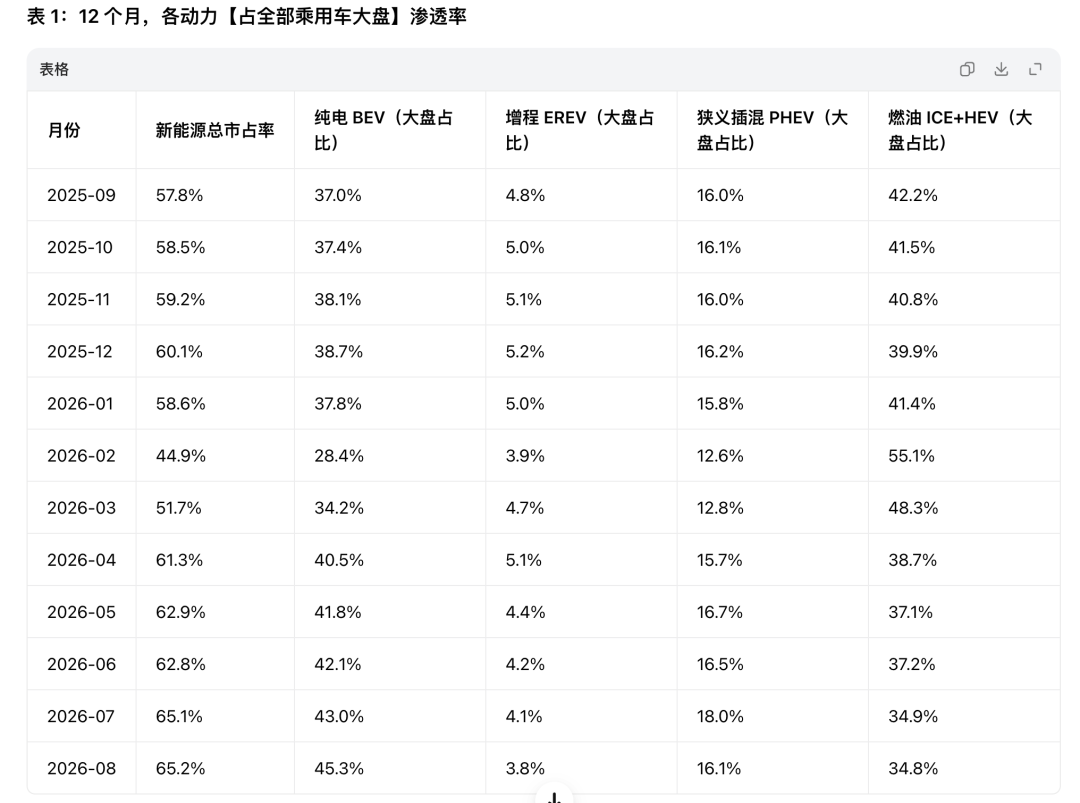
Over the past twelve months, the proportion of pure electric models among new energy models has surpassed 60%. Even in February 2026, when the overall sales proportion of new energy vehicles fell below 50%, the sales proportion of pure electric models among new energy vehicles still stood at 63.3%. In August of the same year, the proportion of pure electric models among new energy models reached an all-time high of 69.5%.
From a market trend perspective, new energy vehicles are encroaching on the market share of fuel vehicles; concurrently, pure electric models are encroaching on the market share of extended-range models.
Statistically, over the past six months, the proportion of extended-range models among new energy models has been on a decline, dropping from 9.1% in March 2026 to 5.8% in August 2026. When considering the overall market share of extended-range models in passenger vehicles, it has been decreasing for the past five months, from 5.1% in April 2026 to 3.8% in August 2026.
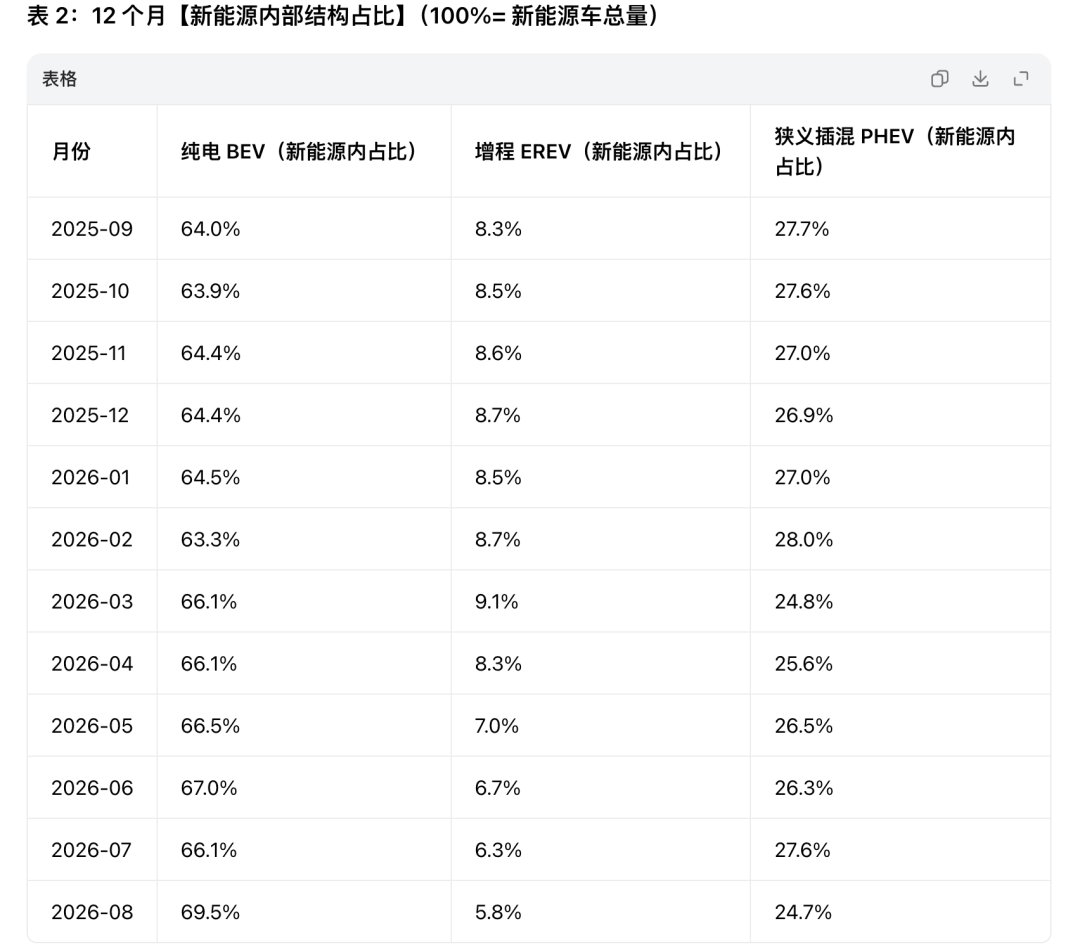
It is noteworthy that the market share of narrowly defined plug-in hybrid electric vehicles (PHEVs) has remained relatively stable over the past 12 months, maintaining a proportion of 24.7%-28.0% among new energy vehicles.
Rewinding to April 3, 2022, BYD officially announced via its official Weibo account that it would cease production of whole fuel vehicles from March 2022 onwards, focusing solely on new energy pure electric and plug-in hybrid models in its automotive sector. At that time, in March 2022, the penetration rate of new energy vehicles in the passenger vehicle market was merely 28.2%.
BYD, the first traditional automaker to announce the cessation of fuel vehicle production, recorded sales of 1.868 million, 3.024 million, 4.272 million, and 4.602 million vehicles from 2022 to 2025, respectively. With the exception of 5,049 fuel vehicles in 2022, all other sales were new energy vehicles.
China surpassed the United States in 2015 to become the world’s largest market for new energy vehicles. In the same year, China also emerged as the world’s largest consumer market for pure electric models, a position it has maintained for 11 years. It is virtually certain that China will continue to be the world’s largest market for new energy vehicles and the largest market for pure electric vehicle sales.
According to statistics from the China Association of Automobile Manufacturers (CAAM), on a comprehensive basis, encompassing passenger and commercial vehicles, as well as total new vehicle sales domestically and for export, the overall penetration rate of new energy vehicles exceeded 50% for the first time on a monthly basis in October 2025, reaching 51.6%. New energy vehicles have also become the cornerstone of China’s automobile exports.
In the pure electric sector, since 2020, 5-6 out of every 10 pure electric models sold globally have been sold in the Chinese market.
The reasons for the continuous surge in sales of pure electric models are as follows:
1. The comprehensive usage cost of pure electric models is advantageous, particularly as oil prices rise, making the cost advantage even more pronounced;
2. The charging speed of pure electric models has improved, with vehicle architectures transitioning from 400V to 800V and above. Especially with the advent of BYD’s flash charging technology, the charging experience is now comparable to the refueling experience. NIO’s promoted battery swapping has also achieved revenue balance through economies of scale;
3. The driving experience of electric vehicles far surpasses that of fuel vehicles at the same price point, and pure electric models can outperform extended-range models in terms of comprehensive experience and lower cost.
The declining market share of extended-range models can be attributed to the dilemma of small batteries in extended-range models. Despite the fact that extended-range models are now equipped with larger batteries, consumer perceptions have been overshadowed by the increasingly convenient charging experience and lower travel costs, which outweigh so-called range anxiety.
Nowadays, the recharging speed of pure electric models is accelerating, and range anxiety is no longer a valid excuse for fuel vehicles and extended-range vehicles to criticize pure electric models.
Therefore, the extended-range brand launched by Xiaomi the day before yesterday was humorously dubbed by the media as an attempt to “crash the old guys’ market” and seize the market of the elderly.
Let’s see if Xiaomi has the capability to single-handedly develop the extended-range market and entice other automakers to join, just as Li Auto did in the past. However, it is worth mentioning that Li Auto’s main models are now pure electric.
What would new energy vehicle brands that once launched extended-range models due to sluggish pure electric sales think now that the market share of pure electric models is about to exceed 50%?
Behind these market shifts lies the rise, decline, and even extinction of some automakers!
The question that arises is: Will pure electric models eventually dominate the market? And how long will it take?
-
Why Are Mobile Phone Prices Rising En Masse? Is AI the Primary Driver?
-
Celebrating Android Manufacturers for Sparking Innovation in Foldable Display Technology
-
![]()
Embracing the 'Lanshan' Legacy: WEY's New Boxy SUV Teases Its 'Entry-Level Pricing'?
-
Xingyu Shares: Governance Weaknesses Come to the Forefront
-
Is Qualcomm in a State of Panic? Apple Adopts Its Self-Developed C2 Modem, Fully Parting Ways with Qualcomm's 5G Chips?
-
![]()
Zotye Automobile Restarts Production
-
![]()
A New Landmark: China’s Pure Electric Vehicle Penetration to Eclipse 50%!
-
![]()
The Loss Conundrum and the High-End Wager: Xiang Xingchu Declares, 'JAC Embarks on Its Third Trailblazing Journey'