Unexpected Trading Suspension! GAC Undergoes Significant Capital Restructuring Amidst Speculation of Mutual Shareholding with FAW, Shaking Up the Automotive Market
 09/14 2026
 445
445
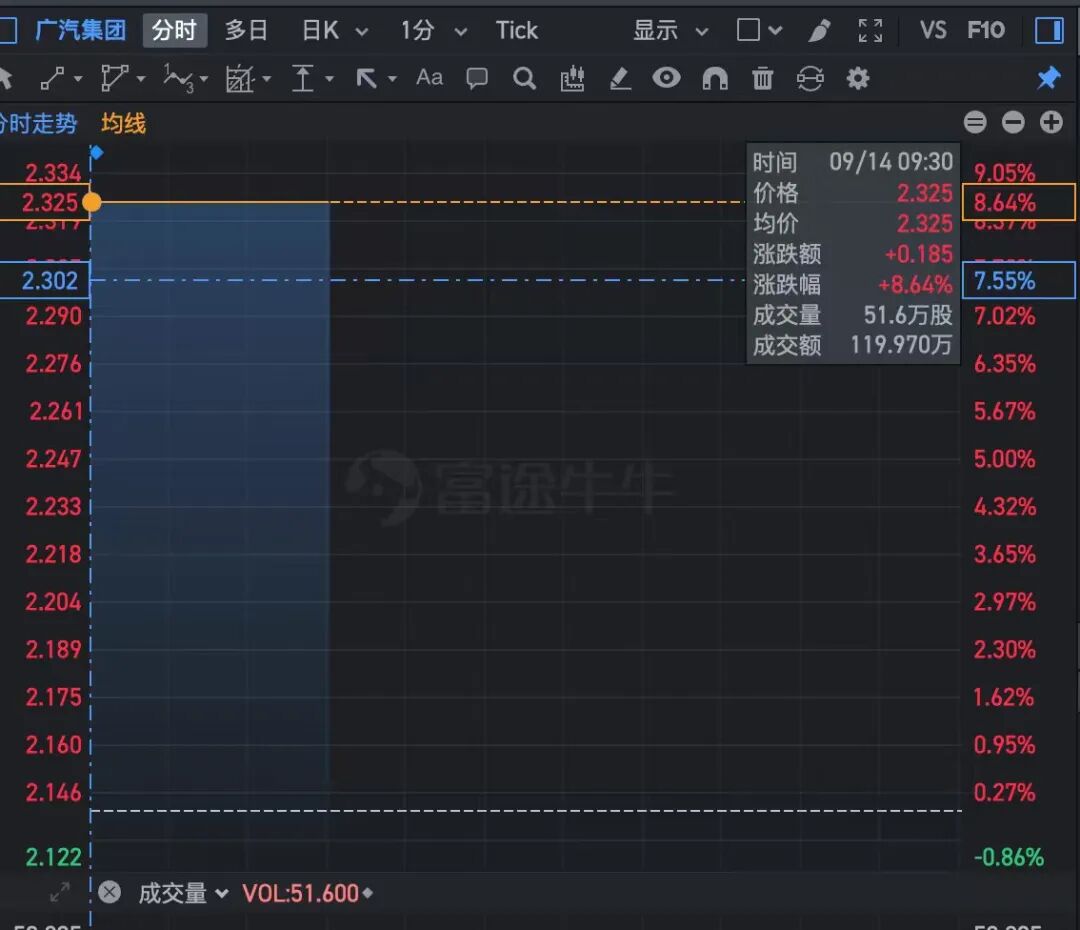
The Hong Kong-listed shares have already soared by 8.64%, yet trading was only halted at this juncture.
At 9:31 AM on September 14, GAC Group abruptly suspended trading for the entire day, with the exchange citing "pending material announcements" as the cause.
The news swiftly reverberated through both the automotive and capital markets, with widespread speculation pointing towards FAW Group and GAC Group moving forward with mutual shareholdings, potentially forging a joint venture between these two state-owned automotive behemoths. GAC simply advised referring to official announcements for relevant information, neither confirming nor denying the market rumors. Initially, Hong Kong-listed shares surged as investors anticipated this major restructuring, but trading was subsequently suspended.
For GAC's share price, which has been under persistent pressure, this trading halt signals industry consolidation and introduces a significant variable amid the company's fundamental challenges.
From a secondary market standpoint, GAC Group's share price has been on a downward trend throughout 2026. By the last trading day before the halt, GAC's A-shares closed at RMB 5.09, with the share price consistently weakening throughout the year, leaving its market capitalization at a mere RMB 51.9 billion, comparable to that of emerging new energy player Leapmotor.
Several factors, including the ongoing price war in the automotive industry, profitability pressures on domestic brands, and declining performance in joint venture segments, have suppressed GAC's valuation. Despite maintaining sales growth in new energy and overseas export businesses, capital markets remain cautious about the pace of profit recovery. Hong Kong-listed shares have also underperformed.
Performance is the primary issue. GAC's current operational reality is characterized by revenue growth coupled with substantial profit losses.
In the first half of the year, the company achieved consolidated total operating revenue of RMB 46.5 billion, up 9.13% year-on-year; operating revenue reached RMB 46.121 billion, up 9.38% year-on-year. Overall group sales volume reached 773,100 units, a slight year-on-year increase of 2.35%, with overseas exports serving as a bright spot, significantly boosting the export scale. While revenue maintained growth, profitability deteriorated markedly, with net profit attributable to shareholders plummeting by RMB 4.467 billion, down 75.98% year-on-year, and net profit attributable to shareholders excluding non-recurring items falling by RMB 5.209 billion, down 76.86% year-on-year.
The sharp decline in profits stems from three main pressures. First, the intensifying price war in the domestic automotive market has compelled GAC's domestic brands to increase marketing and R&D investments to defend market share, while changes in the product mix have further dragged down per-unit profits.
Second, the joint venture segment remains under pressure, with declining terminal sales volume combined with increased channel investments leading to a sharp contraction in investment income from joint ventures. Meanwhile, exchange rate fluctuations have resulted in foreign exchange losses, further eroding profitability.
From an industry-wide perspective, most listed automotive companies achieved profit recovery in the first half of 2026, with GAC ranking among the top losers, underscoring its operational pressures. Revenue growth has relied on sales volume expansion, but this has not translated into profit gains—a core reason why capital markets have continued to depress GAC's valuation this year.
Against this backdrop, rumors of FAW and GAC engaging in mutual shareholdings have sparked significant market speculation. The proposed plan involves cross-shareholdings through equity arrangements and the establishment of a joint venture framework, with FAW potentially becoming a major shareholder in GAC through asset transfers, while the two sides would interchange personnel at the board level.
This represents another major consolidation speculation among China's state-owned automakers, following Dongfeng and Changan's restructuring efforts. With FAW holding strong positions in northern markets, commercial vehicles, and traditional fuel vehicles, and GAC possessing advantages in southern markets, new energy, overseas exports, and supply chain integration, a potential equity-level cooperation could theoretically enable resource synergies in procurement, R&D, distribution, and overseas expansion, sharing the high costs of new energy R&D and alleviating profitability pressures from industry overcapacity.
However, it must be noted that restructuring rumors do not equate to implementation. Equity adjustments among state-owned automakers involve complex processes, including state asset approvals, asset valuations, and governance structure redesigns, introducing significant uncertainty. GAC has not officially confirmed the rumors, with the trading halt merely indicating the presence of undisclosed material matters—everything awaits an official announcement. After all, the earlier partnership between Dongfeng and Changan lasted only a few months before fading away.
Nevertheless, GAC's emergency trading halt has invigorated the automotive sector. On the morning of September 14, the automotive sector rebounded from Oscillation rebound market volatility, ranking second in market-wide gains, with Haima Automobile hitting the daily limit, Zotye Automobile touching the limit, and shares of Zhongtong Bus, FAW Jiefang, Changan Automobile, Ankai Bus, and Seres rising in tandem.
-
![]()
Why Do More Camera Sales Lead to Less Profit? The Dilemma of Perception Hardware Provider Haoen Automotive Electronics
-
![]()
Has the Market for A00-Class Pure Electric Vehicles Dried Up, Leaving Them in the Dust of Progress?
-
![]()
Can Zotye Make a Comeback with Its New Car?
-
![]()
Where is the $142 Million Going? Domestic Focus on Optical Waveguides, Overseas Shift to Application Layer
-
![]()
JD Builds 100,000-Card Cluster, ByteDance 'Borrows' $29.6 Billion: AI Computing Power Enters a High-Stakes Gambling Phase
-
![]()
Jiangsu Liyang: Leading County in the Power Battery Sector, Propelling Electric Vehicle Growth in Eastern China
-
![]()
Apple’s Foldable Phone: A Revolution That Even Steve Jobs’ Legacy Can’t Stop
-
![]()
Unexpected Trading Suspension! GAC Undergoes Significant Capital Restructuring Amidst Speculation of Mutual Shareholding with FAW, Shaking Up the Automotive Market