Where is the $142 Million Going? Domestic Focus on Optical Waveguides, Overseas Shift to Application Layer
 09/14 2026
 371
371
Click on the Blue Text to Follow Us
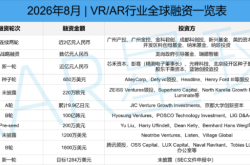
According to incomplete statistics from VRAR Planet, in August 2026, the global VR/AR sector witnessed 11 financing events, with a disclosed funding amount of approximately $142 million (approximately RMB 955 million, calculated at an exchange rate of 1 USD ≈ 6.71 RMB).
From a regional perspective, this month, the domestic VR/AR sector saw a cumulative total of 3 financing projects, a decrease of 8 from the previous month, with a total funding amount of approximately $74.5 million.
Globally, there were 8 financing events, an increase of 7 from the previous month, with a funding amount of approximately $67.76 million.
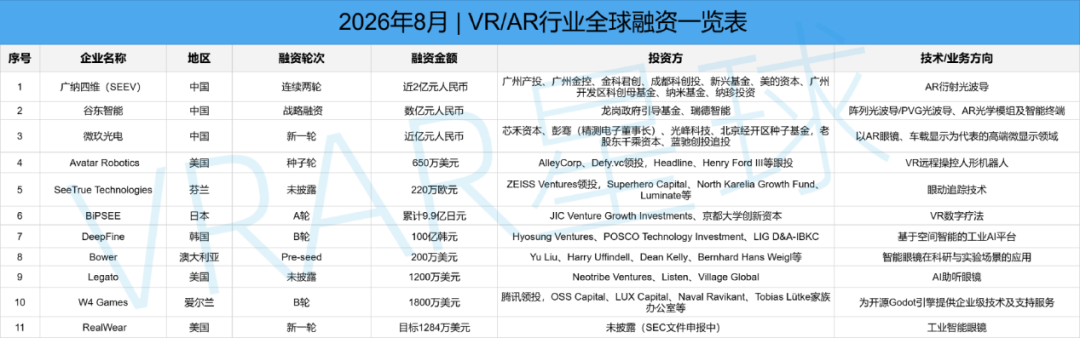
Image Source: VRAR Planet
Note: For financings where specific amounts were not disclosed, such as Guangna Siwei (nearly RMB 200 million), it is estimated at RMB 200 million; Gudong Intelligence (several hundred million RMB) is estimated at the minimum threshold of RMB 200 million; Weijiu Optoelectronics (nearly RMB 100 million) is estimated at RMB 100 million. The actual total may have minor deviations.
In terms of financing characteristics, the global VR/AR investment and financing market in August exhibited several notable features:
Domestic financing continues to focus on optics, with a slight decline in capital concentration: Domestic financing centered on upstream optics and Micro-LED displays: In August, there were 3 clear financing events in the domestic market, all concentrated in the fields of AR diffractive waveguides and Micro-LED microdisplay chips. The three financings—Guangna Siwei (nearly RMB 200 million), Gudong Intelligence (several hundred million RMB), and Weijiu Optoelectronics (nearly RMB 100 million)—all targeted waveguide materials, process production lines, and Micro-LED full-color displays, continuing the high concentration of capital on AR core optical display devices since 2026. Compared to the previous month, the number of domestic financing events decreased (11 in July), but the individual amounts remained substantial.
The international market shows significant diversification, covering multiple application scenarios: In August, there were 8 financing events in the international market, with geographical coverage spanning the United States, Finland, Japan, South Korea, Australia, and Ireland. The track (translation: sectors) were widely distributed—ranging from VR remote-controlled robots (Avatar Robotics), eye-tracking (SeeTrue), VR digital therapy (BiPSEE), industrial AI platforms (DeepFine), smart glasses for laboratory applications (Bower), AI hearing aids (Legato), Godot engine enterprise services (W4 Games), to industrial smart glasses (RealWear). This indicates that the overseas VR/AR industry is comprehensively penetrating from hardware infrastructure to application layers, platform layers, and vertical industry solutions.
XR foundational software and engine layers secure large-scale financing: W4 Games ($18 million Series B, led by Tencent) was a key event in the international market this month. It provides enterprise-level XR support around the open-source Godot engine, reflecting capital's emphasis on the underlying toolchains of the XR content development ecosystem. Godot, as a competitive open-source alternative to Unity and Unreal, is gaining influence in the XR developer community.
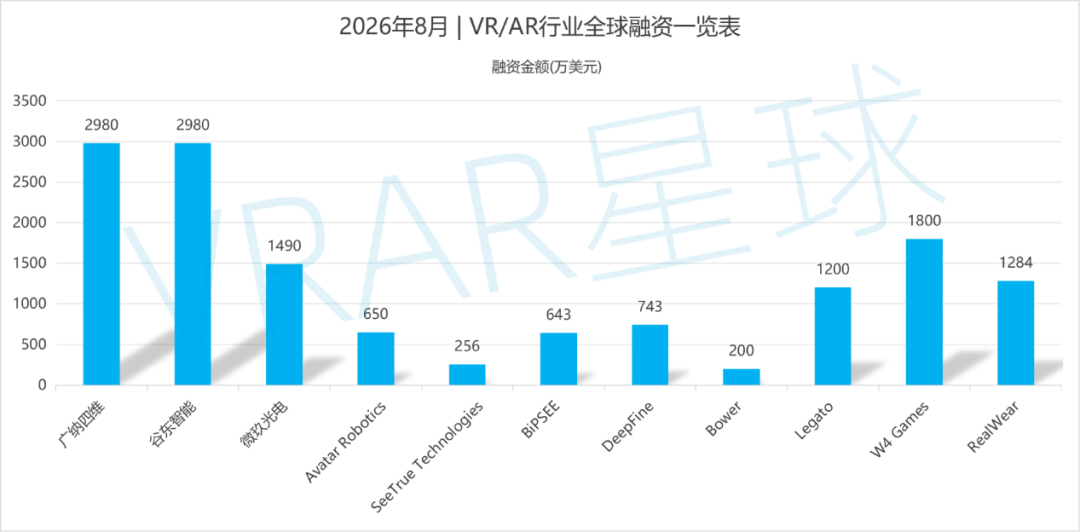
Image Source: VRAR Planet
Global VR/AR Financing Events in August 2026
Domestic Market
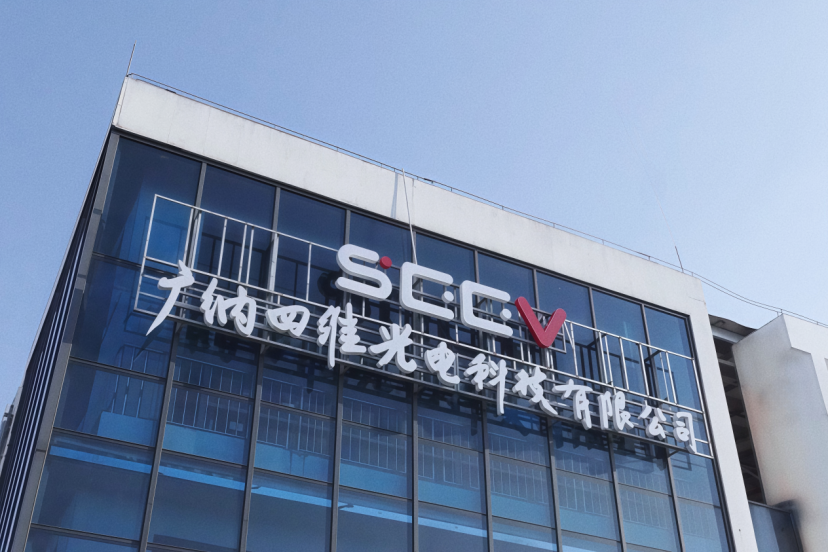
「Guangna Siwei」 (SEEV) Completes Two Consecutive Rounds of Financing, Totaling Nearly RMB 200 Million
On August 5, AR diffractive waveguide IDM enterprise 「Guangna Siwei」 (SEEV) announced the completion of two consecutive rounds of financing, totaling nearly RMB 200 million. This round of investors included state-owned industrial funds, leading industrial capital, and professional science and technology investment institutions, such as Guangzhou Industrial Investment, Guangzhou Finance Holdings, Jinke Junchuang, Chengdu Science and Technology Investment, Emerging Fund, Midea Capital, Guangzhou Development Zone Science and Technology Innovation Mother Fund Company, Nami Fund, and Nazhen Investment. Nami Fund, as an existing shareholder, continued to invest.
This round of funds will be primarily used for the research and development of next-generation full-color waveguide technology, expansion of new process production lines, overseas and domestic market expansion, and the recruitment of core talent. This will strengthen the company's IDM full-chain self-research and self-production capabilities in the AR diffractive waveguide field, positioning it ahead of the 2027 industry technology and capacity explosion cycle.
It is reported that the company has simultaneously initiated Series A financing to continue accelerating technological iteration and capacity scale-up.
Gudong Intelligence Secures Several Hundred Million RMB in Financing
In August, Guangdong Gudong Intelligence Technology Co., Ltd. (hereinafter referred to as "Gudong Intelligence") announced that since 2026, it has successively received strategic investments from the Longgang Government Guidance Fund and listed company Guangdong Ruide Intelligent Technology Co., Ltd. (hereinafter referred to as "Ruide Intelligent"), cumulatively completing financing in the hundred-million RMB range.
It is reported that this round of financing will be used for the research and development of waveguide materials and core processes, iteration of optical modules and AR smart terminals, construction of large-scale manufacturing capabilities, and expansion of domestic and international industrial markets.
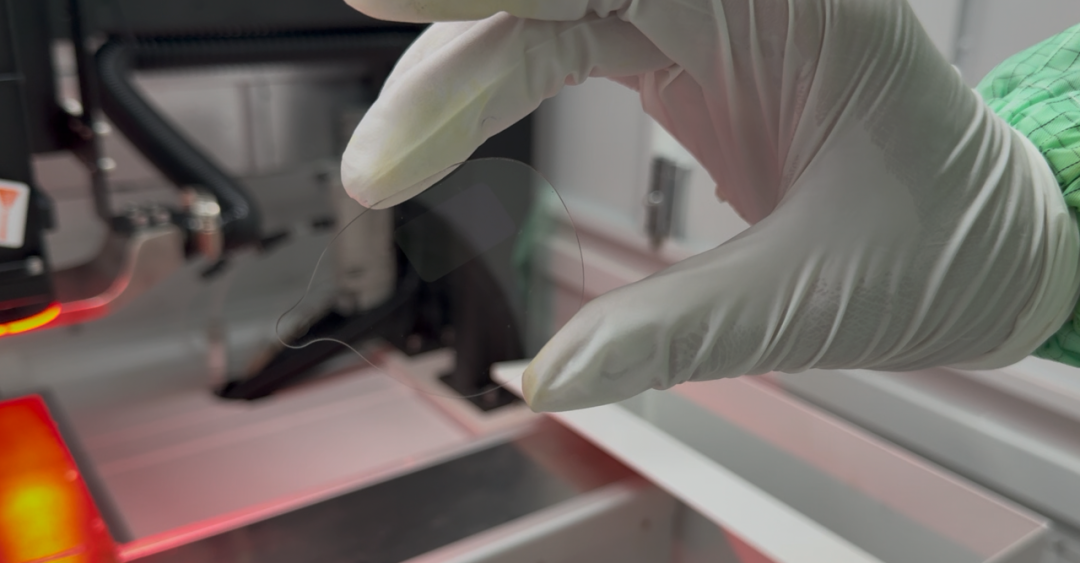
After the relevant funds are in place, Gudong will continue to increase R&D investment in waveguide materials, optical design, and core processes, advancing the iteration of array waveguides and PVG products, and improving the collaborative development of optical modules, smart terminals, and software platforms. On the manufacturing side, it will strengthen the construction of production, testing, quality, and supply chain systems to improve product consistency, reliability, and large-scale delivery efficiency.
On the market side, it will continue to deepen its presence among industrial clients and strategic major clients, expanding the coverage of standardized products and solutions through regional sales, industry agency, industrial alliances, and localized overseas cooperation. At the same time, it will strengthen collaboration with manufacturing partners, platform channels, universities, and AI hardware and software enterprises to form a more complete industrial ecosystem of technology, products, scenarios, and market resources.
Accumulating technology and scenario experience, capital drives the scaling process. Gudong is transforming the technological depth of waveguides into the industrial foundation for the next generation of AR and AI glasses.
Weijiu Optoelectronics Completes New Round of Financing Nearing RMB 100 Million
On August 24, Weijiu Optoelectronics Technology Co., Ltd. (hereinafter referred to as "Weijiu Optoelectronics") announced the completion of a new round of financing nearing RMB 100 million, with participation from Xihe Capital, Peng Qian, Appotronics, and the Beijing Economic-Technological Development Area Seed Investment Fund (hereinafter referred to as the "Seed Fund"). Existing shareholders Qiancheng Capital and BlueRun Ventures made multiple follow-on investments.
From the perspective of investors, Peng Qian, the chairman of Jingce Electronic, a domestic leader in semiconductor measurement and testing equipment, invested in a personal capacity; Appotronics, a listed company in the optical applications field, made a strategic investment.
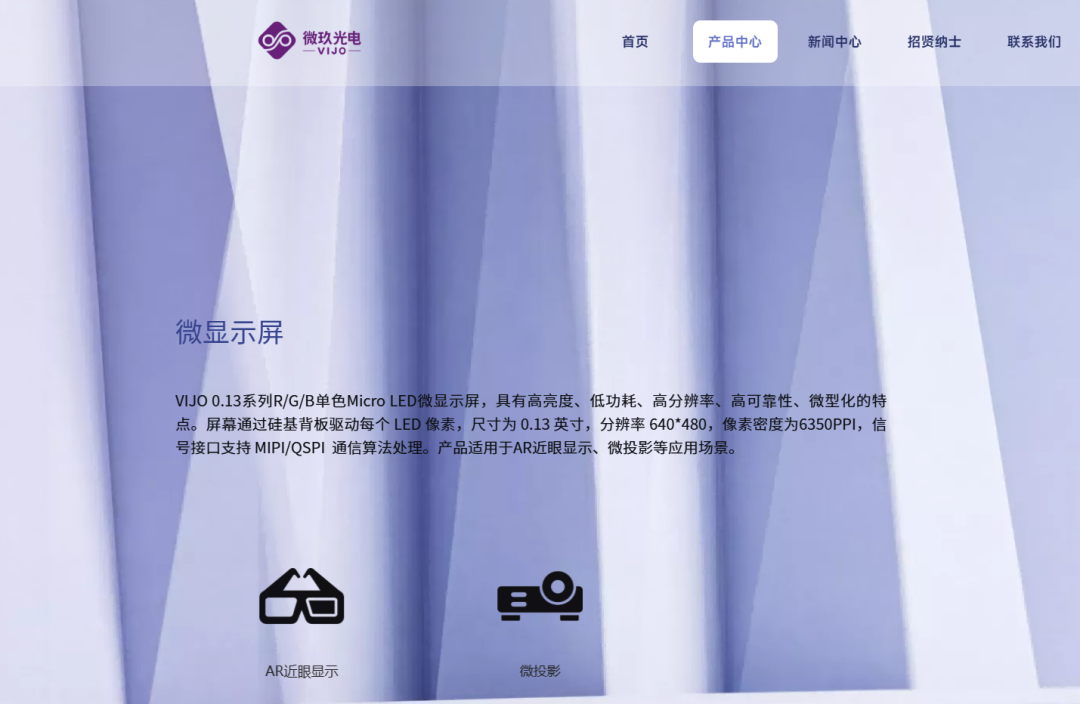
Founded in December 2023, Weijiu Optoelectronics focuses on the high-end microdisplay field represented by AR glasses and automotive displays, dedicated to the research, development, and production of high-performance red, green, blue monochrome, and full-color MicroLED displays for matching (translation: supporting) applications.
According to a report by Securities Times e Company, this financing is the second round completed by Weijiu Optoelectronics this year. In January, the company announced the completion of an angel+ round of financing nearing RMB 100 million, led by Yuanhe Origin, with follow-on investments from Qiancheng Capital and Shunxi Fund. The funds will be primarily invested in business expansion, capacity building, technological breakthroughs, and market development.
International Market
Avatar Robotics Secures $6.5 Million in Financing
In August, Avatar Robotics, a robotics startup in San Francisco, USA, announced the completion of a $6.5 million seed round of financing, led by AlleyCorp and Defy.vc, with participation from Headline and Henry Ford III, a member of the Ford family.
Founded in 2024, the company's founder and CEO, Colin Webb (30 years old), studied at MIT and worked at Cruise, an autonomous driving company under General Motors.
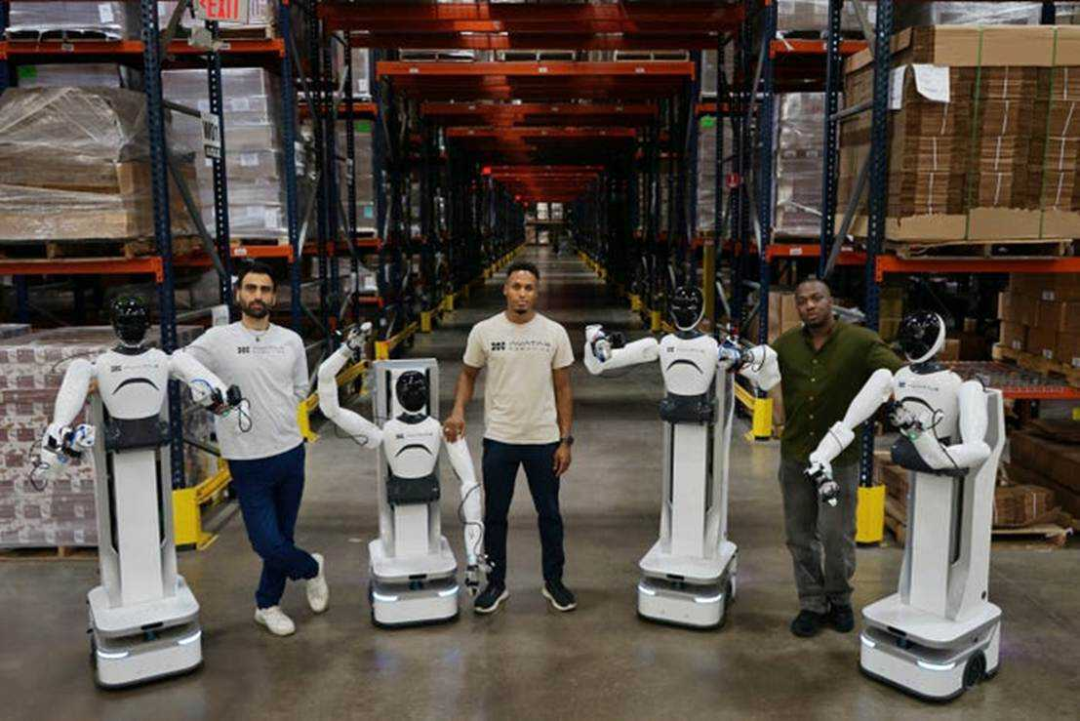
Avatar's business model does not involve direct sales of robots. Instead, it procures wheeled dual-arm humanoid robots from China and uses remote operators wearing Meta Quest headsets and handheld controllers to "control" the robots in real-time to complete packaging, sorting, and other tasks in warehouses. Customers pay periodic service fees based on usage frequency.
According to the company, since its launch in December 2024, its robots have packaged nearly 1 million items and operated in multiple warehouse facilities.
Avatar's remote operators are mainly contract workers from Mexico, Colombia, and the Philippines, with hourly wages ranging from $5 to $20, lower than the direct labor costs in U.S. warehouses. Webb believes that this model not only immediately creates value for paying customers but also continuously collects visual and motion data from human operators interacting with robots during operations—data that is urgently needed to train "physical AI" models.
Finnish Eye-Tracking Company SeeTrue Technologies Secures €2.2 Million in Financing
In August, SeeTrue Technologies, a Finnish eye-tracking technology company, announced the completion of €2.2 million in financing. This round of financing was led by ZEISS Ventures, with participation from Superhero Capital, the North Karelia Growth Fund managed by Redstone Nordics, Luminate, Piotr Frasunkiewicz, and existing angel investors. The funds will be primarily used to commercialize its low-power eye-tracking technology and expand its R&D team in Joensuu, Finland.
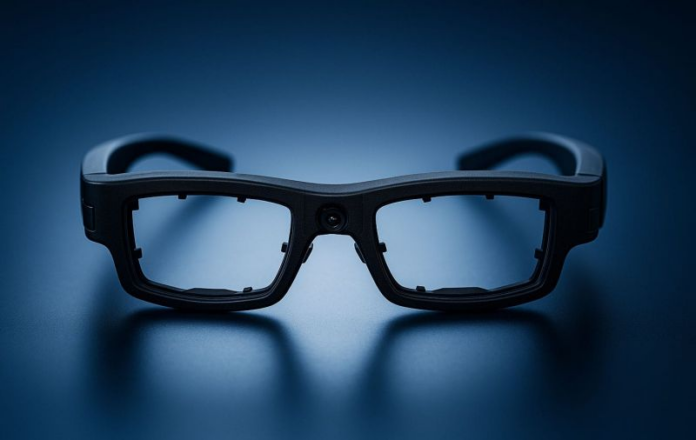
Founded in 2018, SeeTrue Technologies mainly develops miniature eye-tracking technologies for devices such as smart glasses and medical optical systems. Compared to traditional camera-based eye-tracking solutions, the company aims to further reduce system power consumption and space usage through miniature sensors and embedded processing architectures while maintaining real-time, high-frame-rate gaze tracking capabilities.
Notably, the lead investor in this round, ZEISS Ventures, is backed by Zeiss, which has been continuously increasing its investment in the XR business in recent years. In October 2025, Zeiss established the "ZEISS Extended Reality" strategic business unit and incorporated it into the Consumer Markets business segment along with ZEISS Vision Care. Currently, Zeiss's XR product portfolio covers optical lenses for AI glasses without displays, curved waveguides for AR glasses, and optical solutions with vision correction capabilities.
BiPSEE Secures a Total of ¥990 Million in Financing
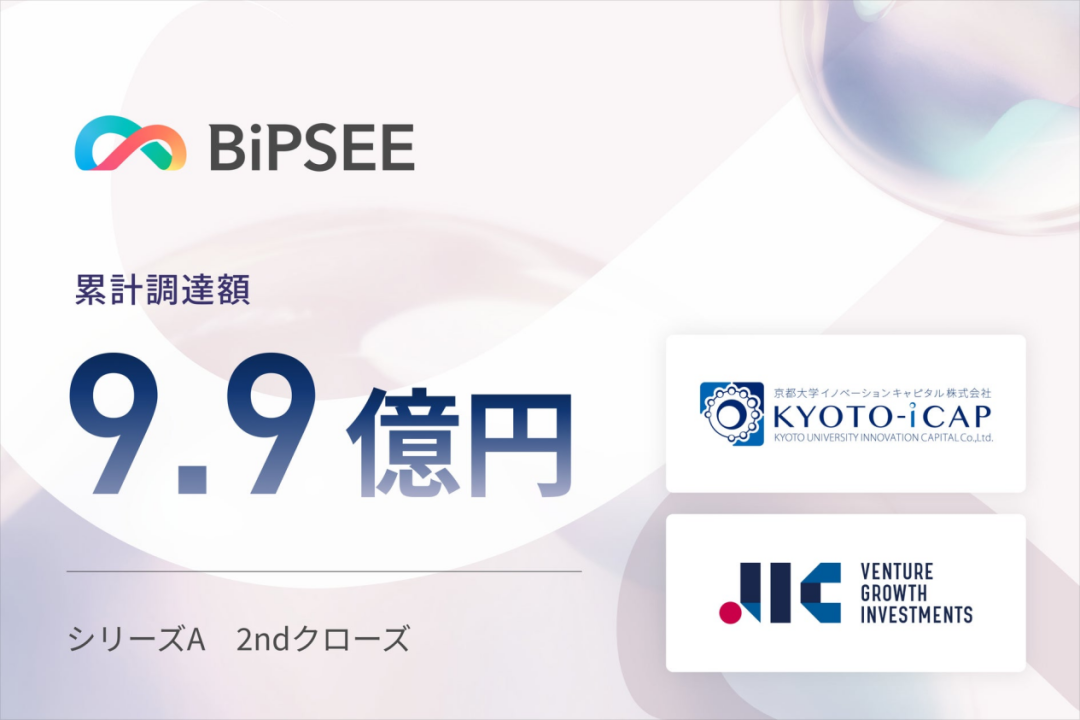
In August, Bipsee, a medical technology startup headquartered in Tokyo, announced the completion of the second tranche of its Series A financing through a third-party private placement of new shares, receiving new funding support from JIC Venture Growth Investments and funds under Kyoto University Innovation Capital. Including subsidies from the New Energy and Industrial Technology Development Organization (NEDO) of Japan in 2023, the company's cumulative financing has reached ¥990 million (approximately RMB 41.85 million at current exchange rates).
Bipsee is developing VR digital therapies for depression and other mental illnesses, allowing users to receive treatment through a VR headset paired with a smartphone app. The therapy focuses on "rumination"—the psychological tendency of individuals to repeatedly dwell on negative thoughts, which is an important cognitive factor in the maintenance and exacerbation of depression.
The new funds will be used to support ongoing confirmatory clinical trials and prepare for subsequent regulatory approvals. Bipsee completed an exploratory clinical trial in collaboration with Kochi University in 2025. The Japanese Ministry of Health, Labour and Welfare has designated the therapy as a priority review object for "program medical devices," potentially granting it a fast-track review channel.
Bipsee's financing in this round reflects strong investor interest in the digital therapy field. Currently, Japan is actively exploring new paths to expand access to mental health treatment and alleviate pressure on clinical teams, with digital therapy seen as an important direction.
However, it should be noted that the product has not yet received formal approval, and its ultimate market availability still depends on the results of the confirmatory clinical trials.
DeepFine Secures ₩10 Billion in Series B Financing
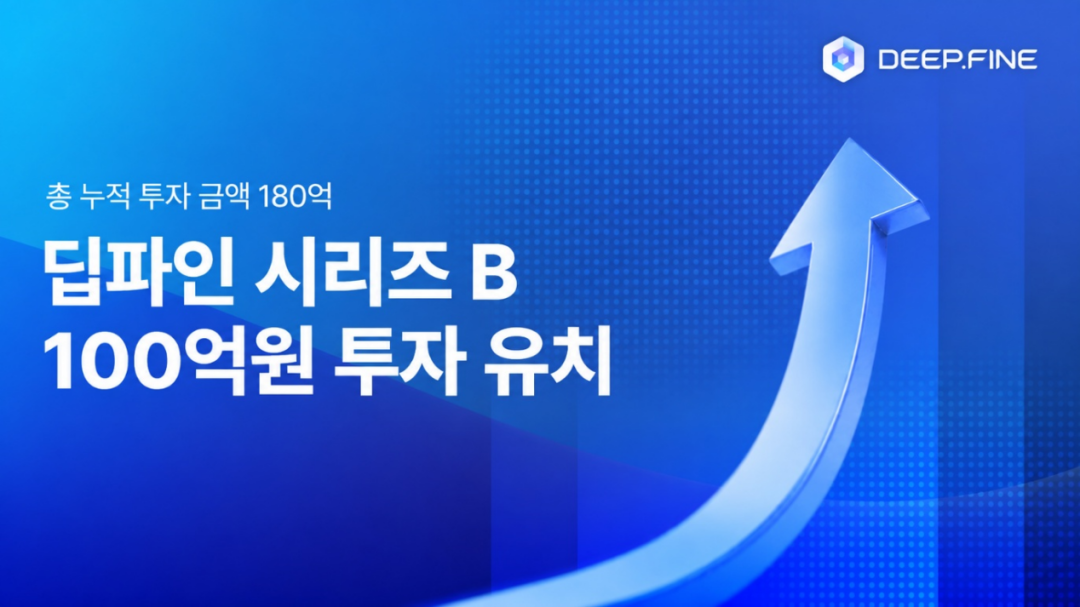
On August 18, DeepFine, a South Korean industrial AI platform company, announced the completion of ₩10 billion (approximately RMB 50 million) in Series B financing. This round of financing involved participation from Hyosung Ventures, POSCO Technology Investment, LIG D&A-IBKC, and other institutions. To date, DeepFine's cumulative financing has reached approximately ₩18 billion.
DeepFine is an industrial AI platform company based on Spatial AI. It primarily leverages smart glasses, visual AI, spatial computing, and on-site data analysis technologies to provide digital solutions for industries such as manufacturing, logistics, shipping, defense, and MRO (maintenance, repair, and operations).
DeepFine stated that this round of financing was primarily attributed to its practical deployment experience in industrial settings, its technical capability to integrate with existing enterprise business systems, and its platform architecture capable of adapting to multi-industry scenarios. Additionally, the investors in this round cover logistics, manufacturing, heavy industry, and defense sectors, providing support for subsequent technical validation and commercial cooperation.
Bower Secures $2 Million in Funding
In August, according to a report by the Australian Financial Review, Bower, a startup based on Australia's Gold Coast and founded by a former Microsoft AI leader, recently announced the completion of a $2 million Pre-seed funding round, bringing its valuation to $10 million.
It is understood that this round of financing received support from various individuals in the technology and investment sectors, including Yu Liu, Chief Technology Officer of medical AI firm Heidi Health; Harry Uffindell, former Head of Business Operations and Strategy at Airbnb; Dean Kelly, an early supporter of digital health company Eucalyptus; and Bernhard Hans Weigl, a former investor at the Gates Foundation. Bower plans to utilize the funds to commercialize its wearable lab technology and accelerate the application of smart glasses in scientific research and experimental scenarios.
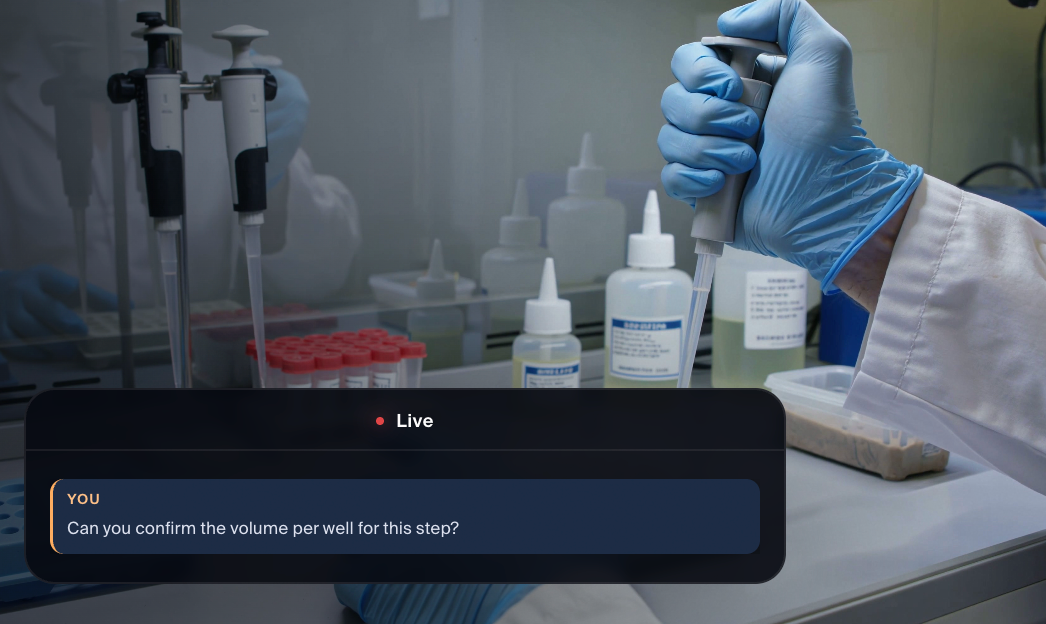
Bower was co-founded by former Microsoft AI leader MacRae, and its team comprises veterans from technology companies such as Microsoft, Google, and Atlassian. Among them, co-founder MacRae previously led the development of AI analysis tools at customer research software company Dovetail, participated in Google's crowdsourcing app Task Mate project, and later served as Microsoft's AI leader.
Legato Raises $12 Million in Funding
In August, emerging hearing technology company Legato exclusively disclosed to TechCrunch that it had secured $12 million in funding. This round of funding was participated in by Neotribe Ventures, Listen, and Village Global, with the funds primarily used for product development and marketing.
Additionally, Legato unveiled its AI-powered hearing glasses for the first time. Dubbed "Legato Frames," these glasses integrate the company's patented hearing technology into the temples and are expected to be released later this fall.
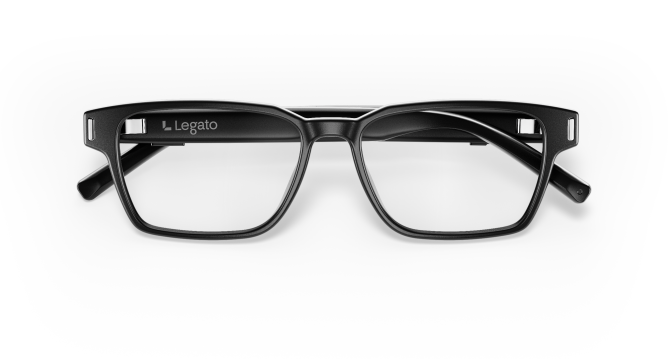
Legato primarily targets individuals with mild to moderate hearing loss, which constitutes the largest segment of the hearing-impaired population.
From its inception, the company has been committed to addressing the issues of cost, comfort, and stigma associated with traditional hearing aids. They strive to make glasses as compact and lightweight as possible, and have developed proprietary acoustic systems, signal processing stacks, and mechanical architectures for this purpose.
Trivedi stated, "We have the opportunity to serve a vast population with this product, creating a solution that avoids the compromises of traditional hearing aids. Hearing improvement is not just about 'better TV watching'; it's about human connection. Hearing more clearly allows for better connection with the world—this can reduce the risk of dementia and depression."
Godot Engine Developer W4 Games Secures $18 Million in Series B Funding
In August, W4 Games, a company providing enterprise-grade technology and support services for the open-source Godot engine, announced the completion of an $18 million (approximately 130 million RMB) Series B funding round.
This round of funding was led by Tencent, with participation from OSS Capital, LUX Capital, renowned investor Naval Ravikant, and the family office of Shopify founder Tobias Lütke. To date, W4 Games' total cumulative funding has reached $33 million.

W4 Games was co-founded by core developers and contributors to the Godot engine, dedicated to bringing this open-source game engine to the enterprise market. It provides engine-level OpenXR and Android XR support, particularly in the fields of extended reality (XR) and immersive technologies, along with professional services, platform and console porting, and advanced support for enterprise-grade production environments.
The company stated that the funds from this round will be used to expand its international team by 50%, accelerate enterprise product development, and meet the growing demand for Godot among enterprise developers.
RealWear Launches New Funding Round
Recently, according to documents filed with the U.S. Securities and Exchange Commission (SEC), industrial smart glasses manufacturer RealWear is advancing a new round of funding, with a target fundraising scale of up to approximately $12.841 million.
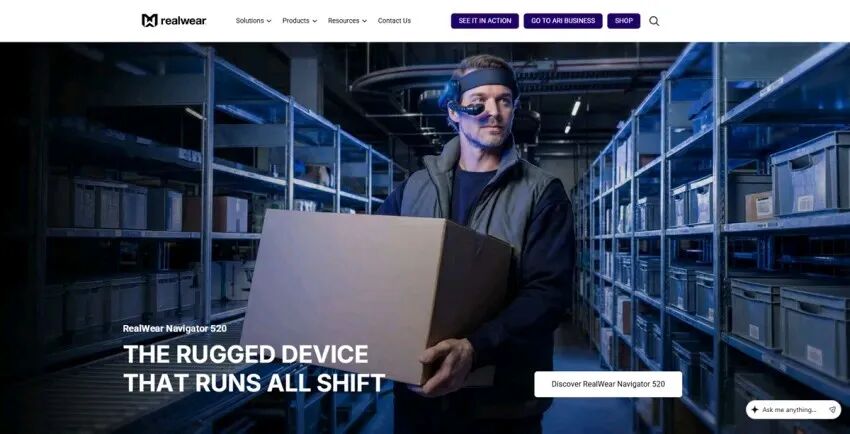
According to the relevant documents, RealWear plans to raise funds through securities issuance this time. RealWear has long focused on the industrial and enterprise-grade smart glasses market, primarily providing hands-free computing devices for frontline workers in industries such as manufacturing, energy, automotive, and healthcare. Its product lineup includes the Navigator series of smart glasses, which can be used in scenarios such as remote collaboration, industrial inspections, and workflow guidance.
Notes:
[1] For financing rounds where specific amounts were not disclosed, such as Guangna Siwei (nearly 200 million RMB), it is estimated at 200 million RMB; Gudong Intelligence (several hundred million RMB) is estimated at the minimum threshold of 200 million RMB; Weijiu Optoelectronics (nearly 100 million RMB) is estimated at 100 million RMB. The actual total may have slight deviations.
[2] Data source: Investment amounts are based on publicly available information from August 1, 2026, to August 31, 2026.
[3] Limited by technology and the availability of public data, the research reports presented by VRAR Planet are for knowledge sharing only and do not constitute any investment advice. Anyone making investment decisions based on this article does so at their own risk, and the information provider assumes no legal, regulatory, or related responsibilities.
-
![]()
Why Do More Camera Sales Lead to Less Profit? The Dilemma of Perception Hardware Provider Haoen Automotive Electronics
-
![]()
Has the Market for A00-Class Pure Electric Vehicles Dried Up, Leaving Them in the Dust of Progress?
-
![]()
Can Zotye Make a Comeback with Its New Car?
-
![]()
Where is the $142 Million Going? Domestic Focus on Optical Waveguides, Overseas Shift to Application Layer
-
![]()
JD Builds 100,000-Card Cluster, ByteDance 'Borrows' $29.6 Billion: AI Computing Power Enters a High-Stakes Gambling Phase
-
![]()
Jiangsu Liyang: Leading County in the Power Battery Sector, Propelling Electric Vehicle Growth in Eastern China
-
![]()
Apple’s Foldable Phone: A Revolution That Even Steve Jobs’ Legacy Can’t Stop
-
![]()
Unexpected Trading Suspension! GAC Undergoes Significant Capital Restructuring Amidst Speculation of Mutual Shareholding with FAW, Shaking Up the Automotive Market