From Purchasing Cells to Defining Cell Specifications: The Shifting Power Dynamics in the New Energy Industry Chain
 09/18 2026
 526
526
In the first half of 2026, CATL reported RMB 276.9 billion in revenue and RMB 43.284 billion in net profit attributable to the parent company, equating to approximately RMB 240 million in daily earnings. Its domestic passenger vehicle battery installation share rose to 46.7%, defying expectations of a decline. However, automakers like Li Auto, Xiaomi, HiMode, Leapmotor, Geely, and GAC are still accelerating the introduction of second-tier suppliers, in-house Pack development, and dominance over BMS and electrochemical parameters. This "de-CATLization" is not merely about supplier substitution but represents automakers' pursuit of three key objectives from upstream suppliers: cost bargaining power, supply security, and the authority to define the integration of batteries with intelligent driving/chassis systems. CATL's response does not rely on price cuts but on ultra-fast charging, multi-chemistry systems, energy storage as a second growth curve, battery swapping, and low-altitude application scenarios. The conclusion is not "the decline of CATL" but a shift from monopolar supply to a tiered competition where "leaders dominate the high-end, second-tier suppliers cover the mid-range, and automakers' in-house development supplements the foundation."
Original work by Xinshang New Consumption Team
Over the past decade in the new energy sector, the most stable profit structure was "automakers scaling up while CATL collected battery profits." The 2026 interim report laid bare this imbalance: CATL's first-half revenue reached RMB 276.917 billion, up 54.8% YoY; net profit attributable to the parent company hit RMB 43.284 billion, up 41.98% YoY, averaging approximately RMB 240 million daily. Power battery revenue reached RMB 192.125 billion, while energy storage revenue surged to RMB 53.261 billion, up 87.54% YoY. During the same period, its domestic passenger vehicle battery installation share stood at 46.7%, up 5.6 percentage points YoY, with a 75.2% share in ternary battery installations.
Despite high profits and a stable market share, automakers continue to dismantle the single-supplier system. The reason lies not in CATL's weakness but in automakers' reluctance to fully outsource the definition, production scheduling, costs, and risks of core components.
It's Not About Introducing Second-Tier Suppliers—It's About Restructuring Procurement Power
In the past, automakers' battery procurement followed a "choose CATL, wait for production scheduling, accept specifications" model. Now, it has evolved into "multi-supplier bidding, joint venture partnerships, and custom parameter definitions."
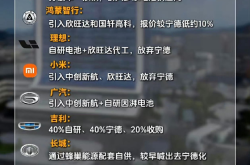
Li Auto exemplifies the most aggressive approach among new forces. Its new L8 series, launched in June 2026, exclusively uses Sunwoda cells, with Packs produced by a Li Auto-Sunwoda joint venture. Li Auto dominates the underlying electrochemistry, structure, thermal management, and BMS, while CATL is excluded from the cell supply for this model. For new models like MEGA, Li Auto is advancing in-house development of 5C ternary batteries, shifting from "purchasing battery packs" to "defining cell standards, outsourcing manufacturing, and owning Pack and BMS."
Xiaomi adopts a "deep customization + dual-supply" strategy rather than full in-house production. Under its Longjia battery system, AVIC and Sunwoda manufacture cells and Packs to Xiaomi's standards, with Xiaomi leading voltage platforms, BMS strategies, thermal management, and on-site quality control. For extended-range and new model series, Xiaomi uses AVIC + Sunwoda, while its pure electric mainstays, the SU7 and YU7, retain CATL as the primary supplier and BYD as a secondary option, creating a multi-supplier diversion (diversified supply) setup. This is not "abandoning CATL" but reducing single-dependency to a portfolio-based one.
The Aito ecosystem, led by HiMode, is also loosening its ties. The 408th batch of announcements revealed that the Aito M6 pure electric version uses Guoxuan's LFP batteries, with HiMode simultaneously introducing AVIC. High-end models like the M9 and Zunjie retain CATL cells. Leapmotor has established a joint venture with AVIC, increasing Guoxuan's supply share. XPeng, GAC Aion, Geely, Chery, Changan, and SAIC are expanding their battery supplier lists through second-tier suppliers, in-house development, or joint ventures.
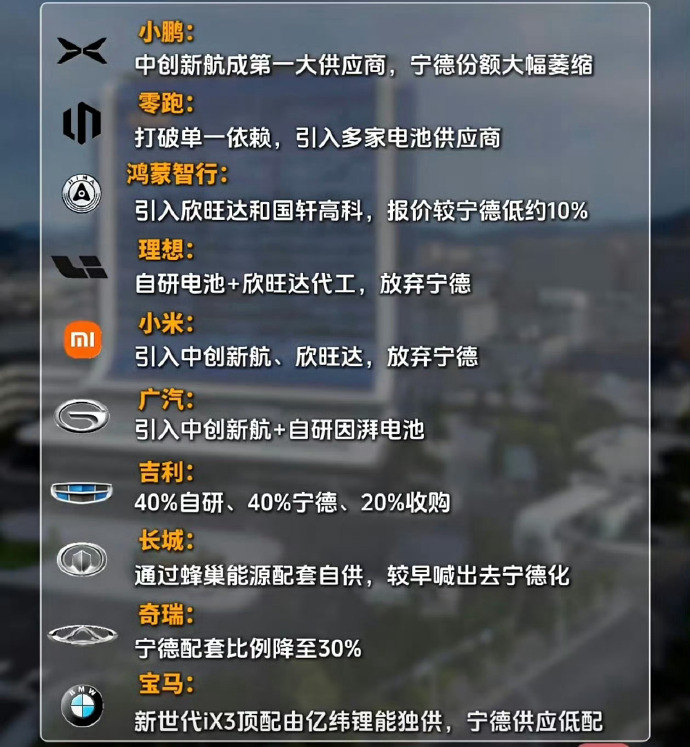
To summarize: Automakers' strategies have evolved from "switching suppliers" to a three-tiered approach—multi-supplier checks to suppress quotes, capital/joint venture partnerships to secure capacity, and in-house Pack and BMS development to seize definition rights. Supplier switching is the surface; power reallocation is the core.
It's Not About Low-Price Substitution—It's About Balancing Cost and Security
"De-CATLization" is often misconstrued as "switching to cheaper second-tier suppliers," but real decision-making involves balancing two accounts.
The first account is procurement cost. Second-tier suppliers offer lower quotes than CATL on some projects, enabling multi-supplier bidding to reduce battery pack costs for conventional models. When batteries account for up to a quarter of a vehicle's total cost, even a few thousand yuan in cost reduction per pack translates to hundreds of millions in annual profits for models selling in the hundreds of thousands. However, price is not the sole criterion—consistency, yield rates, after-sales service, ultra-fast charging degradation, and low-temperature performance determine eligibility for high-end models.
The second account is supply security. Previously, automakers' delivery schedules were at the mercy of a single leader's production scheduling. With multi-sourcing, renegotiations on pricing, production scheduling, and warranty terms reduce supply disruption risks. Leapmotor's Zhu Jiangming succinctly summarized multi-sourcing: "Multiple cell types from multiple suppliers lower prices and diversify risks (diversify risks)." CCTV's take on supply chain diversification is more neutral—shifting from monopolar dependency to open procurement reduces "chokepoint" and supply disruption risks, using competition to drive suppliers to upgrade technology and stabilize quality.
Thus, automakers are not fully replacing CATL but adopting a tiered approach: high-end flagships, extreme fast-charging, and low-temperature high-rate models still prioritize CATL; mass-market family cars, operational vehicles, and cost-sensitive pure electric/plug-in hybrids are allocated to Sunwoda, AVIC, Guoxuan, EVE, and others. "De-CATLization" is closer to "de-singularization" than "de- Ningde Chemical (de-CATL-ization)."
To conclude with parallelism: Costs must be suppressed, delivery schedules must be stable, and technology must be controllable—failure to meet any of these three renders the multi-sourcing strategy untenable.
It's Not About CATL's Decline—It's About the Industry Shifting from Monopolar to Tiered Competition
Comparing CATL's interim report with automakers' actions, the conclusion is not "the collapse of the leader" but a shift in competitive dimensions.
CATL's first trump card is technological foundation. Its third-generation Shenxing and Qilin batteries achieve peak charging rates of 15C, enabling minute-level recharging in high-SOC ranges at room temperature. The Qilin battery maintains leading energy density, low-temperature performance, and safety margins, while sodium-ion, condensed matter, and Xiaoyao extended-range hybrid batteries cover diverse scenarios. Automakers' in-house development focuses on Packs, BMS, thermal management, and parameter definitions; cell materials, processes, yield rates, and lifespan models require long-term accumulation.
CATL's second card is energy storage and emerging scenarios to offset automakers' order diversification. In the first half of 2026, energy storage revenue surged to RMB 53.261 billion, up 87.54% YoY, driven by Tianheng energy storage systems, 587Ah storage cells, 9MWh systems, and overseas grid projects. Peakflight's 5-ton eVTOL completed conversion flights, while its 2-ton cargo model secured overseas VTC certification. Battery swapping stations, grid-computing synergy, and zero-carbon parks expand CATL's role from a "battery company" to an "energy infrastructure company." This reduces CATL's reliance on single-vehicle power battery (power batteries) while expanding coverage of full-scenario electricity usage.
CATL's third card is scale and yield rates. In the first half, battery system production reached 498GWh, with a capacity utilization rate of 94.86% and 764GWh under construction. Near-full capacity operation allows cost dilution, stable delivery rhythms, and cross-model platform capabilities that most in-house automakers cannot match short-term.
Thus, the future landscape is likely tiered: Leaders dominate the high-end and high-rate segments, second-tier suppliers cover the mid-range and mass-market, and automakers' in-house development controls Pack/BMS and some cell standards. Profitably, automakers reclaim some battery premiums; technologically, CATL retains material and scale moats; power-wise, definition rights shift from "suppliers alone" to "automakers define experience, suppliers define fundamentals, both co-define standards."
"De-CATLization" sounds like a war, but it's more about redefining division of labor. Automakers aim not to eject CATL from the table but to prevent any single supplier from dictating all rules. CATL seeks not to supply every vehicle but to expand batteries from "automotive components" to an "energy operating system." The era of monopolar profits is loosening; the era of tiered competition has just begun. Whoever balances cost, security, and definition rights will dominate the next phase.
References:
36Kr: March 11, 2026 - CATL's High-Stakes Gamble
CCTV Finance: August 5, 2026 - Earning RMB 250 Million Daily! Giant Distributes Over RMB 640 Million in Dividends
Autohome: April 16, 2026 - CATL Earns RMB 200 Million Daily: Who Are Automakers Working For?
Southern Finance Network: July 25, 2026 - CATL's First-Half Daily Earnings Hit RMB 240 Million: Nearing Full Capacity, Production to Expand Another 1.5x
Energy Planet: September 2, 2026 - CATL Doubles Down on AI Energy: Partners with 21Vianet to Compete for Grid-Computing Synergy Definition Rights
-
After Huawei Steps Back, Can Seres Take the Helm of AITO?
-
Computing Power Amidst Snow-Capped Peaks
-
15.3068 Million Yuan! Daoming Optics Secures Contract for Raw Material Supply in Guangdong’s New Energy Vehicle License Plate Project
-
![]()
1.1 Billion Yuan in Fundraising Reallocated! FG Optics Inc. Ramps Up Investment in Precision Optics and Aerospace Lenses
-
![]()
Domestically Overlooked, Yet Coveted Abroad: How China’s Bus Industry Rakes in $26 Billion Annually
-
Has the FCC靴子 Finally Landed? Can Domestic Optical Module Companies Breathe a Sigh of Relief?
-
![]()
From Purchasing Cells to Defining Cell Specifications: The Shifting Power Dynamics in the New Energy Industry Chain
-
![]()
If ByteDance Goes Public, Could It Become China’s Largest Company by Market Capitalization?