AITO Strikes Out on Its Own: China’s Auto Industry Steps into the Post-Huawei Era
 09/21 2026
 441
441
Huawei does not manufacture cars directly but has been deeply involved, or “asset-heavy,” in at least five automotive brands: AITO, Luxeed, Maextro, Shangjie, and Smart. These brands are all supported by state-owned enterprises—AITO with Dongfeng, Luxeed with BAIC, Maextro with JAC, Shangjie with SAIC, and Smart with Chery. Each represents a national heavyweight and a core asset under the State-owned Assets Supervision and Administration Commission (SASAC). But is this really the future of China’s auto industry?
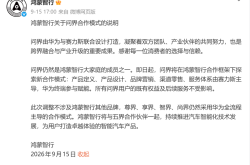
On September 15, Harmony Intelligent Mobility announced: “Starting today, AITO will explore a new cooperation model within the Harmony Intelligent Mobility framework. Seres will take the lead in product definition, design, brand marketing, channel retail, and service systems, with Huawei Terminal providing support.”
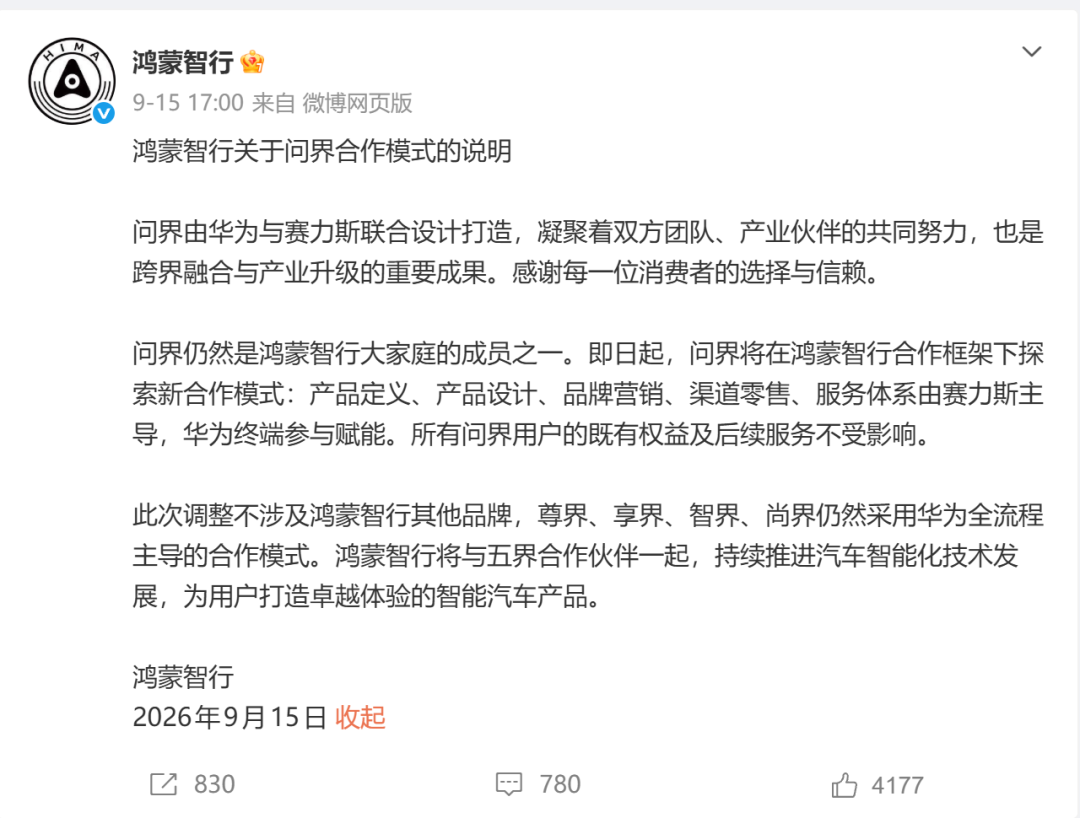
Harmony Intelligent Mobility further clarified: “This adjustment does not affect other brands under our umbrella. Maextro, Luxeed, Smart, and Shangjie will continue to adopt Huawei’s full-process-led cooperation model.” In other words, even excluding AITO, Huawei remains deeply involved in four brands.
Additionally, with brands like Qijing and Yijing, as well as Huawei’s ongoing trademark registration for “Wenjing,” the company is moving beyond traditional equity-based models. By relying solely on commercial contracts covering technology, product definition, and channels, Huawei gains disproportionate control over automakers without holding any equity, effectively dominating the rise and fall of these brands. Is this the ultimate model for China’s auto industry?
Public data shows that in 2019, Huawei’s Intelligent Automotive Solutions Business Unit (BU) started with a team of about 400 people, expanding to around 5,000 by 2021 and reaching approximately 8,000 by 2025. This figure does not include the Harmony Intelligent Mobility terminal sales team.
In terms of annual sales, Harmony Intelligent Mobility reported that in 2022, only AITO sold 75,000 units. In 2023, with the official naming of Harmony Intelligent Mobility, only AITO delivered vehicles, totaling 94,400 units for the year. By 2024, cumulative deliveries under Harmony Intelligent Mobility rapidly climbed to 444,900 units. In 2025, it reached 589,100 units across five brands. What would happen if all five brands achieved significant success?
As early as 2022, Huawei’s Yu Chengdong stated in an interview with auto blogger Wu Pei: “The main players may be within one hand,” meaning five.
At the China Auto Chongqing Forum on June 8-9, 2023, Yu Chengdong reiterated this view: the main players in China’s future auto market may be less than or equal to five, fitting within one hand. He judged that companies unable to produce at least 5 million or 10 million units annually would struggle to survive in the era.
This perspective is shared not only by Yu Chengdong but also by several leaders in China’s auto industry, including He Xiaopeng, Yin Tongyue, Zhu Huarong, and Zeng Qinghong.
If this judgment holds, under Harmony Intelligent Mobility alone, there are already “Five Brands”: AITO (founded in 2021), Smart (founded in 2023), Luxeed and Maextro (founded in 2024), and Shangjie (founded in 2025). Adding industry-recognized leading independent brands like BYD, Geely (Galaxy, Zeekr, Geely), and Chery (Chery, Fengyun, Jetour, etc.), the list far exceeds five.
From this perspective, even with Huawei’s support, the likelihood of all “Five Brands” plus Two Realms (Qijing, Yijing) achieving success and reaching annual production scales of over 5 million units, as Yu Chengdong suggested, is almost negligible.
This time, Huawei’s “separation” from AITO has led to a prevalent market interpretation: Huawei has squeezed Seres dry.
According to financial reports, in 2025, Seres achieved revenue of RMB 165.054 billion and a net profit of RMB 5.957 billion. However, for every vehicle sold, Seres pays Huawei a portion of sales commissions, technology licensing fees, core component procurement costs, and R&D sharing expenses.
Based on Seres’ HK IPO prospectus and financial reports, from 2022 to 2025, Seres’ procurement from Huawei amounted to RMB 5.802 billion, RMB 7.248 billion, RMB 42.020 billion, and RMB 56.054 billion, accounting for 14.5%, 17.4%, 30.2%, and 33.78% of its total procurement during the same periods, respectively, and 17.04%, 20.25%, 28.96%, and 34.00% of its revenue during the same periods.
A simple calculation reveals: in 2025, with AITO sales of 430,400 units, for every AITO sold, nearly RMB 130,000 flowed to Huawei, leaving Seres with a net profit of just over RMB 14,000 per vehicle.
The industry generally believes that once raw material price fluctuations and inventory vehicle price reductions occur, the already thin profit per vehicle will be quickly eroded, making it inevitable for Seres to shift from profit to loss.
According to the first half of 2026 financial report data, Seres achieved revenue of RMB 57.493 billion, a year-on-year increase of 7.87%, but a net loss of RMB 1.717 billion. Among this, Seres procured goods and services from Yinwang worth RMB 9.84 billion, compared to RMB 5.6 billion in the same period last year, an increase of RMB 4.24 billion. In terms of specific sales, in the first half of this year, AITO wholesaled 160,770 new vehicles, a year-on-year increase of only 5.6%.
Does this mean that AITO’s announcement of “going solo” from Harmony Intelligent Mobility and reclaiming brand leadership is entirely due to cost pressure?
Earlier, a senior executive from GAC Aion expressed a similar view: “Huawei is also a big-name supplier with high prices and no control. When we want to cooperate with Huawei, we find we basically have no bargaining power.” Due to this reason, the “GAC Aion AH8 project,” initially planned for cooperation with Huawei, underwent changes: GAC Aion AH8 became independently developed, with Huawei shifting from a joint developer to an important supplier. The market generally believes that GAC Aion’s refusal to cede “leadership” led to it missing out on development opportunities like AITO.
Including when SAIC Motor’s former chairman, Chen Hong, was asked by investors whether SAIC would cooperate with Huawei in autonomous driving, he expressed the view: “This is like a company providing us with an overall solution, making it the soul while SAIC becomes the body. SAIC cannot accept such an outcome and must keep the soul in its own hands.” Chen Hong’s remark was summarized by the industry as the “Soul Theory” and was widely criticized at the time.
Interestingly, GAC Group later resumed cooperation with Huawei, launching the new brand Qijing in September 2025. SAIC Motor also collaborated with Huawei to launch Shangjie in 2025.
Some voices argue that Huawei’s cooperation model with the “Five Brands” has been “overstepping boundaries” from the beginning and “this model can no longer last and must change.”
How should we view this matter? Our view is that Huawei’s cooperation with major automakers has indeed “overstepped boundaries,” but its success is also evident. Without Huawei’s involvement, AITO could not have achieved its current scale and product popularity, including subsequent brands like Luxeed and Maextro. Especially Maextro, without Huawei’s “asset-heavy” participation, the Maextro 800, priced starting at RMB 708,000, could not have achieved its current sales scale.
However, Huawei’s continuous “asset-heavy” involvement is clearly unsustainable. If all “Five Brands” achieve significant success and sales volumes continue to grow to millions or even more units annually, Huawei’s Automotive BU staff size will continue to expand, and its assets will become increasingly heavy. Since Huawei is not an automaker itself and is unlikely to become one directly in the future, such continuous asset expansion may not be beneficial for Huawei.
Just like Huawei and AITO, their cooperation began in 2018. By 2026, their cooperation model underwent fundamental changes. This means that this cooperation model is clearly not the best paradigm for long-term cooperation. Thus, after AITO weans off, China’s auto industry will enter a thorough post-Huawei era.
From a certain perspective, Huawei is more like a super nanny for China’s auto industry. As the brands it nurtures grow up, they will eventually leave and embark on a path of independent family and career establishment.
“The AITO approach may have its historical reasons. If our own strength is strong, our Yijing model is better, allowing us to leverage both Dongfeng’s and Huawei’s strengths for deep integration. Some companies may primarily hope to leverage Huawei’s technology or brand momentum. I have always believed that relying solely on anyone cannot lead to success. Or rather, the traditional belief that simply cooperating with Huawei guarantees success is certainly incorrect,” said Zeng Qinglin, General Manager of Yijing Auto Brand, in a recent media interview.
-
![]()
Facing Fierce Competition, Pricing Emerges as the Top Challenge for the Brand-New Hongqi H7
-
![]()
For Seres, Enduring Short-Term Pain Is Preferable to Long-Term Misery
-
Why Is Assessing Xiaomi's Business in India Increasingly Challenging?
-
Copper Prices Plunge: Unraveling the Logic Behind AI-Driven Metals
-
Reassessment of Three Key Values: Seres Presses Ahead, the Market Holds the Key
-
![]()
AITO Strikes Out on Its Own: China’s Auto Industry Steps into the Post-Huawei Era
-
![]()
7 Sets of Data Unveiling 70 Years of China's Auto Industry | Cover Story: Striving for 70 Years (Part XIII)
-
![]()
Why Are China's Leading New Energy Vehicle Players Shifting to In-House Battery Development?