New Technologies Are Swiftly Integrated into Vehicles, Spawning a Cluster of Electrical Issues in Car Bodies
 09/24 2026
 385
385
Recently, Xiao Lingyun, the Director of the Industrial Products Division at the Technical Center for Defective Product Recalls under the State Administration for Market Regulation, disclosed that approximately half of the problematic vehicles recalled in China in 2025 were voluntarily recalled by the enterprises themselves. It is worth noting that as automotive intelligence and electrification continue to gain momentum, the rapid integration of new technologies is also unveiling associated functional and component issues. Xiao Lingyun further mentioned that on August 21st of this year alone, nearly 8 million vehicles were recalled in the Chinese market, with many of the issues stemming from new technologies.
The issues brought about by these new technologies are also evident from user feedback. Data gathered from car owners' feedback on Qichemen.com from January to August this year reveals that electrical issues in car bodies, such as those related to vehicle systems, connected car services, and power batteries, have emerged as a major focus of user dissatisfaction. Next, we will provide a brief analysis of the reputation index for electrical issues in car bodies among automakers this year.
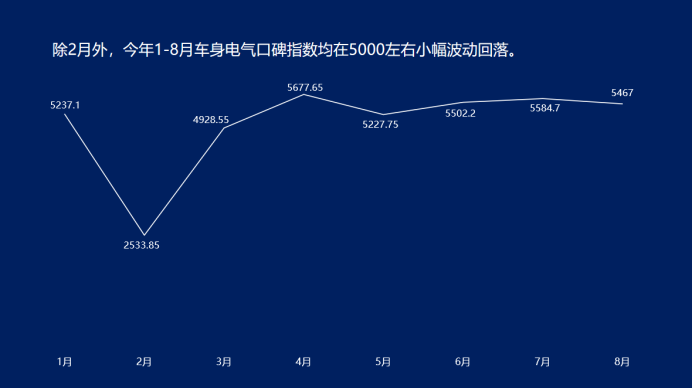
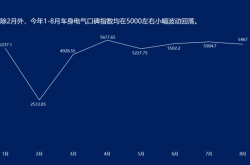
From a monthly trend perspective, the reputation index for electrical issues in car bodies has generally hovered around 5,000 from January to August this year, with a noticeable dip in February due to the Spring Festival holiday, while remaining relatively stable in other months. Electrical issues in car bodies have been the most frequently reported problems by users during this period.
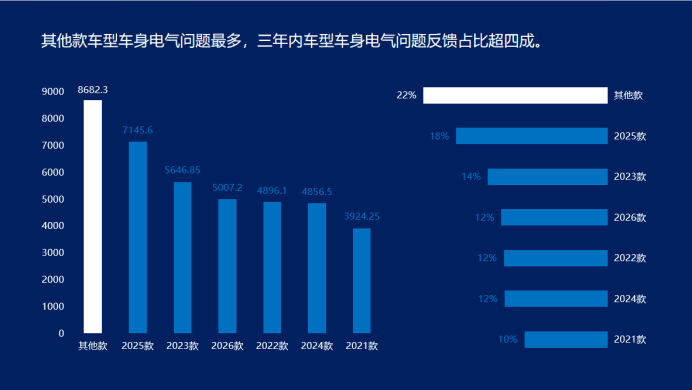
In terms of model years, vehicles over six years old have garnered the highest volume of feedback, with a reputation index reaching 8,682.3. New models within three years, including those from the 2024, 2025, and 2026 model years, account for over 40% of the feedback, becoming the primary models for which car owners voice complaints about electrical issues in car bodies. Among these, issues related to the 2025 model year are more concentrated in owner feedback.
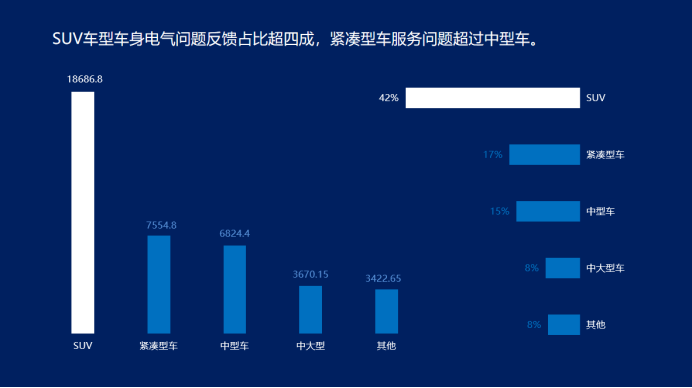
Regarding vehicle type distribution, SUVs have received the most feedback on electrical issues in car bodies, accounting for 42%, significantly "outpacing" other vehicle types. Additionally, compact cars have generated more feedback on related issues than mid-size cars, with both categories accounting for over 15% of the feedback.
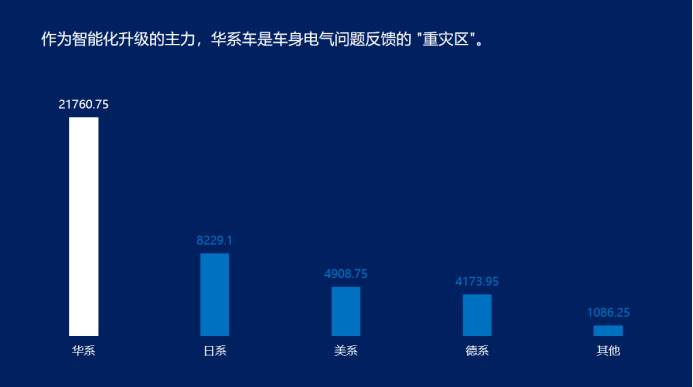
In terms of vehicle lineups, feedback on electrical issues in car bodies is predominantly concentrated in Chinese-brand vehicles, with a reputation index reaching 21,760.75, making it a major area of complaint for car owners. Japanese and American vehicles combined account for 32.71% of the reputation index, also facing some complaints from car owners. Overall, feedback on electrical issues in car bodies is highly concentrated in Chinese-brand vehicles, which boast richer intelligent configurations and faster iteration rates.
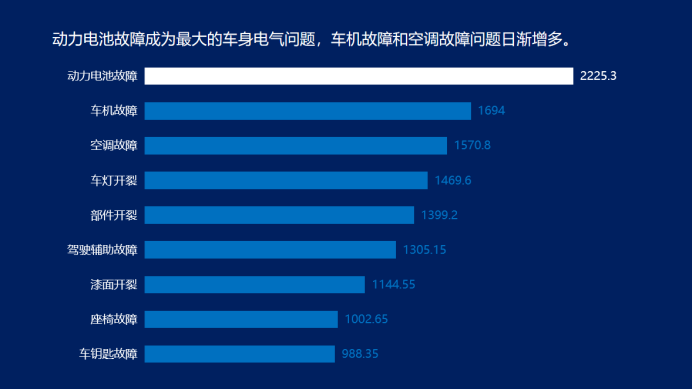
From car owners' feedback, power battery failures have surpassed vehicle system failures, ranking first with a reputation index of 2,225.3, becoming the most significant electrical issue in car bodies. At the same time, feedback on vehicle system failures and air conditioning failures closely follows. As a core component of new energy vehicles, any issues with the power battery often impact range, charging, and even daily vehicle use, making it a more prominent focus of complaints from car owners.
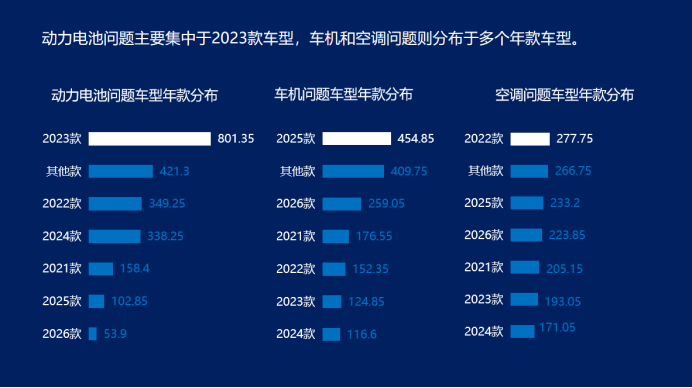
In terms of model years, power battery issues are mainly concentrated in the 2023 model year, with significantly higher feedback compared to other model years. Problems such as battery swelling and degradation in some GAC Aion models have been a major contributing factor. In contrast, vehicle system failures are more dispersed, with relatively concentrated feedback in the 2025 model year, primarily manifesting as loss of connectivity, poor signal, and inability to use connected car services. Additionally, air conditioning failures span multiple model years, with the highest feedback in the 2022 model year.
It is noteworthy that power battery degradation and vehicle system issues are also prominent in vehicles over six years old. As vehicles age, issues such as battery performance degradation and aging of vehicle system hardware and software are more likely to surface gradually.
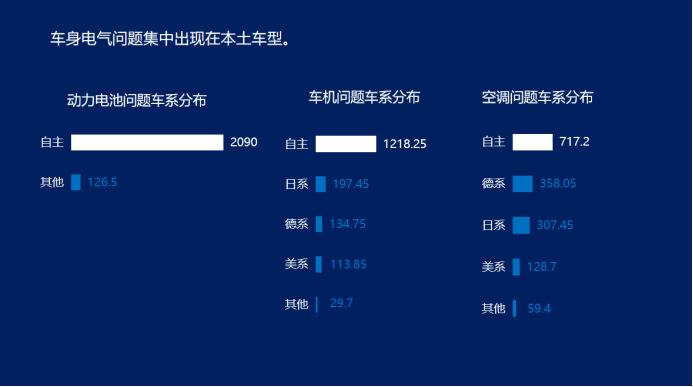
Regarding the distribution of problematic vehicle lineups, the three categories of electrical issues in car bodies—power batteries, vehicle systems, and air conditioning—are highly concentrated in local independent brands. This is attributed to the faster popularization and larger installed base of electric and intelligent technologies in independent brands. Additionally, while feedback on air conditioning issues remains highest for independent brands, there is also relatively significant feedback from German and Japanese models, making it a more noticeable electrical issue in car bodies for joint venture brands.
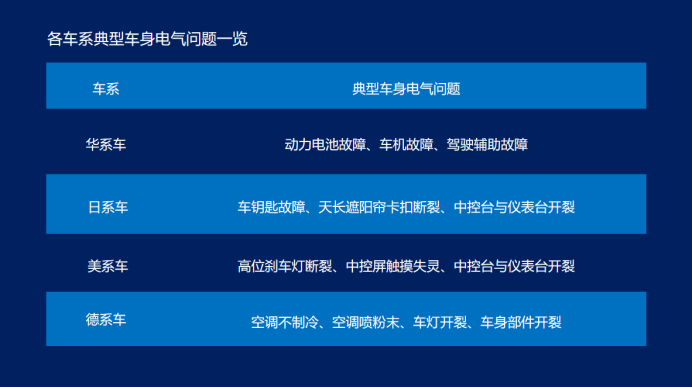
Based on the above analysis, the following conclusions can be drawn:
From January to August this year, electrical issues in car bodies have emerged as the most frequently reported category by users, with Chinese-brand vehicles standing out in terms of issue feedback. This is because, in recent years, Chinese local brands have accelerated their efforts in electrification and intelligence, leading to faster integration and wider application of new technologies such as vehicle systems, connected car services, and power batteries, making related issues more likely to surface concentrically. It can be said that as technologies are rapidly integrated into vehicles, product stability and reliability will face greater challenges.
From recalls to car owner feedback, issues brought about by new technologies are gradually coming to the fore. The competition in automotive intelligence and electrification is no longer solely about the number of functions or how "lavish" the configurations are, but also about whether these new technologies can withstand the test of time and daily vehicle use. For automakers, while speed is crucial, ensuring product stability and reliability should not be overlooked.
(Images sourced from the internet, removed if infringing)
-
![]()
【Electric Equipment】Weichai Foton Signs Agreement Again
-
![]()
Wan Gang and Zhu Huarong: How to Transform, Upgrade, and Achieve Resilient Growth Amid Declining Sales
-
![]()
New Technologies Are Swiftly Integrated into Vehicles, Spawning a Cluster of Electrical Issues in Car Bodies
-
![]()
Luxury Car Market Sees Sharp Decline: Porsche Prices Plummet by 300,000 Yuan?
-
Yaopi Glass's Revenue Stagnates in the First Half of the Year, Net Profit After Non-Recurring Gains and Losses Drops More Than 70%: Effectiveness of Technological Transformation Remains to Be Verified
-
![]()
Why Does Hungary's New Energy Industry Policy 'Waver Between Two Paths?'
-
![]()
Why Is Chery Reshuffling Its Executives Now—For Globalization or Luxury Ambitions?
-
Retail Industry Evolution: From Instant to AI-Driven Retail