After 40 Years of Competition, It's Time to Clear the Field in China's Auto Market
 09/24 2026
 413
413
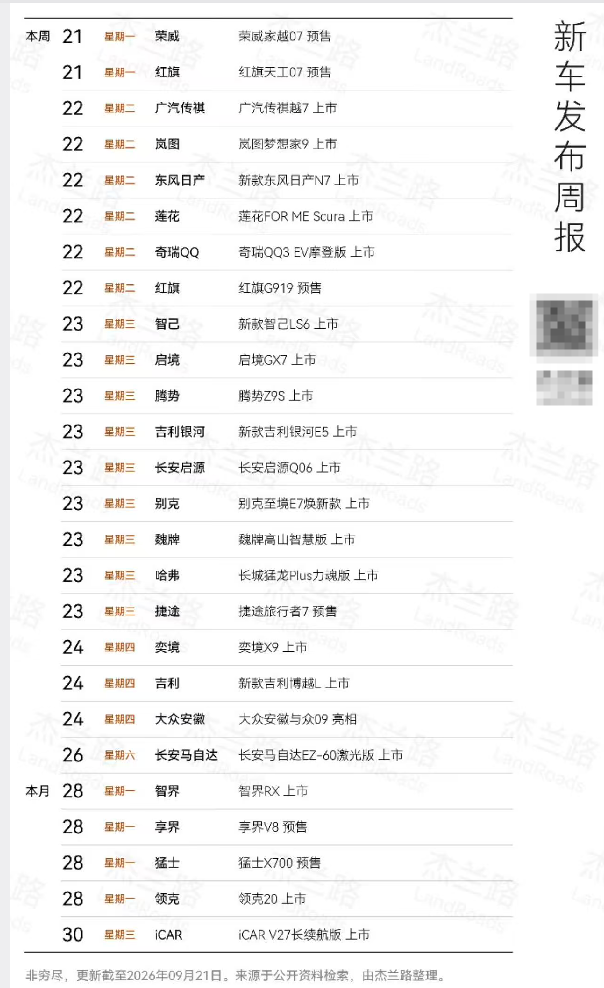
In the last week of September, over a dozen new vehicle models were launched domestically.
In the first eight months of 2026, cumulative retail sales of passenger vehicles reached 11.716 million units, down 20.8% year-on-year. Profit margins in the auto manufacturing sector fell to 3.4%, with only 1.5% at the vehicle assembly level, marking a decade-low.
If this were the computer, smartphone, social media, or group-buying industries, consolidation would have happened long ago.
China's group-buying websites went from 5,058 to just over 200 in under three years.
The smartphone market consolidated from thousands of brands to the top five holding 87% market share within five years.
Yet, after four decades in the auto industry, the arrival of new energy vehicles has only increased the number of brands.
I. Other Industries Consolidated in Three Years; Auto Industry Still Adding Players After Forty
Take the computer industry. In the 1990s, China's PC market featured dozens of well-known brands like Lenovo, Founder, Tsinghua Tongfang, Great Wall, TCL, Haier, Hisense, and Start. The global market was similarly fragmented, with IBM, Compaq, Dell, HP, and Apple vying for dominance.
Eventually, the top five global PC brands—Lenovo, HP, Dell, Apple, and ASUS—accounted for about 76% of the market.
In China, Lenovo now holds a 40% share, with the rest divided among HP, Dell, Huawei, and others.
The smartphone industry is even more telling.
At its peak, China had over 6,000 smartphone brands. In 2013, 2,288 new smartphone models were launched domestically, averaging six per day.
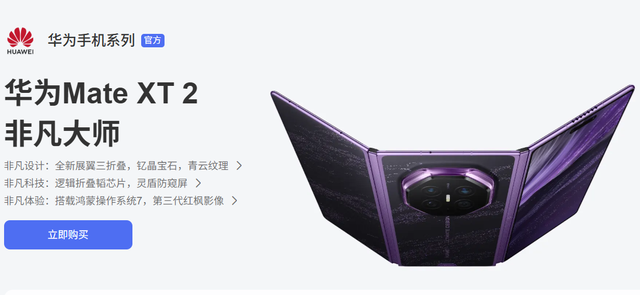
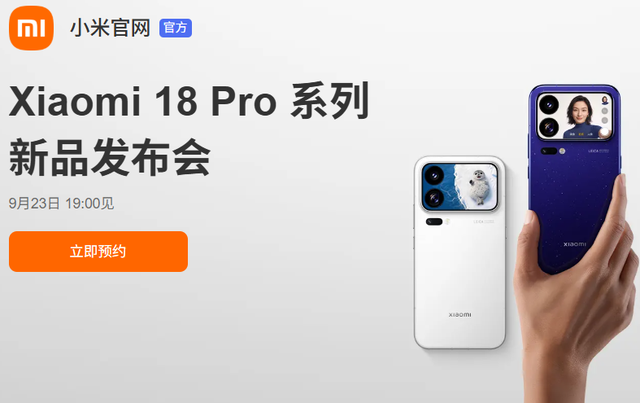
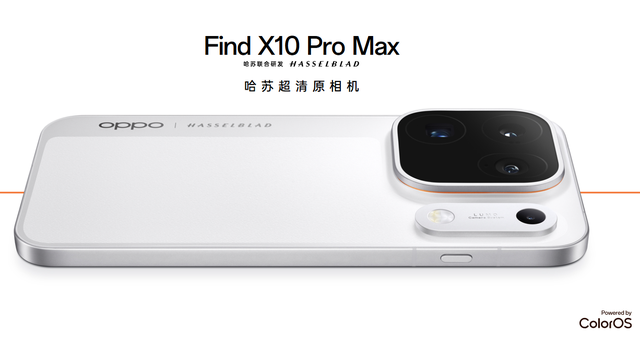
By the third quarter of 2018, the top five manufacturers captured 87% of the market share. The once-prominent "Zhong Hua Ku Lian" (ZTE, Huawei, Coolpad, Lenovo) gave way to "Hua Mi OV" (Huawei, Xiaomi, OPPO, Vivo), with the rest largely exiting the market.
The group-buying sector saw even faster consolidation.
The number of group-buying websites peaked at 5,058 in August 2011, dwindling to just 213 by December 2013—a survival rate of 3.5%. After the merger of Meituan and Dianping, the landscape for food delivery and group-buying became settled.
The pattern in these industries is clear: capital-driven growth, money-burning to capture market share, consolidation through competition or mergers within three to five years, leaving a few oligopolies standing.
Only with concentrated resources can significant R&D investment and quality service follow.
The auto industry, however, operates in reverse.
China has 71 registered automakers and over 130 brands in the market, with 129 new energy brands by the end of 2025.
In the first half of 2026, the top ten automakers by sales volume accounted for 84.2% of the market. Meanwhile, 23 new energy automakers have gone bankrupt, restructured, or halted operations. Nio Auto is the latest example—governments in Yichun, Jiangxi; Tongxiang, Zhejiang; and Nanning, Guangxi, competed to attract the company with equity investments, factory construction, ten-year rent-free periods, and per-vehicle subsidies. The result? 18.3 billion yuan spent, 26 billion yuan in debt, and idle production lines.
Even someone like Jia Yueting, who famously promised to return to China "next week," could casually launch a new auto venture.
While other industries consolidated within three years, the auto industry continues to add players after four decades.
II. Why Do So Many Automakers 'Refuse to Die'?
It's not that they haven't fallen; it's that they linger on life support.
In 2024, Zotye Auto's R&D expenditure was just 5.7 million yuan, down 86.97% year-on-year—barely enough for a decent product launch.
Eight once-prominent automakers—FAW Xiali, Brilliance Auto, Zotye, Leopaard, Lifan, Huatai, BAIC Yinxiang, and Old Haima—have had their vehicle production licenses frozen. WM Motor, with 26 billion yuan in debt, has a restructuring investor with just 100 million yuan in registered capital, yet plans to resume production.
Local governments serve as critical "lifeboats."
The auto industry has become a cornerstone of local economies following the real estate downturn.
Professor Zhu Xichan from Tongji University's School of Automotive Studies points out that significant resistance to industry consolidation exists domestically. To stabilize the economy, local state-owned assets will revive capacity even if automakers are unprofitable. The case of Hubei WM Motor, taken over by Chuanen after bankruptcy, is a prime example, substantially delaying industry consolidation.
But this lifeboat is now taking on water itself.
Previously, local governments could rely on land sales to subsidize automakers and maintain GDP growth.
Times have changed.
Hu Bo, an associate professor at Renmin University of China's School of Finance, offers a piercing analysis: some localities view "concessions" as a "key bargaining chip" to attract projects, falling into the mindset of "no incentives, no investment." The government's role has shifted from "guidance and support" to "excessive bailouts," ultimately distorting the market and straining finances.
The collapse of Nio Auto left state-owned assets in Yichun and other locales unable to recoup investments, a direct consequence of excessive government intervention in business operations.
The financial "spigot" is also tightening.
In 2026, subsidies for trade-ins will decline compared to the previous year, while the purchase tax exemption for new energy vehicles will be halved. Subsidies for low-priced models have effectively dropped significantly. Coupled with strict national controls on local debt, the model of relying on fiscal support to sustain zombie automakers has reached its end.
Capital is also gambling—on the scarcity (rare) "auto manufacturing licenses" reviving, on new narratives boosting valuations. In 2025, China's total auto production capacity will reach about 47.5 million units, with actual sales at 34.4 million units, yielding a capacity utilization rate of around 73%. However, most brands operate at just 20-30% capacity utilization, with only leading automakers running at full capacity.
Money circulates idly, people wait for favorable winds—but the wind won't blow for everyone.
More importantly, the backers themselves are running out of money.
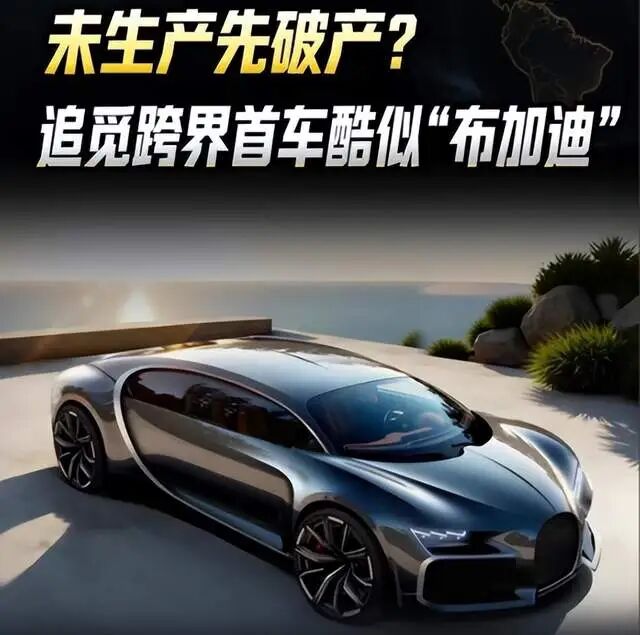
Here's a placeholder for Zhuomi Auto (a hypothetical or niche player).
III. How Many Should Survive? Look to Others' Paths
The U.S. auto industry underwent similar consolidation.
In 1920, the U.S. had 169 automakers. The Great Depression and postwar consolidation left General Motors, Ford, and Stellantis (formerly Chrysler) as the dominant players.
The European market is more fragmented but controlled by a few groups: Volkswagen, Stellantis, Renault, and BMW.
China won't simply replicate these paths, but the direction is clear.
The "15th Five-Year Plan" for the auto industry, released by Changchun's Bureau of Industry and Information Technology, projects that the number of domestic automaker groups will shrink from 71 to around 15 by 2030.
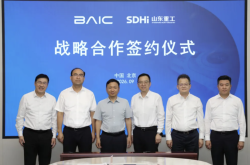
Consolidation is already underway: Changan Auto integrated Avatr and Deepal, sharing R&D platforms and supply chains in the mid- and back-end, expecting to reduce public resource costs by 20-30%. Geely acquired Radar Auto for 218 million yuan, incorporating its new energy pickup business into its listed entity. GAC Group and FAW Group are also planning strategic restructuring.
He Xiaopeng predicts that China will stabilize at around five brands with significant sales volume. Yang Dayong, executive vice president of Changan Auto, is more blunt—the Chinese market will eliminate 100 auto brands in the coming years.
Professor Zhu Xichan sets a more specific threshold: an annual production and sales volume of 2 million units is essential. Currently, only seven automakers in China—BYD, SAIC, Geely, and others—meet this standard.
The challenges of going global are also magnified.
In the first seven months of this year, China exported 6.14 million vehicles, up 66.8% year-on-year, with full-year exports expected to surpass 10 million units for the first time. However, export volume has outpaced competitive order.
Some Chinese automakers have exported their domestic price wars overseas, with successive price cuts in Thailand triggering dissatisfaction among existing customers and investigations by local authorities. The Ministry of Commerce, Ministry of Industry and Information Technology, and State Administration for Market Regulation jointly issued the "Guidelines on Overseas Competition Behavior and Compliance Construction in the Auto Industry," explicitly requiring reasonable pricing, orderly competition, and prohibiting frequent and substantial price fluctuations.
Meanwhile, the EU has imposed anti-subsidy tariffs of up to 35.3% on Chinese electric vehicles, superposition (combined) with a 10% basic import tariff, reaching a total of 45.3%.
Faced with such barriers, a small brand selling tens of thousands of units annually has no capacity to build overseas factories, establish distribution channels, or mitigate policy risks. Only by consolidating into super-giants with economies of scale can they compete globally.
Preventing the unviable from dying harms the viable.
Conclusion
China's auto industry hasn't missed its consolidation window—every time it approached, "preserving jobs," "protecting tax revenue," and "safeguarding licenses" pulled it back.
Zhang Dongwei argues that the auto industry now needs to stop resuscitating zombie automakers and instead release land, equipment, and talent to truly competitive enterprises.
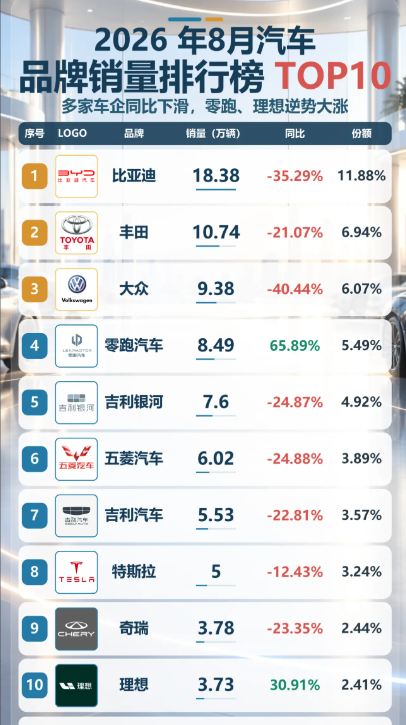
[Surprised that Huawei's HarmonyOS Intelligent Mobility series, Xiaomi Auto, and XPENG Motors didn't make the top 10 sales list in August?]
The supply-side reforms in the steel and coal industries have proven that eliminating outdated capacity doesn't destroy an industry—it allows survivors to profit and invest in R&D.
In the second half of the auto industry's journey, the key isn't launching new models quickly but learning to streamline.
Close the unviable, merge the redundant.
Let the capable compete globally—the skills honed in domestic competition count for little against European and Southeast Asian tariff barriers.
So, who do you think will exit first? Who will have the last laugh? Leave a comment and share your insights.
-
China’s PC Market Defies Downturn: Huawei Surges 82%, Apple Up 63%
-
![]()
Pupil Function → PSF → MTF: A Three-Tiered Numerical Framework for Optical Assessment
-
![]()
GW is Becoming the Unit of Measurement for Cloud Providers
-
![]()
Doubao Enters Smartphone Arena, Qianwen Ventures into Tablets
-
![]()
After 40 Years of Competition, It's Time to Clear the Field in China's Auto Market
-
![]()
Manus Valued at $27 Billion: Revenue Surges 4x, Marketing Outshines Technology
-
![]()
【Electric Equipment】Weichai Foton Signs Agreement Again
-
![]()
Wan Gang and Zhu Huarong: How to Transform, Upgrade, and Achieve Resilient Growth Amid Declining Sales