BYD’s 5-Minute Charge vs. Geely’s 4.5-Minute Charge: The Megawatt-Level Charging Race Heats Up
 09/28 2026
 474
474
On September 23, Geely Auto Group unveiled its cutting-edge AI energy replenishment technology, dubbed "Geely Intelligent Charging." According to company officials, the single-gun peak charging power can reach an impressive 2.2 megawatts. The Lynk & Co 10, featuring a compatible battery, takes an average of 4 minutes and 30 seconds to charge from 10% to 70%, and 8 minutes and 40 seconds to reach 97% under normal temperature conditions. Six months prior, in March, BYD introduced its second-generation Blade Battery and megawatt flash charging technology, claiming a 5-minute charge from 10% to 70% and a 9-minute charge from 10% to 97% under similar conditions, with a single-gun peak power of 1500kW at its flash charging stations.
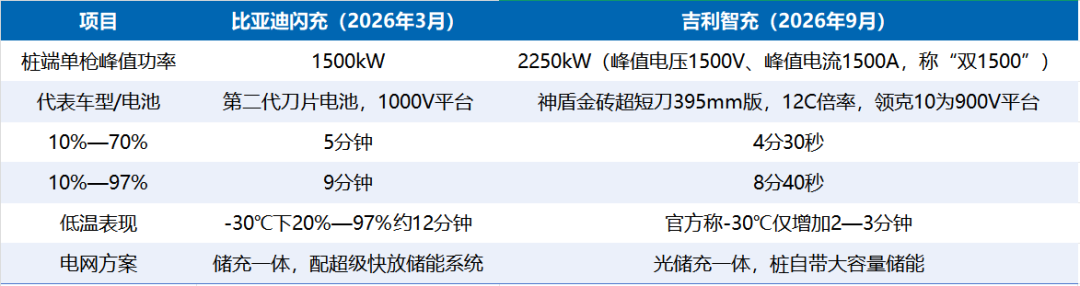
At first glance, these two sets of data, separated by just six months and a matter of seconds, seem to suggest a "who's faster" relay race. However, when we translate the parameters announced at the press conferences into real-world engineering conditions, it becomes clear that the approaches of the two companies are remarkably similar, and the true difference does not lie in those "few minutes."
It's important to note that the speed and power data mentioned above are all sourced from official corporate releases. Some of Geely's temperature control data comes from real-world tests of the Lynk & Co 10 conducted by the China Automotive Technology & Research Center (CATARC), while some of BYD's safety data is based on test results published by the company. The test objects, conditions, and the extent of third-party involvement are not entirely comparable between the two.
Ultra-Fast Energy Replenishment: A Holistic Requirement
Both companies emphasized at their press conferences a crucial but often overlooked fact: ultra-fast energy replenishment cannot be achieved solely through charging stations; it requires the simultaneous presence of vehicles, charging stations, and energy storage systems.
The vehicle must be equipped with a specific new-generation battery and utilize a high-voltage platform (1000V for BYD, 900V for Geely's Lynk & Co 10). Older 400V or 800V models, even when plugged into the same station, can only charge at the power limit specified by the vehicle's Battery Management System (BMS). 
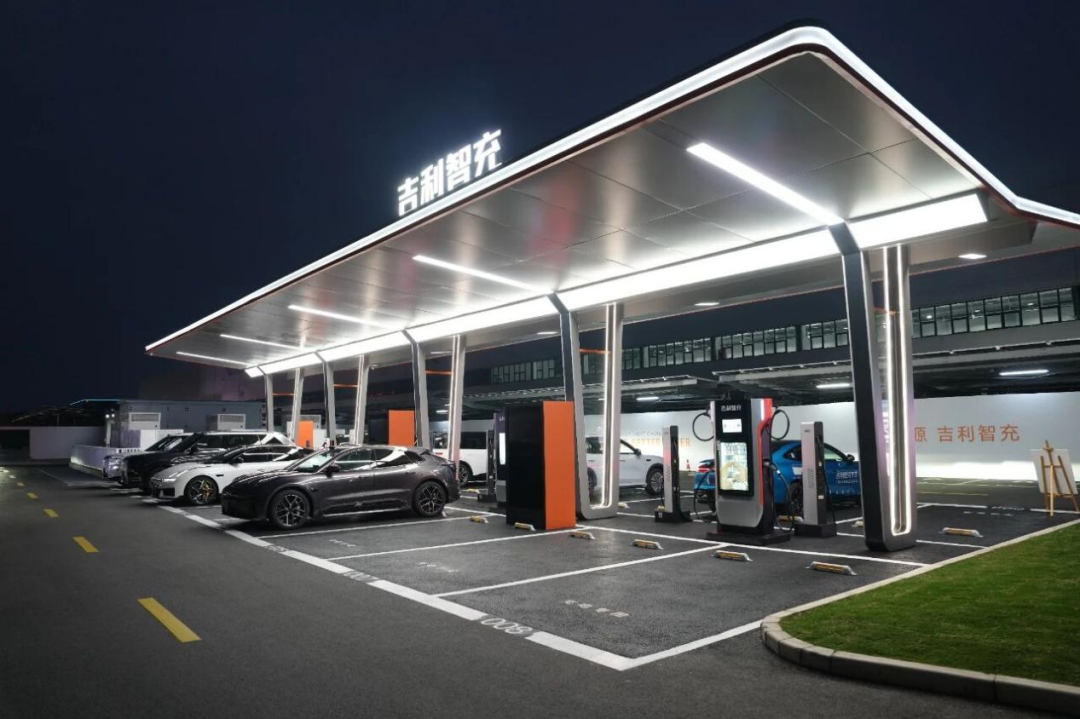
The charging station must be a self-built, dedicated high-power station, as ordinary 120-480kW DC fast-charging stations cannot trigger ultra-fast mode.
Both companies have equipped their stations with on-site energy storage systems that utilize off-peak electricity for energy storage and discharge during peak hours, with power supplied jointly by the grid and the energy storage system.
This means that the "5 minutes" or "4 minutes and 30 seconds" experienced by users are the combined results of specific vehicle models, specific charging stations, normal temperature conditions, and specific State of Charge (SOC) ranges, rather than universal conditions. Additionally, charging to "97%" rather than 100% is a common industry practice (leaving a buffer at the end to protect the battery and accommodate kinetic energy recovery), but this also objectively shortens the advertised charging time.
Peak Power vs. Actual Speed
It's crucial to understand that peak power does not equate to actual charging power, which is the key to interpreting these two sets of figures.
Firstly, peak power is an instantaneous value, not an average over the entire charging process. Taking Geely as an example, when the China Automotive Technology & Research Center (CATARC) tested the Lynk & Co 10 charging from 10% to 97%, the peak charging power was 1093kW—lower than the station's rated 2250kW due to limitations in the vehicle's capabilities. BYD's 1500kW station capability may also not be fully utilized throughout the actual charging process.
Secondly, calculating based on energy transferred provides a more accurate reflection of real-world performance. Assuming a vehicle has a usable battery capacity of about 70 kWh, charging from 10% to 70% requires approximately 42 kWh of energy. If this takes 4 minutes and 30 seconds, the corresponding average power is about 560kW; if it takes 5 minutes, the average power is about 504kW. In other words,
even in the most ideal charging range, the actual average power is only about one-third to one-half of the peak power. This is not a "watering down" of the technology but rather a physical limitation of lithium-ion batteries: as the SOC and temperature increase, the acceptable current decreases, and any fast-charging curve will inevitably decline.
Therefore, the comparison of "2250kW vs. 1500kW" primarily reflects the upper limit of the station's capabilities and does not directly equate to the speed difference experienced by users. What truly determines the user experience is the fullness of the entire charging curve, the extent of low-temperature performance degradation, and whether users can easily find available charging stations.
The fact that both BYD and Geely, two leading companies in the industry, have chosen to equip high-power charging stations with energy storage systems reflects a pragmatic industry judgment. If a single station with megawatt-level power were to draw directly from the grid, it would be equivalent to hundreds of household air conditioners running simultaneously, necessitating dedicated power lines, transformer upgrades, and lengthy approval processes. The "off-peak charging, peak discharging" buffer pool model significantly lowers site selection thresholds and makes deployment possible in commercial districts, residential areas, highway service stations, and remote regions.
The difference between 4 minutes and 30 seconds and 5 minutes is more of a phased milestone in technological evolution rather than a decisive turning point. For consumers, judging the maturity of an energy replenishment technology might involve paying less attention to "peak power" and more to three things: whether there are charging stations nearby, how fast it charges in winter, and how much battery capacity remains after five years. These factors can only be verified over time.
-
Why is Geely introducing Zhichong now, and what stage has Geely's new energy strategy reached?
-
![]()
Fuel Vehicle Sales Slump and New Energy Gaps Present Limited Growth Avenues for Joint Ventures
-
![]()
How to Calculate MTF from a Slanted Edge? A Three-Step Derivation from ESF to the Curve
-
![]()
The Other Side of the 'First Year of Mass Production' of Optical Waveguides: Has Capacity Been Built Up and Yield Kept Up?
-
![]()
Huawei Set to Unveil '10x Zoom Module Camera'! Patent Visuals Unveiled: Boasts Built-in CMOS
-
![]()
Silicon Carbide Optical Waveguides: From 'Performance Option' to 'Mass Production Element'
-
![]()
BYD’s 5-Minute Charge vs. Geely’s 4.5-Minute Charge: The Megawatt-Level Charging Race Heats Up
-
![]()
Trump Urges Factory Construction, While Detroit Resists: Who’s Playing the Good Cop, and Who’s the Bad Cop?