Collaborating with NIO to Propel Battery Swap Technology, Exploring Geely Auto's Dual Strategy
 09/30 2026
 366
366
Embracing Change, Embarking on a New Journey
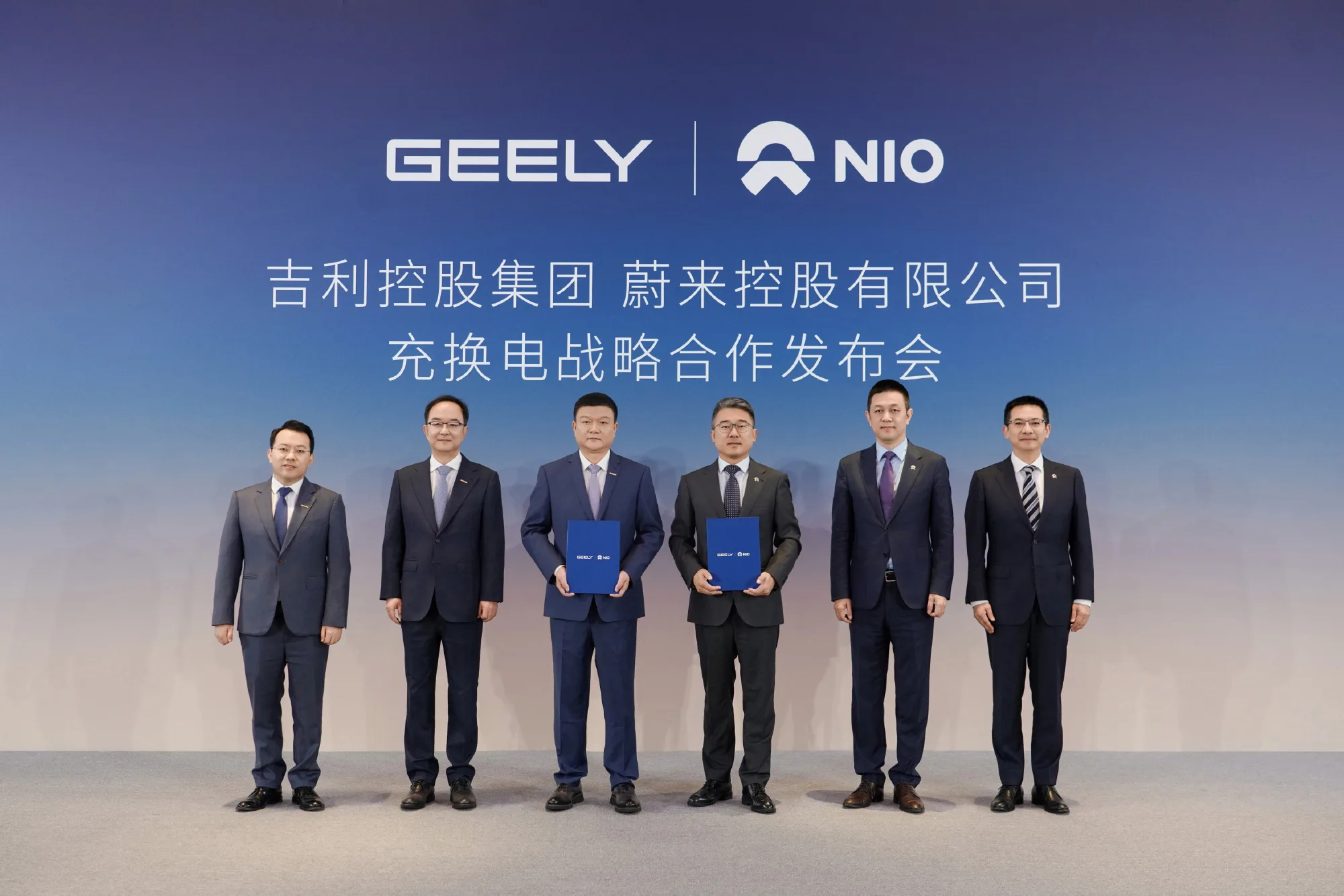
The automotive industry is abuzz with the latest news: the groundbreaking collaboration between NIO and Geely in the realm of charging and battery swap technologies.
Both entities have released comprehensive press statements detailing this partnership, brimming with insights. Therefore, Dianchetong (ID: dianchetong233) will first offer a succinct overview, briefly introducing the essence of their cooperation and their subsequent objectives.
Let's delve into the capital-level transformations first. Geely Holding Group will inject 100% of the equity of its subsidiary, Yiyi Internet, along with RMB 640 million in cash, to acquire a 30% stake in NIO Energy. Concurrently, NIO Energy will secure a 10% stake in Haohan Energy, a Geely Holding subsidiary.
(Image Source: NIO)
The core of their cooperation revolves around two key areas: B-end (business-end) operational vehicles and C-end (consumer-end) vehicles.
For B-end operational vehicles, Yiyi Internet's battery swap operations will be integrated into NIO Energy, implying that Geely's existing battery swap stations for ride-hailing services will now be managed by NIO. In the C-end segment, NIO and Geely will jointly establish unified battery swap standards. Geely will develop battery swap models tailored for the C-end market, with NIO Energy providing the corresponding battery swap services. Additionally, the charging resources of both NIO and Geely will be interconnected.
At this juncture, many may question why Geely, amidst the rapid advancement of ultra-fast charging technology, has opted to collaborate with NIO and venture into the C-end battery swap market. What are Geely's underlying intentions?
Today, Dianchetong will delve deeper into this topic with all of you.
Embracing Change, Embarking on a New Journey
Few may be aware that prior to this collaboration, Geely already had a foothold in the battery swap sector through Yiyi Internet, as previously mentioned.
However, the challenge lies in Yiyi Internet's exclusive focus on the B-end mobility market, specifically ride-hailing vehicles, which does not facilitate Geely's expansion into the C-end battery swap market but rather acts as a hindrance.
Why do we say that?
Firstly, Yiyi Internet has been deeply entrenched in the battery swap business for the mobility market for years. All its stations and supporting batteries are tailored for taxis and ride-hailing vehicles. This poses a dilemma: if Geely intends to develop a battery swap business for C-end models, it cannot repurpose Yiyi Internet's existing infrastructure.
For consumers, it would be unappealing to utilize battery swap stations shared with ride-hailing vehicles for personal vehicle battery swaps. In essence, if Geely aims to penetrate the C-end battery swap market, it must establish separate energy replenishment networks for B-end and C-end markets.
This presents Geely with a conundrum: the battery swap network it has painstakingly built over the years cannot be seamlessly integrated with its C-end business and has limited growth potential. Constructing a new battery swap system from scratch is evidently impractical.
Thus, from this vantage point, Geely's decision to collaborate with NIO emerges as the optimal solution for its growth trajectory.
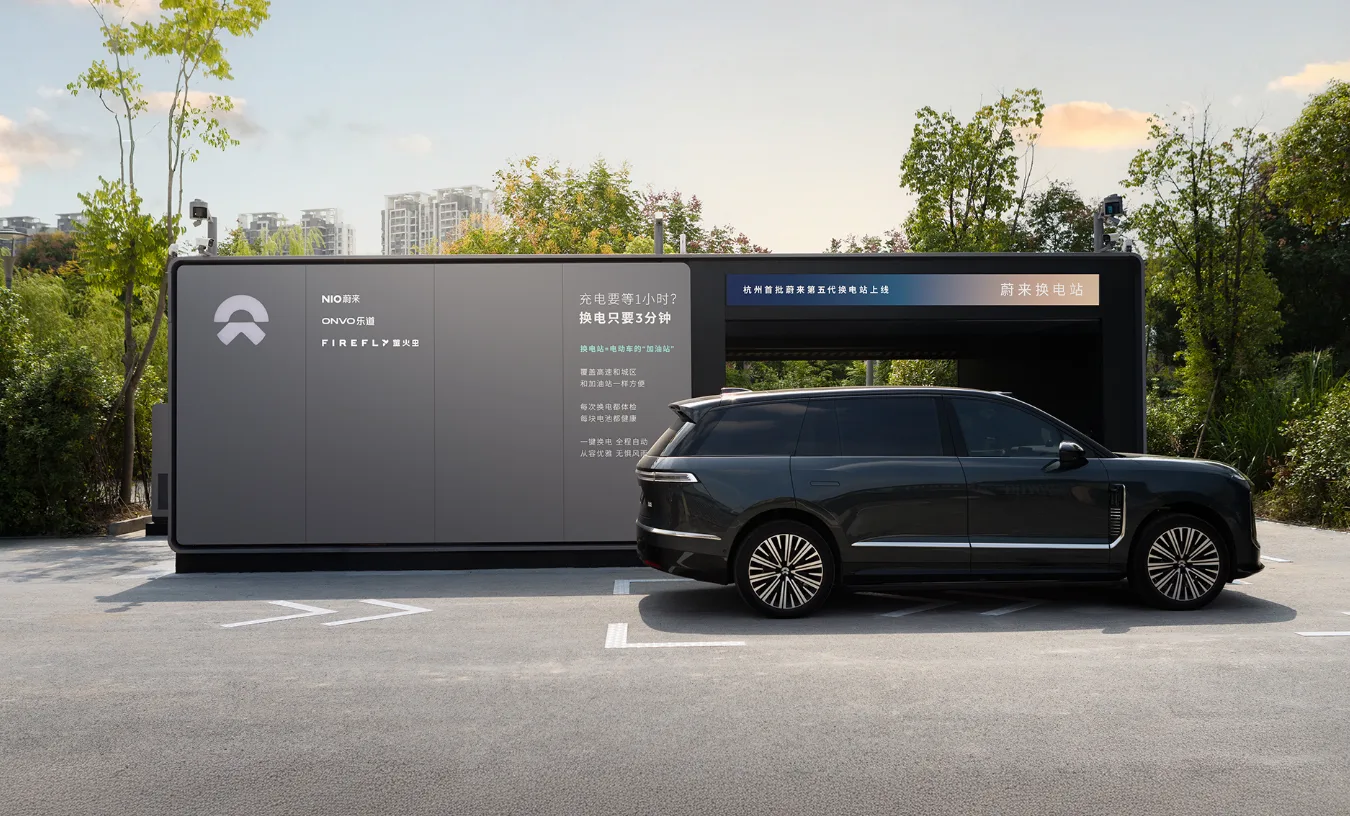
(Image Source: NIO)
On one hand, Geely sheds the 'burden' of Yiyi Internet, eliminating the need for arduous operations and allowing it to concentrate on its core vehicle manufacturing business. On the other hand, Geely avoids the necessity of constructing a new battery swap system from the ground up. Its new models simply need to be compatible with NIO's battery swap system to access some of NIO's existing battery swap stations.
This collaboration also opens up new avenues for NIO. It not only acquires a comprehensive battery swap system for B-end models, facilitating its further expansion in the mobility market, but NIO can also integrate Geely's newly launched battery swap models into its ecosystem, thereby enhancing the utilization rate of its existing battery swap stations, which bodes well for the overall development of its battery swap business.
With opportunities come challenges. How will Geely's models adapt to the standards of NIO's battery swap stations? How will NIO's battery swap stations deploy batteries for Geely's models? Will there be competition between Geely's ultra-fast charging models and battery swap models? Will NIO and Geely's battery swap models compete? These are all considerations for both parties.
Nevertheless, both entities have taken a significant stride forward in their charging and battery swap business collaboration. Whether their partnership will proceed smoothly and yield tangible results remains to be seen and validated over time.
Battery Swap and Ultra-Fast Charging: Geely's Dual Approach
On September 23, mere days before the official announcement of the Geely-NIO collaboration, Geely unveiled its new-generation AI energy replenishment technology, 'Geely Smart Charging.' According to Geely, this technology can achieve an average charging time of 4 minutes and 30 seconds for a 10%-70% charge and 8 minutes and 40 seconds for a 10%-97% charge.
In essence, within a week, Geely showcased its latest advancements in both ultra-fast charging and battery swap technologies, signaling to the industry and consumers its commitment to pursuing both avenues.
Interestingly, prior to this, the battery swap and ultra-fast charging routes were often seen as mutually exclusive.
Proponents of ultra-fast charging argue that the time savings offered by battery swap are no longer significantly advantageous, and batteries are in constant circulation, meaning consumers are perpetually using older batteries.
Conversely, supporters of the battery swap route contend that ultra-fast charging also necessitates energy storage, adding an extra step of power transmission from the energy storage cabinet to the vehicle compared to battery swap. Moreover, ultra-fast charging cannot guarantee that batteries are always new and flexible.
Amidst this heated debate, Geely's stance is clear: 'I want both.'
Why does Geely adopt this approach? Dianchetong (ID: dianchetong233) believes that for Geely, ultra-fast charging addresses current challenges, while battery swap is a strategic move to shape the future.
Let's first examine the present. As one of China's leading new energy vehicle companies, Geely's primary competitor in the new energy sector is undoubtedly BYD.
On March 5 this year, BYD introduced its second-generation Blade Battery and flash charging technology, claiming it could achieve 'five minutes to charge enough, nine minutes to charge full.' Since then, BYD has launched several flash charging models, spanning price ranges from RMB 100,000 to RMB 1 million. Flash charging has become one of BYD's key selling points.
BYD's aggressive flash charging technology has put Geely in a somewhat defensive position.
Therefore, for Geely, it is imperative to introduce technology with charging speeds comparable to or even surpassing BYD's flash charging as soon as possible and equip it across its various models to neutralize BYD's generational advantage in charging.
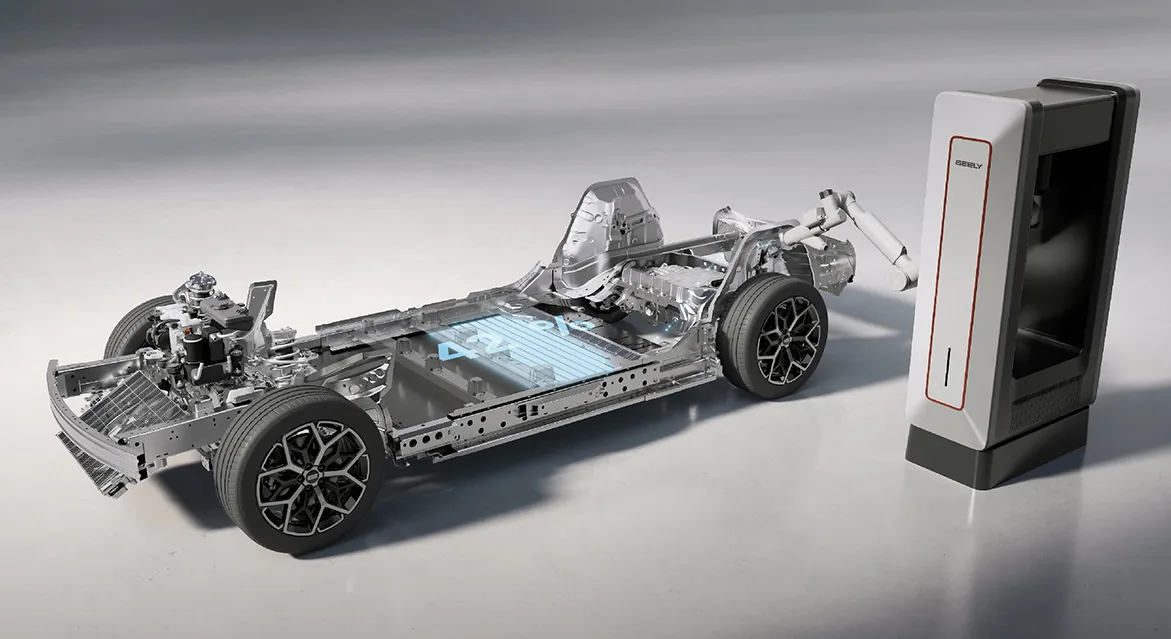
(Image Source: Geely)
Looking ahead, in Dianchetong's (ID: dianchetong233) view, Geely's ambition extends beyond battery swap technology itself; it encompasses the infrastructure, energy storage, and long-term battery utilization it enables.
With the steady rise in new energy vehicle ownership and the evolution of charging technology, it is evident that high-power charging stations will incorporate energy storage facilities in the future. This prompts charging service operators to actively invest in energy storage infrastructure, gaining experience and insights through continuous experimentation.
However, NIO stands out. Its subsidiary, NIO Energy, is not only a charging and battery swap service operator but also holds a substantial portfolio of battery assets. It possesses its own expertise and methodology in battery asset deployment, healthy and efficient utilization, and retired battery disposal. These are precisely the areas where Geely can benefit.
Moreover, NIO currently operates 4,129 battery swap stations and 5,320 ultra-fast charging stations, with plans to exceed 10,000 battery swap stations by 2030. Each of these stations has the potential to evolve into an energy storage + ultra-fast charging model and could even be collaboratively constructed with Geely's own ultra-fast charging network, which holds significant implications for Geely's future energy replenishment strategy.
In Conclusion
The collaboration between Geely and NIO in charging and battery swap represents a unique model in China's new energy industry. The two companies have not only cooperated but also achieved mutual shareholding and even business transfer, demonstrating their unwavering commitment to the partnership.
Looking forward, the impact of this collaboration may extend beyond the two companies. Will the ultra-fast charging and battery swap routes transition from opposition to integration in the future? Will more automakers adopt NIO's battery swap technology route, leading to a gradual unification of battery swap technology?
Although their collaboration may be accompanied by uncertainties and challenges in the future, at least for now, this partnership between Geely and NIO presents us with new possibilities for industry development.
Source: Leikeji
Images in this article are from: 123RF Royalty-Free Image Library Source: Leikeji
-
![]()
Huawei Steps into External Optics! Mate 90 Unveiled with Modular Camera, Is It Geared for AI Imaging?
-
![]()
Collaborating with NIO to Propel Battery Swap Technology, Exploring Geely Auto's Dual Strategy
-
![]()
iQOO Pad Ultra Review: A Perfect Blend of Portability and Performance, Ideal for Productivity
-
Ten Years of Magic: HONOR Splits the 'All-Rounder Flagship' into Three Answers
-
![]()
Office Agent Showdown: Kingsoft, SenseTime, iFLYTEK, Youdao - Who Makes the Cut, Who's Just Along for the Ride?
-
![]()
Starting at 118,800 yuan with standard LiDAR, the new Lynk & Co 20 is all business this time around.
-
COSTAR Auto Optoelectronic Display Branch Passes Supplier Admittance Review by a Leading Headlamp Enterprise!
-
![]()
Domestic Memory Behemoth Unveils Plan to Invest 34.9 Billion Yuan in Production Scale-Up