Nexteer’s H1 Performance: Half of Revenue Yields Just 7% Profit
 09/30 2026
 508
508
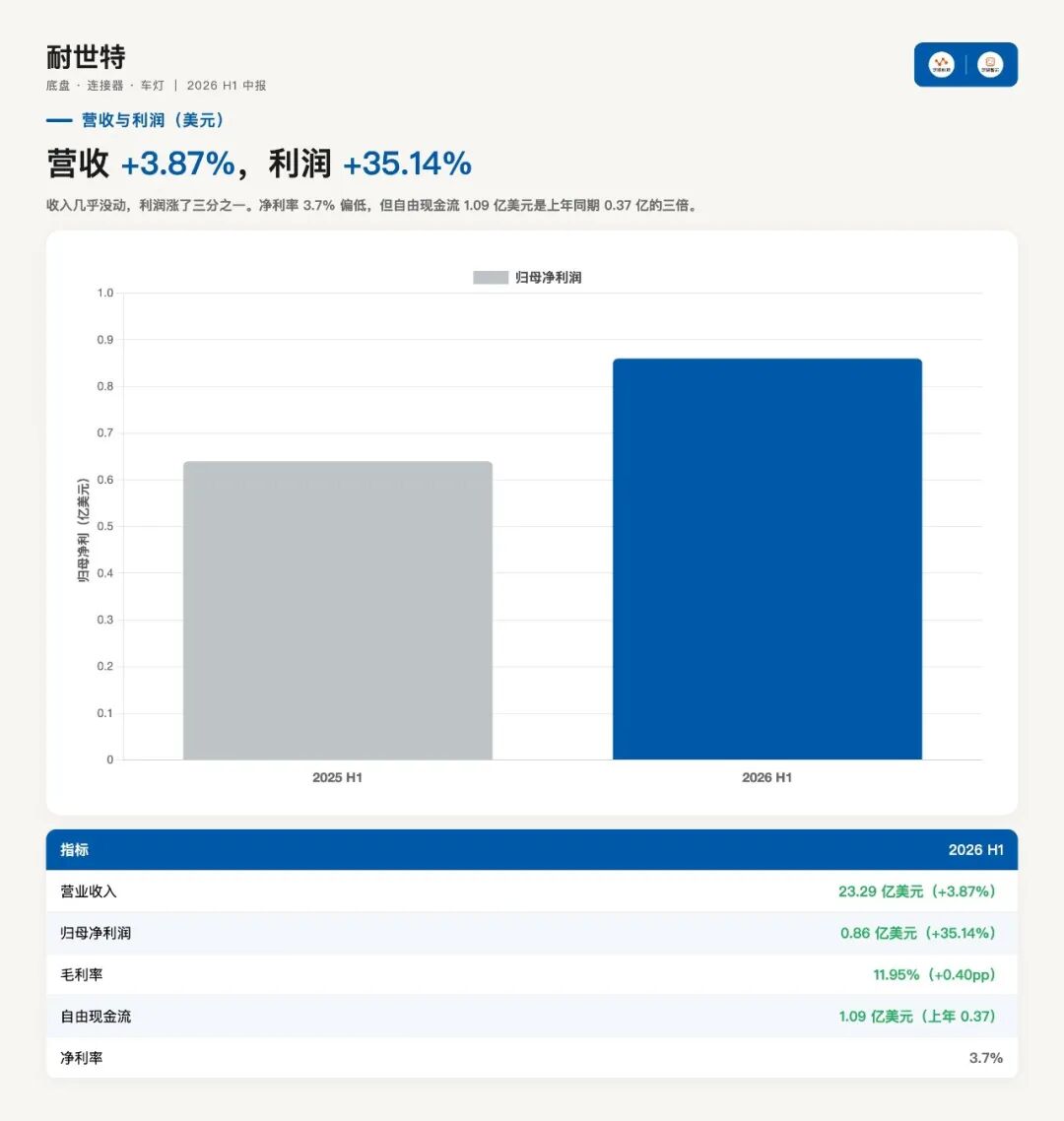
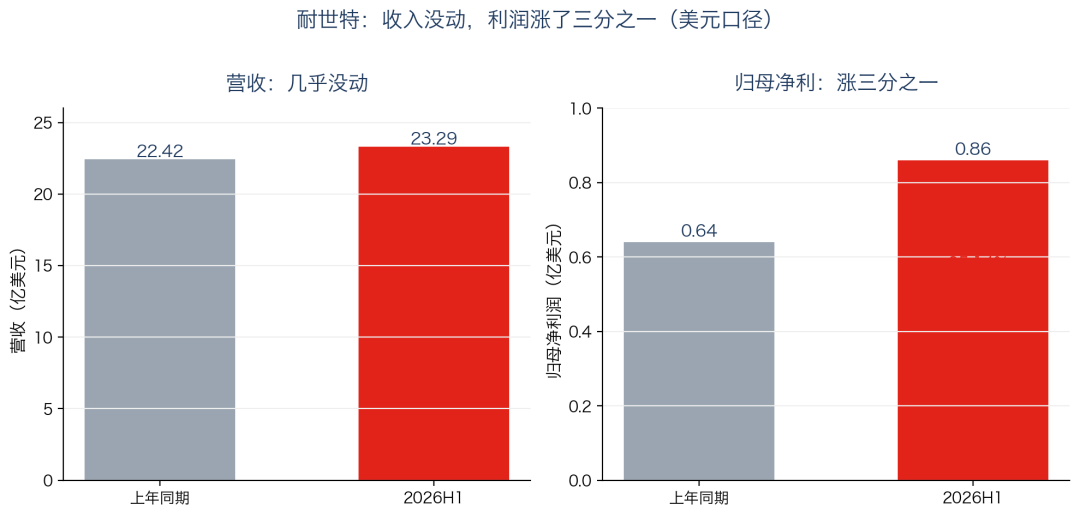
Nexteer’s revenue in the first half of the year reached $2.329 billion, marking a year-on-year increase of 3.87%. The net profit attributable to the parent company was $86 million, up 35.14% from the previous year.
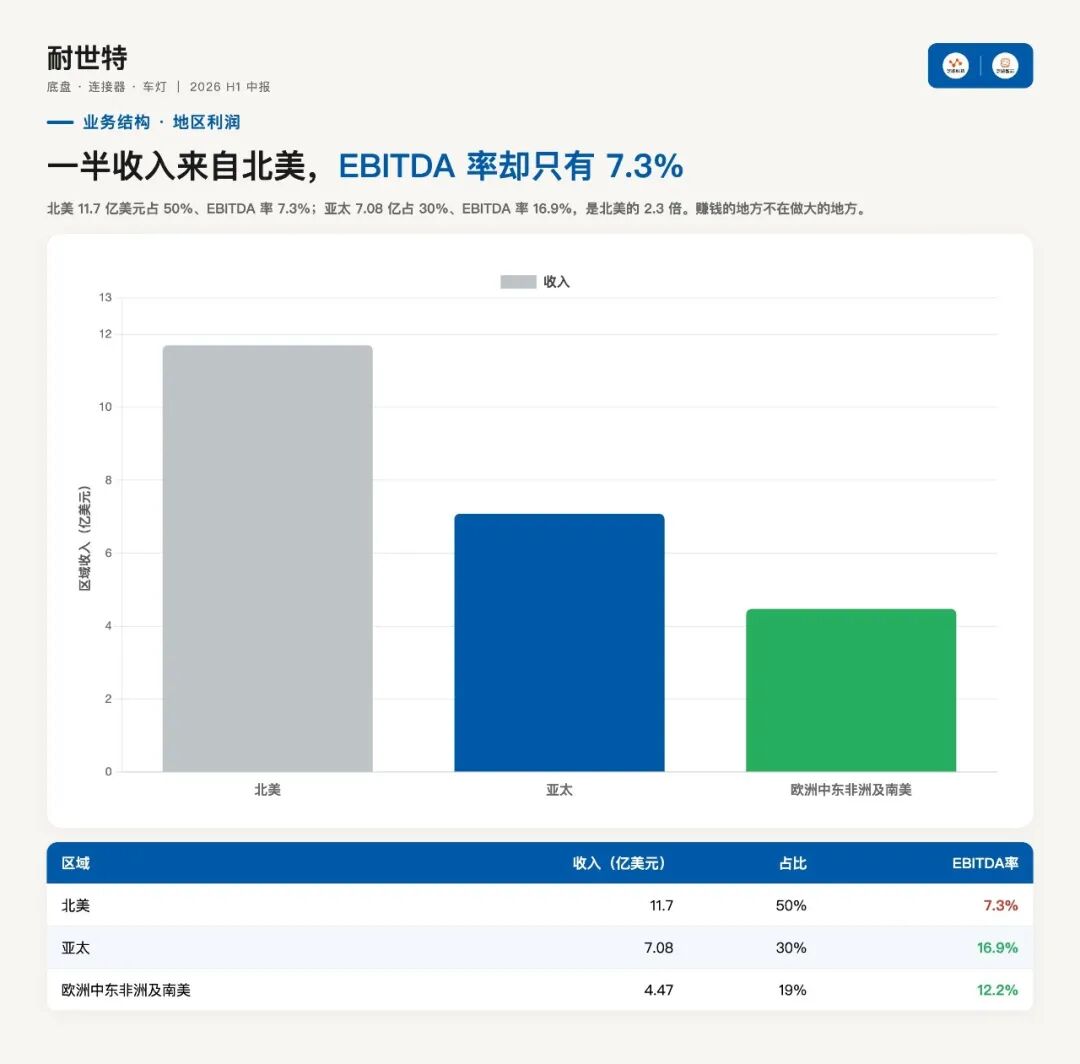
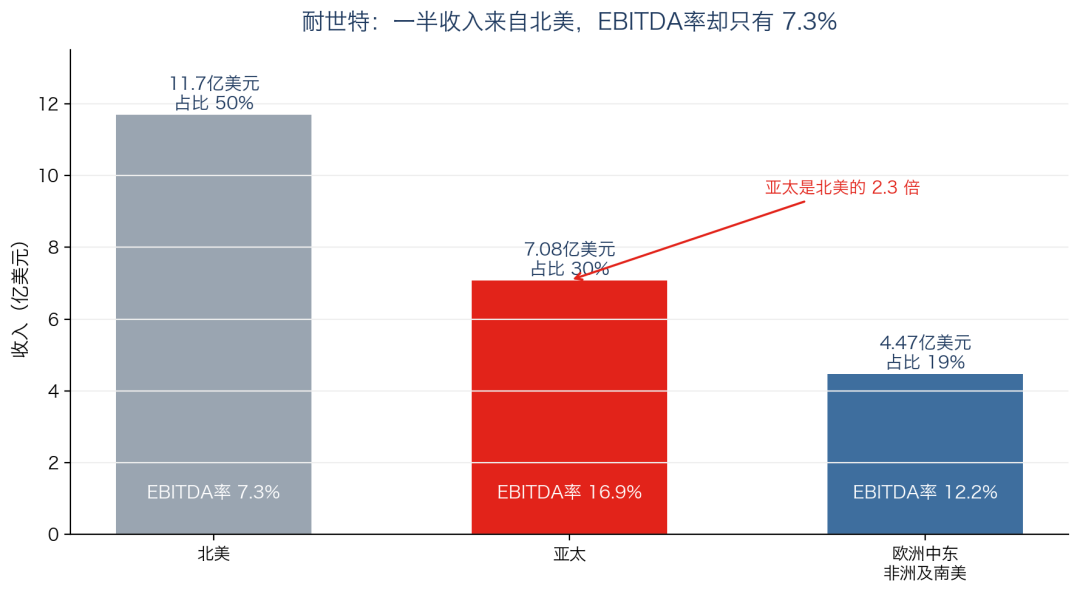
The North American market contributed $1.17 billion in revenue, accounting for 50% of the total, with a modest year-on-year increase of 2.7% and an EBITDA margin of 7.3%. The Asia-Pacific market generated $708 million, representing 30% of revenue, with a 3.2% year-on-year growth and an EBITDA margin of 16.9%. Europe, the Middle East, Africa, and South America collectively contributed $447 million, or 19% of revenue, experiencing an 11.6% year-on-year increase and an EBITDA margin of 12.2%.
Despite revenue remaining relatively flat, Nexteer saw profits surge by a third in the first half of the year. While North America accounts for half of the revenue, its EBITDA margin stands at a mere 7.3%. In contrast, the Asia-Pacific region, contributing 30% of revenue, boasts an EBITDA margin of 16.9%.
This long-standing steering systems company is pinning its growth hopes on steer-by-wire technology and its recent foray into the EMB braking sector, achieving a net profit margin of 3.7%.
Part 1: Half of Revenue, Only 7% Profit Margin
In the first half of the year, Nexteer’s revenue remained largely unchanged, while profits soared by a third.
◎ Revenue: $2.329 billion, up 3.87% year-on-year.
◎ Net profit attributable to the parent company: $86 million, up 35.14% year-on-year.
What drove this 35% increase?
◎ North America: $1.17 billion in revenue (50% of total), up 2.7% year-on-year, with an EBITDA margin of 7.3%.
◎ Asia-Pacific: $708 million in revenue (30% of total), up 3.2% year-on-year, with an EBITDA margin of 16.9%.
◎ Europe, Middle East, Africa, and South America: $447 million in revenue (19% of total), up 11.6% year-on-year, with an EBITDA margin of 12.2%.
Half of Nexteer’s revenue comes from North America, which contributes a mere 7.3% EBITDA margin. In contrast, three-tenths of the revenue comes from the Asia-Pacific region, which boasts an EBITDA margin 2.3 times higher than North America’s.
The company’s overall profitability improvement is primarily driven by the Asia-Pacific and European regions, while North America, the largest revenue source, has the lowest profit margin.
Profitability in North America remained stagnant, with internal efficiency gains offset by foreign exchange factors and power supply interruptions.
Foreign exchange is an inherent cost of globalization.
Nexteer operates and sells in North America, Mexico, Poland, and China, with mismatched currencies on the revenue and cost sides. Exchange rate fluctuations directly erode profit margins.
Power supply interruptions refer to issues at a North American factory in the first half of the year, leading to lost production capacity. While such incidents are one-time, they highlight the stability risks of North American infrastructure.
Customer and Product Structure:
◎ North American customers are primarily traditional automakers like General Motors, Ford, and Stellantis, with large purchase volumes but intense price pressure. The matching models are mainly pickups and SUVs, featuring high-value but low-gross-margin steering systems.
◎ In the Asia-Pacific region, especially China, the proportion of local automakers in the customer base is increasing, offering relative pricing flexibility for new projects.
Without structural changes, low profit margins in North America will persist, dragging down the company’s overall profitability.
Improvement can only come from two paths: further efficiency gains in North America or increasing the proportion of revenue from the Asia-Pacific and European regions.
Given that North America still accounts for 46% of new orders signed in the first half, structural adjustments will not happen quickly.
◎ Gross margin: Revenue was $2.329 billion, operating costs were $2.051 billion, gross profit was $278 million, and the gross margin was 11.95%, up 0.40 percentage points from 11.55% in the same period last year.
11.95% is the lowest among seven companies, far below Xingyu’s 18.76% or Dianlian’s 29.07%.
◎ Expenses: Selling expenses were $13 million, administrative expenses were $87 million, and R&D expenses were $72 million, totaling $172 million.
After deducting these expenses from the gross profit of $278 million, $106 million remains. Adding in the share of equity in joint ventures and other income items, operating profit is $116 million. Profit before tax is $115 million, after-tax profit is $90 million, minority shareholders take $5 million, and net profit attributable to the parent company falls to $86 million.
Compared to the same period last year, revenue was $2.242 billion, operating profit was $93 million, and net profit attributable to the parent company was $64 million. Operating profit increased by $23 million, roughly matching the $22 million increase in net profit attributable to the parent company. Profit growth came from operations.
Adjusted EBITDA was $263 million, accounting for 11.3% of revenue, compared to $230 million and 10.3% in the same period last year. The EBITDA margin increased by 1 percentage point, which the company attributes to continuous improvement in operational performance. The net profit margin increased from 2.8% to 3.7%.
A 3.7% net profit margin is relatively low in the global automotive parts industry, with annualized revenue of $4.6 billion indicating weak profitability.
Part 2: Venturing into Braking
By product: Electric Power Steering (EPS) accounts for 69.77%, Driveline Systems (DL) account for 17.14%, Steering Columns and Intermediate Shafts (CIS) account for 9.48%, and Hydraulic Power Steering (HPS) accounts for 3.61%.
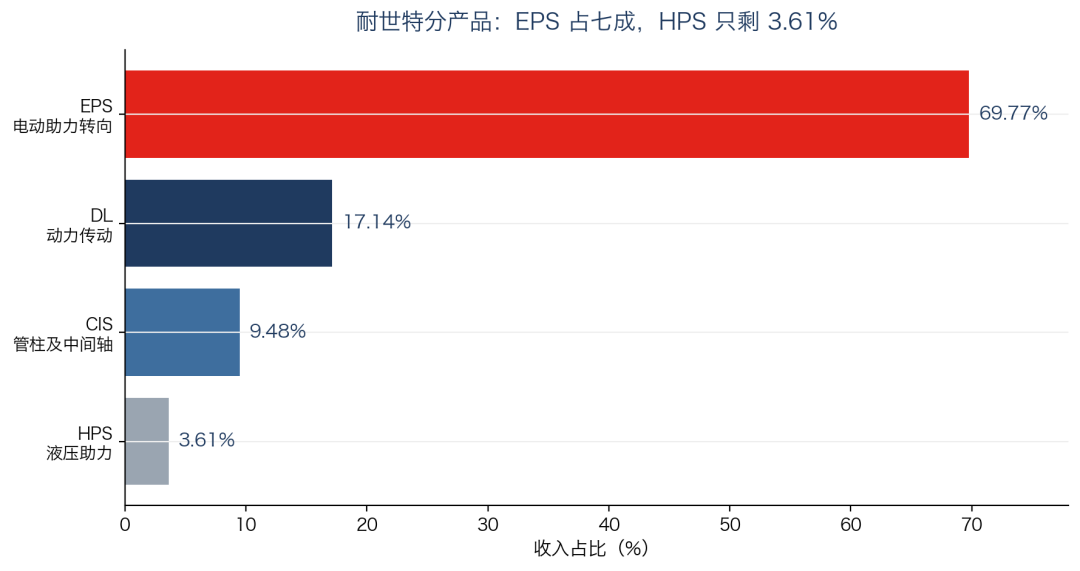
With EPS accounting for nearly 70% and HPS only 3.61%, Nexteer has largely completed the transition from hydraulic to electric power steering.
It’s important to clarify: electric power steering is a technical route for steering and does not equate to the revenue proportion of new energy vehicles. EPS is also widely used in fuel-powered and hybrid vehicles.
In terms of production bases and customers: China accounts for 26.94%, the United States accounts for 26.26%, Mexico accounts for 23.92%, Poland accounts for 11.5%, other regions in Europe, the Middle East, Africa, and South America account for 7.7%, and other regions in the Asia-Pacific account for 3.47%.
China and the United States each account for slightly more than a quarter, with Mexico close to a quarter. A risk point in this distribution is that Mexico’s 23.92% mainly serves North American customers. If North America imposes tariffs on parts produced in Mexico, this cost advantage will be eroded. The United States’ 26.26% plus Mexico’s 23.92% means that North America-related exposure is nearly half.
Nexteer achieved two mass production milestones in the first half of the year. The first batch of steer-by-wire (SbW) projects achieved mass production in China and Mexico, respectively, and the first high-output column-type electric power steering (HO CEPS) project achieved mass production in China. Steer-by-wire eliminates the mechanical connection between the steering wheel and the wheels, relying on electrical signals to transmit steering intentions.
The steering wheel’s position can be arbitrarily arranged, leaving space for cabin design; steering feel can be adjusted through software; in autonomous driving mode, the steering wheel can be retracted. For L3 and above autonomous driving, steer-by-wire, combined with brake-by-wire, forms a complete execution layer.
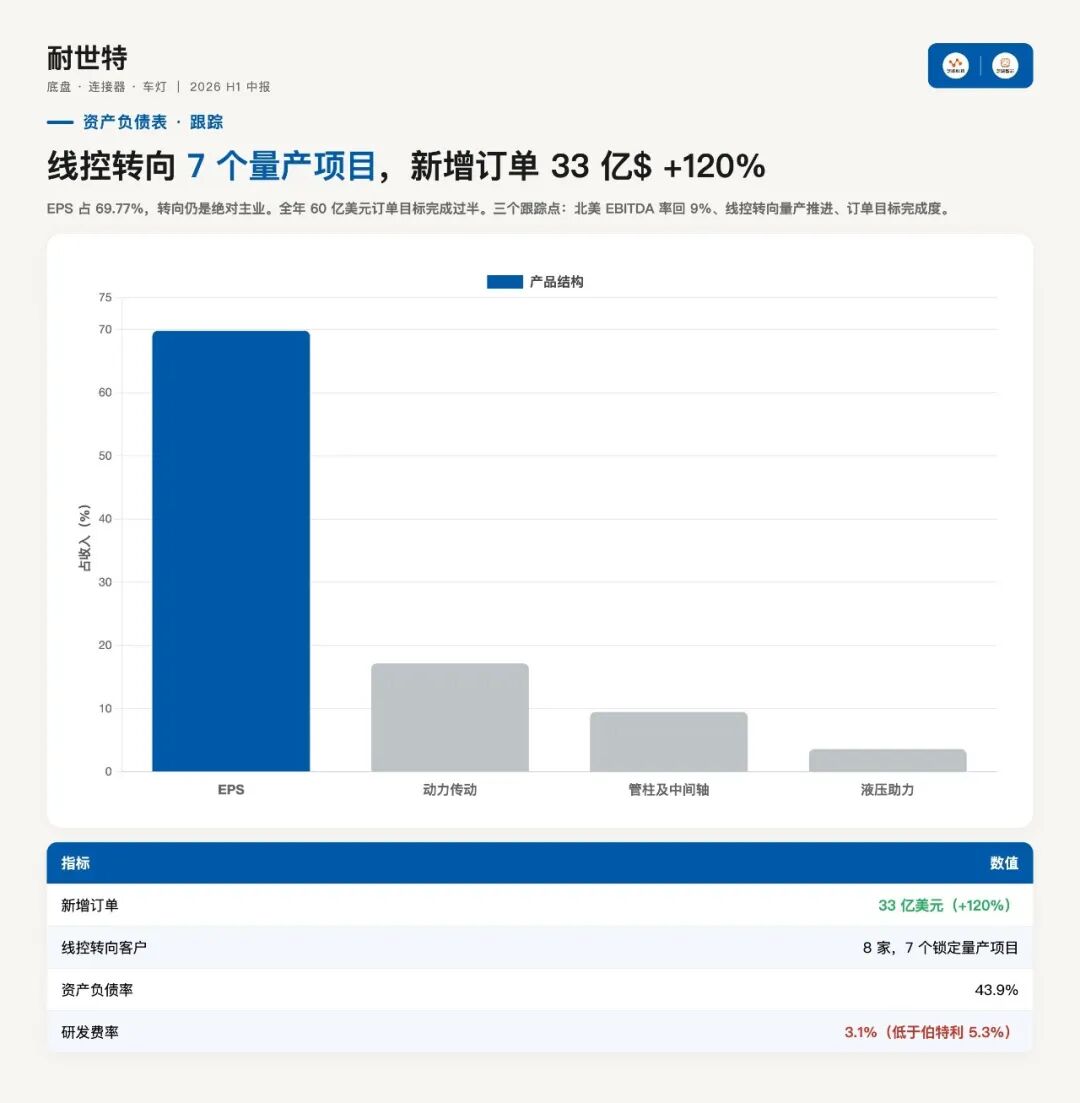
Nexteer is at the forefront in steer-by-wire technology. The company has 8 steer-by-wire customers, with 7 locked-in mass production projects. In China, there are 4 projects pending mass production and 1 under development; in North America, there are 2 under development; in Europe, there are already customers locked in for fixed-point production.
The system equipped on a Chinese brand model is the world’s first ASIL D-rated mass-produced steer-by-wire system recognized by Germany’s DAkkS.
At the order level, new customer orders in the first half of the year reached $3.3 billion, up 120% year-on-year, with more than half of the $6 billion annual target completed.
In terms of structure, new customers or newly acquired business accounted for 43%, with orders from local Chinese automakers approximately $1 billion, accounting for 30%.
EPS products accounted for 72% of new orders, with North America accounting for 46% and the Asia-Pacific accounting for 34%. 28 new projects were put into production, of which 26 were for new customers or newly acquired business, and 17 were for pure electric vehicle platforms. This set of figures indicates that market share is still expanding, with the company’s performance outpacing the market by 180 basis points.
As EMB reaches market readiness, Nexteer has established a full-stack motion control product portfolio covering steering and braking functions. Nexteer is set to enter the braking sector.
It was originally a pure steering system supplier. EMB (Electro-Mechanical Braking) is the next-generation braking technology, the same as what Berte is currently mass-producing.
Berte started from braking, acquired Yubei Steering to enter the steering field, aiming for a “braking + steering + suspension” brake-by-wire chassis platform.
Nexteer started from steering, developed EMB in-house to enter the braking field, also aiming for full-stack motion control. Berte completed the first batch of EMB mass production deliveries in March 2026, being among the first in China, with an annual capacity of 600,000 units, and the selling point being that it is 6-12 months ahead of foreign competitors.
If Nexteer brings EMB to market, it brings global customer relationships and mass production experience, giving it an advantage over Berte with European and American automakers.
For Nexteer, developing EMB is about filling a gap.
It has 120 years of accumulation in steering, but braking is a blank area. L3 and above autonomous driving requires coordinated control of steering and braking, and being a supplier for only half of the system puts it at a disadvantage in system integration. Filling the braking gap allows it to provide a complete motion control solution.
The cost lies in R&D investment.
Nexteer’s R&D expense ratio is only 3.1% ($72 million against $2.329 billion in revenue), lower than Berte’s 5.33% and Xingyu’s 6.92%. To simultaneously support technological iterations in steering and new product development in braking, this intensity may need to be increased.
Summary
Nexteer fought a commendable efficiency battle in the first half of the year. With revenue increasing by only 3.87%, it pushed net profit attributable to the parent company up by 35%, increased the EBITDA margin by 1 percentage point, and tripled free cash flow compared to the same period last year.
Improvements came from operational efficiency and regional structure: high-value steer-by-wire systems began mass production, and the Asia-Pacific and European regions, which have higher profit margins, grew faster. The problem still lies in North America.
Half of the revenue only brings a 7.3% EBITDA margin, keeping the overall profitability at a gross margin of 11.95% and a net profit margin of 3.7%.
-
![]()
New-Type Battery '15th Five-Year Plan' Launched! All-Solid-State Batteries on Track for Vehicle Integration by 2027, with Lithium Sulfide Pricing as the Last Barrier
-
![]()
China Launches the Narrative of Space-Based Computing Power: Over 1,000 Satellites to Form a ‘Data Center’ in the Sky
-
Meta Launches Enterprise Version of Muse, Prompting CEO of $10 Billion Listed Company to Make the Switch
-
【Insight】Black-light Optoelectronic Tweezers Can Be Used in the Development of Antibody Drugs, with Xinguang Biotechnology as a Representative Enterprise in China
-
![]()
AMD Bets $8.2 Billion on Fei-Fei Li, ByteDance is Also 'Creating Worlds,' Is XR About to Change?
-
![]()
Huawei Qiankun ADS 5 Integrated: The 2027 Zongheng G700 Makes a Bold Statement
-
It’s Quite Surprising: Just Three Days Post-Launch, iPhone 18 Pro Catapults Apple to the Top, Outpacing Huawei and Xiaomi
-
![]()
Price Soars 30-Fold: Are Internet Cafes Making a Comeback?