Will Chinese Cars Secure 20% of the European Market This Year?
 10/08 2026
 408
408
Lead
Introduction
If Chinese cars manage to capture 20% of the market in the birthplace of the automobile, it will mark a significant milestone, providing the most compelling endorsement and recognition for China's automotive industry as it transitions from a large-scale producer to a global powerhouse.
Everyone is aware that Chinese cars are making significant strides overseas, but the question remains: How much market share can they realistically capture in Europe, the cradle of the automotive industry, this year?
Many might find it hard to believe that "Chinese cars could capture 20% of the European market within the year." Yet, UBS's latest assessment suggests that if current trends persist, Chinese brands could achieve an annualized market share of around 20% in Europe this year.
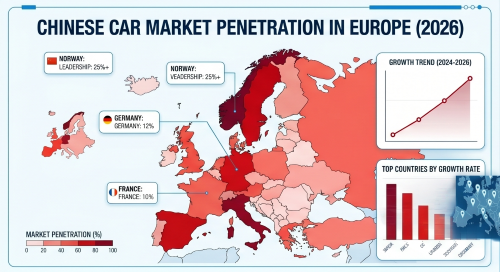
As of August, this figure stood at just 9.9%. Many observers, including Auto Business Review, still perceive Chinese cars as holding around 10% of the European market.
UBS's latest assessment indicates that China's automotive exports to Europe are nearly double the registration rate. A substantial number of vehicles are held up at ports, awaiting trucks and transport capacity, thus concealing the true scale of shipments. In other words, the registration volumes (license plate registrations) observed by Europeans do not fully reflect the influx of Chinese cars.
This assessment serves as a wake-up call for European policymakers: Do not just focus on Chinese cars' current 10% market share; their true potential has yet to be fully realized.
01 10% is Just the Tip of the Iceberg; 20% is the Realistic Target
"We believe the EU still lacks a sense of urgency," said UBS analyst Patrick Hummel at a media briefing on September 25. "This issue is more pressing than many involved in the policymaking process realize."
Hummel also provided a concrete example: Chinese automakers are not struggling to sell cars but to transport them to dealerships. He cited discussions with BYD, noting that Chinese automakers face difficulties in securing sufficient trucking capacity to move vehicles from European ports to dealers.
This results in cars piling up at ports, with registration volumes not yet fully reflected, while European policymakers assume the offensive from Chinese cars is limited.
UBS believes that these logistical bottlenecks obscure the true scale of Chinese car exports. Once these vehicles are delivered, registration volumes in Europe will surge further this year, intensifying the cost gap pressure faced by EU policymakers.
The data is already compelling.
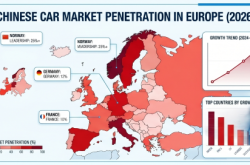
In the first eight months of this year, Chinese brands sold 913,703 vehicles in Europe, with their market share rising from 5.2% year-on-year to 9.9%. This does not include Volvo, owned by Geely.
At the brand level, SAIC MG is the best-selling Chinese brand, with 179,909 registrations in the first eight months; BYD follows closely with 172,590 sales. In comparison, Fiat, their European rival, sold 198,671 vehicles in the same period.
In other words, MG and BYD are closely trailing Fiat, and a slight acceleration could alter the rankings.
At the model level, the MG ZS, including its full hybrid variant, is the best-selling Chinese model in Europe, with 81,316 registrations.
Among European countries, the UK has set a positive precedent, allowing Chinese cars to achieve rapid sales growth.
According to UK Department for Transport vehicle registration statistics, in 2021, five Chinese brands combined held just a 0.97% market share in the UK. By 2024, this figure had steadily risen to 2.94%.
The real breakthrough came in 2025: 14 Chinese brands, led by MG, BYD, Jaecoo, and Omoda, tripled their sales, capturing a 9.29% market share. By 2026, they are expected to hold nearly 14% of the market.
Chinese automakers are increasingly reliant on overseas markets, including Europe, Russia, and Brazil, to offset weak domestic demand. Hummel's assessment is that Chinese automakers would rather absorb tariff impacts and keep consumer prices unchanged than reduce exports.
02 New Energy as the Driving Force
Chinese cars' growth in Europe is not primarily driven by low-priced fuel vehicles but by pure electric and plug-in hybrid models—new energy vehicles are the main engine behind Chinese cars' offensive.
As conflicts involving Iran drive up fuel prices, European consumers' demand for electrified models further intensifies. Chinese brands are reaping the benefits of this trend.
According to Dataforce data, as of August, Chinese brands accounted for nearly 30% of plug-in hybrid vehicle sales in Europe—a staggering figure.
The European Commission is now considering whether to impose additional tariffs on plug-in hybrid vehicles manufactured in China, similar to the tariffs already levied on pure electric vehicles imported from China.
In the pure electric market, Chinese brands captured a 15% share in Europe in the first eight months, up from 10% year-on-year. In the hybrid market, MG leads, with Chinese brands doubling their share to 15%.
In fact, Europe has been actively pursuing new energy transition and vehicle electrification. Auto Business Review interviewed Renault's CTO this year, who stated that Renault's new energy penetration rate in European sales had already reached 50% by 2026, far exceeding the 20% target for 2025.
However, this is a double-edged sword. On one hand, it confirms that "China is not an isolated island in the global automotive market, self-absorbed in new energy and intelligence while being isolated by Europe and the US." On the other hand, it may also subject Chinese cars to backlash due to their new energy advantages.
Some countries, including Italy, are pushing for higher tariffs on Chinese car imports to protect domestic manufacturers. But the question remains: Can tariffs really hold them back?
Hummel believes that the EU is unlikely to adopt measures as extreme as those taken by the US. The US has effectively blocked Chinese-made cars from its market through prohibitively high tariffs. However, it is unrealistic for the EU to go that far.
"I don't believe there is a realistic chance of that happening," Hummel said. "That would take us deep into territory that deviates from WTO rules. It would also require a highly coordinated effort among member states, and I still see divergences in national interests."
03 Will the US and Europe Become Stages for Chinese Cars?
Yesterday, Auto Business Review published an article titled "US Lawmakers Attempt to Permanently Ban Chinese Cars, 'Otherwise, 1.9 Million Units Will Be Sold Annually,'" which included another notable assessment: If the US fully opened its market, Chinese cars could capture a 14% market share by around 2030.
Note the emphasis on "fully opened." Currently, the US uses prohibitive tariffs—high enough to effectively block imports—to keep Chinese-made cars out.
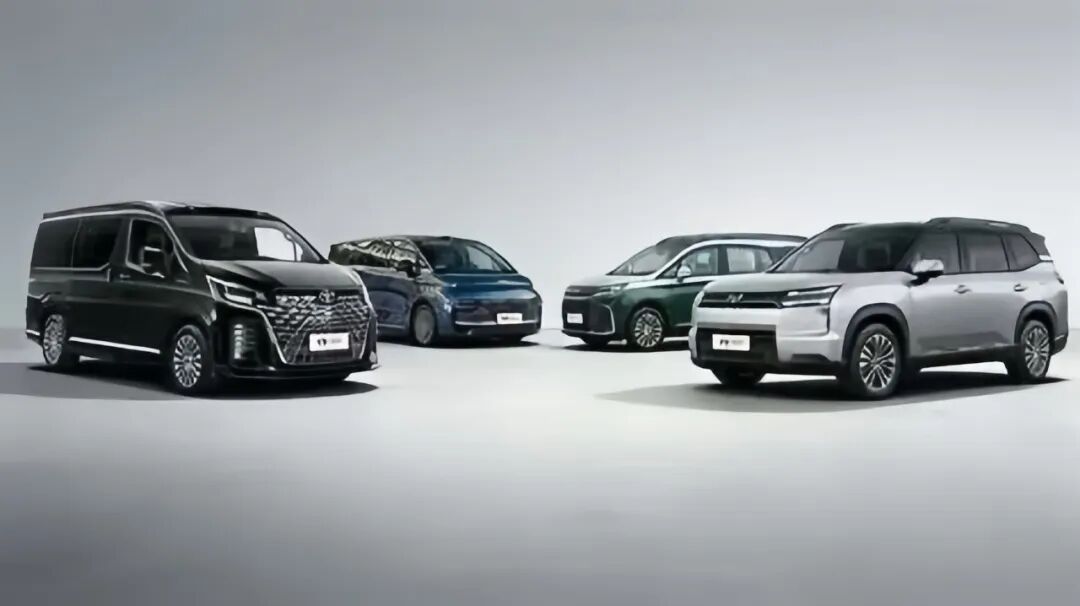
But once opened, 14% would equate to annual sales of 1.9 million units, or nearly matching the US sales of top-three automakers like Toyota and Ford. This would mean Chinese cars could not only conquer Europe but also carve out a significant share in the US, one of the world's most lucrative automotive markets.
Back in Europe, the UK has emerged as a hotspot for Chinese cars, accounting for roughly a quarter of registrations. The reason is simple: The UK has chosen not to follow the EU in imposing additional tariffs on Chinese pure electric vehicles.
Brussels has warned the UK government that it may need to raise tariffs on Chinese car imports to align more closely with EU policies, risking the loss of preferential treatment under the proposed "Made in Europe" rules. According to a Financial Times report on September 25, the UK is facing pressure to choose sides. However, the overall trend cannot be reversed by temporary policies.
On the policy front, Europe has generally been favorable toward new energy vehicles.
The EU is also considering revising legislation requiring automakers to reduce average fleet CO2 emissions. Some industry observers say that stricter emission targets could actually benefit Chinese automakers, as they typically have lower battery costs and stronger supply chain integration capabilities than European rivals.
However, Hummel believes that even if the EU relaxes its rules, the impact would be limited.
"Demand is so high that it is unlikely to make a meaningful difference in sales," he said.
So, the real challenge for Europe is not whether Chinese cars can enter but who, once they arrive, can truly stop them—be it through tariffs, logistics, policies, or demand.
UBS's answer is clear: Demand is too high to block significantly.
Can Chinese cars capture 20% of the European market this year? At least, UBS believes this is not far-fetched. And as Chinese cars transition from big to strong, they will receive their most powerful endorsement and recognition in the birthplace of the automobile.
Editor-in-Chief: Shi Jie Editor: Wang Yue

THE END
-
![]()
From Green Leaves to Flowers: How AI Inference Transforms NAND's Destiny?
-
![]()
Paris Auto Show Transforms into a Chinese Auto Extravaganza: AITO Showcases Full Lineup, Geely Occupies 5 Halls
-
![]()
Will Chinese Cars Secure 20% of the European Market This Year?
-
![]()
Is the auto industry too depressing? Feedback from the front lines is a bit heart-wrenching
-
![]()
Qualcomm Pays Huawei, Yet Chip Sales Remain Restricted
-
![]()
The Android Moment of Embodied AI Lies in the Cost of Switching Bodies
-
![]()
After Testing ChatGPT dot, I Understand Why Big Companies Must Develop Personal Agents
-
![]()
SAIC Surpasses BYD! Automakers' 2026 Yearly Goals Prove to Be a Daunting Task