After Testing ChatGPT dot, I Understand Why Big Companies Must Develop Personal Agents
 10/08 2026
 455
455
ChatGPT has also equipped users with personal assistants, even including computers.
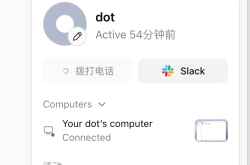
On September 29, OpenAI began rolling out dot in batches. Essentially, it's the recently popular personal agent, following a similar strategy.
You can send messages or make calls to it, have it handle tasks on its cloud computer, or connect your own computer to it. In essence, it's more of the same—shifting from office suites to personal agents, now interacting with AI has returned to its original form.
The same assistant can be found on both phones and computers. After discussing a matter, you can continue to have it work on it there.
I tested it with my old draft, asking it to rewrite it into a complete set of Xiaohongshu copy and images. It took on the task, but the waiting process tested my patience.
01 Slow Phone Calls, Laggy Cloud Computer
I clicked 'Make a Call' in dot, which is essentially a voice communication function for the cloud computer. The interface kept showing 'Calling.' I waited at least 20 seconds, but it still didn't connect.
'Bro, can AI not answer the phone?'
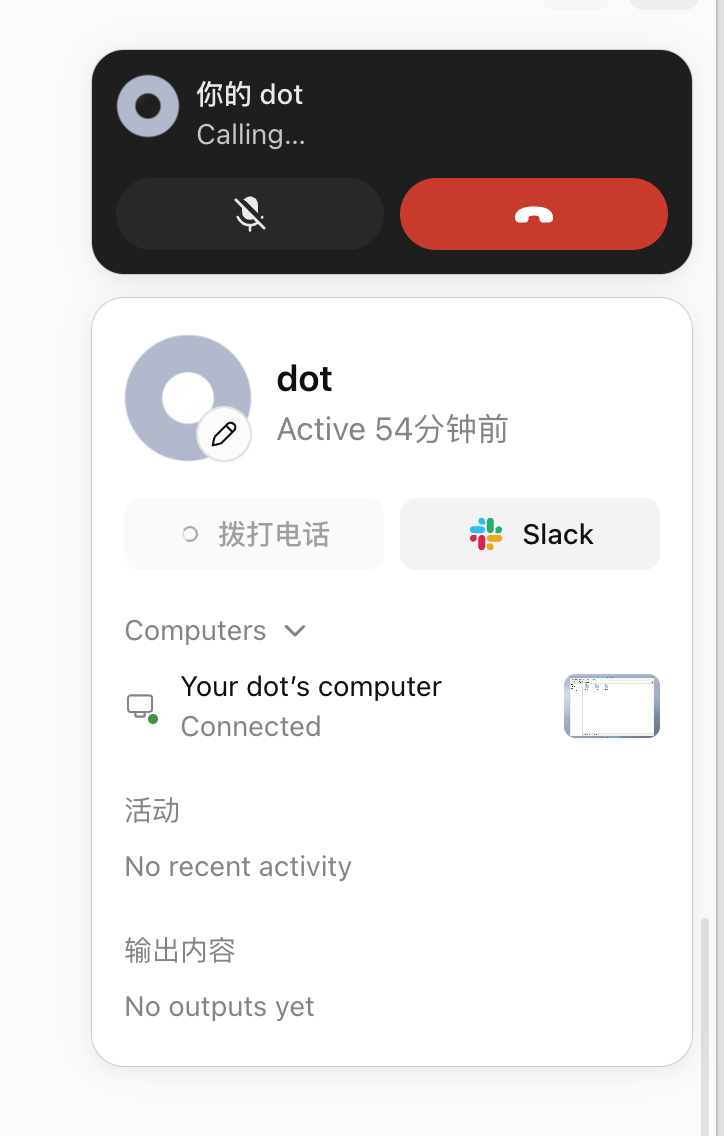
The call was initiated, but the interface still showed 'Calling.'
That's what I said at the time. Later, the call connected, but the wait was unexpected.
The cloud computer was also laggy, and it affected work more than waiting for a call.
It could run slowly in the background while I did other things. But when I needed to take over the cloud computer and operate it myself, the lag made it even harder to get things done.
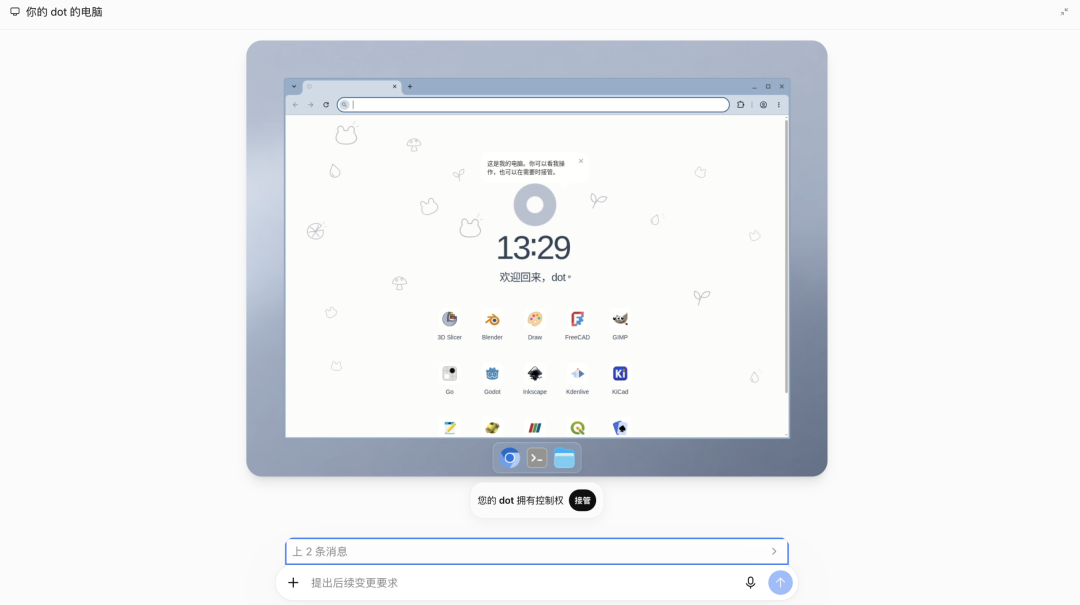
In dot's cloud computer, users can click 'Take Over' to operate it themselves.
Compared to the original Codex and ChatGPT, there isn't much new content. The functions include regular Google Drive, Google Calendar, Outlook Email, as well as interfaces with Runway and GitHub. If we ignore the speed, the actual experience isn't much different from local use.
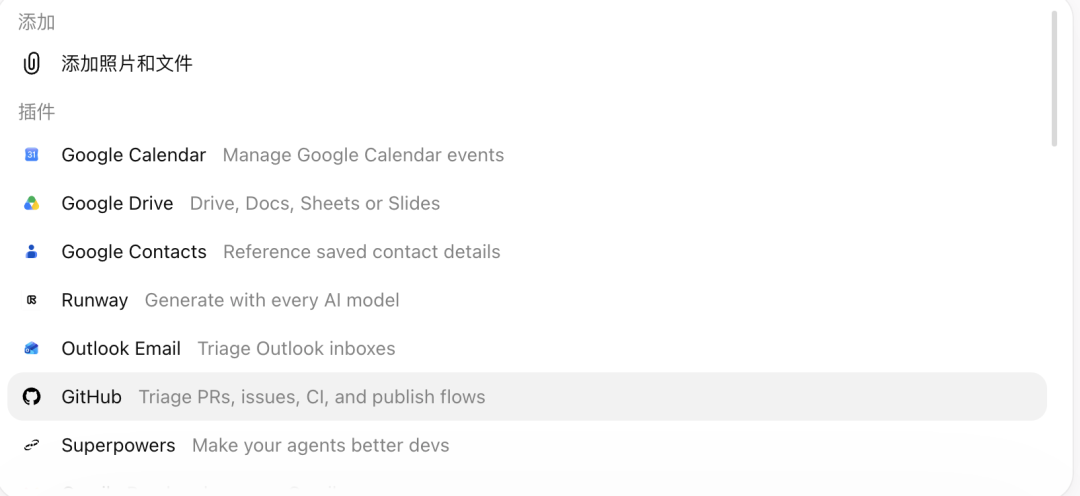
dot's plugin menu lists various tool entries.
My request was to first understand the posting patterns of Xiaohongshu graphics and text, then select drafts from the content library to generate copy and illustrations. It followed this sequence, first opening Xiaohongshu, then encountering a login popup.
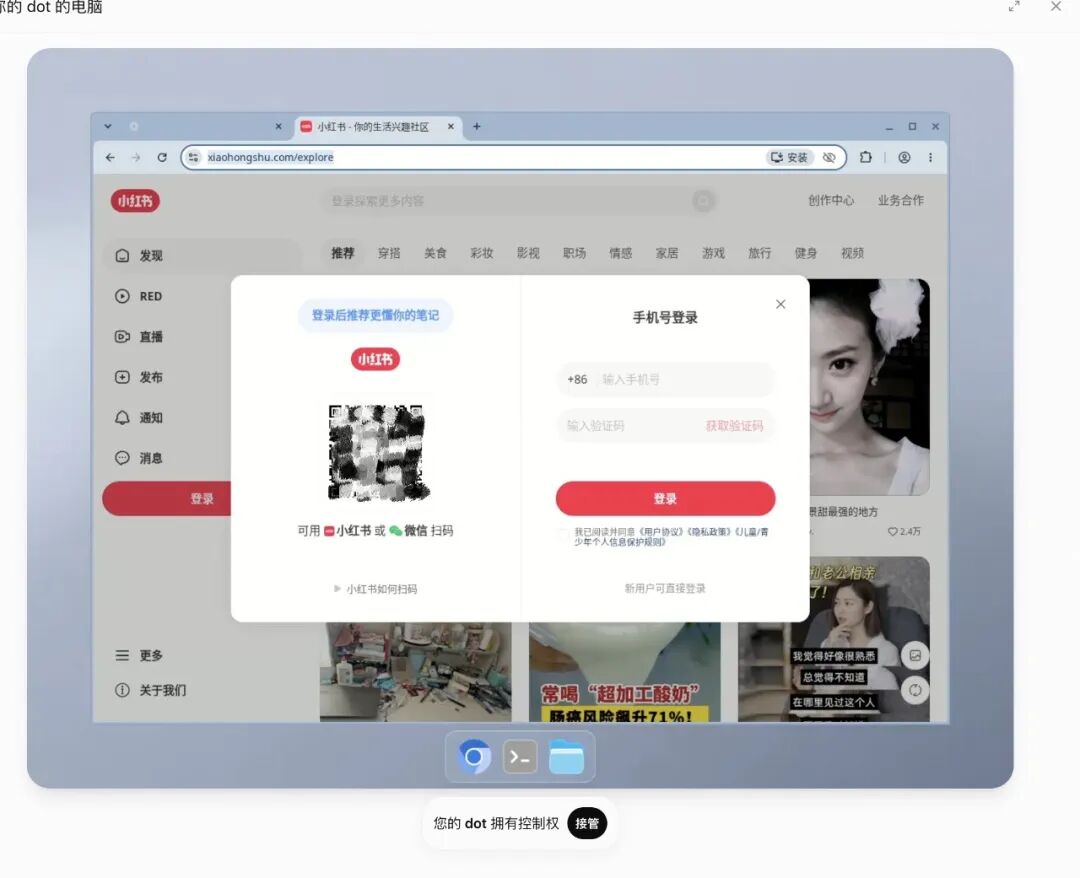
After dot opened Xiaohongshu, a login window popped up on the page.
In the actual operation instructions dot gave me, it searched for similar dissemination samples and analyzed Xiaohongshu's posting format, mainly checking posting requirements and providing editing suggestions. But it wasn't very in-depth—just barely usable. Of course, the reason is that we hadn't directly used AI to generate and post content before, so it lacked memory and prompts.
Halfway through, I changed the topic once. I just sent a message—no need to choose between queuing or inserting. The message showed 'Read,' and subsequent tasks continued according to the new requirements.
In the end, it delivered seven illustrations, copyable text, a Word publishing package, and a complete compressed package.
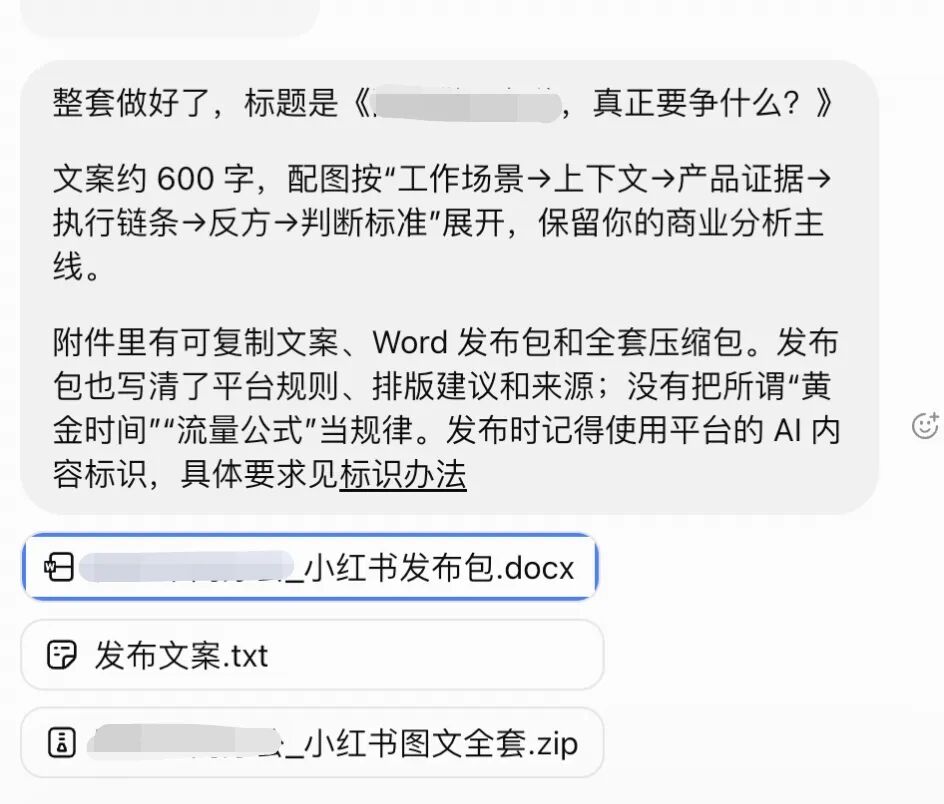
dot delivered the copy, Word publishing package, and graphic compressed package.
When I checked the files, they were uniformly in a 3:4 vertical format, with a consistent blue-black-yellow color scheme, a unified style, and normal Chinese readability. The company judgment I wanted to retain wasn't expanded upon, but the final product included long paragraphs of context and permissions. After replacing the company name, it seemed usable.
Later, I did another round of revision testing: only change the fourth image, replacing the general introduction with a specific task flow, and directly giving it the corresponding text replacement paragraph, leaving the other six images untouched.
This time, it succeeded. Codex downloaded the old and new files and compared them item by item. The file checksums for the other six images were identical, and only the specified parts of the text and Word were changed. I only wanted to change one image, and my biggest fear was that it would redo all six. This time, it preserved what was already done, making subsequent revisions much easier.
During the retest, Codex also closed the dot page and came back later to retrieve the results, and the task continued as usual. This way, I could go do other things and come back to edit the files once they were ready. It was more comfortable than sitting there waiting for the cloud computer to lag.
The pleasant surprise is that the space OpenAI released this time allows for interoperability between dot in the cloud and Codex locally. Simply put, products from both parts can be placed in the space, and users can retrieve content from Codex or dot, specifying products from the cloud space, and get the desired context more accurately.
Then, the hardest part to synchronize before—information between mobile and computer—can also be interconnected through dot, effectively connect through (connecting) contexts across all dimensions through the cloud.
In comparison, the original chat function of ChatGPT and Codex had some issues with interoperability, and synchronization with mobile contexts was even worse. This is a very positive functional improvement.

I used to discuss topics with ChatGPT and process materials and create files with Codex. If I switched locations, I often had to tell it again.
According to the official explanation, Space can save files and pages, while dot's memory will selectively retain information. Having materials clearly placed there is at least more convenient than expecting it to remember every time.
After using it this way, I hope dot first improves its response speed and material retrieval. Telling it things on my phone and coming back to edit images on my computer is a usage pattern I really need. But if I have to wait for it and help it find files every time, the saved operations will be offset.
Precisely because I went through these steps myself, I began to understand why domestic big companies want to develop personal agents. In the future, when I encounter something, I might first turn to my own assistant, which will then call on software. What big companies want to compete for is the chance that I'll hand over the task to them from the start.
02 It's More of the Same
Tencent
WorkBuddy was launched in March this year, capable of receiving tasks like file processing and content creation, and it integrates with WeCom, DingTalk, Feishu, and QQ. In subsequent updates, Tencent added a document library, product uploads, and the ability to view and edit long-term local memory.
Alibaba's QwenPaw, formerly known as CoPaw, supports both local deployment and cloud operation. Dialogue history, personal knowledge bases, and file workspaces are all things it wants to retain long-term. ByteDance's Volcano Engine ArkClaw directly places the assistant in the cloud, allowing users to assign tasks from Feishu, WeChat, and DingTalk without needing to keep their computers on.
Currently, there are clear moves from Doubao and Yuanbao. Qianwen did a round of promotion tied to Muse, but the actual product hasn't been seen yet.
But one thing is certain: the industry's 'Hundred Shrimp Battle' is about to repeat. After all, a personal agent is almost just a reconfiguration of functions, becoming another integrated cloud service entry point with room for incremental sales.
Rather than calling it a 'new paradigm,' it's more like a good timing for big companies' various business units to compete for internal influence after a new hot topic emerges. After all, with new services added, it can reactivate users.
Users certainly need such services too. How to save and process personal data and work files must comply with domestic data regulations; daily-used accounts and software must also be connectable. Domestic vendors have a lot to do—just putting out a chat window isn't enough to handle all this work.
For big companies with cloud businesses, there's an additional revenue opportunity.
03 Cloud Vendors Have Business Now
If I were asked to rent a cloud server alone, I might not need it.
But if an assistant can search for materials, revise drafts, and create images on it for me—telling it on my phone and having it continue even after I turn off my computer—then that server becomes useful. The drafts and products also need to be stored; I'll come back to revise them in a few days.
Users might pay an assistant subscription fee, but behind the service will be storage, computing, and model usage. Third-party assistants running in the cloud will create procurement needs for cloud vendors; if the assistant is made by the cloud vendor itself, these services can also be provided together.
Tencent Cloud's Agent Bucket already has concrete cases: each WorkBuddy agent instance has its own cloud storage space for saving uploaded files, intermediate results, and work products.
Alibaba Cloud also offers OSS Agentic Bucket for intelligent agent sandboxes, used for long-term file storage. When its Agent Sandbox enters deep hibernation, it stops charging for CPU and memory usage but continues to charge for snapshot storage fees to preserve the state.
When the assistant is idle, files and work states can be saved first, and computing can be restarted when tasks arrive. Every time old materials are revisited or a file is processed, computing and model services may continue to be used. Storage retains the materials, and subsequent work brings new usage.
Of course, materials and assistants can also remain on your own computer. For cloud vendors to get ordinary people to keep paying, installation, maintenance, and usage must be made easy enough. This might be the biggest significance of this wave of personal agent proliferation for vendors.
Domestic cloud vendors also have a very real opportunity. The deeper personal agents integrate into daily work, the more personal data will need to be saved and called upon long-term, creating more demand for local storage and compliant processing of this data.
The usage patterns demonstrated by overseas products can be supported by domestic vendors using local cloud services.
Ordinary people who wouldn't have rented servers or cared about computing power before might start paying monthly subscription fees for an assistant that continuously works for them. Selling cloud services directly to individual users used to be hard to justify; now, the assistant's daily tasks provide the reason to pay. Domestic cloud vendors thus have a chance to meet a significant portion of individual user demand, turning storage and computing into a Continuous charging (continuously billed) C-end business.
-
![]()
After Testing ChatGPT dot, I Understand Why Big Companies Must Develop Personal Agents
-
![]()
SAIC Surpasses BYD! Automakers' 2026 Yearly Goals Prove to Be a Daunting Task
-
![]()
Leapmotor Surges Ahead! Li Auto and HiMo Harmony Intelligent Travel See Declines, September’s New Energy Vehicle Market a Blend of Triumph and Challenge
-
![]()
SERES and Huawei Make a Dramatic Shift! AITO Launches Ultimate Evolution Strategy
-
![]()
Changan Automobile Takes Action: What Lies Ahead for Deepal and Avatr?
-
![]()
World Model Track: Who's Consolidating, Who's Breaking Through?
-
![]()
AI Self-Generation: The Dawn of a New Era
-
![]()
Musk Changed the Name Again, But This Time It's No Simple Matter