SAIC Surpasses BYD! Automakers' 2026 Yearly Goals Prove to Be a Daunting Task
 10/08 2026
 340
340
Authored by | Guanche Jun
The months of September and October were traditionally the high season for automakers to revel in their successes. Yet, in October 2026, as Guanche Jun perused the performance reports from leading automakers for the first three quarters, a palpable sense of fierce competition permeated the atmosphere.
The battle for inventory supremacy has fully unfolded.
01
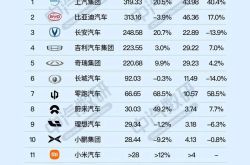
As illustrated in the accompanying figure, data compiled by CAAM Data Research reveals that SAIC Group emerged as the frontrunner in sales volume for the first three quarters, with 3.1933 million units sold, outpacing BYD's 3.1316 million units and reclaiming the top spot in cumulative sales for the period.
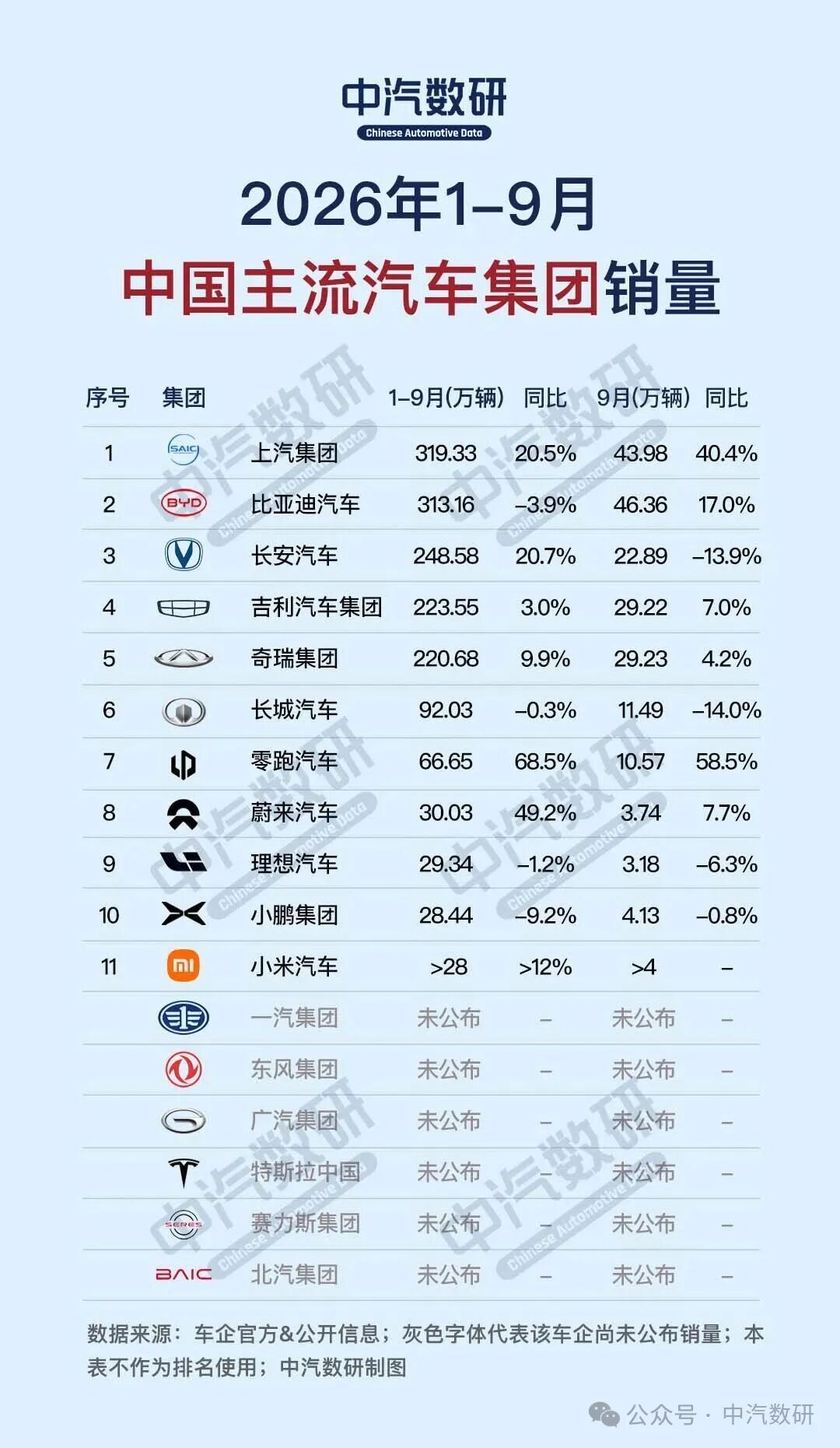
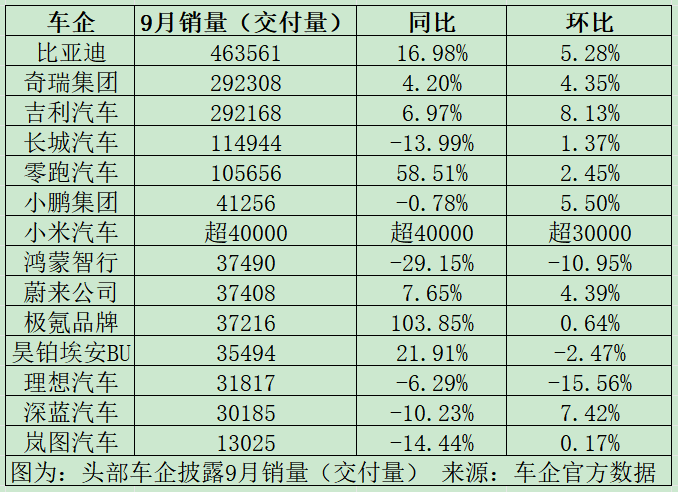
Has BYD faltered? Focusing solely on September, BYD's remarkable performance of 463,600 units remained unmatched, perpetuating its 'invincible' streak for the month. However, Guanche Jun cautions that there are underlying concerns amidst this prosperity. A year-on-year decline of 3.9% in cumulative sales volume is BYD's most significant challenge.
Compared to the ambitious target of 5 million units set at the year's outset, the completion rate for the first three quarters has barely surpassed the halfway mark. What does this imply? It signifies that over the next three months, BYD's average monthly sales volume must surge by approximately 34% above its September peak to merely reach the target line.
How did SAIC manage to overtake? A closer look at the detailed data, as analyzed by Guanche Jun, reveals the answer: overseas expansion. SAIC's overseas sales volume in the first three quarters soared to 1.166 million units, marking a year-on-year increase of 52.4%. As the domestic market transforms into a fiercely competitive 'red ocean,' overseas markets have become SAIC's lifeline for maintaining its market position.
Similarly, Geely (2.2355 million units) and Chery (2.2068 million units) have relied heavily on overseas markets to 'stay afloat.' Chery's export proportion has even soared to a staggering 70%! It is evident that without the support of exports, the rankings on this list would undergo a dramatic transformation.
02
While the leading automakers continue to vie for dominance, the landscape among the new entrants has undergone a complete overhaul in the first three quarters of 2026.
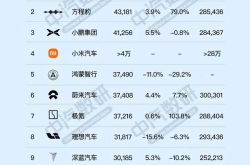
The erstwhile 'Big Three' of NIO, XPeng, and Li Auto have now faded into the background. Leapmotor, once a relatively unknown entity, has surged ahead with 666,500 units sold, a year-on-year increase of 68.5%, and has achieved monthly sales exceeding 100,000 units for three consecutive months.
With stringent cost control and highly precise product planning, Leapmotor has delivered a valuable lesson to all new entrants: in this era, survival hinges not on storytelling but on prudent financial management.
Trailing closely behind Leapmotor are NIO (300,300 units) and Zeekr (288,400 units). Zeekr's year-on-year growth exceeding 100% is also a force to be reckoned with.
Xiaomi's performance, with over 280,000 units sold in the first three quarters, is also noteworthy. However, it still falls significantly short of its annual target of 550,000 units.
The most disheartening sight is that of former high achievers. XPeng (284,400 units) experienced a year-on-year decline of 9.24% and is still grappling with adjustments. Li Auto (293,400 units), once a benchmark that capitalized on 'refrigerators, large TVs, and sofas,' has lost its sheen in terms of year-on-year growth in the first three quarters, ranking at the bottom among the leading group.
Not to mention HiMo, which, although not listed in this table, has a completion rate of less than 40% for its annual target, according to publicly available information reviewed by Guanche Jun.
03
On the flip side, the completion rate of annual targets is the most disconcerting aspect of this year's automotive market.
Three quarters of 2026 have already elapsed, and in terms of annual target completion rates, according to statistics from Jiemian News reviewed by Guanche Jun, Zeekr stands at 83.7%, Chery at 69%, Leapmotor at 67%, NIO at 66%, and SAIC at 63%... Does this seem acceptable? However, delving deeper, BYD is at 53%, Xiaomi at 52%, Li Auto at 53%, and XPeng at 47%...
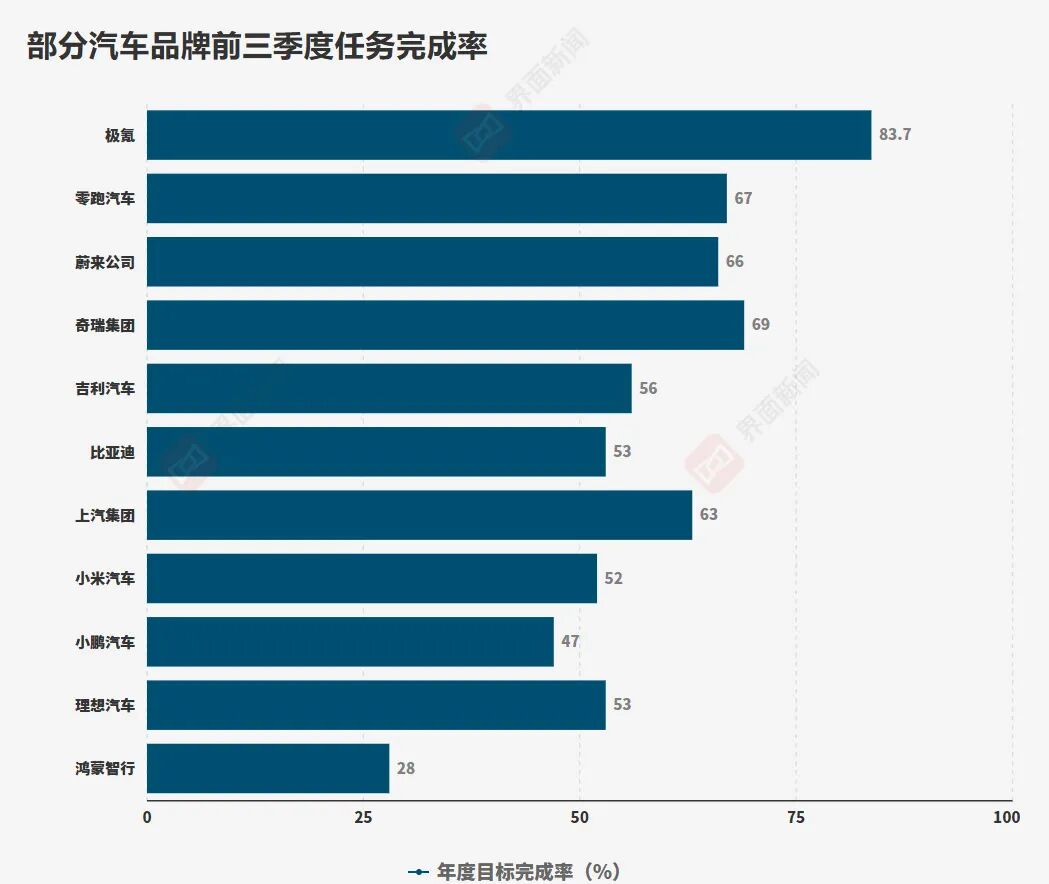
Excessive optimism at the beginning of the year, compounded by a price war that has raged throughout the year, has rendered most automakers' annual targets unrealistic. With only one-fourth of the fourth quarter remaining, the window of opportunity for automakers to make a final push has become exceedingly narrow.
To achieve its target, SAIC must sustain an average monthly sales volume of over 620,000 units in the fourth quarter. For many other automakers, actions in the fourth quarter are no longer about 'winning' but about 'surviving'.
Over the past decade, China's automotive industry has executed a splendid overtaking maneuver, leveraging the first-mover advantage in new energy vehicles and the vast unified domestic market. However, in the latter half of the inventory competition in 2026, scale is no longer an absolute advantage, and growth rate is no longer a guarantee of security.
The foreseeable fourth quarter will not witness a relaxed 'Silver October.' As the tide recedes, the cost of survival is escalating.
The charts in this article, unless otherwise specified, are sourced from publicly disclosed information from various channels. We hereby acknowledge and express our gratitude! Due to variations in statistical methods, some data may exhibit slight discrepancies. The views expressed in this article are for reference only and do not constitute investment advice.
This article is original content from Leverage Auto Observations and is prohibited from being reproduced without authorization. To reproduce, please obtain authorization. Additionally, when reproducing with authorization, please indicate the source and author at the beginning of the article. Thank you!
-
![]()
After Testing ChatGPT dot, I Understand Why Big Companies Must Develop Personal Agents
-
![]()
SAIC Surpasses BYD! Automakers' 2026 Yearly Goals Prove to Be a Daunting Task
-
![]()
Leapmotor Surges Ahead! Li Auto and HiMo Harmony Intelligent Travel See Declines, September’s New Energy Vehicle Market a Blend of Triumph and Challenge
-
![]()
SERES and Huawei Make a Dramatic Shift! AITO Launches Ultimate Evolution Strategy
-
![]()
Changan Automobile Takes Action: What Lies Ahead for Deepal and Avatr?
-
![]()
World Model Track: Who's Consolidating, Who's Breaking Through?
-
![]()
AI Self-Generation: The Dawn of a New Era
-
![]()
Musk Changed the Name Again, But This Time It's No Simple Matter