Tesla Delivers 486,500 Vehicles in Q3: Beyond Cars, What Other Achievements Have Been Made?
 10/08 2026
 328
328
Authored by Zhineng Technology
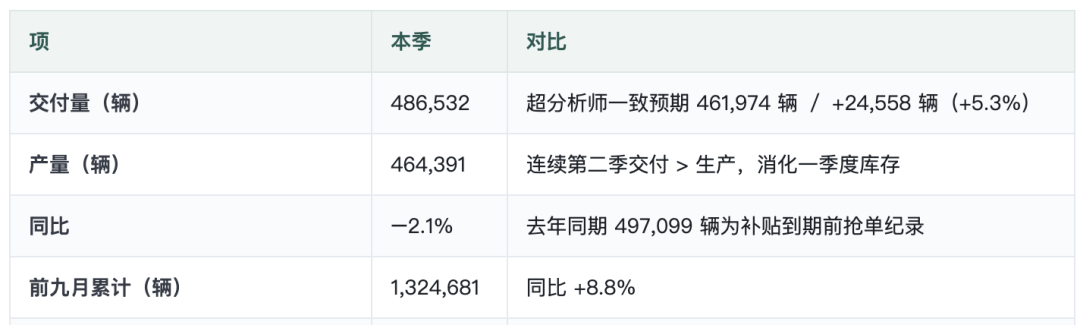
On October 2, Tesla unveiled its delivery and production figures for the third quarter (Q3) of 2026: 486,532 vehicles were delivered, and 464,391 vehicles were produced. Additionally, energy storage deployment soared to 13.7 GWh.
Tesla's Q3 delivery volume surpassed the average analyst expectation of 461,974 vehicles, compiled by the company, by 24,558 vehicles, marking a 5.3% increase. However, it still showed a 2.1% decline compared to the same period last year. In Q3 of the previous year, Tesla delivered 497,099 vehicles, setting a quarterly record for the company. Back then, U.S. buyers rushed to place orders before the expiration of the $7,500 federal electric vehicle subsidy on September 30. After the subsidy was discontinued, the U.S. market witnessed a lack of sales momentum post-September 30, 2025.
Part One · Total Volume Exceeds Expectations, but Composition Falls Short 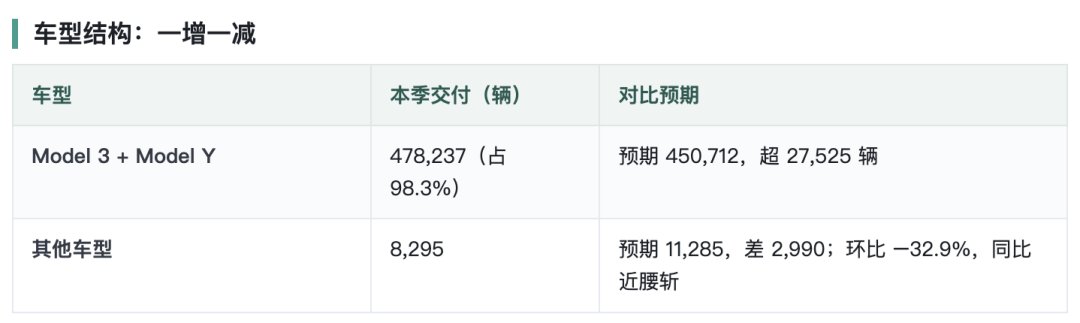
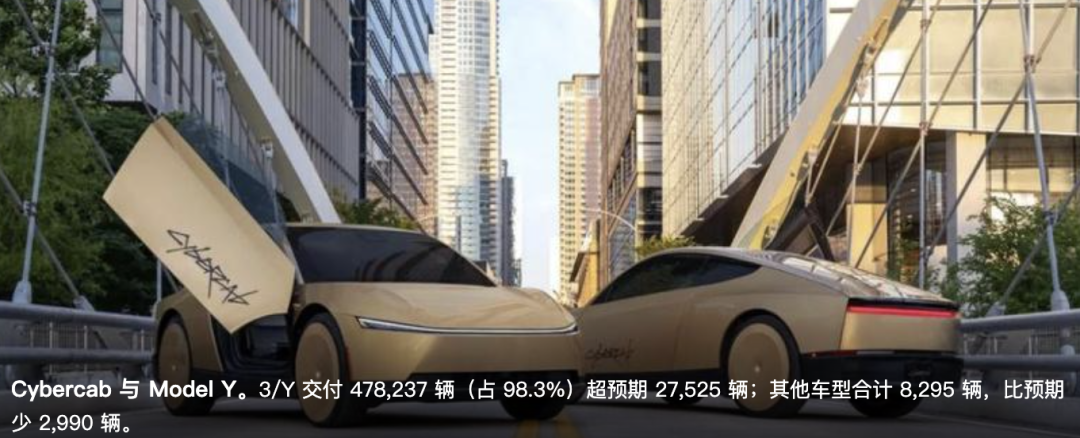
The Model 3 and Model Y accounted for 478,237 deliveries, representing a staggering 98.3% of the total deliveries. Deliveries of other models totaled 8,295 vehicles, marking a 32.9% decrease from the 12,364 vehicles delivered in Q2. This figure also fell below the compiled expectation of 11,285 vehicles (compared to 15,933 vehicles in the same period last year), indicating a nearly 50% drop year-on-year. The Cybertruck has now emerged as the primary model in this category. Notably, the production lines for the Model S and Model X were discontinued in July.
A total of 464,391 vehicles were produced, which is 22,141 fewer than the number delivered. This marked the second consecutive quarter where deliveries exceeded production. In Q1, approximately 50,000 more vehicles were produced than delivered, and over the two quarters, the inventory built up in Q1 has been significantly depleted. In the first nine months, cumulative deliveries reached 1,324,681 vehicles, showing an 8.8% increase year-on-year.
When deliveries surpass production, it generally signals inventory clearance. Delivery volume and energy storage deployment are merely two operational indicators. The fact that the total volume exceeded expectations suggests that demand is stronger than anticipated. While the Model 3 and Y maintained their momentum, high-priced models like the Cybertruck witnessed a 30% drop.
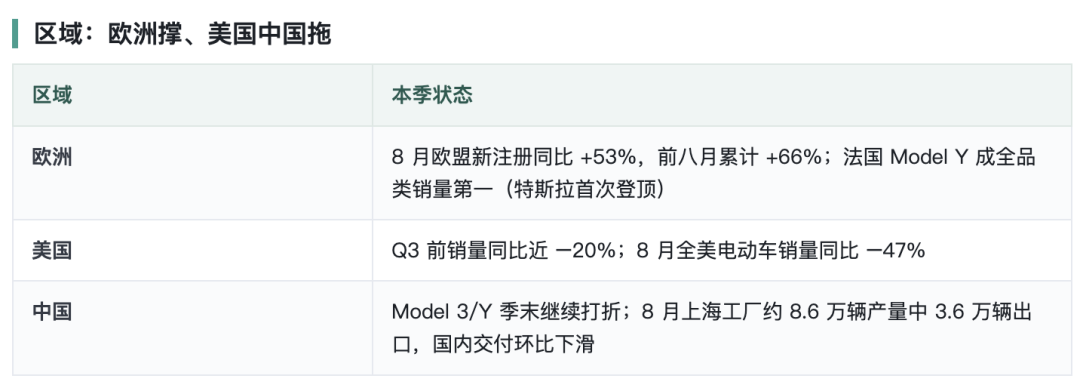
Europe emerged as the primary growth driver this quarter. According to data from the European Automobile Manufacturers Association, Tesla's new vehicle registrations in the EU in August surged by approximately 53% year-on-year, with a cumulative increase of 66% over the first eight months. The Model Y claimed the top spot as the best-selling model across all categories in France, marking Tesla's first-ever achievement. Portugal witnessed a 128.3% increase, France a cumulative 61.9% increase, Sweden a 38.4% increase, and Spain a 24.8% increase.
However, the two largest markets, the U.S. and China, are lagging. In the U.S., data from Cox Automotive revealed that sales were down nearly 20% year-on-year before entering Q3, and electric vehicle sales across the country plummeted by 47% year-on-year in August. In China, the Model 3 and Y continued to offer end-of-quarter discounts. In August, of the approximately 86,000 vehicles produced at the Shanghai factory, 36,000 were exported, while domestic deliveries declined month-on-month.
The 13.7 GWh of energy storage deployed surpassed the 13.5 GWh in Q2 and the 12.5 GWh in the same period last year, representing a year-on-year increase of approximately 9.6%. However, it fell short of the compiled expectation of 15.9 GWh by about 13.8%. This marks Tesla's second-highest record, with the highest being 14.2 GWh in Q4 2025.
From a product mix perspective, the growth in energy storage in recent years has primarily been driven by large-scale projects like the Megapack. The Megafactory Texas is making progress, with plans to commence production of the Megapack 3 and Megablock within 2026.
Part Two · Cybercab Enters Paid Operation, Regulation Follows Suit
On September 3, in downtown Austin, the Cybercab commenced charging passengers through the Robotaxi app. Passengers hailing a ride in Austin can now choose between a two-seat Cybercab and a four-seat Model Y. This vehicle represents Tesla's first model that cannot be manually driven. It lacks a steering wheel, pedals, rearview mirrors, and rear windows, featuring scissor doors, a two-seat layout, and a single 22-inch central control screen in the cabin. It is equipped with a 48 kWh battery, a single 219-horsepower motor, an initial EPA-estimated range of approximately 293 miles, and a curb weight of 3,113 pounds. Trial production began at the Texas Gigafactory in February 2026, with mass production commencing in April.
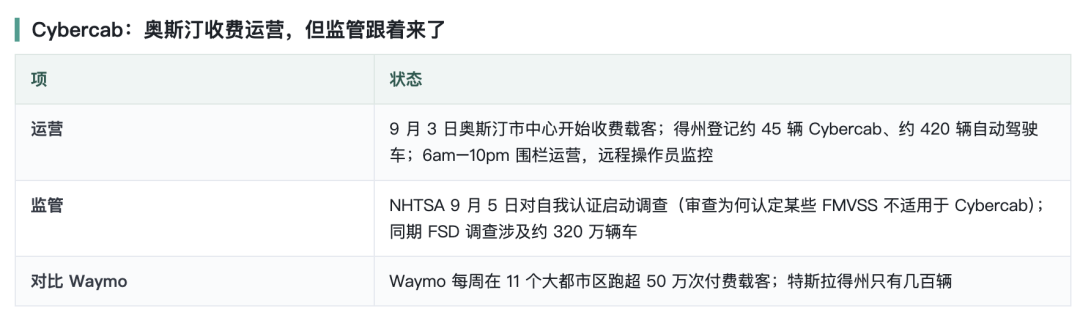
The scale of operations remains limited. Data from the Texas Department of Motor Vehicles indicates that Tesla has approximately 45 Cybercabs registered in Texas, with a total of around 420 fully autonomous vehicles. Operations run from 6 AM to 10 PM within a geofenced area, monitored by remote operators who can take over at any time. The vehicles operate on AI4 with FSD software.
Musk has consistently emphasized the goal of reducing operating costs per mile to 20 cents and having passengers pay 30 to 40 cents, but no official base fare or pricing system has been announced yet. A commercial partnership interest form has also been launched to gauge corporate interest in purchasing Cybercab fleets and building transportation hubs.
On September 5, the NHTSA initiated an investigation into Tesla's self-certification, reviewing the basis for its determination that certain federal motor vehicle safety standards do not apply to the Cybercab. U.S. current standards are tailored for vehicles with human drivers, including steering wheels and pedals. Tesla did not seek exemptions and opted for self-certification instead. During the same period, the NHTSA was also investigating the FSD software and several accidents involving approximately 3.2 million vehicles.
The EU committee vote on FSD Supervised (with a driver version) is scheduled for October 6. Tesla's release of the Article 39 safety case is also in preparation for this vote.
Part Three · Optimus Still Installing Production Lines, AI5 Heads to Robots First
Tesla has not yet announced any production or delivery volumes for Optimus.
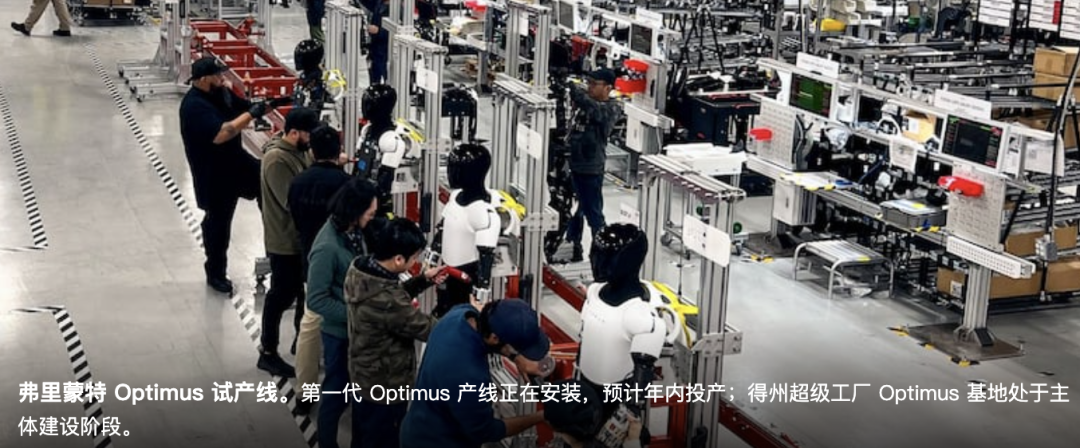
The progress was elucidated in the Q2 update in July. The production lines for the Model S and Model X at the Fremont factory have been discontinued, and the first-generation Optimus production line is currently being installed, with production expected to commence within the year. The Optimus base at the Texas Gigafactory is in the main construction phase. The Fremont factory is designed for an annual capacity of 1 million units, while the long-term goal for Texas is 10 million units.
Tesla has requested suppliers to ramp up Optimus component production capacity to 1,000 units per week by September 2026, escalating to 2,000 to 2,500 units per week by the end of the year. The initial batch of Optimus units will be utilized for the Optimus Academy for training data collection and feature development, and this production volume does not constitute external deliveries.
During the earnings call on July 22, Musk tempered expectations, referring to Optimus as Tesla's most challenging product to scale up in manufacturing history. Nearly all components are newly designed, with no existing supply chain to leverage, necessitating the resolution of tens of thousands of individual issues. The initial S-curve will be flat and protracted.
The bottleneck for Optimus lies in enabling the robot to repeatedly complete tasks, record failures, and refine movements. The initial production volume will be dedicated to training purposes.
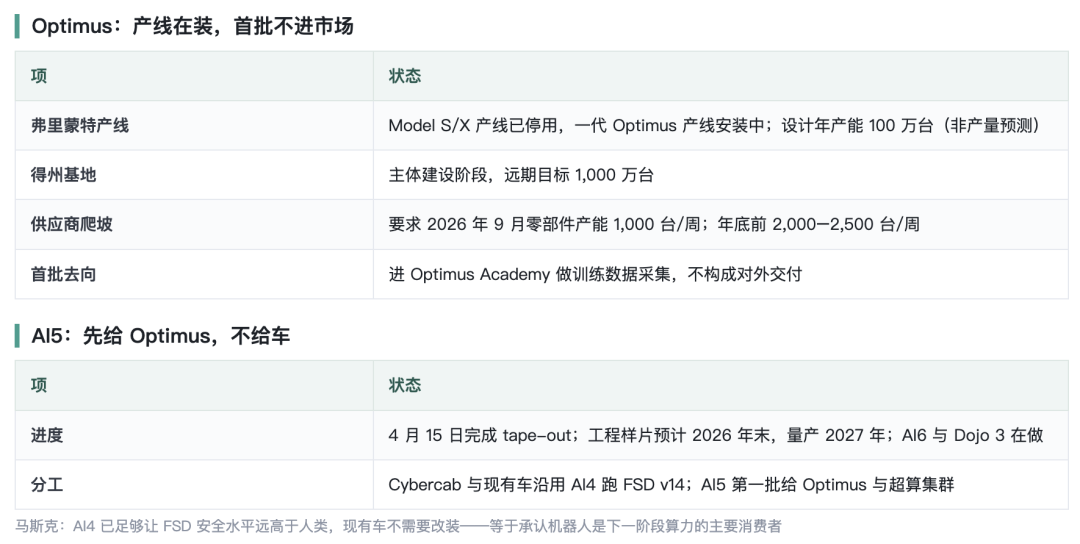
On April 15, Musk announced that the AI5 chip had completed tape-out and design freeze, with production entrusted to TSMC's Arizona facility and Samsung's Taylor, Texas facility. He mentioned that AI6 and Dojo 3 are already in development. Engineering samples are anticipated by the end of 2026, with mass production slated for 2027. The first batch of AI5 chips will not be allocated to vehicles but to Optimus and supercomputing clusters. By directing AI5 to Optimus, humanoid robots will emerge as the primary consumers of computing power in the next phase.
The Terafab wafer factory in Austin is still in its nascent stages, with equipment procurement and construction underway.
Conclusion
Tesla delivered 486,532 vehicles, exceeding the compiled expectation by 24,558 vehicles, albeit still showing a 2.1% decline year-on-year. Energy storage reached 13.7 GWh, marking a year-on-year increase of approximately 9.6%, falling short of expectations by 13.8% and representing the second-highest record in history. The Robotaxi service commenced paid operations in Austin with 45 Cybercabs. The Optimus production line is currently being installed, with the initial production volume earmarked for the training academy. Suppliers have been instructed to ramp up production to 2,000 to 2,500 units per week by the end of the year. The AI5 chip has completed design freeze and will initially be deployed in robots.
We will revisit this topic upon the release of the earnings report.
-
![]()
[Electric Equipment] BRETON Eyes African Mining Sectors: Venturing into Electric Mining Truck Sales
-
Anthropic is Going Public: Valued at 2 Trillion in 5 Years, Who’s Paying for the AI Bubble?
-
![]()
Going to work! Let's meet the new colleague: available 24/7, works hard for little pay, and has a great attitude.
-
![]()
Why Has NVIDIA Become the Biggest Winner in the AI Computing Power Race?
-
![]()
Day 4 of National Day: How are new energy vehicles performing for travel?
-
![]()
O-film Tech Becomes the Exclusive Supplier of Main Camera and 200MP Periscope Telephoto Lenses for Huawei Pura 90 Pro Series
-
![]()
Why is Baidu's AI large model rarely mentioned anymore?
-
![]()
In-Depth Guide to Car Purchase Incentives: Can You Really Save Nearly 10,000 Yuan on the Spot?