In-Depth Guide to Car Purchase Incentives: Can You Really Save Nearly 10,000 Yuan on the Spot?
 10/08 2026
 530
530
Is the 'Golden September, Silver October' sales boom upon us?
As the National Day holiday draws near, local governments and car manufacturers are rolling out a fresh wave of car purchase subsidies to invigorate the automotive market during this peak season. At the local level, we're seeing both provincial-level special subsidies and municipal/district-level car purchase discounts. When combined with incentives from car companies, the total savings can amount to tens of thousands of yuan.
September also witnessed a flurry of new domestic car launches. On September 28 alone, nine new models hit the market, with several offering time-limited purchase discounts.
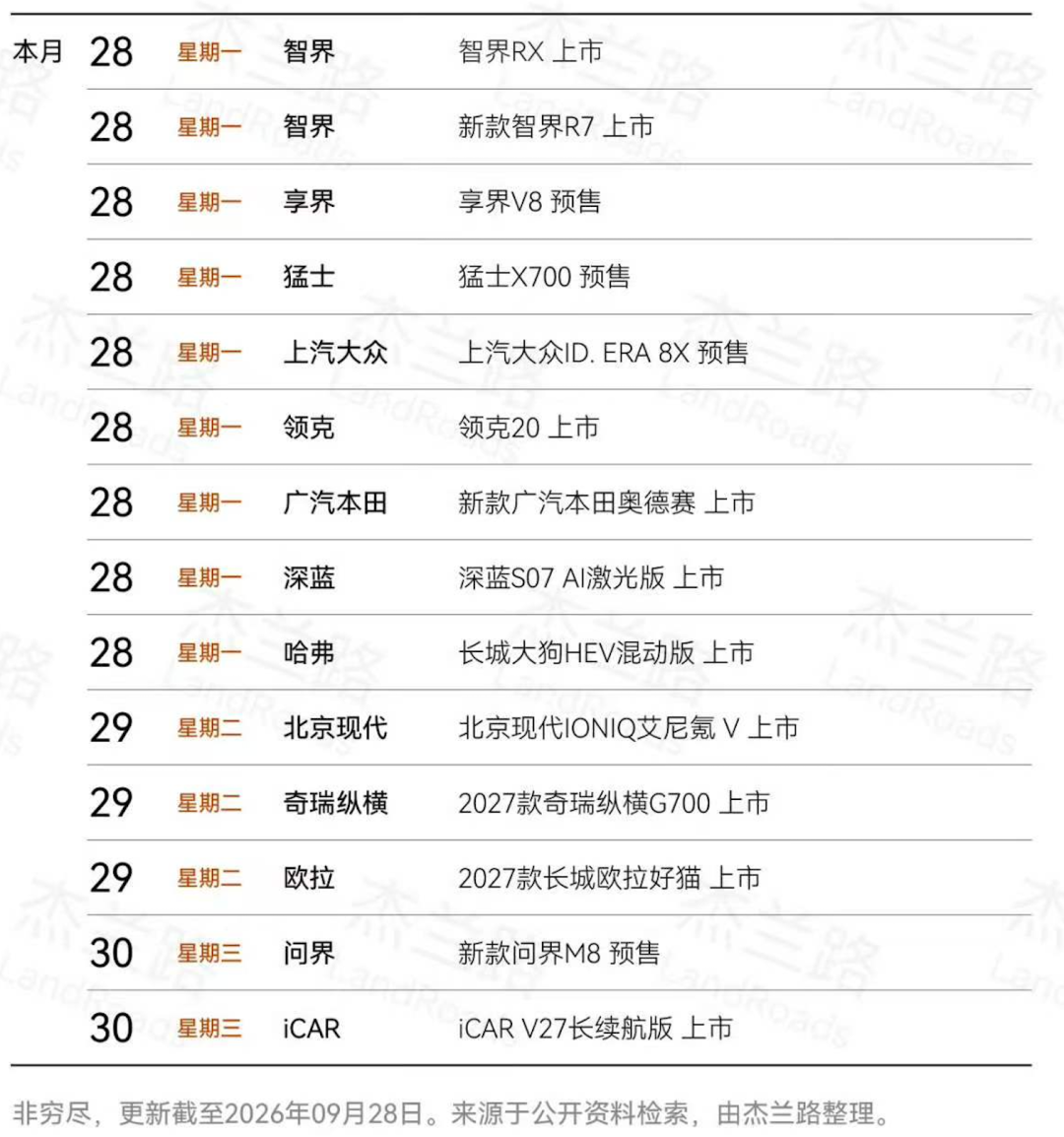
Image source: Jielanlu
Since the start of 2026, the frequency of new domestic car launches has remained high, significantly expanding the product range. However, the recovery of the consumer market has been slower than anticipated, with overall sales under pressure and the traditional sales peaks exerting a diminishing influence on the market. Amid this sluggish market recovery, the combined impact of policy subsidies and car company incentives has notably lowered the barrier to car purchases, delivering a clear short-term boost.
Can this round of intensive benefits propel the automotive market towards a phased recovery?
Multiple Provinces and Cities Ramp Up Car Purchase Incentives
Various regions are now intensively implementing a new round of automotive consumption promotion policies. Cities and provinces such as Hohhot, Gansu, Nanjing, Lanzhou, and Qingdao have all introduced car purchase subsidy programs.
Qingdao City has unveiled the 'Gifts for Golden Autumn' new car consumption subsidy: New energy passenger vehicles will receive a subsidy equivalent to 4% of the new car's sales price (including invoice tax), capped at 12,000 yuan; fuel-powered passenger vehicles will get a subsidy of 3% of the sales price (including invoice tax), up to a maximum of 10,000 yuan.
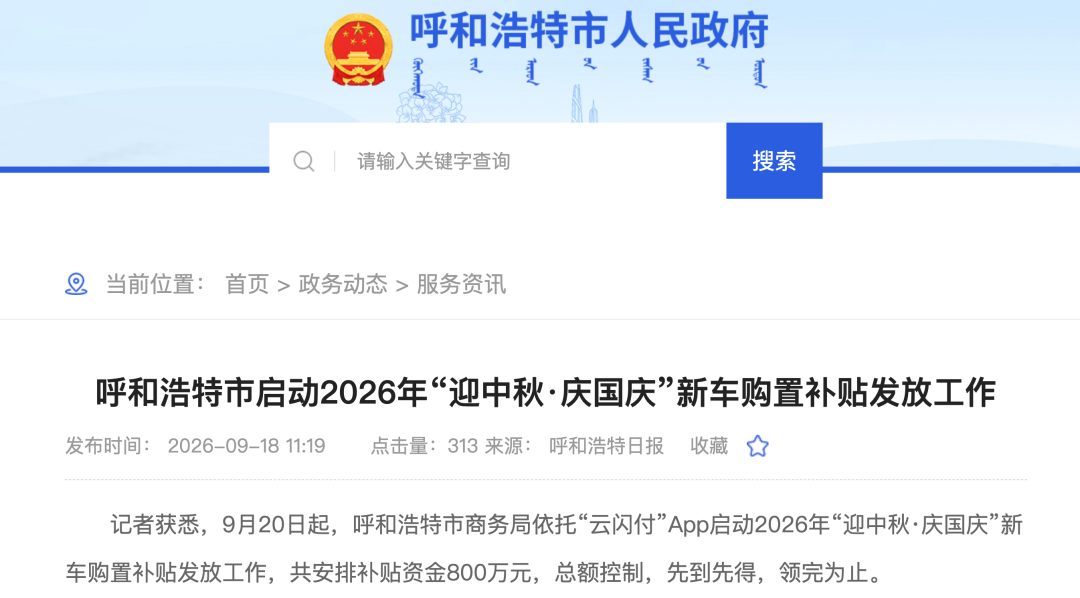
Image source: Hohhot Municipal People's Government
According to Hohhot's 'Welcoming the Mid-Autumn Festival and Celebrating the National Day' new car purchase subsidy details, a total of 8 million yuan in subsidy funds has been earmarked. The event will run from September 20 to October 7, with subsidies tiered based on the vehicle's total invoice price (including tax): 3,000 yuan for models priced between 60,000 and 150,000 yuan, 6,000 yuan for those between 150,000 and 200,000 yuan, and a maximum single subsidy of 10,000 yuan for new cars priced over 200,000 yuan.
Gansu Province has allocated 6 million yuan in provincial-level special funds to spur consumption and will host a new car purchase subsidy event from September 23 to October 7 during the National Day period. The subsidy standards are as follows: 2,000 yuan for home-use models priced at 100,000 yuan or below, and 3,000 yuan for models priced above 100,000 yuan, targeting mainstream car purchase groups with rigid demand.
Lanzhou City has launched special Mid-Autumn Festival and National Day car purchase subsidies. Starting from September 23, a 'double superposition' policy (combining provincial and municipal subsidies) will be implemented citywide, with subsidy amounts ranging from 3,200 to 3,600 yuan.
Nanjing City will carry out a second round of automotive purchase promotion activities from September 16 to December 31. For new energy passenger vehicles priced at 50,000 yuan (inclusive) or above, a subsidy of 3% of the new car's sales price will be provided, capped at 7,000 yuan; for fuel-powered passenger vehicles in the same price range, a subsidy of 2% will be given, up to 6,000 yuan. In addition to new car purchase subsidies, Yuhuatai District in Nanjing City has also launched a separate used car consumption promotion activity.
This round of car purchase subsidies across regions generally displays characteristics of differentiation, orientation, inclusiveness, and limitations. Some regions have introduced short-term stimulus measures focused on the National Day holiday, while places like Nanjing have extended the policy cycle until year-end, using cross-quarter long-term policies to bolster market demand.
At the industrial guidance level, regions continue to prioritize the consumption of new energy vehicles. Subsidy ratios and amounts for new energy vehicle models are generally more favorable than those for fuel-powered vehicles.
Simultaneously, this round of subsidies generally sets a low application threshold. In most regions, models priced at 50,000 yuan are eligible, accurately targeting mainstream home car purchase groups and emphasizing public benefit. It's worth noting that all local subsidies suffer from the drawback of limited funding. Most have set a cap on the total subsidy amount and implement a first-come, first-served distribution rule, with subsidies ending once funds are depleted.
Multiple Car Companies Offer Peak Season Incentives
In addition to local subsidies, promotional efforts from car companies have also intensified. Since September, over 30 automotive brands have introduced time-limited policies, involving more than a hundred models eligible for discounts. Discount forms include down payment reductions, trade-in benefits, and low-interest financing plans.
On September 25, Tesla announced a time-limited down payment reduction policy, requiring consumers to place their orders by October 31 (inclusive). The policy includes a 5,000 yuan reduction in the down payment for all Model 3 variants and a 7,000 yuan reduction for certain Model Y variants. When combined with the brand's 5-year 0-interest financing plan, the starting price of the Model 3 drops to 222,500 yuan, and the Model Y to 256,500 yuan.
As a leading brand in the new energy market, Tesla's price adjustments often influence the pricing strategies of new energy vehicle models in the same price range, further intensifying competitive pressure in the 200,000-yuan-level new energy market.
Meanwhile, September saw a wave of new car launches in the automotive market. Over a dozen car companies, including FAW, SAIC, Changan, Geely, BYD, and Li Auto, launched more than 50 new models (including all-new, new generation, and facelifted models), with prices spanning from 60,000-yuan commuter cars to 500,000-yuan flagship models.
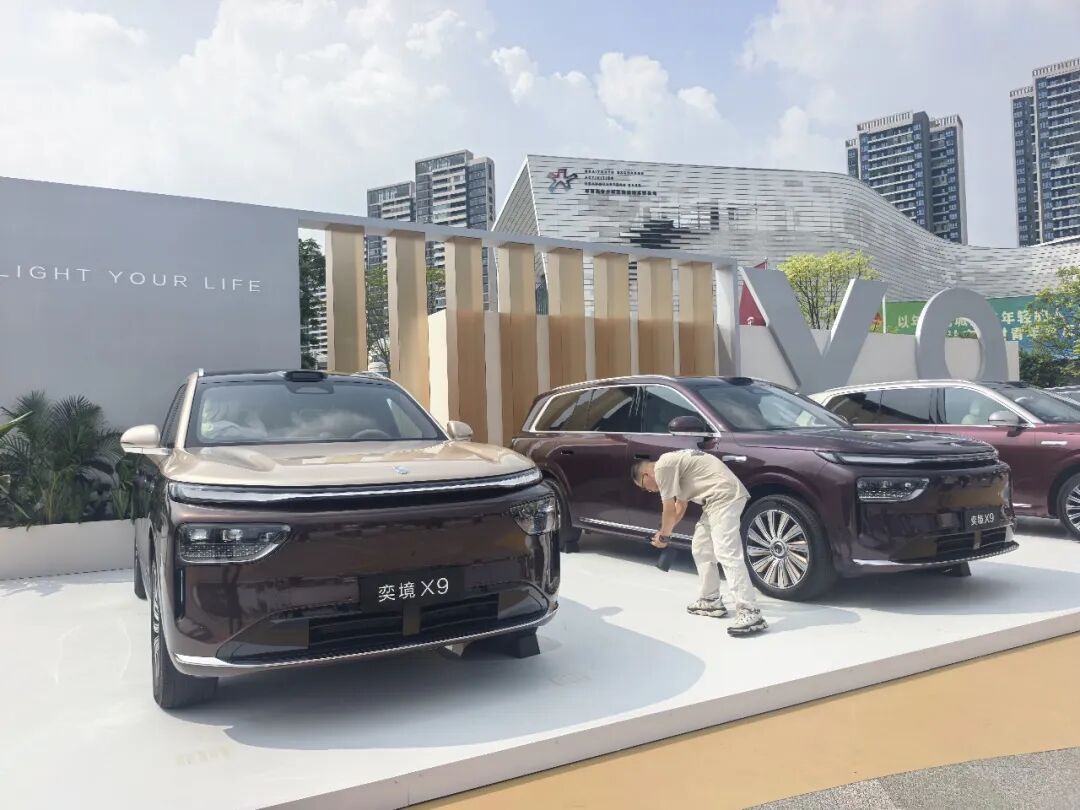
Yijing X9 (Photography/Liu Shanshan)
Many models have offered discounts right from launch, altering the traditional pattern where new cars maintained firm prices upon launch and only offered discounts after some time on the market. Industry competition has further intensified.
On September 24, Yijing X9 announced its launch prices. The new car comes in four variants, with official guide prices ranging from 289,800 to 369,800 yuan. After applying a 10,000 yuan super trade-in benefit, the time-limited discounted price range is 279,800 to 359,800 yuan, with the starting price directly reduced by 20,000 yuan from the pre-sale price of 299,800 yuan. Cheng Jinwen, Deputy General Manager of Marketing at Yijing Auto, told China Newsweek, 'We've eliminated all high-premium components. We genuinely want customers to experience ultimate value without the high cost, achieving elegance without extravagance.'
'The first model doesn't really generate profit,' said Zeng Qinglin, General Manager of the Yijing Auto brand. 'It comes fully equipped with Huawei's top-tier configurations, including million-pixel headlights, ADS5, 896-level lidar, and four lasers. These are Huawei's 500,000-yuan-level configurations. We insist on using CATL's batteries because CATL's battery DPPM (Defects Per Million Parts) is significantly better than many other brands.'
The Xpeng G9L, launched in September, simultaneously introduced a time-limited discount policy of up to 10,000 yuan. In an exclusive interview after the launch event, Wu Anfei, General Manager of the Product Matrix at Xpeng Group, said, 'The widespread adoption of technology has brought about significant changes in product experience. Nowadays, the GX and G9L priced at 300,000 yuan possess capabilities that were once comparable to million-yuan models.' Wu Anfei also mentioned, 'We focus more on how to make this large five-seater flagship model gain recognition from both Chinese and global users. We hope it can create new growth points for the company in terms of sales, profits, and overseas business.'
Can the Market Turn Around?
Comprehensive data from Yiche's vehicle model library reveals that in the first half of 2026, a cumulative total of 576 new domestic passenger car models were launched, involving 1,731 variants, averaging over 3.3 models launched per day. Dongchedi's statistical scope is even broader. After including annual minor facelifts, configuration-derived models, and limited-edition special models, the number of new cars launched in China from January to June this year alone exceeded 600, averaging over 100 per month.
However, the concentrated launch of new cars has not translated into increased sales. According to data from the China Association of Automobile Manufacturers, from January to August this year, domestic sales of passenger vehicles were 11.125 million units, a year-on-year decrease of 24.6%. Competition in the domestic automotive market has shifted from an incremental market to a stock market.
In previous years, the rapid popularization of car consumption led to a large number of households purchasing their first cars. At this stage, the main consumer force has shifted to trade-in and additional purchase users. Consumers' car purchase decisions have become more rational. They no longer simply chase after new car gimmicks but begin to comprehensively consider factors such as price, product reliability, intelligent configurations, and vehicle usage costs.
Local car purchase subsidies have been employed as a tool to boost the automotive market during multiple previous consumption peaks. The advantage of such policies lies in their quick effectiveness, short-term reduction in car purchase costs, and release of a portion of potential users who originally planned to buy a car but were temporarily hesitant, accelerating order placements. However, the inherent drawback of local subsidies is that the total amount of subsidy funds is limited, and the policy cycle is short. They can only stimulate short-term demand and are difficult to create new consumer demand.
At the car company level, proactive price reductions and low-priced launches of new cars can drive orders in the short term and enhance product competitiveness. However, sustained price wars will squeeze the profits of complete vehicle enterprises. For car companies, long-term breakthroughs cannot rely solely on price reductions. Xpeng's targeting of its flagship models at the global market is precisely because it recognizes the limitations of the domestic stock market. Going overseas has become an important direction for domestic car companies to hedge against domestic market pressure.
-
Second-Generation Doubao Phone Falls Short in Resolving Previous Limitations
-
![]()
"Dark Side of the Moon" Completes Final Pre-IPO Funding Round with Valuation of Approximately $50 Billion, Kimi Set to List in Hong Kong!
-
![]()
Apple Imposes Mandatory Adaptation Directive for iPhone Duo, Marking Unprecedented Assertiveness
-
![]()
Huawei's Xu Zhijun: The Real Challenge of Super Nodes Transcends Technology
-
The Long-Standing Foldable Adaptation Challenge: Solved by Apple, Eluding Huawei, Xiaomi, and Samsung for Years
-
![]()
Impressive Annual Output: 1 Million Pieces! Zhongteng Huasheng's Ultra-Precision High-Performance Optical Film Project Commences Trial Production
-
![]()
Tens of Millions in Funding Secured! Can Yuanxi Photonics Surmount the Mass Production Hurdle for Metasurface Optics?
-
AMD Invests Massively in Physical AI? Acquires World Labs for $8.2 Billion