JAC’s Three Strategic Gambles for Self-Revival Amid a Decade of Controversy
 10/10 2026
 438
438
Industry reshuffles invariably present opportunities for growth and transformation.
The automotive sector has witnessed its fair share of remarkable turnarounds, with Seres standing out as a prime example.
However, JAC Motors, a prominent name in China's commercial vehicle arena, has yet to make a significant breakthrough in the passenger vehicle market.
On October 8, JAC Motors' stock price surged to its daily limit, only to plummet again at the market's opening on the 9th, closing at 22.75 yuan, down 7.97%.
In 2016, JAC ventured into the passenger vehicle segment through a strategic partnership with NIO, marking its foray into manufacturing platforms alongside top-tier collaborators.
In 2018, NIO's Li Bin remarked on a CCTV program that 'Porsche's factory pales in comparison to JAC's state-of-the-art facility.'
He later clarified that his comparison was between JAC's modern factory and Porsche's older one.
Nevertheless, for a 62-year-old automaker with a current market capitalization of 50 billion yuan, forging a path in the new energy passenger vehicle market independently remains a formidable challenge.
JAC has largely abandoned the notion of going solo, instead focusing its resources on collaborative vehicle manufacturing endeavors.
It has engaged in OEM production for NIO, forged a partnership with Volkswagen, and made a substantial bet on Huawei, with each collaboration involving progressively larger investments.
Thus far, these three strategic alliances have not yet transformed JAC's fortunes, but perhaps time will tell.
The golden window for establishing independent new energy brands has closed, and JAC's 10 billion yuan MAEXTRO mega-factory is already up and running.
Seres has successfully graduated and found renewed vitality; could JAC Motors be next in line?
01 Indirect Breakthrough
In 2016, NIO lacked vehicle production qualifications and could not afford to wait for a lengthy factory construction process, urgently requiring a manufacturing partner for mass production.
On the flip side, JAC Motors in Hefei was struggling in the passenger vehicle business and aspired to enter the new energy passenger vehicle market through OEM production.
JAC provided stable deliveries for NIO, while NIO paid substantial annual OEM fees in return.
In 2021, this cooperation deepened as both parties jointly established a company dedicated to NIO's supply chain coordination and production.
The pure OEM model has its advantages and disadvantages, and the trade-offs have shaped the outcome of this collaboration.
NIO's financial reports reveal that from 2018 to 2022, OEM fees amounted to approximately 3.038 billion yuan.
According to media reports, JAC had already recouped its factory construction costs during the cooperation period.
However, this represents the limit of JAC's gains from this collaboration—manufacturing is arduous work, and while production capacity was revitalized, JAC still lacked its own brand and core technologies such as intelligent cockpits and autonomous driving.
In simple terms, NIO was a client, not a true partner in the traditional sense.
In 2023, NIO obtained vehicle production qualifications, signaling the end of the OEM collaboration.
NIO commenced building its own factories, while JAC, in addition to earning OEM fees, gained valuable experience and production capacity in new energy vehicle manufacturing.
If OEM production is not the path forward, would a joint venture be a better alternative?
After parting ways with NIO, JAC welcomed Volkswagen into the fold.
However, this joint venture project necessitated massive investments, and capacity ramp-up was sluggish.
In 2025, Volkswagen Anhui sold only about 9,000 units for the entire year, with capacity utilization at 350,000 units once plummeting below 3%.
Based on data from 2023 to 2025, the company incurred losses exceeding 11.4 billion yuan, with JAC bearing 2.87 billion yuan of the burden.
Continued massive losses have made JAC realize that traditional forms of cooperation are difficult to break through and yield sustainable growth.
02 Betting on MAEXTRO
For JAC, the opportunity to collaborate with Huawei is of paramount importance.
The story traces back to 2019 when Huawei launched the HiCar ecosystem, and JAC emerged as one of its ecological partners, with the two companies signing a framework cooperation agreement that same year.
In December 2023, the fourth brand under Hongmeng Intelligent Automotive Solutions, MAEXTRO, made its debut, and JAC secured the collaboration.
This time, JAC's cooperation with Huawei differs significantly from previous endeavors.
Under the agreement, JAC is responsible for the vehicle platform, chassis development, vehicle engineering, and manufacturing, owning the MAEXTRO brand trademark.
Huawei, on the other hand, is tasked with intelligent driving, the Hongmeng cockpit, and vehicle digitization solutions, exclusively handling global sales and user services for the models.
The two sides have formed a joint R&D team of over 5,000 people, making joint decisions throughout the entire process, from product definition, design, R&D, and testing to supply chain management.
This model bears some resemblance to Seres' AITO, but it is not identical, primarily differing in trademark ownership.
Broadly speaking, Huawei takes the lead in product development, launch, and marketing, as well as sales, while JAC handles production and shoulders the heavy assets of factory construction.
Huawei primarily earns supply fees for core components, as well as technology licensing fees and channel service fees based on sales volume.
From a cooperation standpoint, JAC has made substantial investments, enabling Huawei to secure stable revenues initially. However, if sales volume surges, JAC stands to benefit immensely and potentially achieve a remarkable turnaround.
In May 2025, the first MAEXTRO model, the S800, was unveiled.
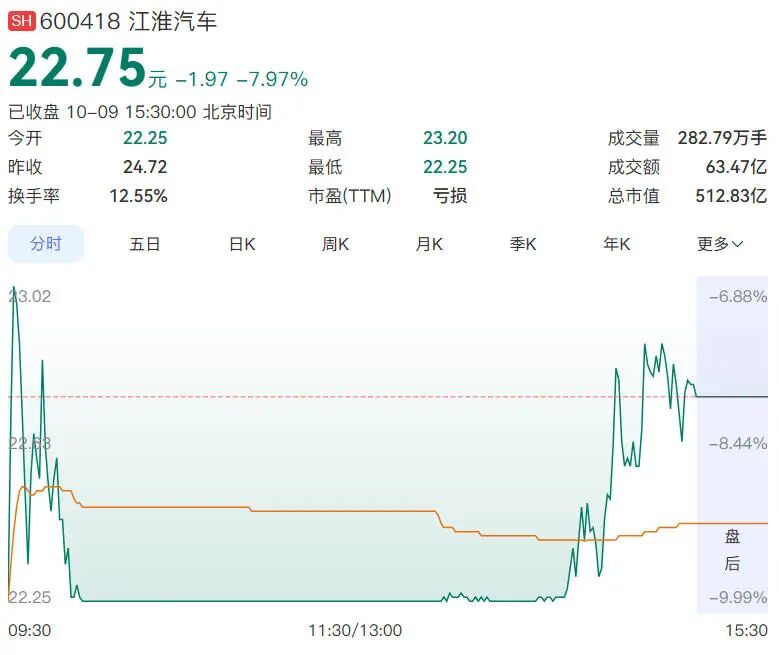
JAC's stock price began to soar that year, reflecting market optimism.
By September, it reached a historic high of 58.81 yuan, with a market capitalization exceeding 100 billion yuan.
The veteran automaker became a hot topic of discussion, with many placing bets on JAC's ability to break through in the high-end market.
03 Critical Moment
JAC has made substantial investments this time around, such as the 10 billion yuan mega-factory, representing a significant gamble on its future.
These investments are reflected in recent financial data, showcasing JAC's ups and downs in its pursuit of transformation.
In 2022, net profit attributable to shareholders was a loss of 1.582 billion yuan.
In 2023, there was a small profit of 152 million yuan, marking a brief recovery.
In 2024, net profit attributable to shareholders was a loss of 1.784 billion yuan.
In 2025, the loss continued at 1.703 billion yuan.
It is evident that after stabilizing in 2023, JAC suffered significant losses for two consecutive years, clearly attributable to the massive investments in the MAEXTRO project, which has yet to generate substantial revenue, and continued losses at Volkswagen Anhui.
For JAC, what can sustain it while waiting for MAEXTRO to become profitable?
While pursuing high-end external collaborations, JAC still has its commercial vehicle foundation to rely on.
Light trucks, trucks, and special vehicles are long-term sources of cash flow, providing a stable financial base.
JAC is also upgrading its foundation, such as launching the Kunpeng ET9 pure electric intelligent truck in collaboration with CATL, as well as new energy pickup trucks and MPVs.
Additionally, vehicle exports are a relatively profitable business segment. In 2024, exports contributed about 56.6% of JAC's revenue and about 79% of its gross profit.
However, the commercial vehicle sector is cyclical, and the export business may be affected by tariffs and trade policies. Ultimately, the MAEXTRO project holds the key to pulling JAC out of its current predicament.
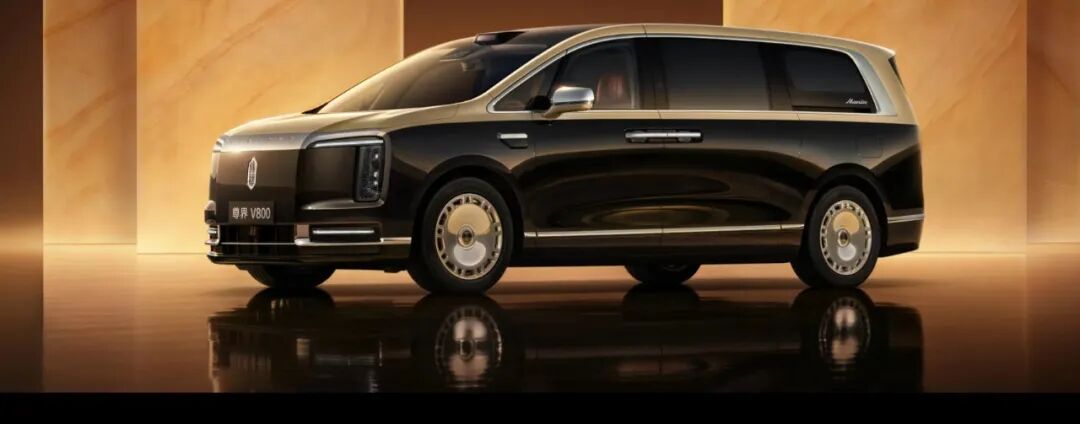
Currently, MAEXTRO is at a critical juncture in its development.
After over a year and 17 months of sales for the S800, how has it performed in the market?
In 2025, the data was impressive, reaching 4,223 units in December alone, placing it among the top performers in the high-end luxury car segment.
However, in 2026, monthly sales began to decline, with only over 300 units sold during the low seasons of July and August.
In terms of total sales, it exceeded 15,000 units in March 2026 and surpassed 20,000 units in September.
According to Huawei, from September 2025 to January 2026, the S800 had a cumulative insurance registration of 13,092 units, surpassing the combined total of the Porsche Panamera, Maybach S, and Mercedes-Benz S-Class.
Next, the performance of the recently launched MPVs, the V800 and V680, will be crucial in determining MAEXTRO's future trajectory.
JAC has not yet reached a position of safety and stability.
-
![]()
Keynote Speaker Announcement | Wang Peng, Alibaba's QianWen Office Business Development Expert, Confirmed for WAIE (10th) 2026 AI Industry Conference & AI Agent Industry Application Summit
-
![]()
A Chaotic Battle in the Smartphone Market: Who is Redefining the Imaging War?
-
![]()
Chaotic Competition in the Smartphone Market: Who is Redefining the Imaging War?
-
![]()
AI Is Not a Get-Out-of-Jail-Free Card: Why Only Microsoft Is Being Rewarded for Its AI Investments
-
![]()
Li Auto’s 2026 i6: The Brand’s Debut Global All-Electric Model Headed to Europe
-
![]()
Kimi K3 Goes Viral and Suspends Service in 48 Hours: Model Wins Benchmarks, Compute Falls Short Against Big Players
-
![]()
Zhixiang Future Secures 2.1 Billion Yuan in Three Months of Financing, Yet Founder Maintains: 'We Haven't Achieved World-Model Status'
-
11 Days, Five Launch Events: The Battle Behind the 2026 Domestic Flagship Smartphones