Tesla Model 3/Y Integrates with Home Grid, Redefining Backup Power Solutions
 10/10 2026
 387
387
Tesla has just rolled out its innovative Powershare Home Backup feature, enabling qualified Model 3/Y vehicles to act as a backup power source for homes via charging equipment. This setup allows the vehicle's battery and the Powerwall 3 to collaborate in power distribution: the Powerwall 3 immediately takes charge in the event of a grid failure, while the vehicle supplements the power when the Powerwall's battery is nearly depleted. This functionality is automatically included in U.S. orders placed after October 2026, though it does not facilitate selling electricity back to the grid. Produced by Zhineng Zhixin.
Tesla is once again pushing boundaries, this time by integrating vehicles with home power systems across North America.
During power outages, electric vehicles parked in driveways often possess ample battery capacity, yet homes may still suffer from power cuts.
Tesla's newly unveiled Powershare Home Backup is designed to bridge this divide. In compatible homes, Model 3 or Model Y vehicles can supply power from their batteries to the household via charging equipment.
The Powerwall 3 is installed at home, while the vehicle maintains its own power battery. Once connected to the same home energy system, the Powerwall 3 manages daily energy storage and post-outage power supply, with the vehicle stepping in as needed to prolong backup duration.
The essence of this new design is to assign specific roles to each battery.
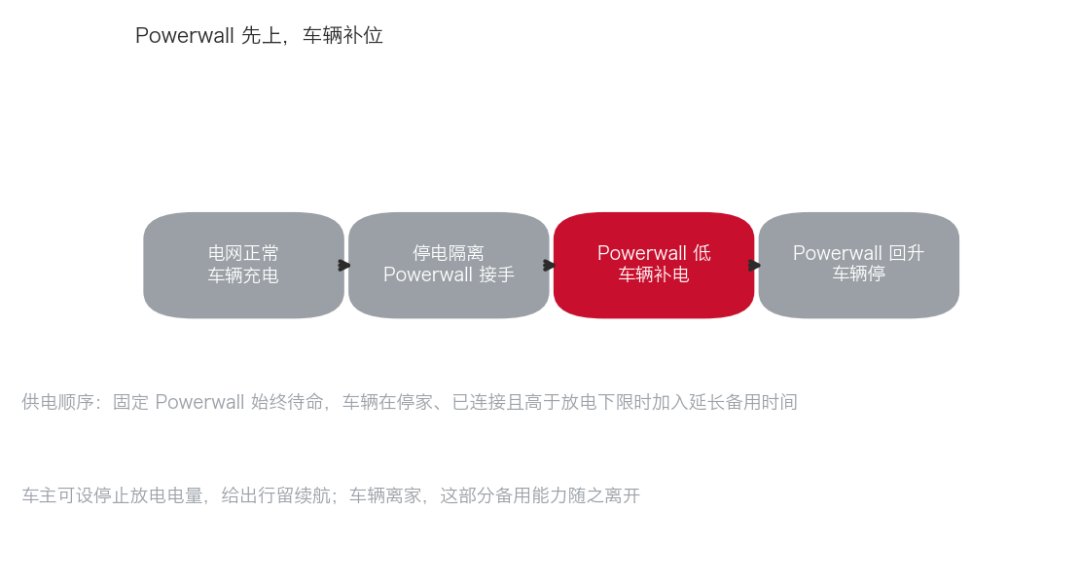
This system operates on a clear power supply sequence:
◎ When the grid is functioning, the vehicle charges normally when plugged in. In the event of a grid outage, the home energy system isolates the house from the public grid, and the Powerwall assumes control of the power supply.
◎ When the Powerwall's battery level drops significantly, the vehicle begins supplying power to the home while also recharging the Powerwall.
Once the Powerwall's battery level is restored, the vehicle ceases discharging, and the Powerwall resumes its role as the backup power supplier.
The stationary Powerwall remains on standby, while the vehicle, when parked at home, connected, and with a battery level above the owner-set discharge threshold, serves as a larger backup energy source.
Owners have the flexibility to set the battery level at which discharging stops, preserving range for upcoming trips. When the vehicle leaves home, this backup capacity is no longer available.
From a product design standpoint, Powershare enhances the utility of vehicle batteries, addressing the challenge of securing power for homes when an outage surpasses the storage capacity of a single Powerwall.
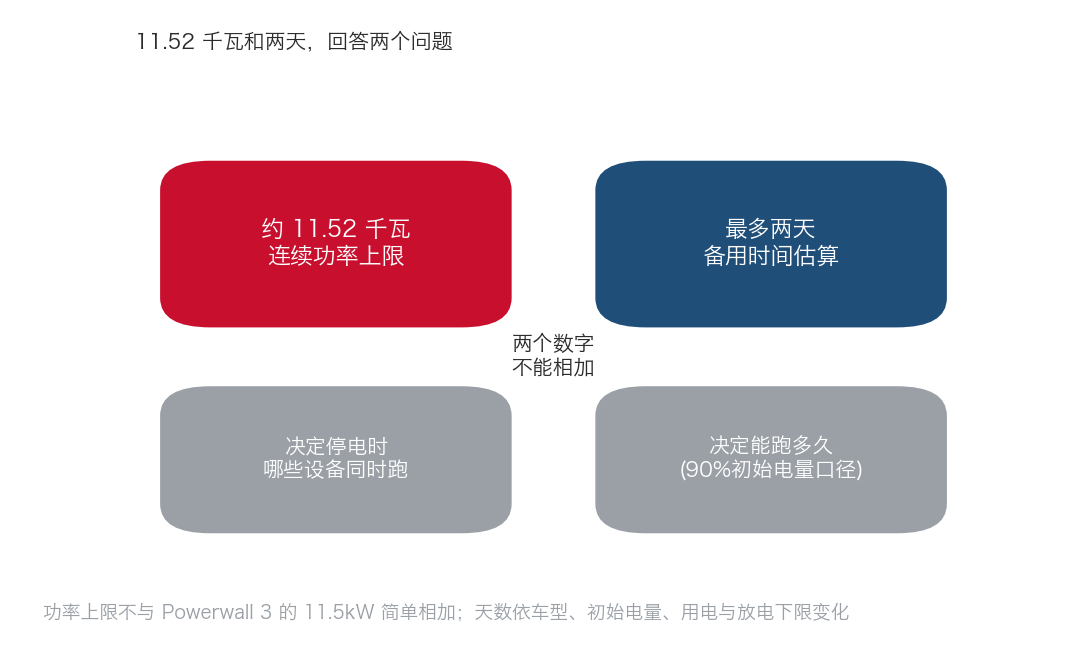
◎ An approximate continuous power limit of 11.52 kW dictates the system's capacity to support instantaneous electrical loads when properly configured.
◎ Tesla's Model 3 manual specifies the vehicle's maximum output as 11.5 kW, noting that actual output may be constrained by home charging equipment.
The rated AC output of the Powerwall 3 can also be adjusted based on installation conditions, with a maximum of 11.5 kW.
According to Tesla, assuming the vehicle initiates power supply at 90% charge and the average U.S. household consumes 30 kWh per day:
◎ The Model 3/Y Standard Range can provide up to two additional days of backup power.
◎ The Premium and Performance versions can offer over two days.
The duration hinges on the vehicle model, initial battery level, household electricity consumption, solar power generation, and the owner-set discharge threshold. Prolonged use of high-load devices such as air conditioners during outages will reduce the available backup days.
Power dictates which devices can operate concurrently during an outage, while battery capacity determines their operational duration.
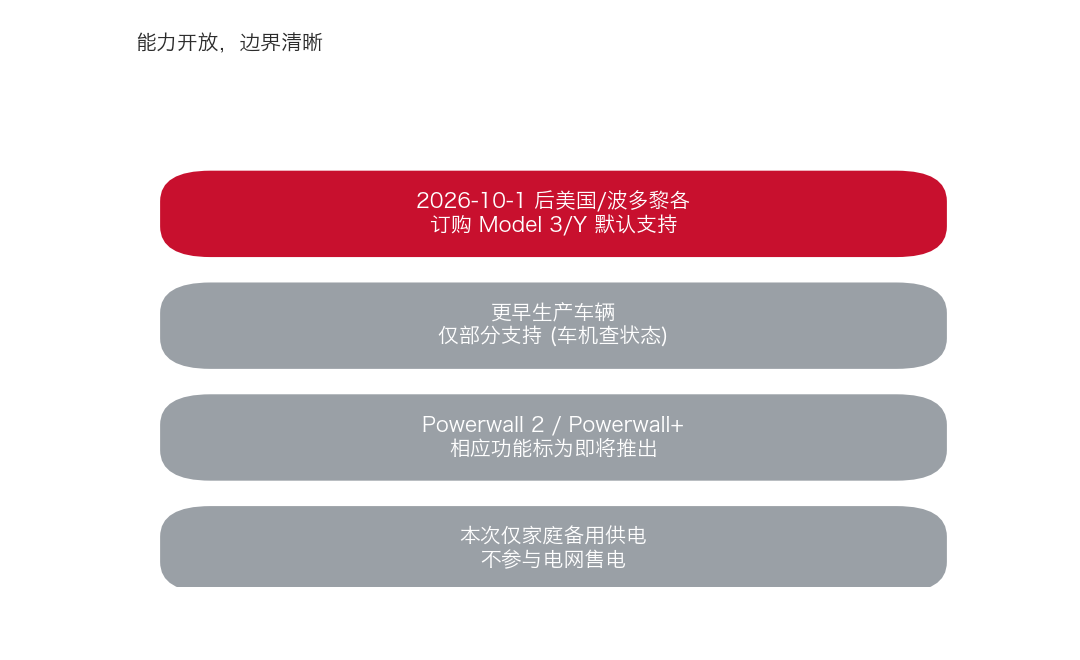
Model 3/Y vehicles ordered in the U.S. and Puerto Rico after October 1, 2026, will come equipped with Powershare capability by default; only select vehicles produced earlier will support it. Owners can verify the Powershare Support status in the vehicle's software or additional information section.
Current technical documentation specifies that the available home configuration for Model 3/Y is the Powerwall 3 paired with a Universal Wall Connector or third-generation Wall Connector; corresponding functions for Powerwall 2 and Powerwall+ are still pending release.
Summary
Tesla has seamlessly integrated vehicles, home batteries, charging equipment, and software control into a unified power supply system. The Powerwall provides a consistent, on-site baseline guarantee; with vehicle integration, homes gain access to expanded energy storage; if solar power is also harnessed, electricity generation during outages can further prolong backup duration.
The rationale behind Tesla's new design is evident: to enable vehicle batteries to function as part of a home's backup energy supply without compromising the owner's ability to retain charge for travel. It introduces considerations beyond a vehicle's driving range into purchasing and home energy decisions—specifically, what a vehicle can contribute to the home during an outage.
-
![]()
Keynote Speaker Announcement | Wang Peng, Alibaba's QianWen Office Business Development Expert, Confirmed for WAIE (10th) 2026 AI Industry Conference & AI Agent Industry Application Summit
-
![]()
A Chaotic Battle in the Smartphone Market: Who is Redefining the Imaging War?
-
![]()
Chaotic Competition in the Smartphone Market: Who is Redefining the Imaging War?
-
![]()
AI Is Not a Get-Out-of-Jail-Free Card: Why Only Microsoft Is Being Rewarded for Its AI Investments
-
![]()
Li Auto’s 2026 i6: The Brand’s Debut Global All-Electric Model Headed to Europe
-
![]()
Kimi K3 Goes Viral and Suspends Service in 48 Hours: Model Wins Benchmarks, Compute Falls Short Against Big Players
-
![]()
Zhixiang Future Secures 2.1 Billion Yuan in Three Months of Financing, Yet Founder Maintains: 'We Haven't Achieved World-Model Status'
-
11 Days, Five Launch Events: The Battle Behind the 2026 Domestic Flagship Smartphones