Why Did Skywell Automobile 'Stumble' in the UK? Why Does the Asset-Light Approach Falter in Mature Markets?
 10/20 2026
 514
Produced by: #Market Value Finance
According to reports from UK media, Innovate Automotive, the sole importer of Skywell Automobile's Skywell brand in the UK, has officially shut down operations, with all 16 dealerships across England and Wales receiving closure notices. This development comes less than two years after Skywell made its debut in the UK market under the Skywell name.
However, in March of this year, Huang Hongsheng, the founder of Skyworth Group, confidently proclaimed at the AWE Shanghai Home Appliance Expo that Skywell aspires to become the 'Transsion' of the automotive sector.
On one hand, Skywell boasts tens of thousands of annual sales in the Middle Eastern deserts, quietly raking in substantial profits. On the other hand, it has managed a mere 127 cumulative registrations across the British Isles, with market expansion grinding to a halt. Why does this company, which has built nearly four decades of brand equity in China's consumer electronics sector, see its brand premium nearly evaporate in Europe's mature automotive market?
Moreover, Skywell Automobile has adopted an asset-light strategy of brand licensing combined with local assembly overseas, a tactic that has proven profitable in the Middle East and Southeast Asia. Why has this approach utterly failed in the UK, one of the world's most fiercely competitive new car markets?
PART 01 OEM Car Manufacturing: A 'Backdoor' Strategy by the King of Color TVs
01
When many people think of Skyworth, they likely recall its heyday as a color TV giant. However, the story of Skywell Automobile cannot begin with Skyworth itself.
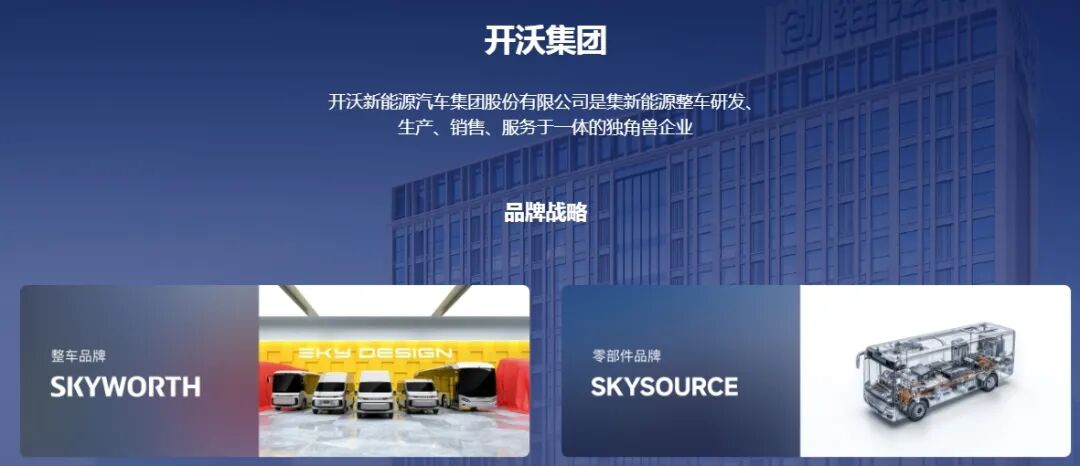
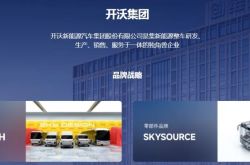
Image Source: Company Official Website
At the end of 2010, Huang Hongsheng, the founder of Skyworth Group, registered a company named 'Skywell Automobile' in Nanjing, with the English name Skywell, differing by only one letter from Skyworth Group's English name Skyworth. This subtle naming detail hints at the core strategy behind Huang's future automotive ventures.
Skywell's initial foray was into the commercial vehicle sector.
In 2011, Huang reorganized Nanjing Golden Dragon Bus Manufacturing Co., Ltd., venturing into the new energy bus market. This move proved to be a resounding success. By 2014, Nanjing Golden Dragon had turned a profit through orders from the Youth Olympic Games, with its pure electric bus sales ranking second nationwide.
The stable cash flow from the commercial vehicle business gave Huang the confidence to delve into passenger vehicles. In 2017, Skywell secured production qualifications for new energy passenger vehicles, and Huang promptly launched the Skywell brand, introducing its first SUV, the Skywell ET5, in 2020.
However, the Skywell ET5 flopped in terms of sales and was subsequently discontinued.
As reported by Yangcheng Evening News, in March 2021, Skywell paid RMB 28 million to acquire the right to use trademarks such as Skyworth and Skywell in the automotive category from Skyworth Group, agreeing to pay annual trademark royalties to Skyworth Group thereafter.
Three months later, the Skywell brand was entirely phased out, with its product line transferred under the Skywell Automobile name.
The essence of this transaction was a meticulously crafted brand appropriation. Skyworth TV has built over three decades of brand recognition in Chinese households, symbolizing reliability, affordability, and home appliance-level cost-effectiveness.
However, there was a catch: Skywell Automobile is not a subsidiary of Skyworth Group but an independent entity that pays to lease the brand. Consumers perceive Skywell Automobile as having no connection to Skyworth TV, only a trademark transaction agreement.
Huang has repeatedly likened Skywell Automobile's overseas strategy to that of Transsion, the Chinese mobile phone brand that outperformed Samsung and Apple in the African market.
Yet, Transsion's success is rooted in extreme localization and a deep understanding of user needs, not merely the transplantation of a brand name. When the brand name itself is leased, the depth of trust it can engender is inherently limited from the outset.
PART 02 Profits in the Desert: The 'Asset-Light' Model in the Middle East Market
02
A stark contrast exists between Skywell Automobile's triumph in the Middle East market and its failure in the UK market.
To comprehend this divide, one must first examine what Skywell sells in the Middle East, to whom, and how.
According to Skyworth Group's 2024 financial report, Skywell Automobile sold approximately 35,000-40,000 vehicles globally in 2024, with 35,000 units sold in the Middle East. The automotive business contributed over 15% of revenue, achieving profitability for the first time, with a net profit of around RMB 200 million.
For 2025, Skywell Automobile set a global sales target of 40,000 units, with overseas sales planned to account for 65%.
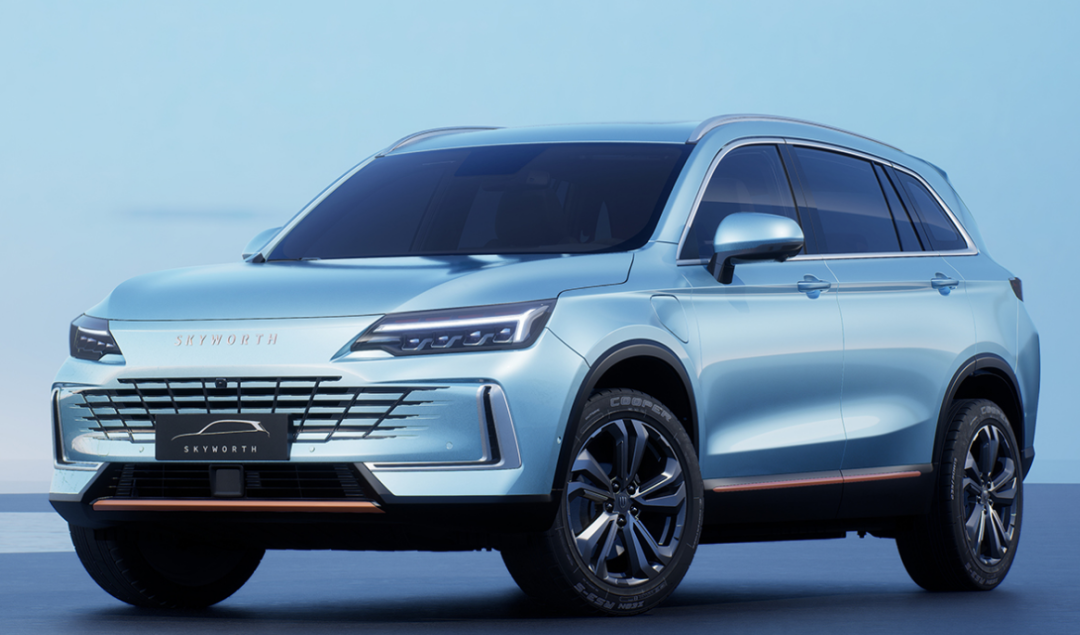
Image Source: Company Official Website
Behind these figures lies a business logic vastly different from the domestic market's focus on configuration competition and intelligent driving. Skywell Automobile's main sales models in the Middle East are customized products targeting B-end government and enterprise procurement as well as taxi fleets.
In 2024, Skywell signed a 10-year strategic cooperation agreement with Saudi Arabia's KAG Group, a subsidiary of the Saudi royal family, planning to invest RMB 10 billion. The agreement encompasses KD (knocked-down) factory construction, supercharging station networks, and smart living ecosystems. KAG Group also became Skywell Automobile's exclusive partner in Saudi Arabia and the United Arab region.
The brilliance of this strategy lies in its bypassing of the most formidable challenge in the Middle East market: C-end brand building.
In the Middle East, Chinese automotive brands face established Japanese and Korean competitors like Toyota and Hyundai, as well as other aggressively expanding Chinese brands like BYD and Chery.
Skywell opted for a lighter approach, avoiding mass advertising and direct-sales stores. Instead, it sold vehicles in bulk to local governments, enterprises, and fleet operators, delegating delivery and service issues to local giants like KAG.
However, the fragility of this model lies in the much lower stability of corporate client orders. Once local partners shift their strategic focus or government policies change, sales could plummet. Skywell Automobile sold 3,763 units in 2025, but only 468 units in the first seven months of 2026.
Moreover, since its partner in this market is a deeply entrenched family enterprise in the Middle East, Skywell Automobile's overseas expansion resembles more borrowing someone else's boat than sailing its own.
PART 03 The British Isles: The Logic of Asset-Light Fails
03
The UK market served as the first litmus test for the resilience of Skywell Automobile's overseas model. The results proved that when the borrowed boat itself is sinking, the model quickly becomes ineffective.
In December 2024, Skywell entered the UK market under the Skywell brand, with the BE11 pure electric SUV, priced at around £32,000, as its sole model for sale.
Unlike its B-end approach in the Middle East, the UK market demands genuine C-end retail capabilities, including brand recognition, test drive experiences, after-sales support, and insurance coverage—every link was something Skywell had never systematically built before. Skywell's choice was again to borrow a boat, entrusting all UK operations to the importer Innovate Automotive while focusing solely on supply.
However, this boat was never sturdy enough. Innovate Automotive's parent company, the Hmicho family, had more mature businesses in the Middle East and lacked a firm commitment to the UK market.
The BE11 registered only six units in its debut year (2024) in the UK. By 2026, Innovate Automotive could no longer sustain operations and ceased trading in June.
According to the UK's Daily Mail, before ceasing operations, Innovate Automotive purchased and registered 64 units from its inventory, bringing the UK's cumulative registrations to a barely passable 127 units.
The real issue emerged in the insurance sector. According to Auto Express, only one of the UK's top ten insurance companies was willing to insure the Skywell BE11, primarily due to concerns over repair costs, spare parts supply, and residual used car (second-hand car) values.
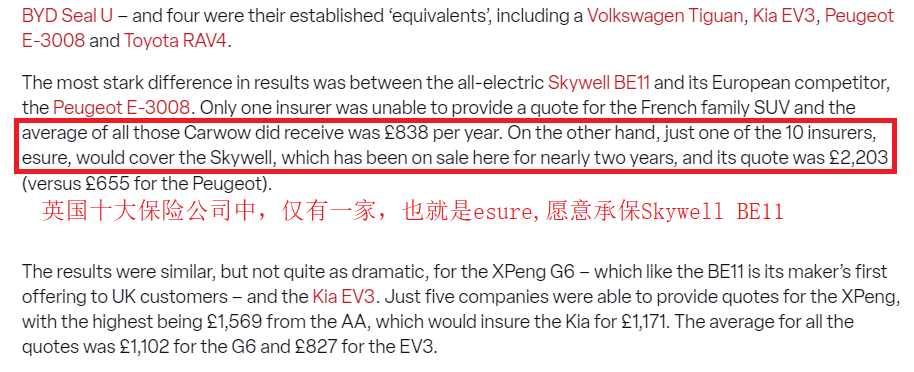
Image Source: Auto Express (UK Automotive Weekly)
In the UK, car insurance is a prerequisite for legal road use, and insurers' attitudes directly determine whether a brand can be accepted by consumers. When mainstream insurers collectively reject a brand, its fate in the market is sealed.
The root cause of insurers' caution lies in Skywell Automobile's lack of an owned after-sales network and spare parts supply system in the UK. Once a vehicle malfunctions, repair cycles and costs become uncontrollable, making residual values unassurable.
David Clark, the general manager of the importer, stated upon closing the company that the cessation of operations was due to the substantial investment required to remain competitive in the UK market, emphasizing that Innovate Automotive's closure in no way reflected issues with Skywell itself.
When the importer could no longer sustain itself, Skywell Automobile instantly lost all sales capabilities, service abilities, and brand presence in the UK because, apart from the products themselves, it had never established any infrastructure of its own in the country.
When 'Skywell' is merely a trademark purchased by Skywell Automobile from Skyworth Group, and when UK consumers abandon the brand due to the inability to find a willing insurer, the question this company must answer is perhaps not which overseas market to target next but rather: What do I truly own?
END
Disclaimer
Market Value Finance hereby states that all information and content provided are objectively compiled and analyzed based on publicly available data. However, we cannot guarantee the absolute accuracy, completeness, or timeliness of this information. Any opinions, analyses, or conclusions contained herein are independent insights from Market Value Finance at a specific point in time and do not represent any investment advice or strategy. Financial markets carry risks, and investors must bear full responsibility for any decisions made based on this information. If you have any questions or discover any omissions regarding this publication, please contact us directly through our official backend channels, and we will verify and address them promptly.
-
![]()
Why Did Skywell Automobile 'Stumble' in the UK? Why Does the Asset-Light Approach Falter in Mature Markets?
-
![]()
DJI/Insta360/Qiyuan/Obsbot Embrace AI Imaging: Can a Non-Photographing Robot Be Deemed Competent Embodied AI?
-
![]()
Revenue Hits 18.1 Billion, Yet Net Loss After Non-Recurring Items Reaches 762 Million: iFLYTEK's Performance Swings to Extremes
-
Huawei Reclaims Leadership, ZTE Secures Third Place in Global Mobile Core Network Market Share Rankings
-
![]()
Why Did the iPhone Duo's 'Electronic Moutai' Hype Fizzle Out in Just Three Days?
-
![]()
Why Did the “Electronic Moutai” Bubble Surrounding the iPhone Duo Burst in Just Three Days?
-
![]()
Double 11 Unfolds: JD.com and Douyin Compete for the Authority to Define Compliance
-
![]()
Liang Wenfeng's Embodied Strategy | iResearch Insights