Three Presidents in Five Years: What Audi China Truly Needs is Decentralization
 10/23 2026
 490
Lagging in Electrification, Audi Needs More Than Just a Local President.
On October 22nd, rumors about personnel changes at Audi quietly emerged, and that afternoon, Audi's official website confirmed the news.
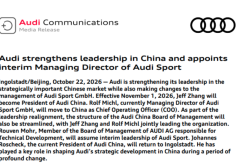
The official announcement stated that starting from November 1, 2026, Zhang Jun will take over as President of Audi China, while the current President, Luo Yinghan, will return to Audi's headquarters in Ingolstadt, Germany.
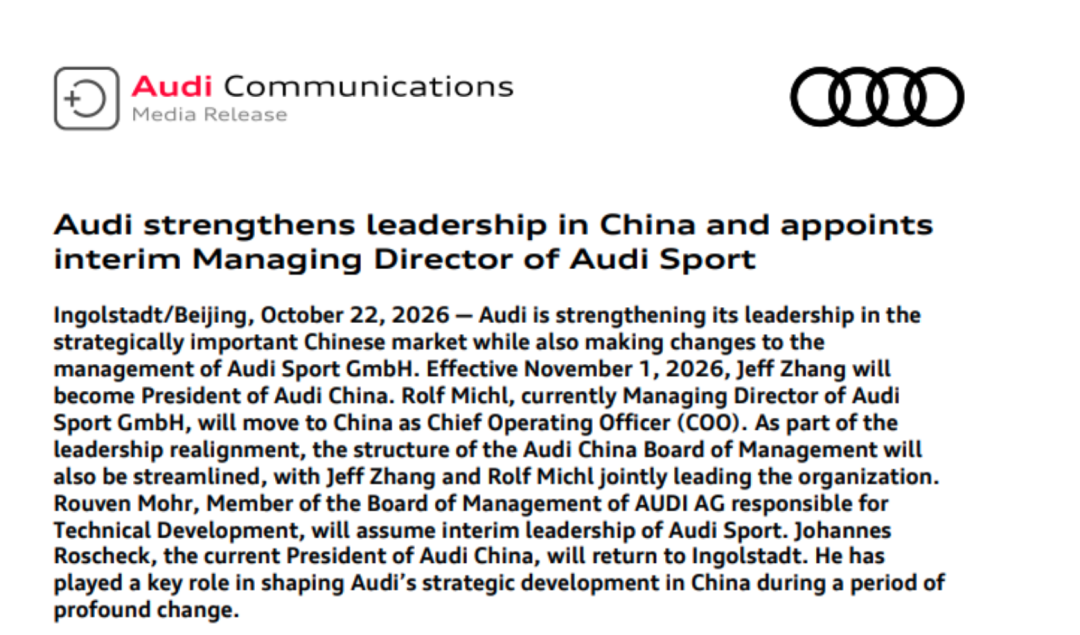
Beyond Zhang Jun becoming Audi China's first Chinese president, the company also appointed Rolf Michl, currently Managing Director of Audi Sport GmbH, as Chief Operating Officer. Together, they will form the smallest managing board in Audi China's history.
From an external perspective, this leadership change represents a significant move by Audi China in response to declining sales in 2026. It also suggests that the strategy advocated by current President Luo Yinghan, which does not pursue short-term sales, has become unacceptable to the German headquarters. Audi urgently needs a real transformation in both quantity and quality in China.
Dual Loss of Sales and Profit
Looking back at Audi's market performance in China over the past five years, 2023 marked Audi's final moment of glory. Under the leadership of then-President Jens Puttfarcken, Audi not only held its ground in the luxury car market but also led BBA with a 13.5% increase.
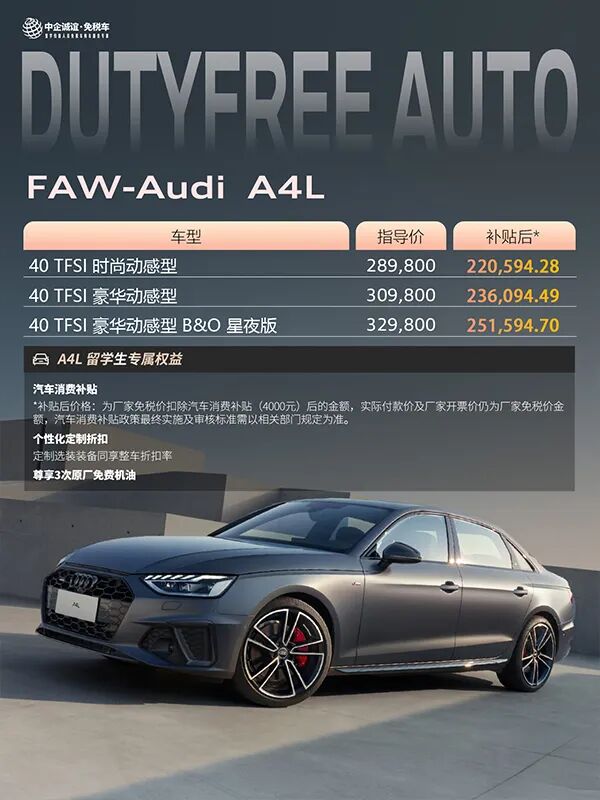
Of course, these sales were achieved through pricing strategies. Under pressure from new competitors, Audi offered significant terminal discounts, with discount amounts (discounts) generally ranging from 80,000 to 120,000 yuan.
The A4L, with an official guide price of 321,800 yuan, had a terminal price of 240,000 yuan, while the entry-level version of the core model A6L saw its bare car price drop to 320,000 yuan.
Ultimately, Audi China delivered a result that prioritized face over substance, with sales up 13.5% but financial returns plummeting 20.6% to 915 million euros.
After the toughest discount season, Audi lost its final market strategy in 2024. Facing competition from new energy vehicles, Mercedes-Benz, and BMW, it ultimately reported a 10.9% decline in sales. Notably, Jens Puttfarcken, who led the discount strategy, left his position in April 2024, and current President Luo Yinghan took charge of Audi China.
As a finance-oriented executive, Luo Yinghan's first priority upon arriving in China was to reverse declining profits. Having previously turned around Audi's operations in Brazil, Luo remained focused on financial and value-driven perspectives rather than purely sales-driven growth.
In several public interviews in China, Luo Yinghan stated, "We are deeply committed to the Chinese market and are not limited to pursuing short-term growth."
However, these strategies failed to produce tangible results. The pricing system continued to collapse, with the bare car price of the FAW-Audi A6L dropping to as low as 258,000 yuan, completely losing its luxury brand pricing power. Meanwhile, the dealer network faced closures due to profitability issues.
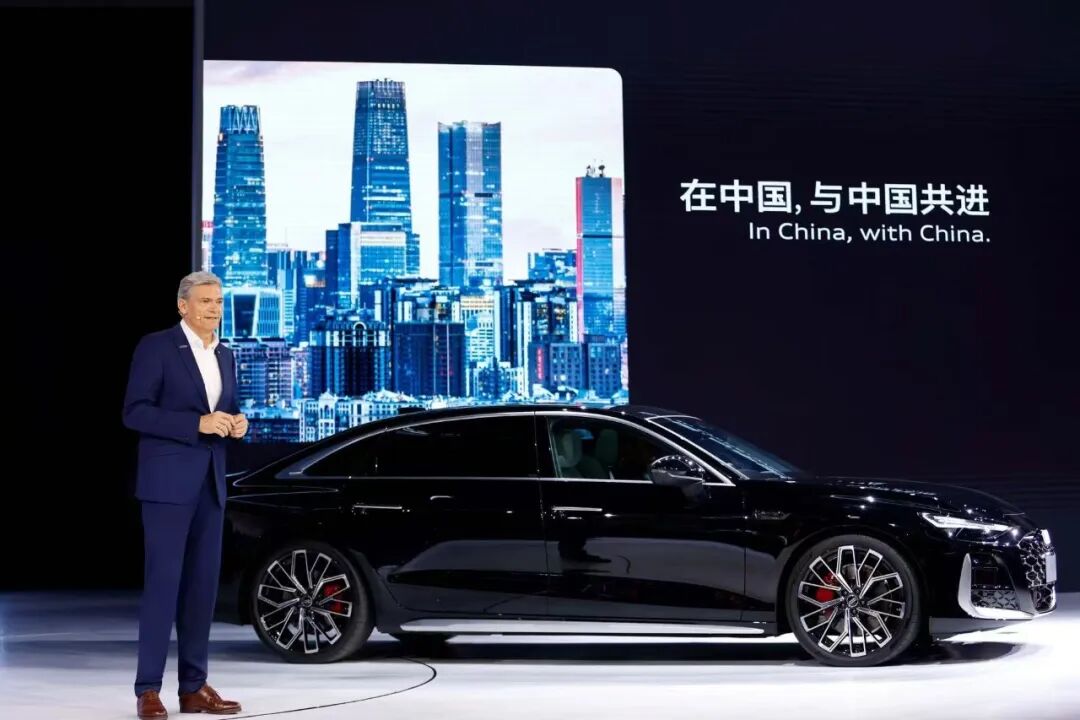
Especially since 2025, a wave of dealership closures has occurred. The Porsche Holding Salzburg, considered a core dealer, closed all four of its Audi stores, while Beijing's largest Audi dealership, Huayang Aotong, transitioned into a store for new energy brands.
Under such circumstances, Audi naturally struggled to maintain sales, dropping to 617,500 units in 2025, a 5% decline. However, revenue fell 14% to 10.114 billion euros, and financial contributions plummeted 22.6% to 504 million euros.
Luo Yinghan's mantra of "not pursuing short-term sales" remained largely a strategic declaration, failing to penetrate terminal execution. The financial contributions he sought to protect continued to decline, ultimately resulting in the failure to safeguard both sales and profitability.
At the strategic level, Luo Yinghan also failed to advance the separation of Audi's north and south operations in China. After more than a year of discussions, no resolution has been reached, and he himself admitted, "The development strategy for the Four Rings brand has not yet been finalized."
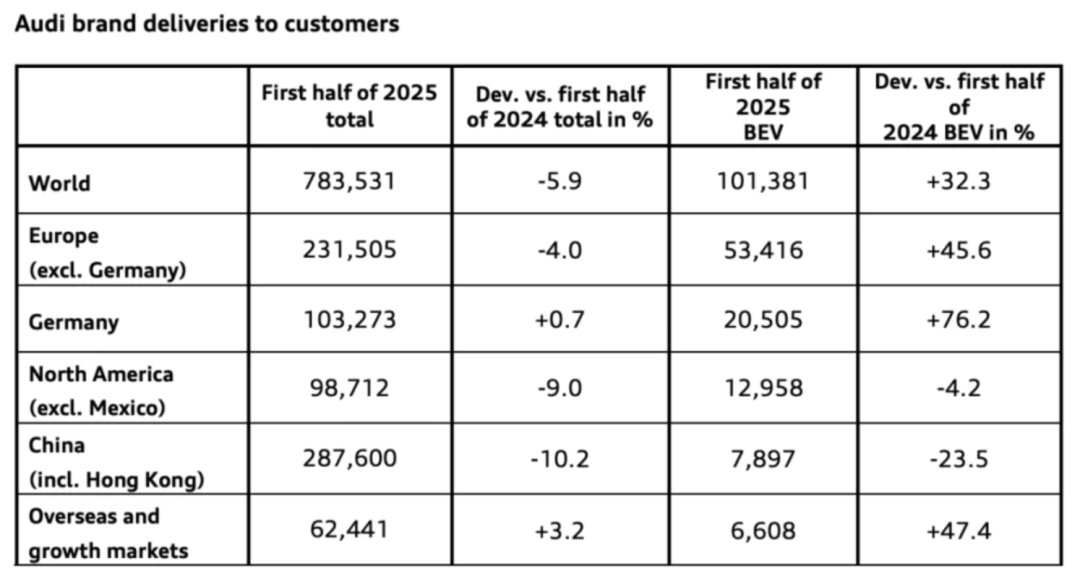
Germany's urgency to replace leadership stems more from the need for a firefighter in light of the Chinese market's performance in 2026. Manager Magazin reported that insiders predict Audi's sales in China in 2026 will barely exceed 420,000 units, a roughly 30% decline from 2025, with Audi even facing the risk of its first loss since entering the Chinese market.
Meanwhile, reports indicate that Audi's business profit in China for the first half of 2026 fell from 279 million euros to 73 million euros, a reduction of about 70%.
Combined with Audi's sales of 233,000 units in the first half of 2026, a 19.3% year-on-year decline, these rumors are not unfounded. Audi has indeed reached a point where it is losing both sales and profit in the Chinese market.
Personnel Turmoil
From an external perspective, Audi's predicament stems from its lagging electrification efforts in the Chinese market. Pure electric vehicle sales account for less than 8% of Audi's total in China, far below the 25% proportion of Mercedes-Benz and BMW. Electrification is a major trend in the Chinese market.
Specifically, FAW-Audi, as Audi's sales powerhouse in China, has a new energy penetration rate of less than 5%. While SAIC Audi has performed well in terms of sales growth and new energy models, with a cumulative increase of 45% in the first seven months, its absolute volume of 25,000 units remains insufficient to stem the bleeding for Audi China in the short term.
It's not that Audi China ignores electrification strategies; rather, factors in Germany have hindered the market. Audi invested 2.6 billion euros in Changchun to build a new factory for the PPE platform, but the sales performance of models like the Q6L e-tron and A6L e-tron has left the factory nearly idle.
FAW-Audi's electrification performance also led to early personnel turmoil. In September 2025, Guo Yongfeng replaced Li Fenggang as Executive Deputy General Manager of FAW-Audi Sales Company. In April 2026, Daniel Weissland, President of Audi in the U.S. market, replaced Andre Stoy as General Manager of FAW-Audi Sales, with FAW-Audi replacing both Chinese and German leaders in less than a year.
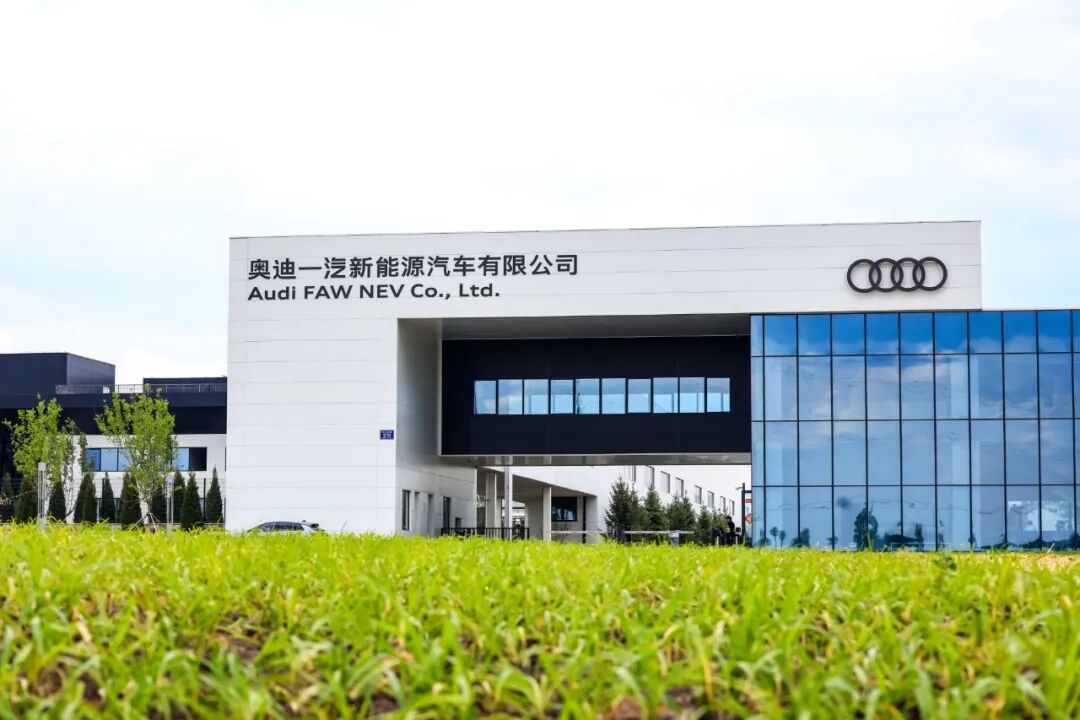
SAIC Audi also underwent personnel adjustments. Song Feiming, who led the SAIC Audi project, stepped down on July 1, 2026, and returned to Germany to serve as CTO of Lamborghini. He was replaced by Shu Ruize, while Hu Yin succeeded Ni Sheng as Head of the SAIC Audi Business Unit.
In other words, Audi underwent a major personnel reshuffle in China within a year, replacing the leaders of Audi China and its north-south joint ventures. Such widespread personnel changes almost confirm reports by German media of Audi's headquarters' dissatisfaction with the Chinese market's performance.
By choosing Zhang Jun, a Chinese national, as President, Audi hopes this breakthrough change will lead to rapid transformations in the Chinese market.
The decision to select Zhang Jun stems from his deep understanding of Audi China's joint venture partners. From 2018 to 2020, he served as a senior executive at Audi China, participated in establishing SAIC Audi's sales organization, and was deeply involved in strategic projects related to FAW-Audi, giving him connections with both north and south Audi entities.
During his time away from Audi, Zhang Jun served as General Manager of Alfa Romeo and DS Automobiles China for Stellantis Group, as well as Head of European Business for Chery International. His diverse background gives him an understanding of both foreign luxury brands' standard processes and Chinese autonomous brands' strategies, as well as familiarity with Chinese consumers' evolving demands for intelligent configurations and price sensitivity.
In addition to appointing Zhang Jun, Audi CEO Gernot Döllner has prepared a bold plan for the Chinese market. Without informing senior group executives, Audi will no longer import the A8 model from Germany to China but will instead produce it locally in China and collaborate deeply with Huawei.
Behind this move is the fact that China's luxury car market has undergone significant changes. Sales of models like the A8 and RS, once exported from Germany, have stagnated, leaving them parked in lots and warehouses, becoming a burden for dealers.
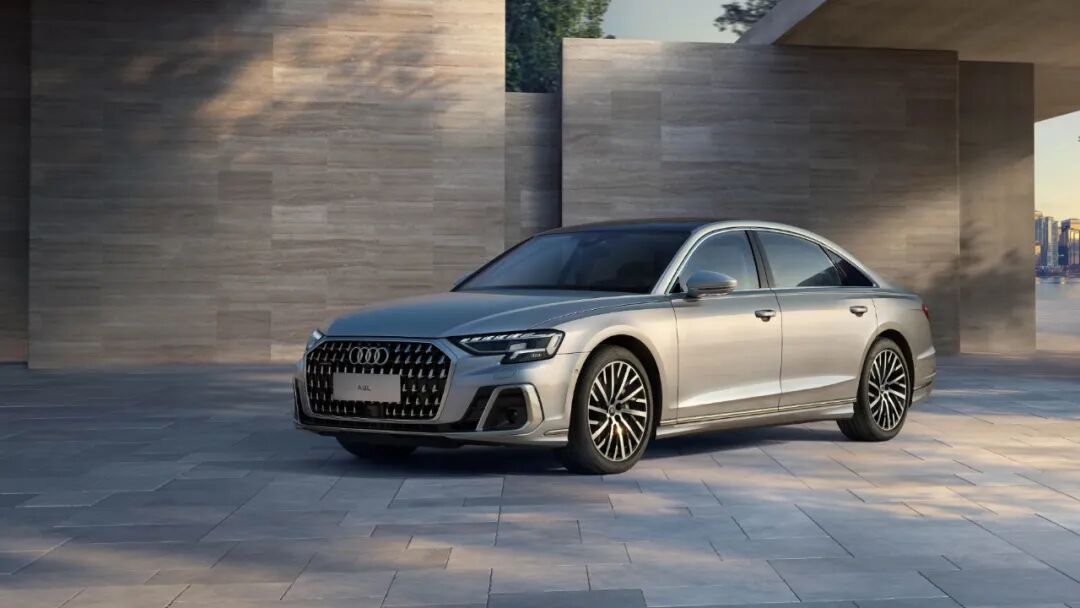
On the other hand, the performance of the AUDI brand in the Chinese market shows that Audi still has opportunities in China. Models developed specifically for the Chinese market are better suited to the local market, as the former global strategy no longer aligns with today's fragmented market landscape.
For Zhang Jun, taking over Audi China at this moment is filled with challenges. Beyond the visible decline in sales, there is the urgent need to clarify the separation of Audi's north and south operations in China. Rumors suggest that both sides had nearly reached an agreement before National Day, but sudden changes occurred in October, leading to Luo Yinghan's transfer.
For Audi, a personnel adjustment alone cannot truly impact sales. Ultimately, it depends on whether Audi's headquarters is willing to substantially delegate product definition rights, pricing rights, and resource allocation rights to China.
Note: Some images are sourced from the internet. If there is any infringement, please contact us for removal.
-END-
-
![]()
People Trapped in Algorithms
-
![]()
Musk’s Computing Power Venture Recoups Investment Within a Year, Meta’s Muse Faces Uncertain Rollout Timeline
-
![]()
AI: From ‘Accelerator’ to ‘Paradigm Reconstructor’ in Metaphotonics
-
![]()
"You've Been Replaced by AI": The Future Landscape for Short Drama Creators in 2026
-
![]()
【Intelligentization】Over 20 Million Intelligent Connected Vehicles Recalled in First Three Quarters, Regulators Criticize 'Aggressive Innovation'
-
![]()
Tesla's Gross Profit Increased by 440 Million, Yet Operating Profit Fell by 900 Million: Where Did Tesla's Money Go?
-
![]()
While Competitors Struggle, GM Stands Firm with $4.1 Billion Profit
-
![]()
Three Presidents in Five Years: What Audi China Truly Needs is Decentralization