Who will be Volkswagen's intelligent driving supplier in Europe?
 10/29 2026
 557
A picture from our previous article, "Model Cuts, Factory Sales, 50,000 Layoffs: Volkswagen's 2030 Plan Fears China's Price War," has sparked much speculation. Volkswagen's technology roadmap is divided into Eastern and Western approaches. The Eastern route is detailed in "Volkswagen's Self-Developed Vehicle System in China | 4 Images to Understand VEGA." However, in the Western ADAS (Advanced Driver-Assistance Systems) supplier landscape, there is an anonymous AI partner
So, who is this AI partner?
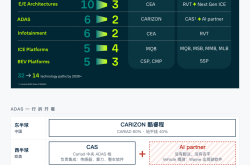
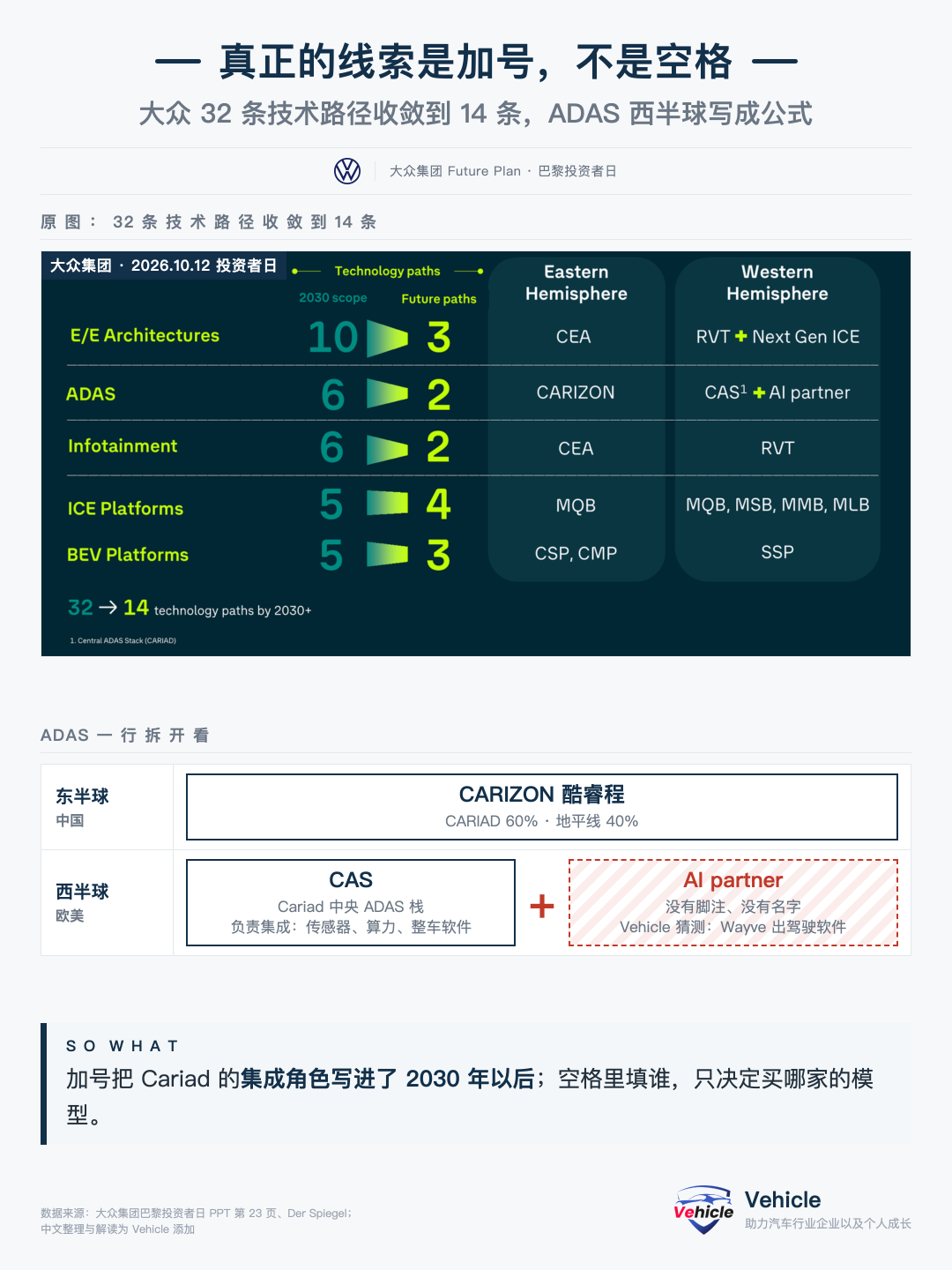
The image is from Volkswagen's Future Plan, showcasing the "convergence of technology paths," where 32 paths are narrowed down to 14.
The ADAS line is particularly interesting: CARIZON for the Eastern Hemisphere and CAS + AI partner for the Western Hemisphere.
CAS has a footnote indicating it is Cariad's Central ADAS Stack. The AI partner has no footnote or name.
Discussions in Europe and the Americas generally fall into two camps: one citing Nvidia and the other Mobileye. Of course, there are also those in China who mention Xpeng.
In fact, after in-depth analysis by vehicle and comparing it with Volkswagen's recent statements in Hefei, the conclusion differs from both camps.
This article will not delve into autonomous driving product technology and roadmaps but will instead gossip about who Volkswagen's chosen intelligent driving company in Europe will ultimately be and how this might rewrite the business of intelligent driving suppliers, perhaps offering stories and inspiration for Chinese automakers and supply chains going global.
Let's dive right in.
01 First, let's see what cards Volkswagen holds
1.5 billion euros spent, and the alliance dissolves
To understand that empty space, we must first know how it became vacant.
In 2022, Bosch and the newly independent Cariad formed the "Autonomous Driving Alliance" (ADA). The goal was to create a modular system, ranging from L2 urban hands-off driving to L3 highway autonomous driving, with the first product planned for mass production in 2023.
At its peak, over 1,000 experts were invested from both sides.
However, mass production did not occur in 2023 or 2024.
On June 29th of this year, German media Bild reported that Volkswagen planned to terminate the alliance. The reported figures indicate that Volkswagen invested around 1.5 billion euros, with internal assessments concluding that the technology did not meet expectations.
More embarrassing was the latter part of the statement. Volkswagen admitted to lagging behind competitors in L2++ urban hands-off driving.
On July 2nd, Cariad confirmed the end of the alliance.
The official wording remained diplomatic: the alliance had developed an AI-based L2 system that both parties could continue to use, with Volkswagen planning to equip the ID.EVERY1 with this system in 2027.
However, Handelsblatt's account was more direct: Volkswagen believed the alliance could not transition to L3 quickly enough.
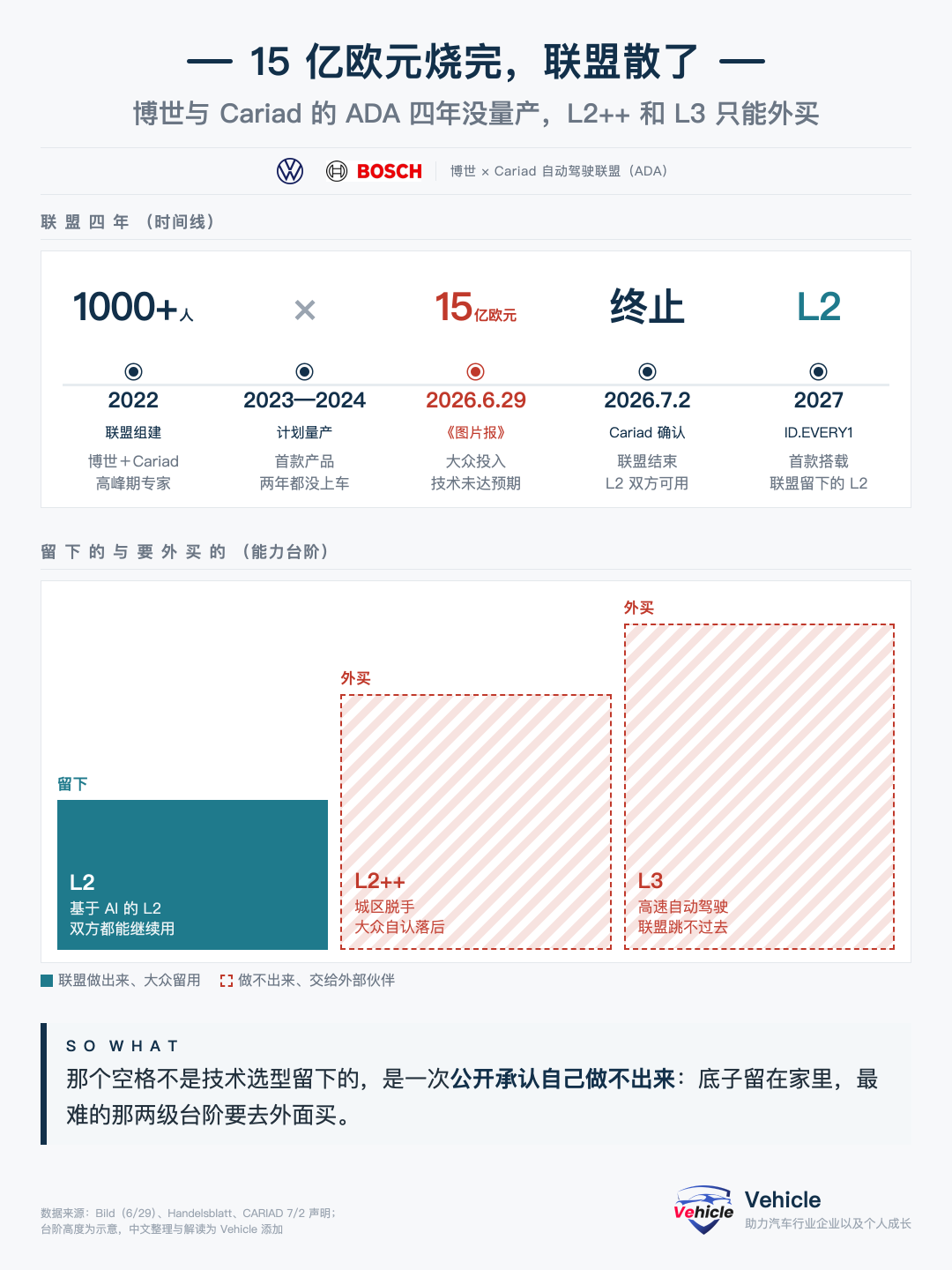
So, that's how the empty space came about: the foundation for L2 remains, but for L2++ and L3, Volkswagen must seek external solutions.
This is not just a technical selection but a public admission of inability to develop in-house.
02 The answer to the empty space has already been written
The real clue lies in the plus sign, not the empty space
Many focus on guessing the four words "AI partner," but the most informative part of the image is actually the plus sign to its left.
CAS + AI partner.
What does this structure imply? Cariad's integration role is written into the roadmap beyond 2030.
Who is this AI partner? In our previous article, "China's Intelligent Driving Going Global: Momenta and Wayve in Europe and the Americas," we shared information about Wayve. According to sources, it could be Wayve. Their division of labor (division of labor) is roughly as follows: Wayve provides the AI driving software, while Cariad is responsible for integrating it into existing sensors, computing hardware, and vehicle software architecture.
01 Conversely, what does this plus sign exclude?
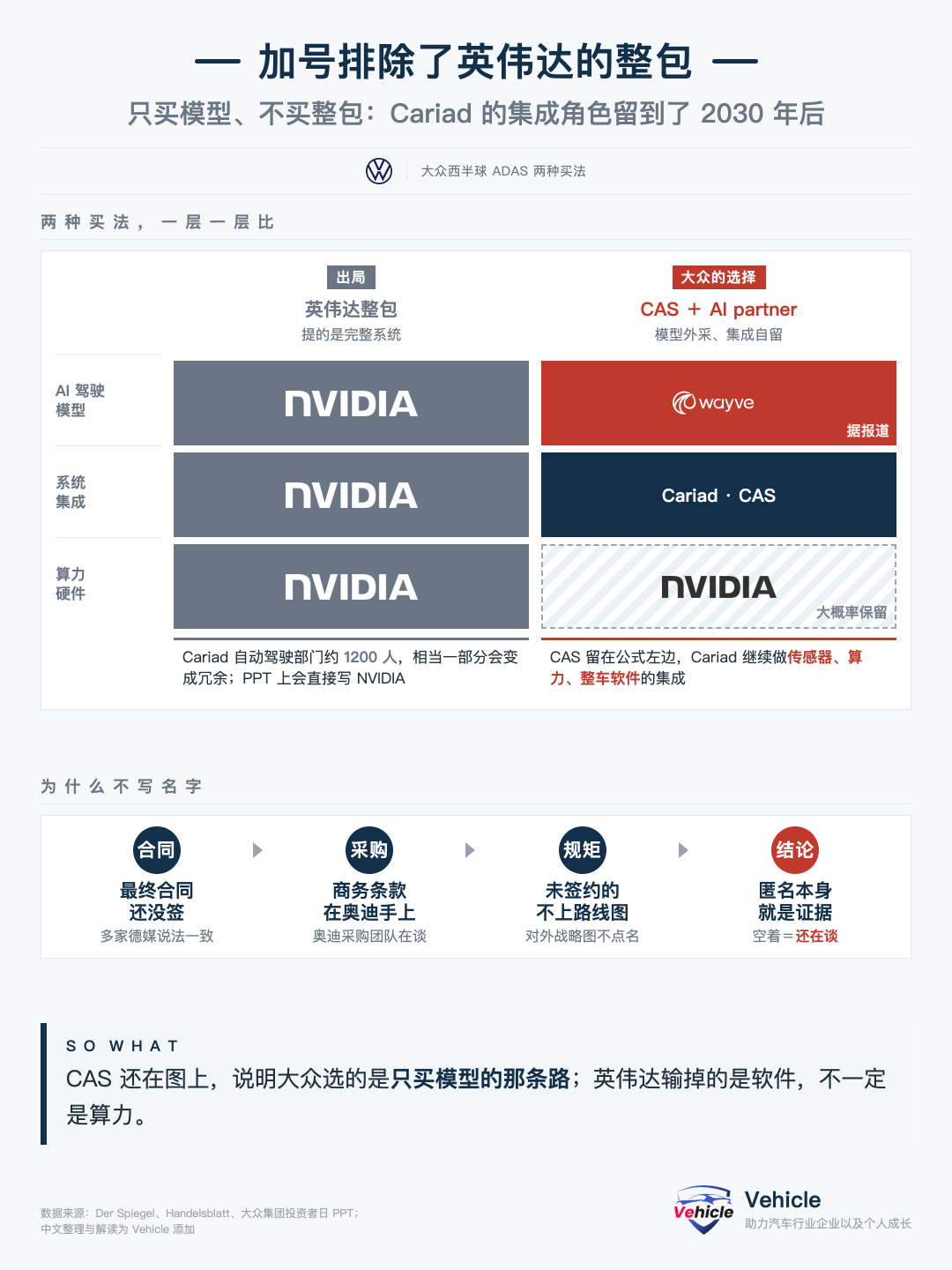
Nvidia proposed a complete system.
According to reports, if Nvidia's solution were chosen, a significant portion of Cariad's autonomous driving department, around 1,200 people, would become redundant.
So, the question arises: if Nvidia won, how would that space be filled?
It would simply say AI partner or even NVIDIA. It would definitely not retain CAS as the left term.
The fact that CAS remains on the image indicates that Volkswagen is opting for the "buy the model, not the whole package" approach.
02 Why isn't the name written?
Because the contract hasn't been signed yet.
Multiple German media sources agree: the final contract has not been signed, and commercial terms are still being negotiated by Audi's procurement team.
An unsigned supplier would not appear on an external strategic roadmap.
Anonymity itself is not a point of suspicion; it is evidence in itself.
03 Why Wayve?
A London-based company founded in 2017
So, what is the background of this company?
Founded in London in 2017, Wayve develops end-to-end "AI Drivers," which the company calls Embodied AI, emphasizing that the system learns driving behavior from real and simulated data rather than executing rigid rules. We have written several articles on their technical path, which can be searched for under Wayve.
This February, it completed a $1.2 billion Series D round, with a post-money valuation of $8.6 billion.
Lead investors include Eclipse, Balderton, and SoftBank Vision Fund 2, with Microsoft, Nvidia, Uber, and three automakers—Mercedes-Benz, Nissan, and Stellantis—participating as followers.
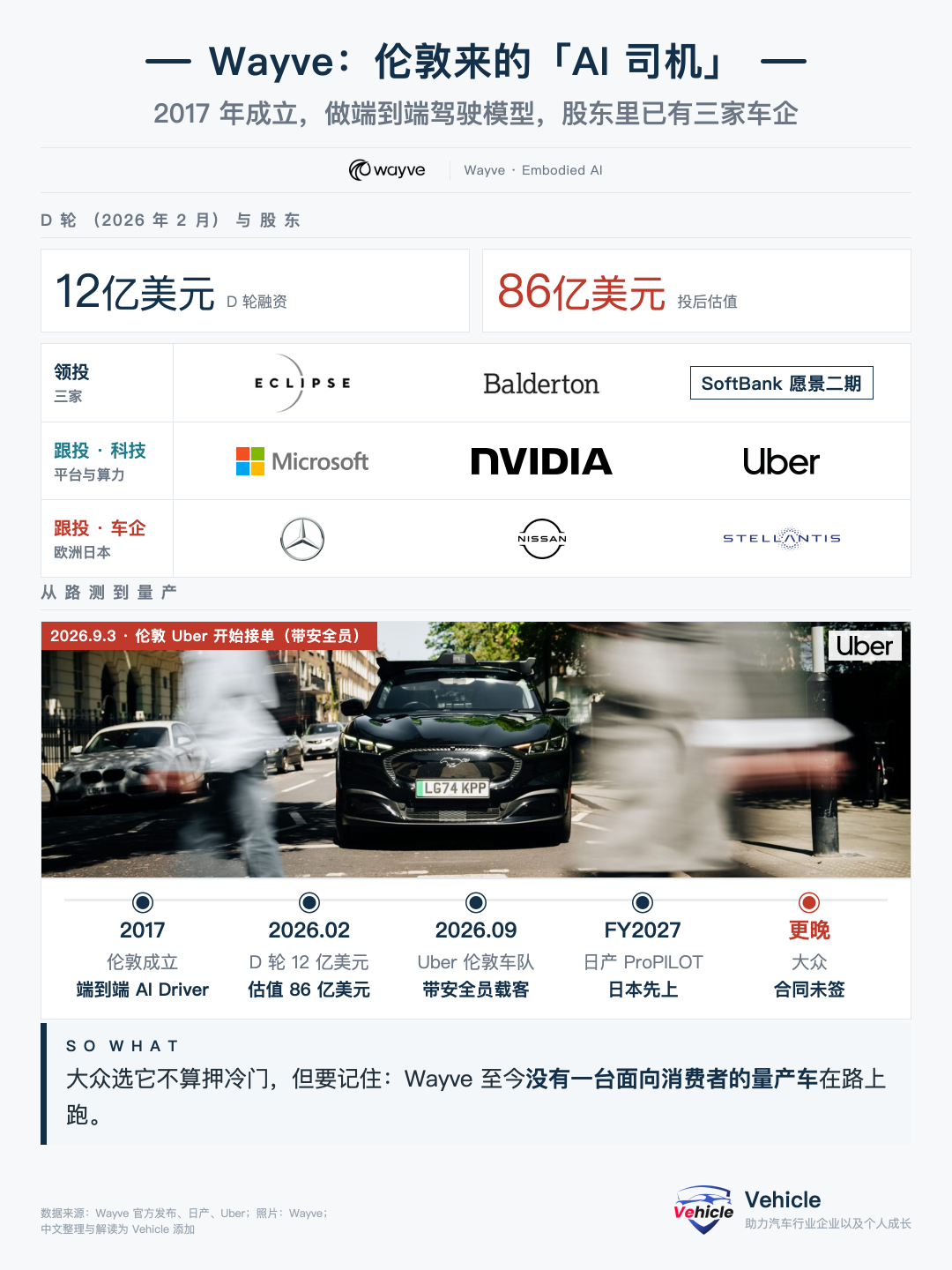
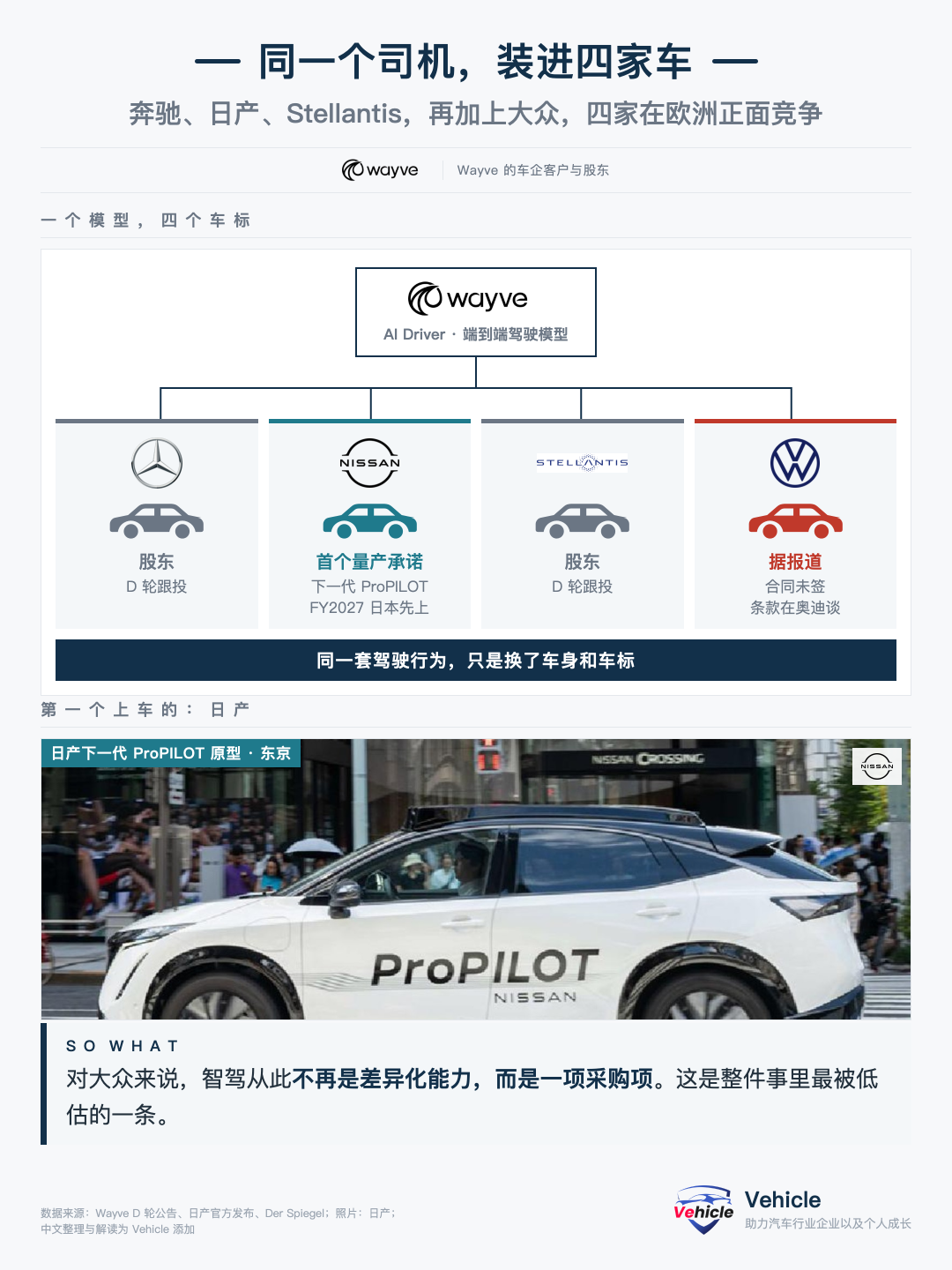
In terms of commercialization progress, Nissan is the first automaker to make a large-scale mass production commitment, planning to integrate Wayve into the next-generation ProPILOT, launching in Japan starting in the 2027 fiscal year.
On September 3rd of this year, Uber began using a fleet equipped with Wayve's AI Driver in London, with safety operators on board.
So, Volkswagen's choice of Wayve is not a bet on an unproven entity.
Note: However, it must be clarified: Wayve has not yet had a single consumer-facing mass-produced vehicle on the road. Nissan's timeline is set for the 2027 fiscal year, and Volkswagen's is even later.
03 A detail easily overlooked
Wayve serves Mercedes-Benz, Nissan, Stellantis, and now Volkswagen.
These four companies are direct competitors in Europe.
In essence, Wayve is selling the same "driver" but installing it in four different vehicles.
For Volkswagen, this means intelligent driving is no longer a differentiating capability but a procurement item, aligning with the conclusion of our previous article, "From the 2026 WICV Speech: Where WenYuan, YuanRong, and New Journey of Intelligent Driving Are Betting on the Next Round of Intelligent Driving," suggesting that intelligent driving may become a non-differentiated feature like AEB/ESP.
04 If negotiations collapse, who steps in?
The contract isn't signed, so the backup list remains valid
Since the contract isn't signed, there's still a chance for alternatives. What are the possible options?
I've ranked four in order of substitution.
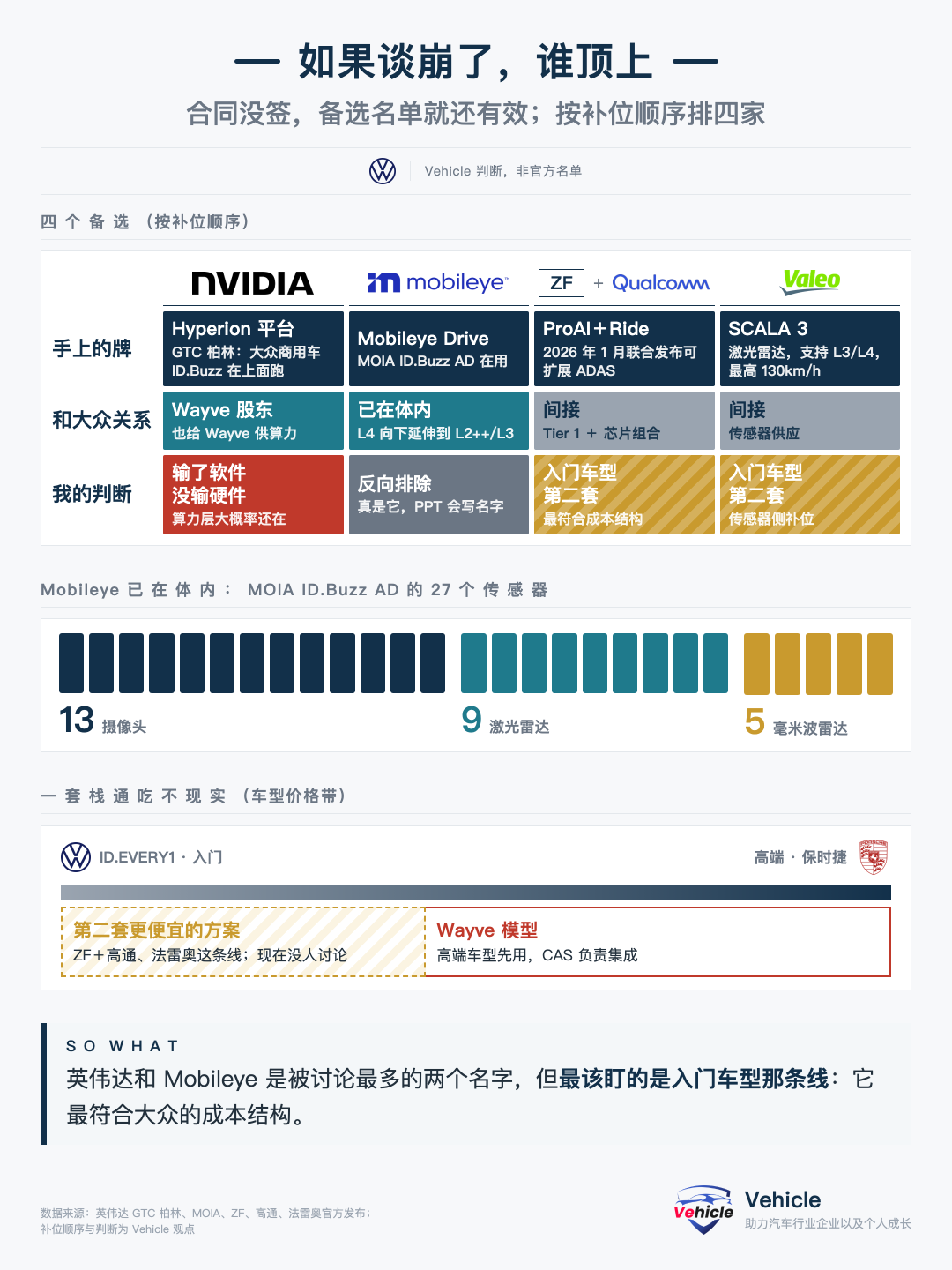
Nvidia: Lost the software battle, not the hardware one
At GTC Berlin on October 22nd, Volkswagen's commercial vehicle autonomous driving ID.Buzz was showcased on Nvidia's Hyperion platform, as detailed in our previous article, "A Comprehensive Look at Nvidia's GTC Berlin: AI as the Three Cards for Manufacturing and Physical AI."
Nvidia positions Hyperion as a platform that "can integrate different autonomous driving systems," implying it doesn't mind being the foundation.
Moreover, Nvidia is a shareholder in Wayve and supplies computing power to Wayve.
So, even if it doesn't secure the software order this time, it's likely to remain at the computing power layer.
Mobileye: Existing relationship, the easiest fallback
Mobileye is already within Volkswagen's ecosystem. MOIA's ID.Buzz AD uses Mobileye Drive, featuring 13 cameras, 9 lidars, and 5 millimeter-wave radars, totaling 27 sensors.
Extending L4 capabilities downward to passenger car L2++/L3 is technically feasible.
However, if it were Mobileye, Volkswagen would have no reason not to write its name on the PPT. This point inversely excludes Mobileye.
ZF + Qualcomm, Valeo: Also possible
In January of this year, ZF and Qualcomm jointly launched the scalable ADAS platform ProAI with Snapdragon Ride. Valeo's SCALA 3 lidar supports L3/L4 up to 130km/h.
Volkswagen's model price range spans from the ID.EVERY1 to Porsche, making a one-size-fits-all stack unrealistic.
My judgment is: high-end models will use Wayve, while entry-level models will likely have a second, cheaper solution. This path isn't being discussed now, but it best fits Volkswagen's cost structure.
05 The Chinese angle: Technically feasible, politically needs approval
Two news items arrived consecutively yesterday and today
We must now discuss China.
On October 26th, German media Manager Magazin reported that Volkswagen was considering reversing the CEA (Connected Electronic Architecture) electronic and electrical architecture, jointly developed with Xpeng, from China to Europe.
This would cover approximately 75% of the next-generation models for Volkswagen, Skoda, and Cupra brands, potentially saving 4-5 billion euros in R&D costs.
The proposal was pushed by Volkswagen brand CEO Schäfer and submitted to the group's management on Tuesday.
The significance of this news lies in Volkswagen's previously strict dual-track approach: China used CEA, while Europe and the Americas bet on Rivian, a $5.8 billion, 50-50 joint venture seen as the core pillar of Oliver Blume's software strategy.
01 But architecture doesn't equal intelligent driving
This is where ordinary people often make mistakes.
Looking back at Volkswagen's official statement during the July 2024 signing: CEA was jointly developed by Volkswagen China Technology (VCTC), CARIAD China, and Xpeng, with CARIAD China responsible for developing and integrating the latest generation ADAS and intelligent cockpit software functions for the new architecture.
So, CEA is not outsourced to Xpeng; it's a joint development, with IP belonging to the Volkswagen Group after completion.
In other words, CEA is the socket, and the intelligent driving stack is what plugs into it.
Changing the socket doesn't mean changing the plug.
Xpeng's intelligent driving solution is currently used only in the ZEEKR 08 and 09 models, and recent trends suggest sluggish sales for these two models. Volkswagen's main intelligent driving line in China is handled by CoPilot (CARIZON), a joint venture with CARIAD holding 60% and Horizon Robotics 40%.
02 Today's statement from Hefei
Then, today, October 28th, Volkswagen China held its first Technology Day in Hefei.
The official release of the VEGA technology package includes 850V fast charging and L3 readiness, set for launch in 2027. Volkswagen also just obtained an L3 road test license in Hefei, aiming for L3 readiness in 2027 and L4 in 2029.
The most interesting part is:
When asked if the Chinese architecture could be used in Europe, CARIAD China CEO Han Sanchu said it was technically feasible but the decision rested with the German headquarters, which would consider factors including geopolitics.
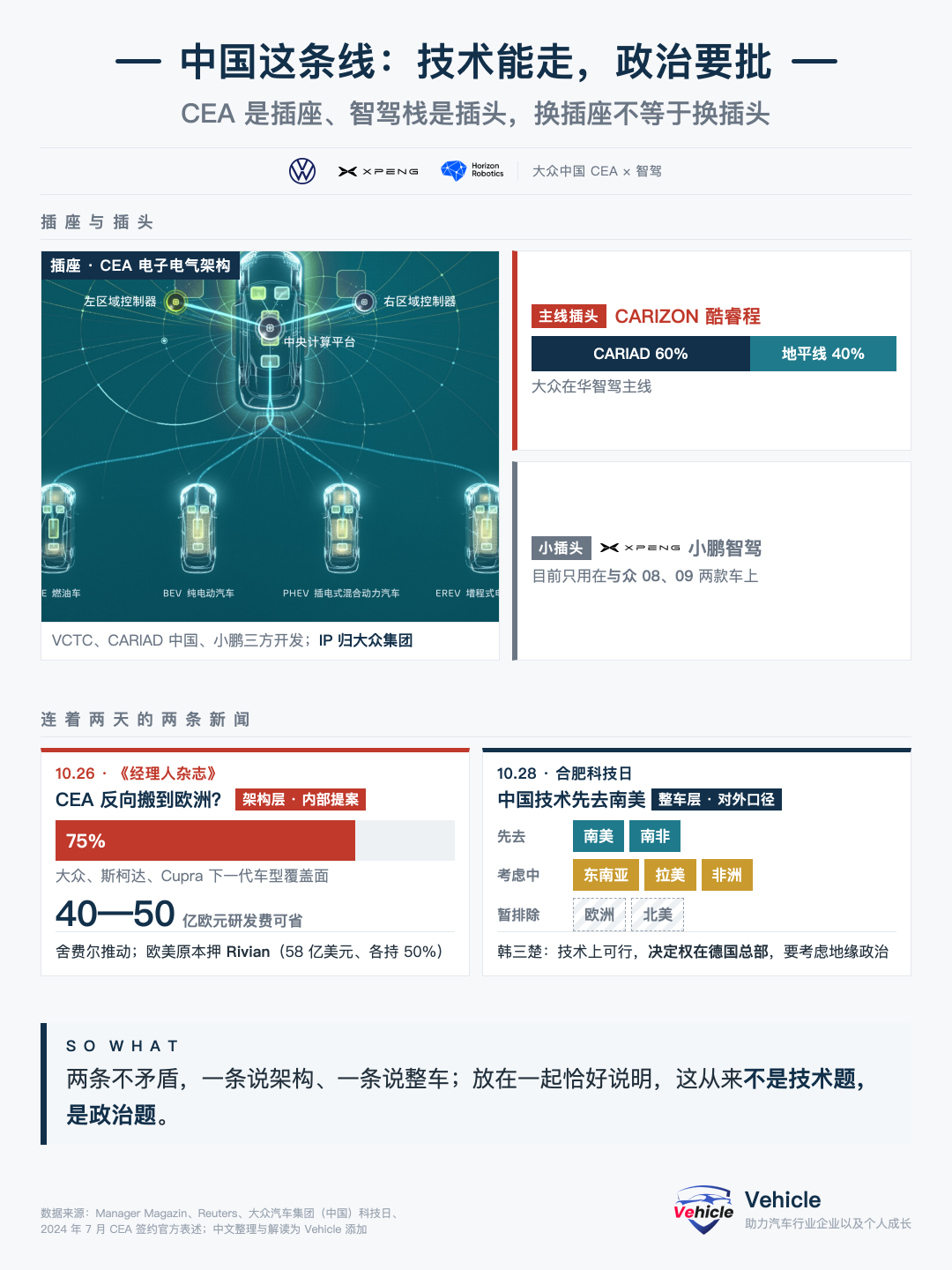
On the same day, Volkswagen officially announced that technologies developed in China would first go to South America and South Africa, with Southeast Asia, Latin America, and Africa under consideration, while Europe and North America were temporarily excluded.
On one hand, Manager Magazin says CEA is entering Europe; on the other hand, the official stance is that Chinese technologies will go to South America first.
These two statements are not contradictory; the former is an internal proposal at the architecture level, while the latter is an external statement at the vehicle level. Together, they illustrate where the bottleneck lies.
This has never been a technical question but a political one.
06 What does this mean for the supplier landscape?
This is what the image truly wants to convey
Now, back to the image.
Writing the AI partner as an unnamed generic slot rather than a specific company is, I believe, a deliberate design.
The ADAS line converges from 6 to 2, not into 1. The Eastern and Western Hemispheres follow their own paths, extending beyond 2030.
While architecture and cockpit are converging, the intelligent driving stack is not.
01 Three Structural Changes
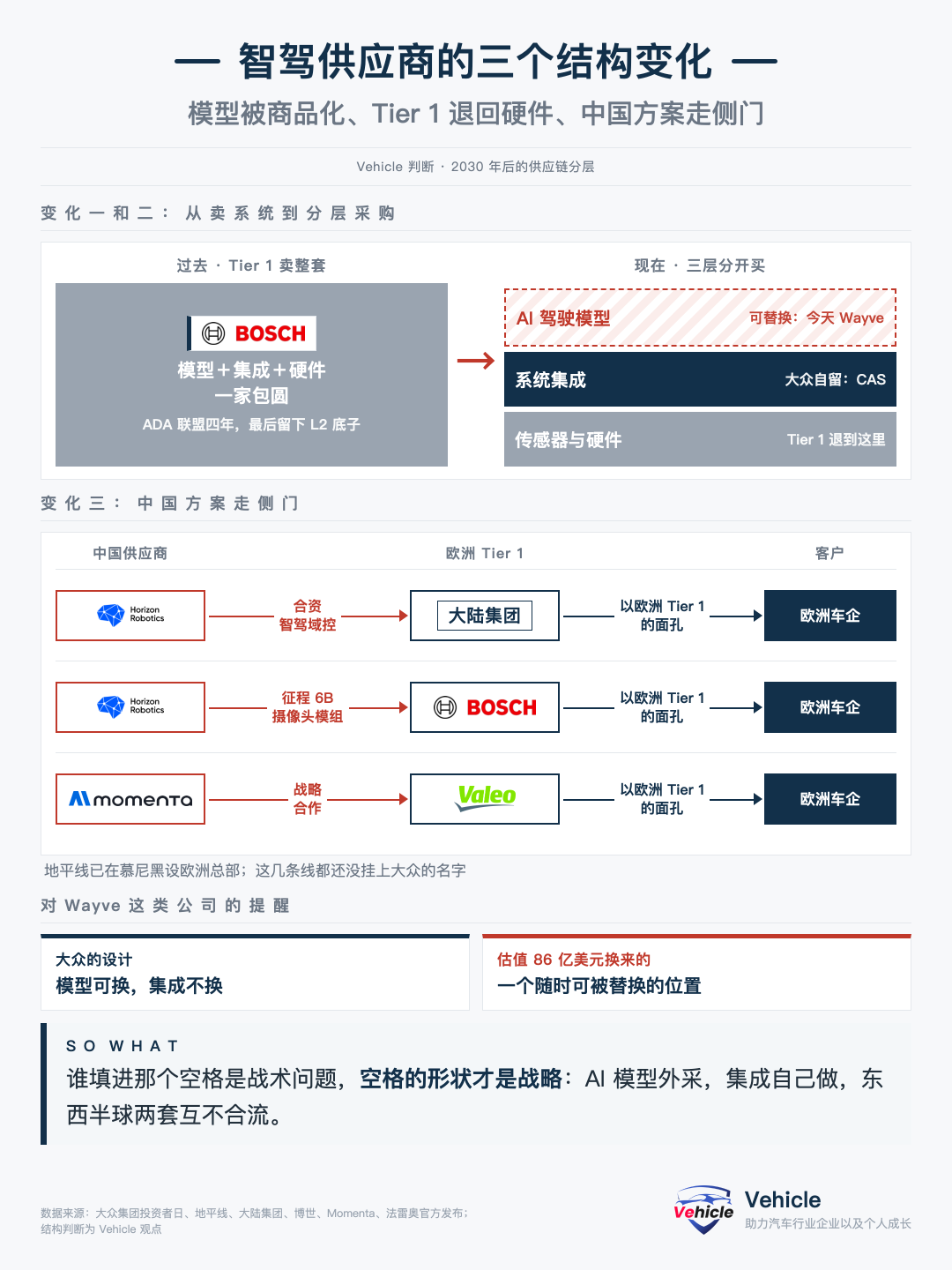
1. The layer of AI driving models is being commoditized. The public wants replaceable model suppliers and holds onto the integration layer themselves. Today it's Wayve, tomorrow it could be someone else.
2. Traditional Tier 1s have been pushed into the hardware position. Bosch burned for four years, and in the end, all that remains is a set of L2 foundations and the qualification to continue supplying hardware. After all these years of shouting about software-defined vehicles, the real result is that Tier 1s have retreated from selling systems to selling parts.
3. The door for Chinese suppliers is opening on the side, not the front. Horizon Robotics has set up its European headquarters in Munich, formed a joint venture with Continental AG to develop intelligent driving domain controllers for European automakers, and is also collaborating with Bosch to develop camera modules based on the Journey 6B. Momenta has signed a strategic cooperation agreement with Valeo.
The third point might be worth studying.
The Chinese approach to entering Europe is not following the path of 'Chinese suppliers securing nominations from European OEMs,' but rather appearing as European Tier 1s.
This path has the lowest political cost, the fastest implementation, and it's already happening, just not yet under the Volkswagen name.
02 A Reminder for Companies Like Wayve
Looking at it from the other side, securing a slot with Volkswagen may not necessarily be a purely good thing.
Volkswagen's design is: the model can be replaced, but the integration remains unchanged.
This means that for any AI supplier, you will always be just a replaceable part.
A company valued at 8.6 billion USD has secured a position that can be structurally replaced at any time. This is a common issue now facing the entire intelligent driving software track.
07 In Conclusion
The blank space hasn't been filled yet, but the rules have already been written.
As I write this piece, my biggest feeling is: whether the contract is signed with Wayve or not isn't actually that important.
What's important is that Volkswagen has already set the rules of the game with a single PPT. AI models are outsourced, system integration is done in-house, and there are two separate systems for the eastern and western hemispheres that don't merge.
Who fills in that blank space is a tactical issue. The shape of the blank space is the strategy.
Of course, my inferences in this piece also have their limits. As long as the contract isn't signed, everything is still up in the air; the proposal for CEA to enter Europe hasn't been officially approved yet. If either of these two things flips, the above judgments will have to be rewritten.
What do you think? Don't you feel that the automotive supply chain is also a vast rivers and lakes (which can be translated as 'realm' or 'arena' in this context)?
That's all for today's sharing. If you found it useful, please help by liking, sharing, and clicking 'seen,' and feel free to chat about your thoughts in the comments section.
*Reproduction and excerpts are strictly prohibited without permission-
-
A RMB 375 Million Share Repurchase Fails to Halt Ultrapower's Stock Price Slide Amid Dual Performance and Valuation Pressures
-
![]()
From a Migrant Worker Earning 7 Yuan a Day to China's Richest Woman Worth 127 Billion at 56: The Market's Skepticism
-
![]()
Surpasses Jack Ma! 41-Year-Old Liang Wenfeng, With RMB 280 Billion Net Worth, Still Resides in a Rented Apartment
-
Relying on Liquid Cooling Component Sales to Propel IPO, Xinfu Technology Faces Registration Challenges: What Caused Its 2026 Performance Slump?
-
![]()
Who will be Volkswagen's intelligent driving supplier in Europe?
-
![]()
Google Unveils World Model Genie 4: Has the 'Data Thirst' of Humanoid Robots Been Quenched?
-
Chinese Brands Capture Only 5% Market Share: Will Vietnam Prove a More Challenging Market for Tesla Compared to Thailand?
-
Xpeng L05 Set for Launch Tonight: Will the Official Price Undercut the 169,800 Yuan Pre-sale Starting Point?