From a Migrant Worker Earning 7 Yuan a Day to China's Richest Woman Worth 127 Billion at 56: The Market's Skepticism
 10/29 2026
 473
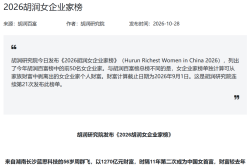
On October 28, 2026, the Hurun Research Institute unveiled the <2026 Hurun Richest Women in China List>. Zhou Qunfei, the 56-year-old founder of Lens Technology, reclaimed the title of China's richest woman for the second time in 11 years, boasting a fortune of 127 billion yuan.
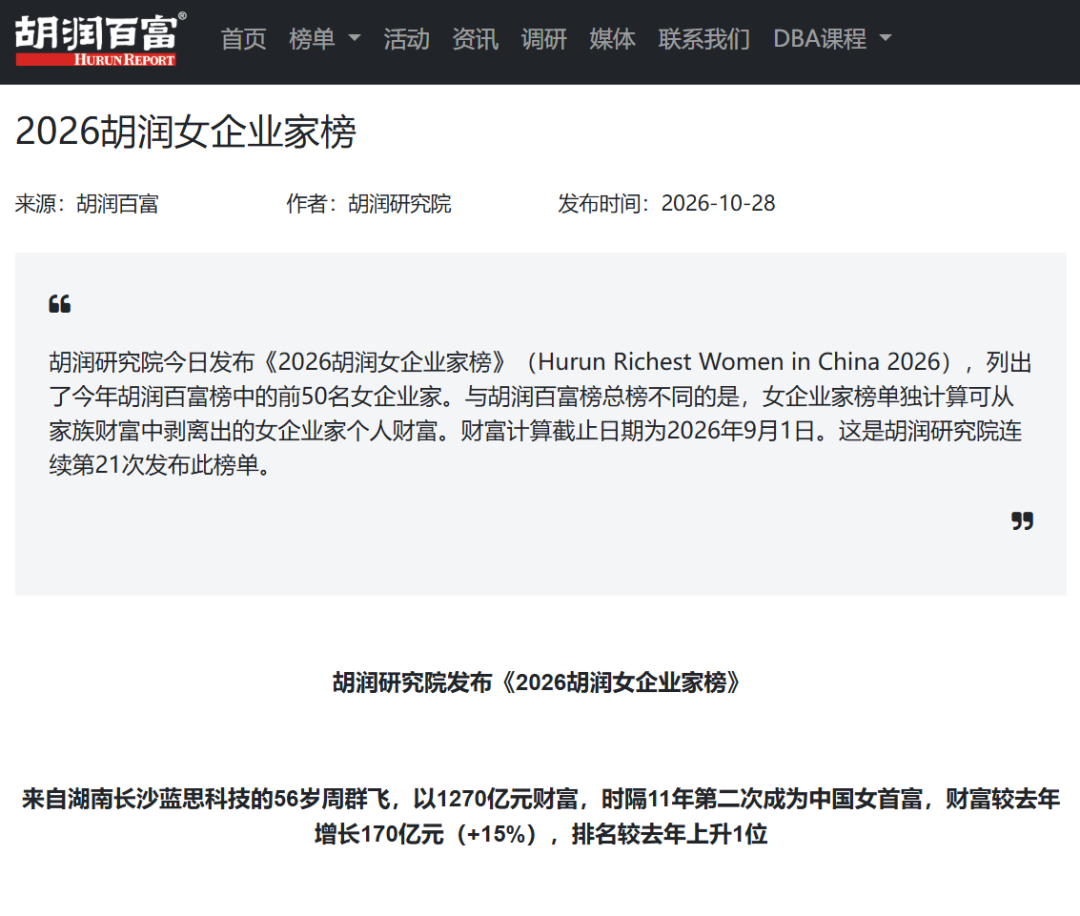
Zhou Qunfei's wealth surged by 17 billion yuan from the previous year. Together with her husband Zheng Junlong, their combined fortune reached 128 billion yuan, placing them 33rd on the overall Hurun Rich List.
The 'Glass Queen,' who dropped out of school at 15, earned a mere 7 yuan a day, and started her journey with 20,000 Hong Kong dollars, has once again secured her throne.

Just as the list dominated headlines, the capital market presented a stark contrast. Although Lens Technology's stock price surged 5% on that day, it had plummeted from its year's high, effectively "halving" in value, and even registered a 6% year-to-date decline. What could be the reason?
01
A Classic Rags-to-Riches Tale
Zhou Qunfei's story epitomizes the classic rags-to-riches narrative.
Born in 1970 in a small Hunan village, she lost her mother at the tender age of 5, and her father went blind due to an accident. At 15, she dropped out of junior high and ventured south to Shenzhen, where she worked as an assembly line worker in a watch glass factory, earning a meager 7 yuan a day.
But she refused to give up. During the day, she toiled away at the factory, grinding glass. At night, she attended night school to acquire certifications in accounting, customs declaration, and even obtained a truck driver's license.

In 1993, at the age of 23, she invested 20,000 Hong Kong dollars of her savings to start a small workshop with her family in a rented three-bedroom "farmhouse." They earned a mere 1.5 yuan per glass in processing fees. During the 1997 Asian Financial Crisis, she resorted to using old equipment to pay off debts and even sold two properties to ensure employee salaries were paid.
She later took bold cross-industry risks, gradually expanding her business empire.
In the early 21st century, she replaced acrylic with glass to manufacture domestic mobile phone glass screens, solving the drop test issues for the Motorola V3.
In 2003, she officially founded Lens Technology.

The real turning point came in 2007 when Lens Technology produced the glass screen for the first iPhone—a feat that no one else globally could accomplish at the time—entering Apple's supply chain.
In 2015, Lens Technology went public on the ChiNext board. At 45, Zhou Qunfei topped China's richest women list with a net worth of 50 billion yuan and was named the world's richest self-made woman that year, earning her the moniker "Glass Queen."
02
Stock Price Hindered by Multiple Realities
However, as Zhou Qunfei reclaims the title of China's richest woman with a net worth of 127 billion yuan, Lens Technology's stock performance is rather lackluster.
The stock price has been under pressure throughout the year, falling nearly 52% from its late-June historic high, officially "halving" in value.
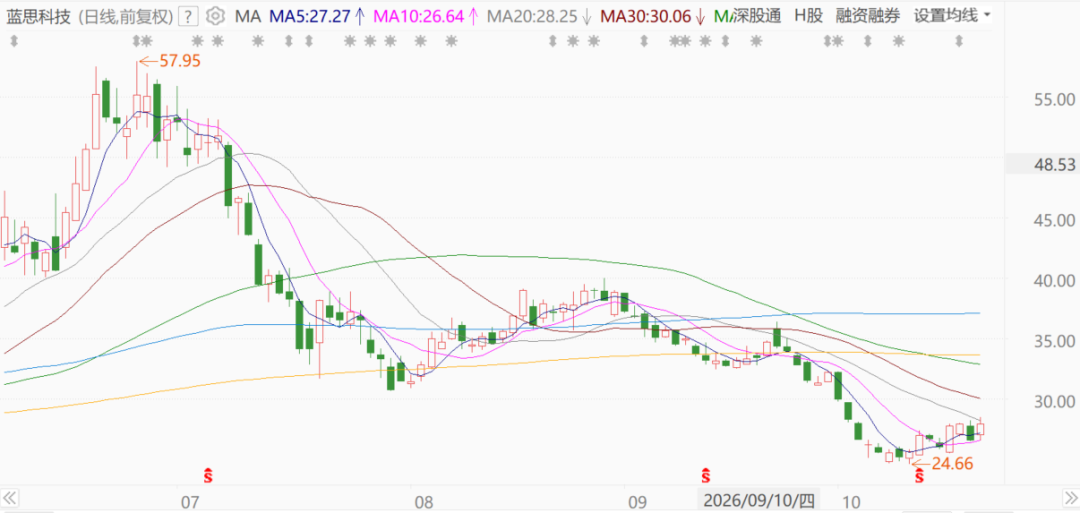
Lens Technology reported a quarterly loss in the first quarter, triggering a downturn in the stock's performance. The latest third-quarter results reveal a 50% year-on-year decline in net profit attributable to the parent company.
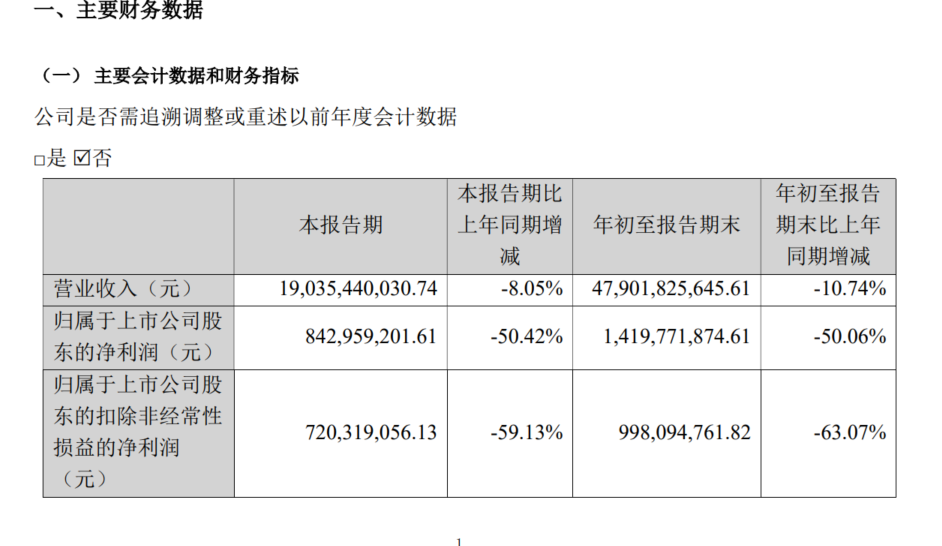
The decline in performance stems from multiple overlapping constraints.
Firstly, there's the cyclical shackle of reliance on major clients.
Apple remains Lens' largest client, accounting for about 45% of total revenue in 2025—a significant drop from a peak of 70% but still binding nearly half of the income to a single brand. Apple's new product scheduling, order allocation, and pricing strategies directly disrupt Lens' revenue and profits.
Coupled with delayed Apple new product stocking this year, weak mobile phone demand, and rising memory chip prices suppressing consumer electronics upgrade willingness, as well as sluggish growth in the traditional mobile phone protective glass business, the expectation of a "weak peak season" continues to pressure Lens' valuation.
Secondly, there's the persistent profit erosion from exchange rate impacts.
Over half of Lens' revenue comes from overseas, with orders settled in U.S. dollars. This year's phased appreciation of the RMB has resulted in significant foreign exchange losses. Exchange losses reached 654 million yuan in the first three quarters, compared to gains last year—a swing creating a nearly 770 million yuan profit gap, offsetting core business profits and becoming a key driver of this year's profit decline.
However, the capital market focuses on expectations, and Lens falls short in this regard as well.
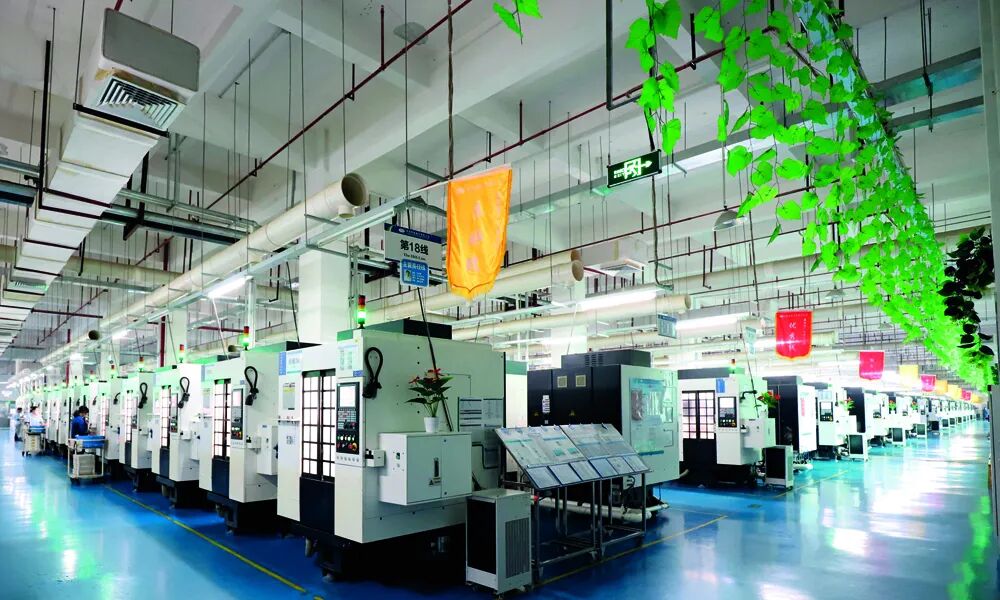
Currently, Lens' second growth curve is still in the investment phase, failing to meet capital market expectations. Zhou Qunfei has long been pushing the company to transition into automotive glass, AI glasses, optical interconnects, and aerospace materials. The market is willing to pay a premium for AI hardware stories, but new businesses are still in capacity building, client validation, and small-scale production stages—unable to fill the gap left by the declining mobile phone business in the short term.
Under the heavy-asset manufacturing model, Lens' continuous investment in factories, equipment, and R&D has raised fixed costs. If terminal demand falls short, capacity utilization declines, and gross margins shrink rapidly. Investors worry that AI glasses and automotive businesses will require a long wait, with cyclical pain lasting much longer.
Meanwhile, the profit ceiling in the contract manufacturing sector remains.
As an intermediate supplier, Lens lacks the brand premium power to face consumers directly, being squeezed by upstream materials and downstream brands. Once the consumer electronics chain enters a downturn, component makers bear the brunt of pricing pressure first.
Institutional funds remain cautious in valuing Apple supply chain stocks, preferring lower safety margins. Performance volatility easily triggers capital flight.
03
Conclusion
Zhou Qunfei has proven over three decades that true wealth that transcends classes is earned through technological barriers and industrial insight.
But for the capital market, while legendary struggle stories deserve respect, investors demand tangible profit realization to justify their investments.
The "Glass Queen's" latest challenge is to turn automotive and AI hardware new businesses from concepts into solid cash flows as soon as possible, bridging the gap between list wealth and secondary market pricing.
·END·
-
![]()
A Small Step for RTX Spark, A Giant Leap for NVIDIA PCs! Lenovo YOGA Pro 15 RTX Spark Review
-
A RMB 375 Million Share Repurchase Fails to Halt Ultrapower's Stock Price Slide Amid Dual Performance and Valuation Pressures
-
![]()
From a Migrant Worker Earning 7 Yuan a Day to China's Richest Woman Worth 127 Billion at 56: The Market's Skepticism
-
![]()
Surpasses Jack Ma! 41-Year-Old Liang Wenfeng, With RMB 280 Billion Net Worth, Still Resides in a Rented Apartment
-
Relying on Liquid Cooling Component Sales to Propel IPO, Xinfu Technology Faces Registration Challenges: What Caused Its 2026 Performance Slump?
-
![]()
Who will be Volkswagen's intelligent driving supplier in Europe?
-
![]()
Google Unveils World Model Genie 4: Has the 'Data Thirst' of Humanoid Robots Been Quenched?
-
Chinese Brands Capture Only 5% Market Share: Will Vietnam Prove a More Challenging Market for Tesla Compared to Thailand?