Tesla Changes Its Car-Buying Policies Nine Times a Year—Only "Honest People" Buy Teslas
 11/02 2026
 443
Introduction
Is there still any car you can buy with your eyes closed?
Buying a Tesla may be one of the most courage-demanding things you can do these days. You place an order today, and tomorrow a discount lands; you finally wait for a discount, and then the next round of policy changes arrives.
When other people buy a car, what they care about most is configuration, range, and driving experience. Tesla owners, by contrast, may also have to ask themselves one question: if I buy now, am I buying too early again?
Actually, this sort of thing is nothing new in today's Chinese new energy vehicle market. And Tesla is not the only one "good at harvesting leeks"—with the price war having dragged on until now, almost every automaker has stabbed its old owners in the back.
Some "sharpen three swords in one year," and some cut prices right after launch, so much so that a saying has caught on—buy early, enjoy early; buy late, enjoy the benefits.
If you look only at the official guide price, Tesla may not be as aggressive as you would imagine. But if you add up cash discounts, financial policies, insurance subsidies, paint benefits, and charging perks, Tesla's moves on the "final landed price" of a car purchase are not few at all.
And so, as soon as November arrived, Tesla adjusted its car-purchase preferential policy again—and this was already the ninth time this year.
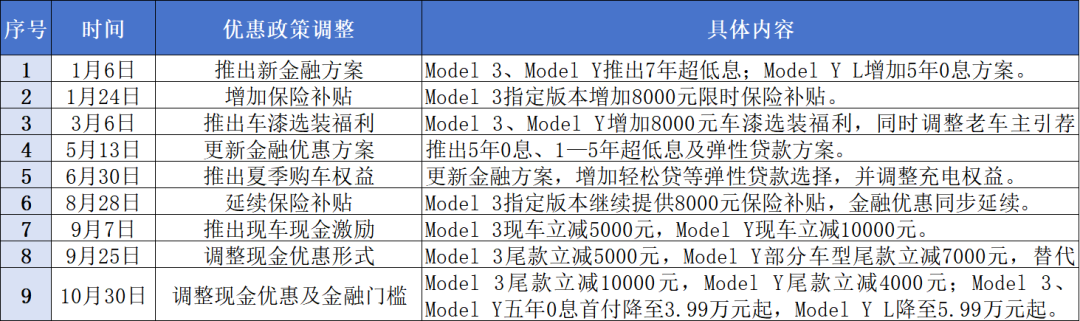
On October 30, Tesla China once again adjusted its car-purchase preferential policy, mainly involving three aspects: immediate cash discounts on car purchases, the down payment threshold for five-year 0-interest loans, and a newly added flexible balloon payment plan.
First, the immediate cash discount on car purchases: for Model 3-related models, the final payment is reduced by 10,000 yuan; for Model Y-related models, the final payment is reduced by 4,000 yuan.
Second, the down payment threshold for the five-year 0-interest plan has been lowered to starting from 39,900 yuan, applicable to Model 3 and Model Y-related models. The Model Y L, however, may sell relatively well, so the concession is not large, with down payments starting from 59,900 yuan.
Finally, there is the so-called flexible balloon payment, which means that under this plan, during the five-year loan period, the monthly payment is lower than before, but after the loan term ends, consumers still need to pay the final car payment of "39,900 yuan" in one lump sum.
In short, Tesla has not reduced the car price, but has provided options with low down payment, low monthly payment, low final payment, and 0 interest, making it easier for consumers to own a Tesla.
Obviously, this approach by Tesla is very effective, and it has attracted more "honest people."
01 More and more honest people are buying Teslas
Once upon a time, Tesla owners were the most restless group on the road. At green lights, they were always the first to rush out; on highways, they often sped like the wind; on city roads, they also weaved through traffic, and so they were nicknamed by road-raging crowds the "evil big mouse."
But now, if you follow any Model Y on an elevated road, it will most likely drive properly, not cutting lanes, not squeezing in, not braking sharply, and traveling quietly. Quite a few people even only use basic assisted driving to follow cars, moving along slowly.
This is not an isolated incident, because on every commute to and from work, you can see quite a few Teslas that are "neither hurried nor slow."
What's going on? Why have Tesla owners collectively become "well-behaved"?
Actually, that is not the case.
In the past, when people mentioned Tesla, it was easy to think of performance, acceleration, and a sense of technology. But from the perspective of actual car purchase needs, the users Tesla attracts are no longer just those young people pursuing speed and passion.
The "Tesla Market Competitiveness Analysis Report (2026 Edition)" released by Tengyi Research Institute shows that in 2025, the average age of Tesla's new buyers is close to 36, the married proportion is less than 80%, and nearly 70% of new buyers regard commuting to and from work as their primary reason for buying a car.
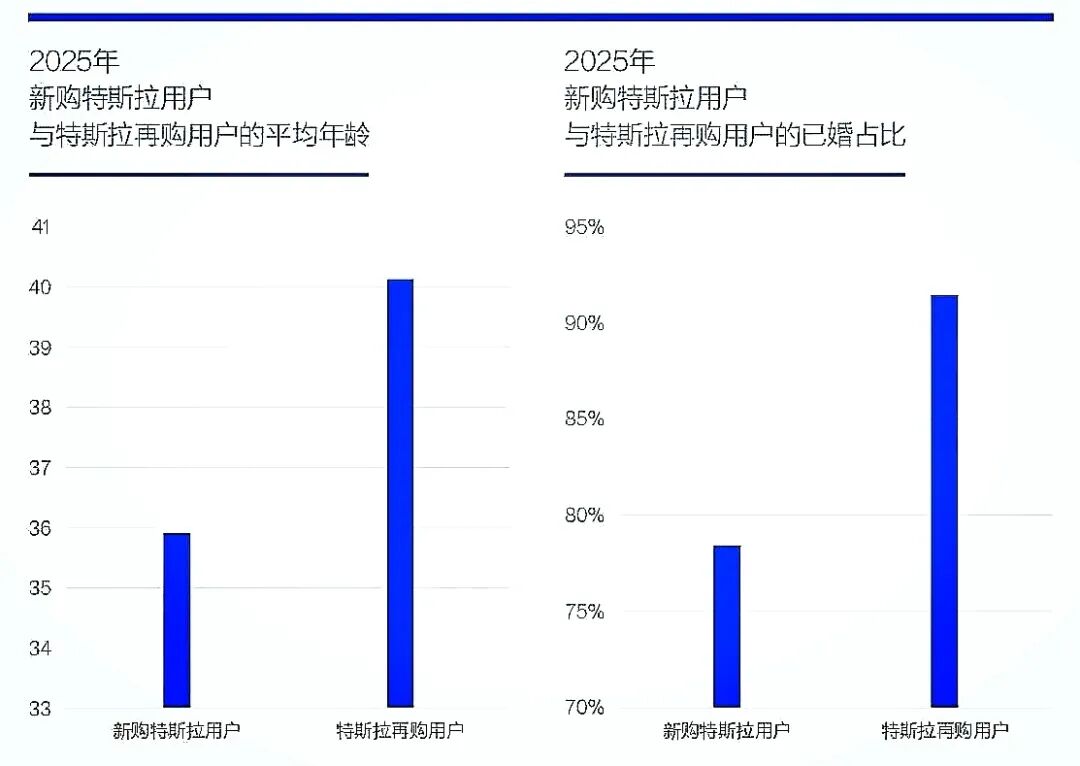
For repeat buyers, the average age exceeds 40, the married proportion exceeds 90%, and more than 60% of them buy cars mainly for road trips.
This data shows that Tesla is entering the daily lives of more ordinary families. For them, a car is first of all a daily means of transportation: commuting every day, picking up and dropping off family members, and going out traveling on weekends.
They do not care whether the 0-100 km/h acceleration can be a few tenths of a second faster, nor do they need to experience the push-back feeling at every traffic light intersection. Compared with aggressive driving, they value vehicle safety, daily use experience, and long-term vehicle ownership costs more.
But the problem lies exactly here—since they value family use more, why not choose domestic new energy vehicles with greater comfort?
Some netizens shared their reasons for buying a Tesla, which may be somewhat representative:
"It's really not because I was fooled by 'huzi'! Instead, I wanted to buy a durable car and also experience new energy. There are so many cars to choose from now, and the prices are so cheap, but instead I don't dare to buy randomly! Since so many people choose Tesla, there is a high probability it won't go wrong."
02 What does it mean that buying a Tesla won't go wrong?
An average age of over 35 may not be enough to show that Tesla owners are more "honest." But one thing is worth noting: the reasons why this new wave of consumers buys Teslas have indeed changed.
A sense of technology, acceleration performance, intelligence... in today's rapidly developing Chinese new energy vehicle market, these are no longer fresh. But in an era of quick-built cars, reduced features and lower prices, and frequent involutionary price wars, consumers are more seeking stability and certainty when buying cars.
First, buying according to sales volume may be one of the simplest ways to avoid risk.
In China's new energy vehicle market, new brands, new technologies, and new models emerge endlessly. Ordinary people find it hard to understand each company's technical route, and they do not have the energy to study dozens of brands and hundreds of models one by one. At this time, sales volume becomes the most intuitive reference.
In 2023 and 2024, Tesla won the global pure electric vehicle sales champion for two consecutive years. Although it was surpassed by BYD in 2025, Model Y remains one of the best-selling single new energy models in the world.
Sales volume cannot represent everything, but it can give consumers a simple judgment: so many people are buying it, which at least shows that the product has passed market testing. Especially for people buying a new energy vehicle for the first time, rather than comparing repeatedly, it is better to choose a brand that has already been verified by a large number of users.
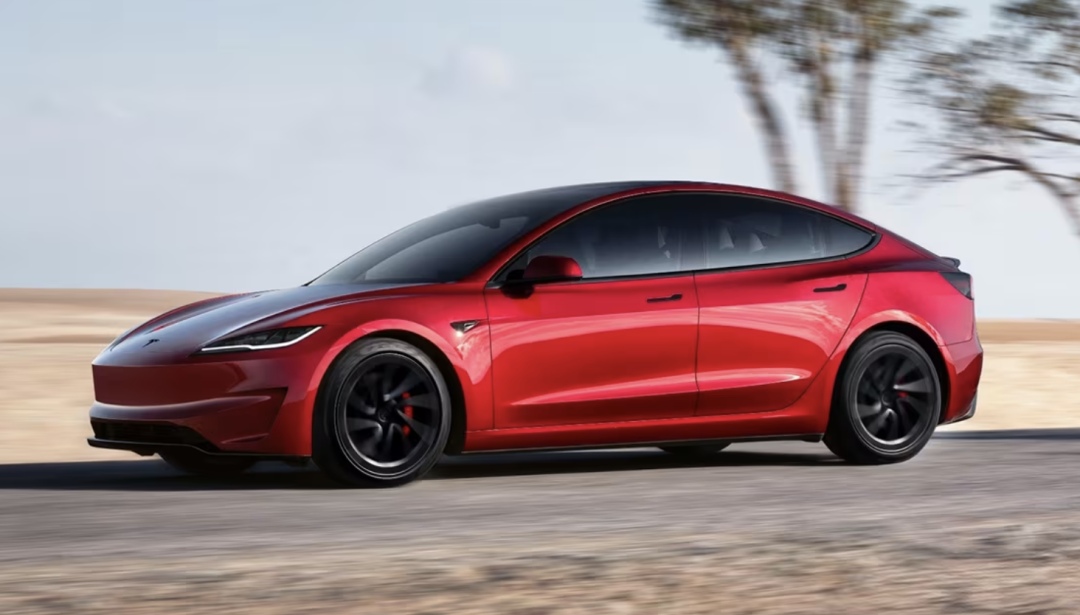
Second, when buying a car now, consumers are really afraid of stepping into pitfalls, especially regarding product safety and after-sales service.
In order to seize the market and catch up with schedules, some automakers compress R&D cycles, reduce necessary testing, and even turn consumers into test drivers. Behind the industry discussion triggered by "quick-built cars" are consumers' concerns about product quality and safety.
The price war is also being transmitted to the manufacturing process. Electrophoresis technology, cavity wax injection, chassis materials, and soundproofing configurations—places that are not easy for consumers to see—have become "disaster areas" for feature cuts. Costs have been reduced, and prices have come down, but consumers are not necessarily more reassured; instead, they wonder: where exactly did a car cut costs?
Of course, even more absurd than feature cuts is that some automakers collapse just like that.
Brands such as WM Motor, HiPhi, and Neta have successively fallen into operational difficulties, leaving behind problems such as interrupted after-sales service, shrinking repair channels, affected in-car system services, and reduced residual value of used cars, with only the owners left to bear the cost.
After all, buying a car home is only the beginning. Consumers also have to consider repairs, maintenance, and service in the coming years, and no one wants the brand to be gone after driving a new car for two years.
Putting these factors together, it is not hard to understand why some people say: buying a Tesla won't go wrong.
03 Please note that Tesla is not perfect
Tesla may not be the best car at the same price, nor necessarily the cheapest, but it has products verified by the market, a mature energy replenishment network, and a brand and service system that continue to operate.
In a market where new cars emerge endlessly, prices keep changing, and automakers frequently reshuffle, Tesla's certainty is indeed considerably higher than that of some competitors.
And many conservative consumers pay for Teslas precisely because of this certainty.
But even so, it does not mean Tesla has polished its products to be invincible.
The Model Y L "rear wheel sag" that attracted owners' attention some time ago is a typical case. Some owners reported that after the vehicle had been used for a period of time, the rear suspension showed abnormal sinking, the rear of the car visibly drooped, and the gap between the rear wheels and the wheel arches became increasingly smaller.
In terms of software and intelligent driving, Tesla is likewise constantly patching things up.
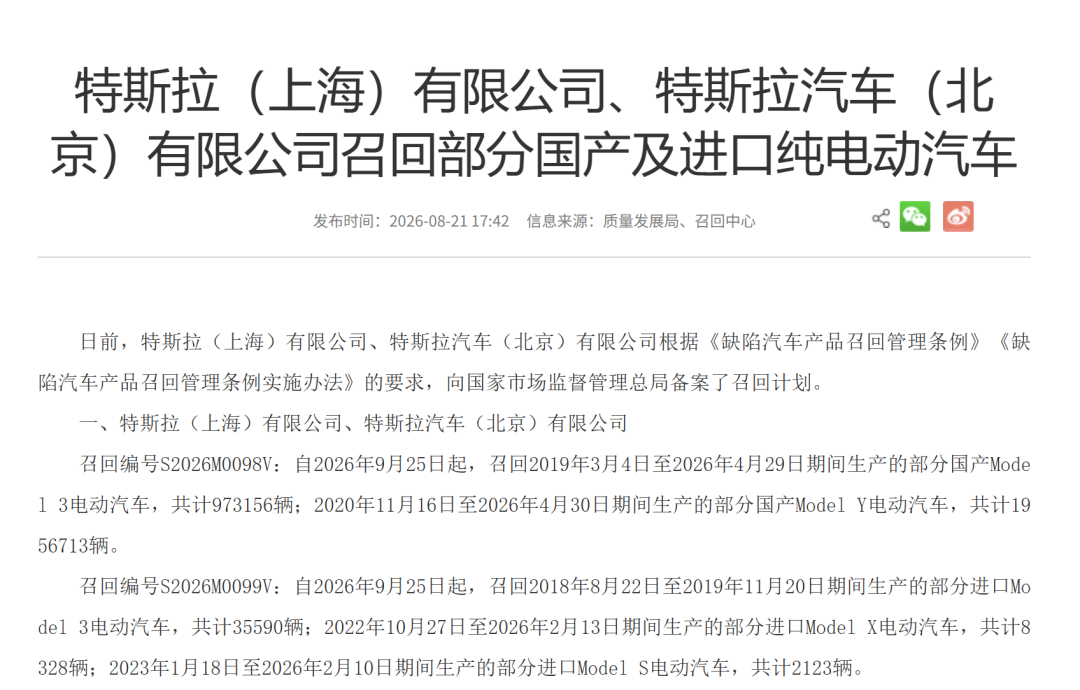
In August 2026, Tesla recalled some domestic Model 3 and Model Y vehicles, involving about 2.74 million vehicles. The reason was that after the assisted steering function was turned on, the original attention monitoring mechanism was insufficient to effectively remind the driver when their line of sight left the road, and an OTA upgrade was needed to add in-cabin camera monitoring.
Problems with mechanical reliability have not occurred only in the Chinese market.
This year, the U.S. National Highway Traffic Safety Administration launched a preliminary investigation into suspension issues involving about 1.2 million Teslas, including some Model 3 and Model Y vehicles. The investigation was prompted by 156 complaints about front suspension lateral links detaching.
Looking at these cases together, Tesla's shortcomings are fully exposed. Yet it is precisely this Tesla, full of mistakes and omissions, that many people flock to.
This is enough to sound a "warning bell" for all automakers.
In the past few years, competition in China's auto market has become more and more like a speed race. Whoever can launch new cars faster, equip new technologies earlier, or even push prices lower has a chance to seize the market.
This has led to faster product updates and more frequent price adjustments, so much so that consumers have not even had time to become familiar with a car before it already has a new model or facelift.
Automakers are chasing the next round of competition, while consumers have to pay for the previous round of decisions. There is a huge misalignment here: for automakers, product iteration may just be a normal business adjustment; but for car owners, it means the new car they just bought rapidly depreciates.
Therefore, consumers are not rejecting innovation, nor are they unwilling to pay for new technologies.
Rather, they have been scared by being "pitched" and "won over," and ultimately either do not buy a car, or only choose the most conservative option.
Editor in charge: Li Sijia Editor: Wang Yue

THE END
-
![]()
Competing for the 2026 Auto Sales Crown Is No Longer Important
-
![]()
Xiaomi Invests 1.7 Billion Yuan for Stake in Sunwoda Power: Automakers Shift from "Buyers" to "Co-Definers"
-
![]()
Microsoft: High Investment, High Growth, Strong Cash Flow—Is It the Only Cloud Giant with True "Character" Deserving a Premium Valuation?
-
![]()
Zhuoyu Hands "Pay Stubs" to 40-Ton Trucks: Saving 20,000–30,000 Yuan in Fuel a Year—But Who Foots the Bill?
-
![]()
Building a "Chicken Farm" Together: Co-Building Charging Piles Becomes an Industry Trend
-
![]()
Computing Power Is No Longer the Ceiling for AI Agents—the Ecosystem Wall Is
-
![]()
BYD: Trading Price for Volume at Home, and Its Overseas "Savior" Is Starting to Falter Too?
-
![]()
The Vanished "Golden September and Silver October"