BYD: Trading Price for Volume at Home, and Its Overseas "Savior" Is Starting to Falter Too?
 11/02 2026
 394
BYD (1211.HK) released its Q3 2026 results after the Hong Kong market close on the evening of October 29, Beijing time. Key takeaways:
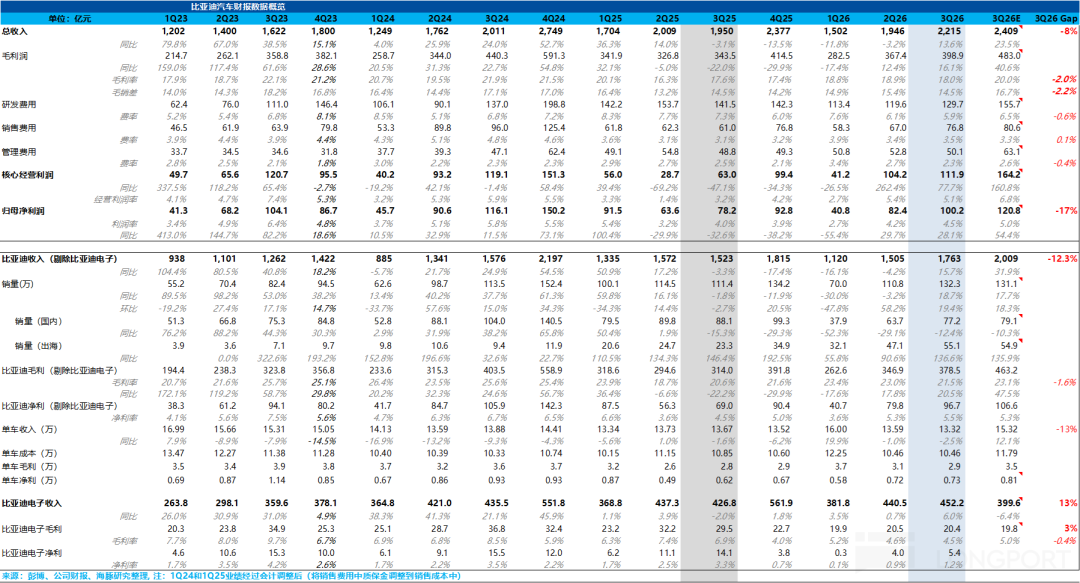
1) Total revenue came in well below expectations, and the problem lies in average selling price per vehicle. In Q3, BYD's total revenue was 221.5 billion yuan, up 13.6% year-on-year and roughly 8% short of the 240.9 billion yuan market consensus.
2) Average selling price per vehicle continued to slide quarter-on-quarter, missing expectations by 20,000 yuan. In Q3, ASP per vehicle was 133,000 yuan, down another ~2,700 yuan QoQ and about 20,000 yuan below the 153,000 yuan market expectation. Three factors were mainly to blame:
a. Domestic recovery outpaced overseas: the overseas share fell ~0.9 percentage points QoQ to 41.6%, diluting the contribution of higher-priced export vehicles;
b. The domestic price war dragged on, with high-end brands (Denza, Fang Cheng Bao, Yangwang) together accounting for only about 13.7%—flat versus Q2 and failing to take over as a driver of higher average prices;
3) Gross margin in the vehicle business fell 1.6 percentage points QoQ, below expectations. In Q3, the automotive business gross margin was 21.5%, about 1.6 percentage points lower than 23.0% in Q2 and also below the ~23% expected. Per-vehicle cost actually held steady (about 105,000 yuan, flat QoQ), so the gross margin decline came entirely from unit price, with economies of scale failing to materialize.
4) Profit also missed expectations, with net profit per vehicle flat, propped up by cost control. In Q3, net profit attributable to parent was 10.02 billion yuan, up 28% year-on-year but about 17% below the 12.08 billion yuan expected. Excluding BYD Electronics, net profit per vehicle was about 7,300 yuan, essentially flat versus Q2 (7,200 yuan).
Profit held flat thanks to restrained R&D expenses (13 billion yuan, down 8% year-on-year) and about 850 million yuan in fair value gains; core operating profit per vehicle—the best gauge of the quality of the main business—was about 8,500 yuan, actually about 900 yuan less than in Q2.
Dolphin Analyst View:
Overall, BYD's performance this quarter fell short of expectations, with the core issue being the "divergence between volume and price": after capacity ramp-up of second-generation blade batteries, domestic sales rebounded about 21% QoQ, overseas volume continued to expand, and total sales volume was delivered; however, average selling price per vehicle fell instead of rising, and gross margin declined accordingly. On the profit side, results were supported by restrained R&D and non-operating gains, while core operating profit per vehicle fell about 900 yuan QoQ—suggesting the quality of profit growth was not high.
First, the domestic market: industry demand is collapsing, and BYD is relying on fast charging to "trade price for volume"
The domestic auto market is going through its worst stretch this year: in September, passenger vehicle retail sales fell about 28% year-on-year, the largest drop of the year. In Q3, domestic new energy passenger vehicle retail sales also fell 11% year-on-year, with growth mainly coming from exports.
But BYD's share is recovering: with capacity ramp-up of second-generation blade batteries, backlogged orders for fast-charging models were delivered, pure electric sales rose about 37% QoQ, and domestic market share rebounded about 2.7 percentage points QoQ to 25.4%.
Notably, however, a gap emerged between wholesale and retail: in September, BYD's domestic retail sales were about 247,000 vehicles, about 36,000 fewer than domestic wholesale (about 283,000 vehicles), with channels passively restocking. Combined with the ongoing price war and still-declining unit prices, BYD is still "trading price for volume" at home rather than achieving "rising volume and price together."
Under a neutral assumption, Dolphin Analyst expects BYD's domestic sales in 2026 to be about 2.74 million vehicles, down about 23% year-on-year (down 30% in the first three quarters), implying Q4 domestic sales need to be about 950,000 vehicles, up about 23% QoQ—not a conservative assumption given channel restocking.
Next, overseas: volume expansion continues, but profit is "discounted"
Overseas sales in Q3 were about 550,000 vehicles, up about 137% year-on-year; cumulative sales in the first three quarters were about 1.34 million vehicles, already exceeding full-year 2025. The full-year target of 1.9–2.0 million vehicles implies average monthly sales of about 190,000–220,000 vehicles in Q4, with the lower bound basically flat with the Q3 monthly average of about 180,000 vehicles—making 1.9 million not difficult to achieve.
The problem lies in overseas net profit per vehicle: according to Dolphin Analyst estimates, overseas net profit per vehicle in Q3 was about 12,500 yuan (range 12,000–13,000 yuan, corresponding to about 3,000–4,000 yuan domestically), significantly below the market's previous assumption of about 20,000 yuan.
In September, management still said overseas net profit per vehicle was "basically stable"; but this time management has lowered the expectation from 20,000 yuan to 16,000 yuan, mainly dragged by exchange rate fluctuations (about 2 billion yuan). The gap between management's guidance and Dolphin Analyst's estimate (about 3,600 yuan per vehicle) roughly equals the impact of the 2 billion yuan exchange loss spread over about 550,000 overseas vehicles in Q3.
Greater pressure lies in 2027, with two policies introduced successively in October:
a. Lower export tax rebates: The Ministry of Finance announced on October 12 that the export tax rebate rate for new energy passenger vehicles will be cut from 13% to 9%, effective April 1, 2027. Based on an average declared export price of about 130,000 yuan in 2026, if automakers do not raise prices, pre-tax cost per vehicle will increase by about 5,000 yuan and after-tax by about 4,000 yuan—something automakers can absorb through price increases of a few thousand yuan or localized production. Automakers will most likely rush exports before April, so exports may be front-loaded in Q1 2027 and then fall back.
b. EU hybrid quota: China and the EU reached an agreement on October 9 on hybrid vehicle exports. According to reports, the EU plans to cap imports of Chinese hybrids at 350,000 vehicles per year starting in December, raising the cap by 6% annually for four years; while in the first seven months of this year, China's hybrid exports to Europe already reached about 377,000 vehicles, and the full year may exceed 800,000—so the quota may cut exports by more than half.
BYD is one of the Chinese automakers with the highest sales in Europe. According to MarkLines, from January to August 2026, retail sales of HEV+PHEV by Chinese brands in the EU were about 280,000 vehicles, of which SAIC, BYD, Chery, and Geely accounted for 105,000/98,000/59,000/13,000 vehicles respectively; by exposure, the four companies' hybrid retail sales in the EU accounted for 22%/15%/8%/4% of their global retail sales (excluding China), respectively—with SAIC and BYD relatively more exposed, and their plug-in hybrid exports to Europe will be directly constrained.
Dolphin Analyst expects BYD to be affected by the quota by about 100,000–150,000 vehicles in 2027 (about 5–6% of potential overseas sales), which can only be mitigated through price increases and mix adjustment.
The hedge lies in localization: the company says per-vehicle shipping cost is over 10,000 yuan and EU tariffs are over 40,000 yuan, and after 1–2 years of stable localized operations, profitability will definitely be better than exports; however, the Hungarian plant will only start assembly in November–December (designed capacity 300,000 vehicles, first phase 150,000 vehicles), about a year behind the original plan, and will be difficult to fully offset in the first half of 2027.
On valuation:
Dolphin Analyst expects BYD's total sales in 2026 to be about 4.64 million vehicles (2.74 million domestically, down about 23% year-on-year; 1.9 million overseas, up about 84% year-on-year). In the first three quarters, vehicle-selling net profit (excluding BYD Electronics) was about 21.7 billion yuan. Assuming Q4 sales of 1.51 million vehicles and net profit per vehicle of about 7,000 yuan (overseas share falling back to about 37%, while domestic per-vehicle profit remains thin), full-year vehicle-selling net profit would be about 32 billion yuan (about 6,900 yuan per vehicle), up only about 6% from 30.3 billion yuan in 2025.
With only two months left in 2026, the valuation anchor needs to shift to 2027, and the key variable is overseas net profit per vehicle. Starting from about 12,500 yuan in Q3, breaking it down:
a. Export tax rebates: after-tax impact per vehicle is about 4,000 yuan, but implementation from April affects only three quarters, and about 20% of vehicles produced locally are also unaffected. Without price increases, overseas net profit per vehicle would be diluted by about 2,500 yuan; if half is absorbed through price increases, about 1,300 yuan.
b. EU quotas and mix downgrading: Europe plug-in hybrids are the overseas market with the fattest profits, and the quota will squeeze out about 100,000–150,000 high-margin vehicles, with incremental volume shifting to lower-unit-price markets such as Latin America and Southeast Asia. Combined with Chinese automakers going overseas collectively and intensifying competition, net profit per vehicle will be reduced by another about 1,000–1,500 yuan.
c. Localization ramp-up and exchange rates: Hungarian and Turkish plants will still be ramping up in 2027, dragging by about 500–1,000 yuan; if exchange losses are not repeated, about 2,000 yuan can be recovered.
Overall, under a neutral assumption, overseas net profit per vehicle in 2027 will be about 10,000 yuan (range 8,000–12,000 yuan), down about 20% from Q3.
In 2027, Dolphin Analyst expects total sales of about 5.15 million vehicles, up 11% year-on-year (2.75 million domestically, basically flat; 2.4 million overseas, up 26% year-on-year, after deducting the impact of about 100,000–150,000 vehicles from the EU quota).
Based on domestic net profit per vehicle of 3,500 yuan and overseas 10,000 yuan, vehicle-selling net profit in 2027 would be about 33.6 billion yuan (about 6,500 yuan per vehicle), up only about 5% from 2026—overseas volume expansion is basically offset by dilution in per-vehicle profit, and 2027 is likely to be a year of "incremental volume without incremental profit."
With profit basically not growing, assigning a 2027 PE of 15x gives the vehicle-selling business a market value of about 504 billion yuan; BYD Electronics, at a 65.74% stake and current market value, is included at about 29 billion yuan, for a total of about 533 billion yuan—basically the same as H-share current market value of 528.3 billion yuan. A-share market value is about 744 billion yuan, at a higher premium.
Overseas net profit per vehicle is the most sensitive valuation variable; every 1,000 yuan change affects 2027 profit by about 2.4 billion yuan and market value by about 6%.
Conclusion: In the previous quarter's review, Dolphin Analyst believed BYD's upside was limited. After the August earnings report, the stock price has retraced about 22%, but this retracement is more about digesting expectations of a "discount" in overseas profit in 2027: under the neutral assumption, the current Hong Kong stock price has basically reflected it, and the risk-reward ratio is not compelling.
There is also a lack of catalysts in the short term. It needs to see Q4 revenue recognition catch up with wholesale volume, inventory decline, as well as overseas price increases landing in Q1 2027 and smooth ramp-up at the Hungarian plant, to verify the "quality" of overseas volume expansion. Before overseas per-vehicle profit stabilizes, the pace of valuation repair may be slow.
- END -
// Reprint permission
This article is an original article by Dolphin Research. Authorization is required for reprinting.
// Disclaimer and general disclosure notice
This report is intended only for general comprehensive data use, aimed at general reading and data reference by users of Dolphin Research and its affiliates, and does not consider the specific investment objectives, investment product preferences, risk tolerance, financial condition, and special needs of any person receiving this report. Investors who make investment decisions based on this report must consult independent professional advisers before investing. Anyone who makes investment decisions by using or referring to the content or information mentioned in this report shall bear the risk themselves. Dolphin Research shall not be liable for any direct or indirect liability or loss that may arise from the use of the data contained in this report. The information and data contained in this report are based on publicly available materials and are for reference only. Dolphin Research strives for but does not guarantee the reliability, accuracy, and completeness of the relevant information and data.
The information mentioned or views expressed in this report shall not be regarded or deemed, in any jurisdiction, as an offer to sell securities or an invitation to buy or sell securities, nor do they constitute advice, inquiry, or recommendation regarding the relevant securities or related financial instruments. The information, tools, and materials contained in this report are not intended or planned to be distributed to citizens or residents in jurisdictions where the distribution, publication, provision, or use of such information, tools, and materials conflicts with applicable laws or regulations or would cause Dolphin Research and/or its subsidiaries or affiliates to be subject to any registration or licensing requirements in such jurisdictions.
This report reflects only the personal views, opinions, and analytical methods of the relevant creators and does not represent the position of Dolphin Research and/or its affiliates.
This report has been prepared by Dolphin Research, and all copyrights are exclusively owned by Dolphin Research. Without the prior written consent of Dolphin Research, no institution or individual may (i) produce, copy, reproduce, duplicate, forward, or otherwise create any form of photocopy or reproduction, and/or (ii) directly or indirectly redistribute or transfer it to any other unauthorized persons. Dolphin Research reserves all related rights.
-
![]()
Competing for the 2026 Auto Sales Crown Is No Longer Important
-
![]()
Xiaomi Invests 1.7 Billion Yuan for Stake in Sunwoda Power: Automakers Shift from "Buyers" to "Co-Definers"
-
![]()
Microsoft: High Investment, High Growth, Strong Cash Flow—Is It the Only Cloud Giant with True "Character" Deserving a Premium Valuation?
-
![]()
Zhuoyu Hands "Pay Stubs" to 40-Ton Trucks: Saving 20,000–30,000 Yuan in Fuel a Year—But Who Foots the Bill?
-
![]()
Building a "Chicken Farm" Together: Co-Building Charging Piles Becomes an Industry Trend
-
![]()
Computing Power Is No Longer the Ceiling for AI Agents—the Ecosystem Wall Is
-
![]()
BYD: Trading Price for Volume at Home, and Its Overseas "Savior" Is Starting to Falter Too?
-
![]()
The Vanished "Golden September and Silver October"