Ford's New Category to Counter Chinese NEVs: The UEV Platform Fathom
 11/03 2026
 513
For Chinese cars, the United States is a closed market. In our previous article, "GM 2026 Q3: Trucks Printing Money, Buybacks Backstopping, EVs Pressing Pause," we noted that GM—America's state-owned enterprise—is essentially shutting the door, prioritizing profits now and leaving the future for later.
But another American auto giant, Ford, has other plans.
On the October 28 Ford Q3 earnings call, CEO Jim Farley made a remarkably blunt comment about their new UEV platform.
On the UEV, we always set our target even 4 years ago with imagining what a BYD could do in Mexico.
When we set the target for the UEV platform four years ago, what we imagined was what BYD could do in Mexico.
—— Jim Farley, Ford CEO, 2026 Q3 earnings call
The first vehicle on this platform is called Fathom, a five-seat mid-size all-electric pickup with a starting price of $28,350. In a U.S. auto market where prices often run $50,000–$60,000, that is a price killer.
I went through Ford's financial reports, earnings call transcripts, and technical articles, and also checked related competitor prices. My biggest takeaway about the first vehicle under this platform is: this car sells a cost methodology; the pickup is just the shell.

In this article, we mainly discuss: why this burden fell on Ford, who this car is actually sold to, what it relies on to resist Chinese cars, and what inspiration and information it offers the Chinese auto industry.
Of course, the Fathom has not launched yet. Ford has not disclosed range, battery capacity, or material costs, and there has been no independent teardown. Unless otherwise stated, the engineering figures below are Ford's targets.
01 The prosperity of the Model T depended on a price-cutting machine
Ford's invocation of the Model T this time is not just nostalgia
When the Model T debuted in 1908, it sold for $850.
By around 1924, the cheapest version cost only $260—a nominal price drop of about 70%.
Everyone knows what happened in between: in October 1913, Ford moved chassis assembly onto a moving assembly line, cutting assembly time per vehicle from about 12 hours to around 93 minutes.
That line ran until 1927, producing more than 15 million vehicles cumulatively. Ford's U.S. market share was 48% in 1914 and reached 57% in 1923.
This history is often told as the story of the assembly line, but I think what is more useful today is the order of cause and effect.
First set a price ordinary people can afford, then work backward to change the product and change the factory.
Fathom's process is exactly the same. First set around $30,000, then calculate backward how small the battery must be, how low the drag must be, and how many workstations are needed.
Doug Field, then Ford's head of electric and digital, said at launch that the inspiration came from the Model T as a "general-purpose vehicle." Farley said Ford tore up the concept of the moving assembly line it had invented and redesigned a better one.
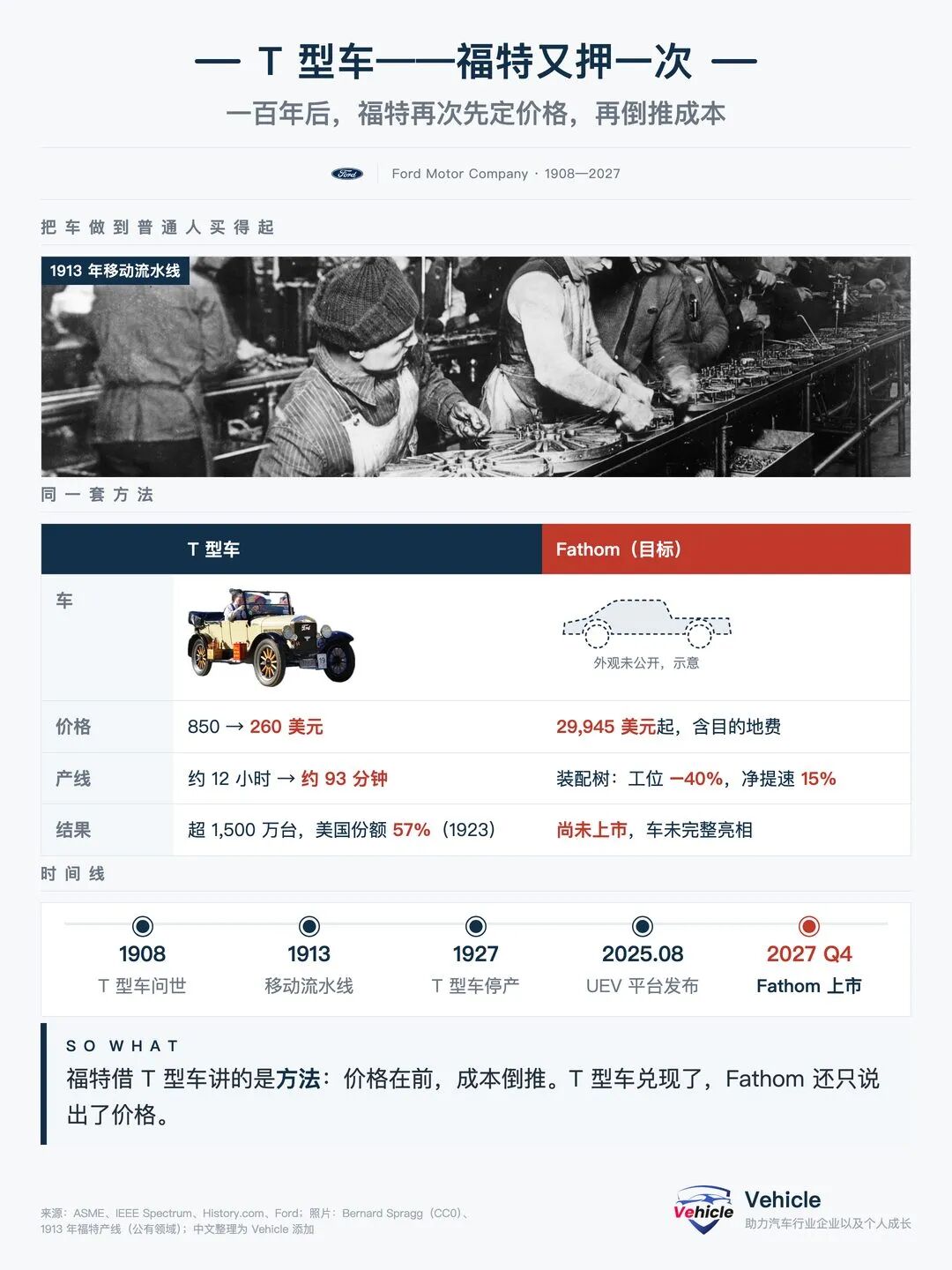
What Ford is using the Model T to talk about is methodology, and this methodology is what all automakers today, including Chinese automakers, are also using.
02 Ford's position in the United States cannot be replaced by others
It dared to bet, and it also has the profits to pay for the bet
First, daring to bet.
In November 2006, Ford mortgaged almost all its assets along with the blue oval logo and borrowed about $23.6 billion. During the financial crisis, GM and Chrysler took government bailout loans, while Ford survived on this money.
In 2021, it also took the best-selling F-150 in the United States and launched an all-electric version. However, the current model was later discontinued.
In 2025, Ford sold about 2.2 million vehicles in the United States, including 828,832 F-Series—the best-selling truck in the United States for 49 consecutive years, nearly 250,000 more than the second place.
In the United States, pickups are both a business and an identity. So for Ford to define an affordable electric pickup carries a weight completely different from a new company doing the same thing.
03 Why is Ford the only one in North America that can fight
This statement holds, but the yardstick needs to change
In the third quarter, Tesla sold about 144,000 electric vehicles in the United States, while Ford sold only 6,047, down 80% year on year. GM's brands combined also ranked second in the United States on a year-to-date basis.
Ranked by today's EV sales, Ford would not even make the list.
So why do I still say this? Because the opponent in this battle is China's cost structure, and the question that should be asked is another one:
Who, at the $30,000 price point, has brought a new platform, retooled factories, and local battery plants?
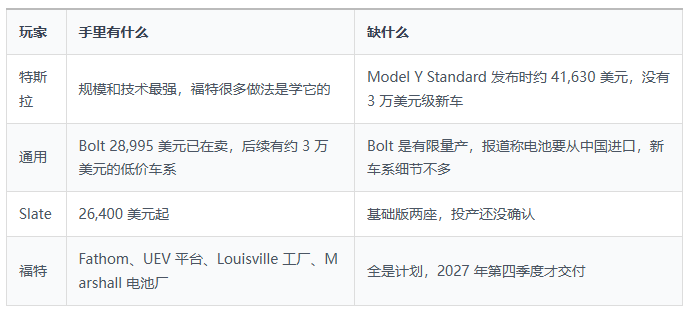
Ford has also paid the highest price. The Model e division lost about $17.4 billion cumulatively from 2023 through the third quarter of 2026.
In December 2025, it announced about $19.5 billion in reset charges, cancelled the three-row SUV, and discontinued the current Lightning.
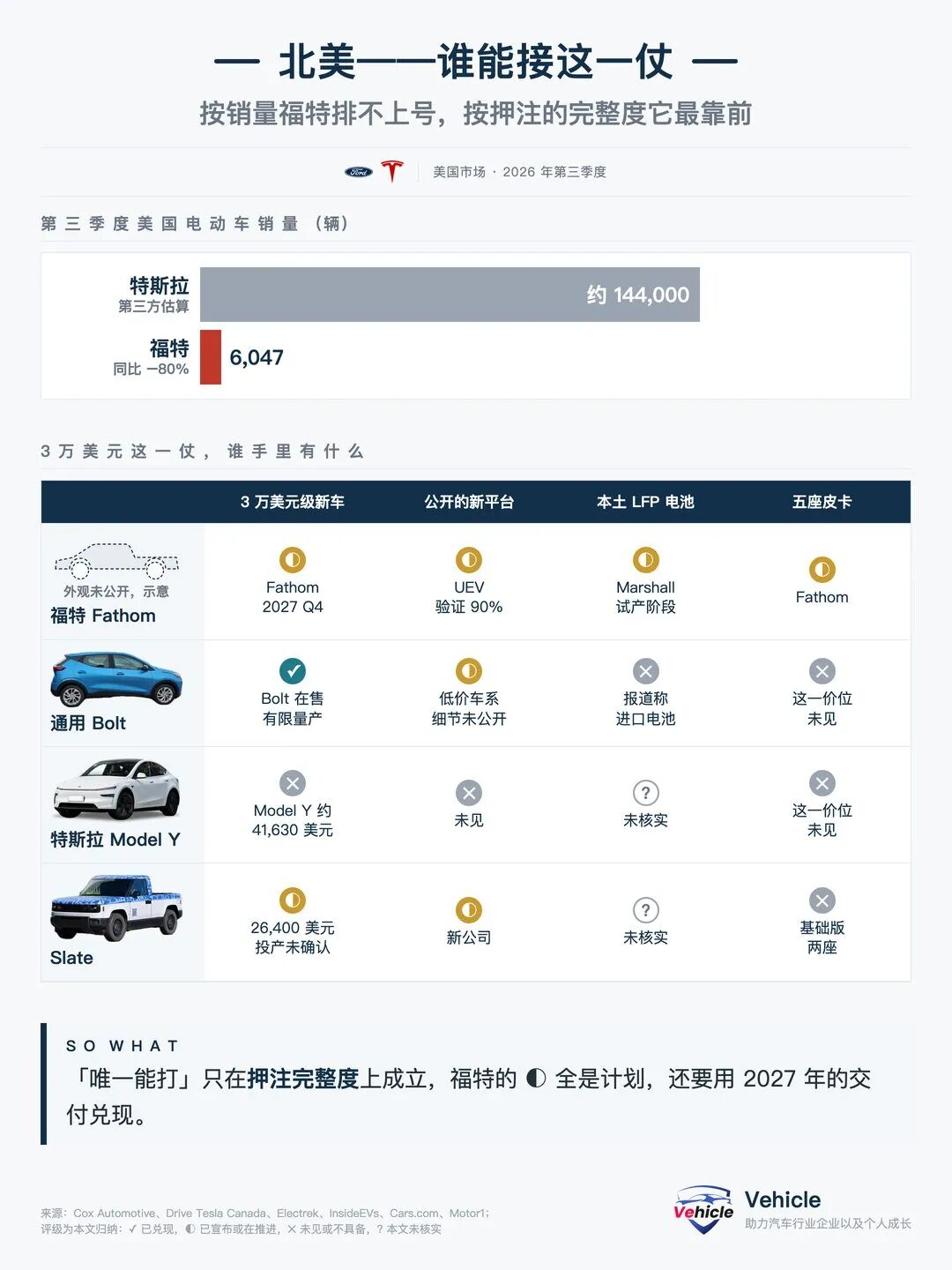
My judgment is: Ford sells very few today, but on the chain for $30,000 electric vehicles, it has placed the most comprehensive bet.
04 Why this car is so important to North American electrification
The first big test after subsidies end
U.S. EVs are now stuck on price.
Third-quarter sales were 262,649 units, a share of about 6.4%, down 39.5% year on year. The federal purchase tax credit expired on September 30, 2025.
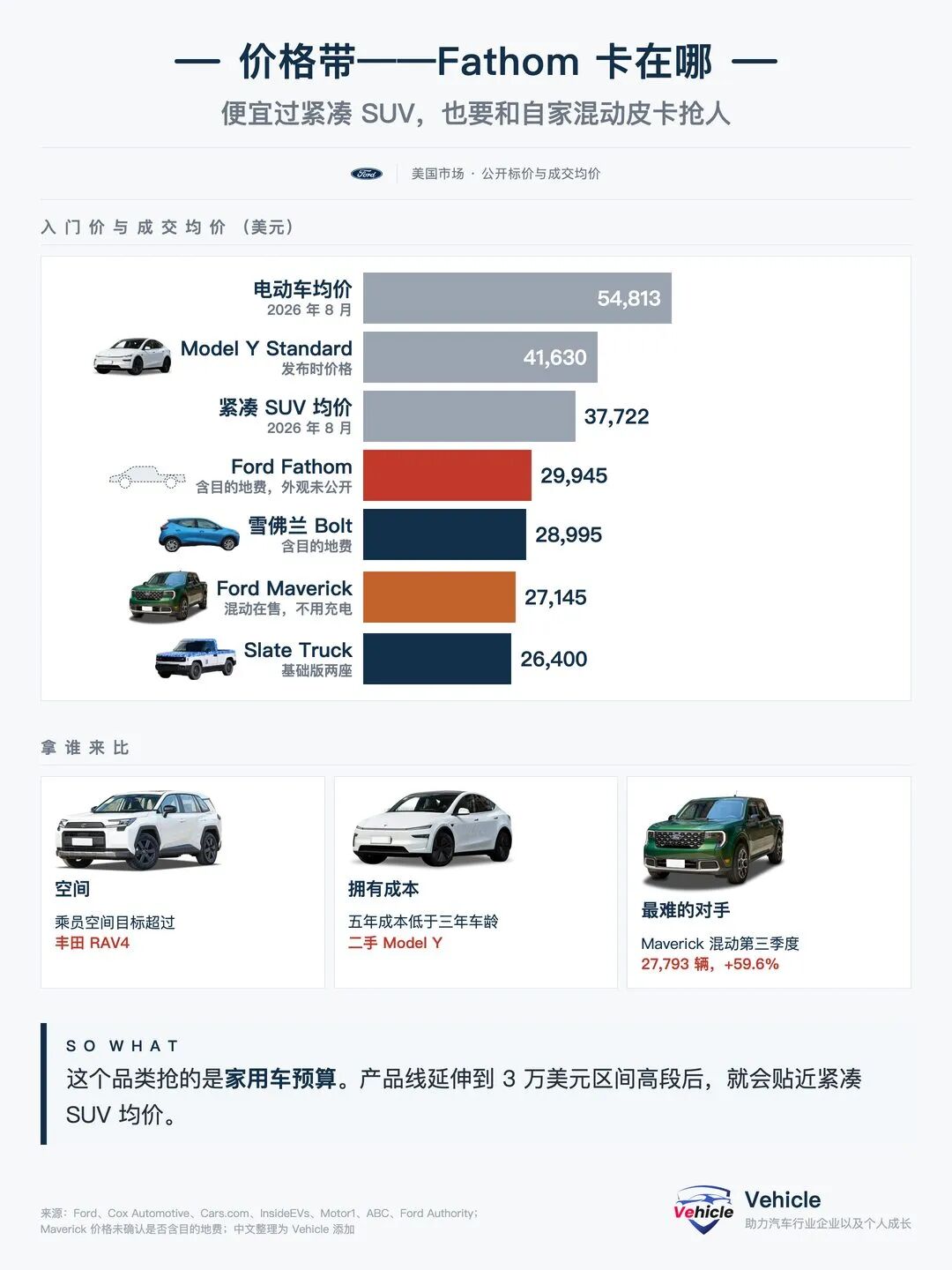
In August, the average transaction price of EVs was $54,813, and Fathom's entry price is about $25,000 lower. Ford's Andrew Frick said that more than half of cars transacting below $40,000 are already used cars.
So the question Fathom must answer goes beyond Ford alone: without subsidies, can the U.S. EV market expand through products and prices?
According to media reports citing The Wall Street Journal, Ford's internal target is 100,000 units in the first year, which Ford has not confirmed.
How hard is that number? Annualized from the third quarter, it equals about 10% of the U.S. EV market. Yet the F-150 Lightning took five years to reach 105,000 cumulative sales.
For Ford itself, the math is also clear. The 8% profit margin target for 2029, based on 2025 revenue, is about $15 billion—about $4.2 billion more than the midpoint of this year's guidance, almost exactly one year's loss at Model e.
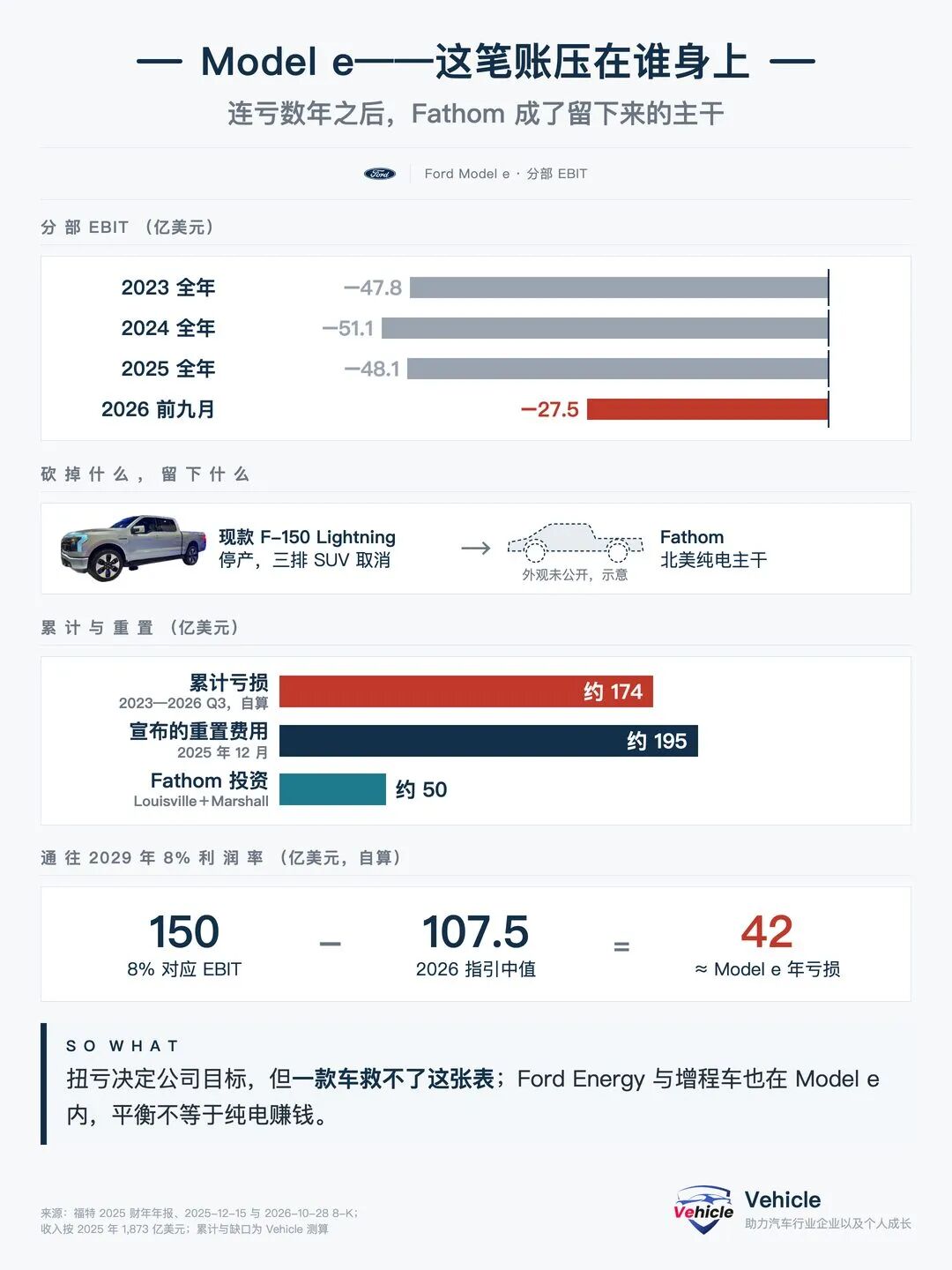
Note: Ford Energy storage and extended-range vehicles are both counted in Model e. Break-even for this division does not mean the all-electric pickup is profitable.
If it succeeds, Detroit will have a template that can be replicated. If it fails, Ford will most likely survive, but North America will lose its most serious attempt.
05 Who is it actually sold to
A new category packaged in pickup form
"New category" is my term; Ford itself only calls it a mid-size electric truck.
I call it that because its buyers and benchmarks do not look like traditional pickups. Kay Hart, general manager of Model e, said most people will treat it as a lifestyle vehicle, not a work truck.
Now look at the competitors Ford has chosen for benchmarking:
Space: passenger space exceeds that of the Toyota RAV4
Cost of ownership: five-year cost lower than that of a three-year-old used Model Y
Acceleration: 0-60 mph similar to a Mustang EcoBoost
Extras: front trunk, cargo box, and more than 10 kW of AC output
A pickup benchmarked against SUVs and used cars. What it wants to do is what Chinese people often call "driving the price down."
But this positioning has one weak spot.
Its own showroom. The Maverick hybrid sold 27,793 units in the third quarter, up 59.6%, starting at $27,145, and does not even need charging. But Ford is betting on the future, where everyone uses EVs.
06 Core technology: converting every millimeter into battery money
Most individual items are catch-up; the accounting is leading
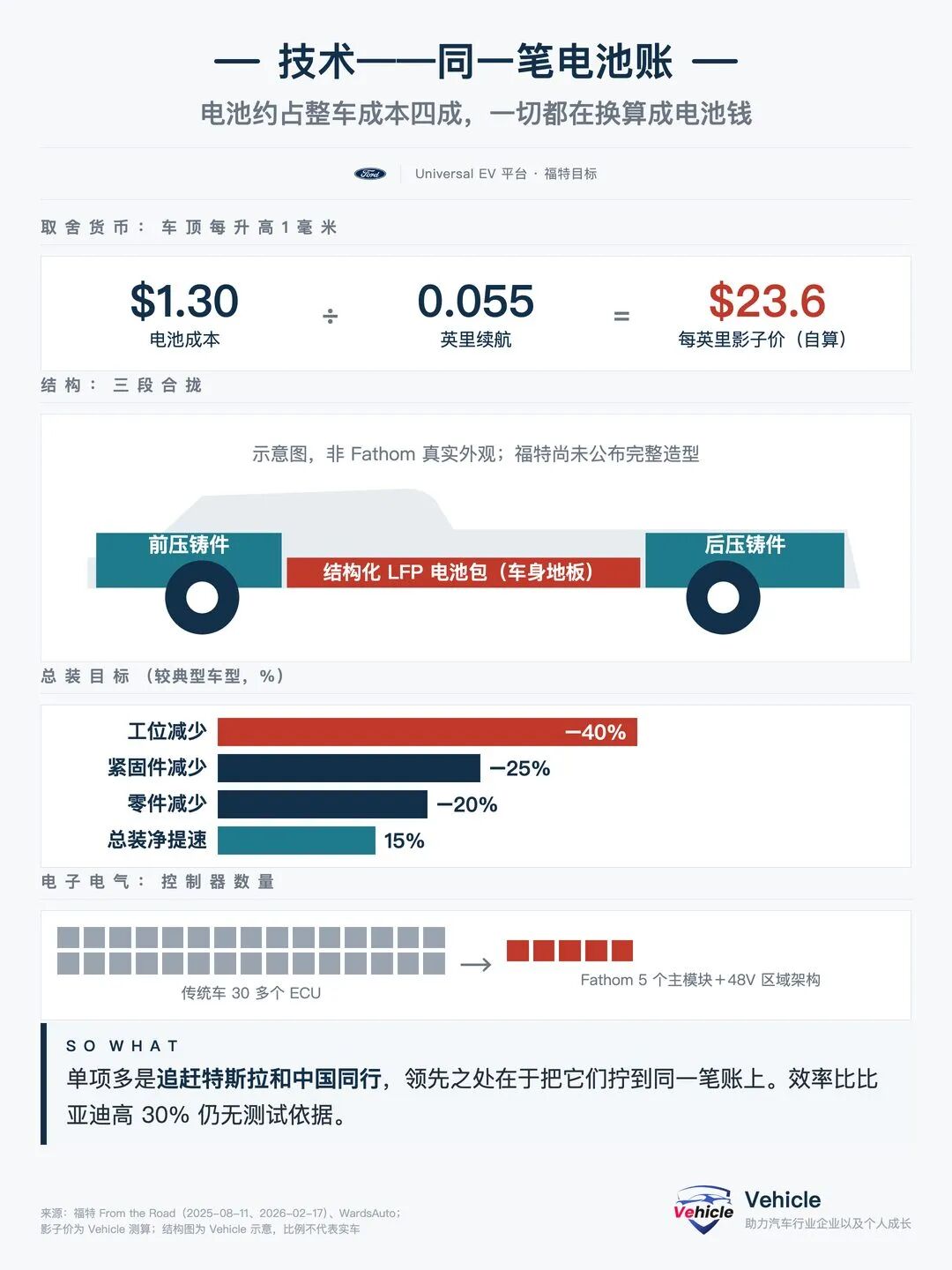
Ford says the battery accounts for about 40% of vehicle cost. All technologies revolve around one goal: using a smaller battery to achieve sufficient range.
01 The most worth-learning item: trade-off currency
Project leader Alan Clarke once publicly shared a conversion.
adding even 1mm to the roof height would mean $1.30 in additional battery cost or .055 miles of range
Adding even 1 millimeter to roof height means $1.30 more in battery cost, or 0.055 miles less range.
—— Alan Clarke, Ford official article, 2026-02-17
Dividing the two numbers gives a shadow price of about $23.6 per mile of range.
In this way, debates over styling, packaging, and weight reduction all have the same currency. Ford has also set internal bounties for this kind of saving. This move costs almost nothing, yet is the hardest to see.
02 The other four blocks, quickly reviewed
Structure: two large aluminum castings front and rear sandwich a structural LFP battery pack, joined in three stages on the line. This comes from Tesla and Chinese peers.
Final assembly: the moving assembly line is changed into a three-branch "assembly tree," with 40% fewer workstations. This is somewhat similar to the Unboxed discussed in the previous article "Deep Teardown of Tesla Cybercab's Unboxed: The New Car-Making Logic of L4 Robotaxi, Designing Backward from Manufacturing."
Electrical/electronic architecture: 5 main modules replace more than 30 ECUs in traditional cars, plus a 48V zonal architecture, with wiring harness more than 4,000 feet shorter. This counts as catching up with Tesla and Chinese peers.
Battery: square LFP made in Michigan, technology licensed from CATL.
The wiring harness number sounds large, but Farley has said the Mach-E has a full mile more wiring than the Model 3. 4,000 feet is about 0.76 miles, so I think this is more like paying off an old debt.
07 Can it hold off Chinese cars
Resistance occurs on three fronts, with very different intensity
First, in the U.S. home market, Fathom does not currently need to compete head-on with Chinese cars.
In our previous article "Not a Single One Sold Yet, U.S. Automakers Ask Congress to Weld the Door Shut," we shared that the connected-vehicle software ban takes effect from the 2027 model year, and tariffs are also very high. So "resistance" must be viewed separately.
Front 1: U.S. home market: blocking the future
Farley has said Chinese cars may enter the United States within five to ten years. While the wall stands, Fathom lacks external pressure; when the wall loosens, Ford will at least have a platform designed around BYD's costs.
Front 2: Mexico and Latin America: the battlefield Ford envisions
Mexico has raised tariffs on Chinese-made light vehicles from 20% to 50%. Whether U.S.-built pickups can enter under USMCA depends on rules of origin and the review outcome; I have not researched this thoroughly enough.
Front 3: International pickup market: pressure arrives earliest
Farley said a low-priced mid-size pickup for international markets will be launched in 2027, with base material cost 20% lower than the current Ranger, directly hitting the price level of Chinese cars.
Of course, it could be other products under this platform. Fathom is currently confirmed only for North America, and Australia at the earliest in 2028-2029.
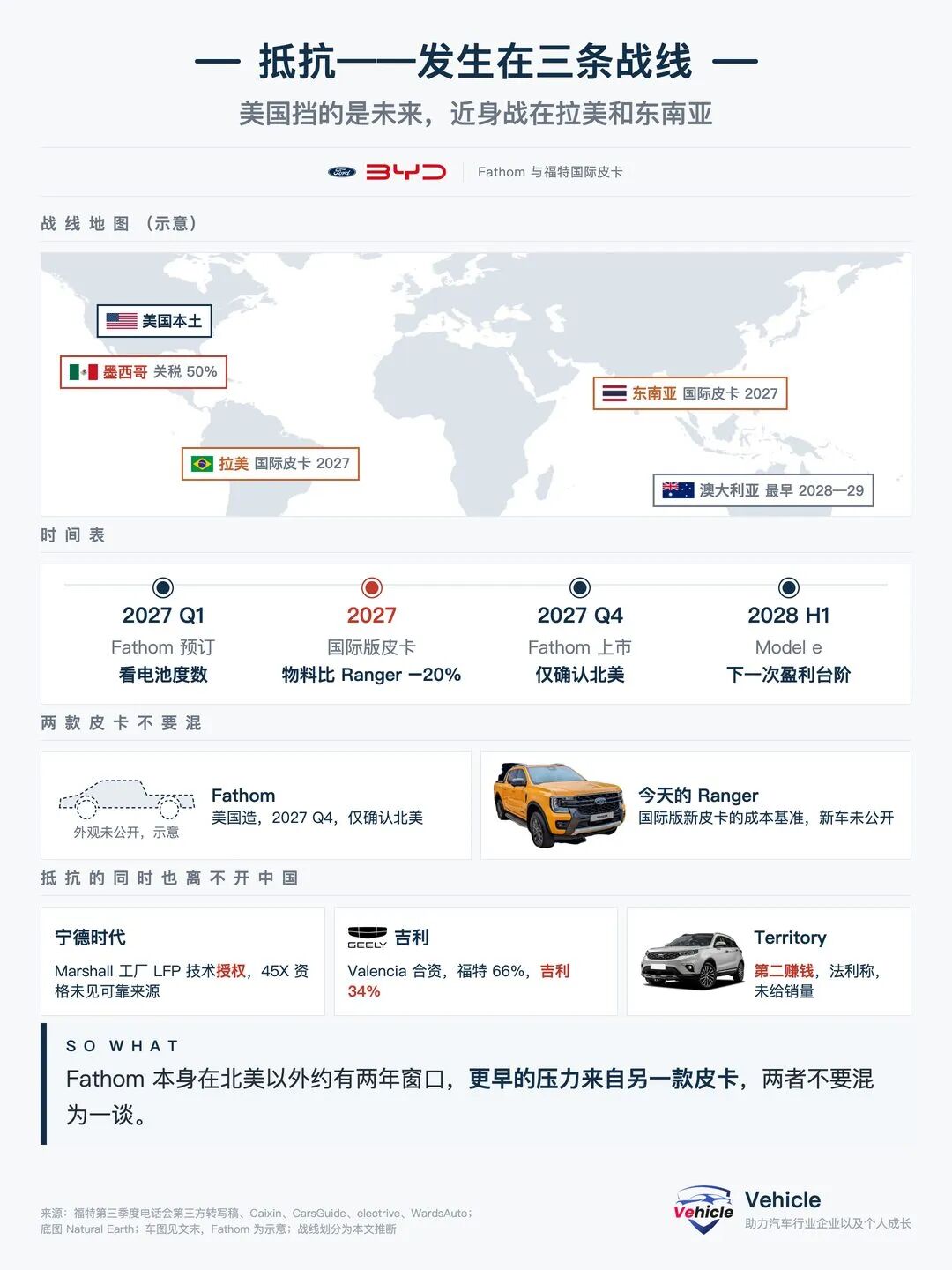
There is also an unavoidable contradiction: Ford resists Chinese cars, while also being inseparable from China.
Battery technology comes from CATL, and the Valencia plant in Spain is a joint venture with Geely (Ford 66%, Geely 34%). Farley calls the Territory the world's second most profitable model.
Kumar Galhotra also said Geely's cost and speed advantages are being incorporated into Ford's global development system.
U.S. Transportation Secretary Sean Duffy already sent a letter in September criticizing these two matters. I could not find a reliable source on whether the Marshall plant can obtain the 45X battery manufacturing credit, and this will directly affect the cost math.
Placed within China's price system, Fathom is about 193,000 yuan, which is not cheap. "Cost parity with China" is still only a goal.
08 Final thoughts
It has only completed the first step so far
The biggest takeaway from this research is that the Model T succeeded because Ford made cost advantages a reality, with the selling price declining year after year.
Fathom has currently only completed the first step, which is to state that price.
If it succeeds, it shows that a considerable portion of China's cost advantages can be replicated through organizational discipline and licensed technology. If it fails, Ford still has the F-Series, Ford Pro, hybrids, and energy storage, but North American electrification will lose its most serious attempt.
Of course, all of this has to wait for the numbers. The earliest and cheapest signal is that battery capacity figure.
Whether Ford can catch up with China is probably no longer important; the most important thing is how our industry can be healthy and sustainable.
That's all for today's sharing. If you find it useful, please like, repost, and click Wow, and feel free to share your thoughts in the comments.
*Unauthorized reproduction and excerpting are strictly prohibited-
-
![]()
Xiaomi's October Sales Surge: "One Meter Pierces Eight Realms" Meme Persists as Pengcheng Delivers
-
![]()
Leapmotor Tops 100k, Xiaomi and Xpeng Cross 50k, HarmonyOS Hits 30k, Li Auto… New Forces Reveal October Sales
-
![]()
Ford's New Category to Counter Chinese NEVs: The UEV Platform Fathom
-
![]()
France Proposes Internet Traffic Tax: 0.4 Yuan per GB Transmitted; Tech Giants Push Back, Bill Unlikely to Pass
-
Lexus's Imported All-Electric RZ Is a Sales Flop—Will Its Domestically Produced EVs Fare Any Better?
-
![]()
Samsung Tops Africa's Smartphone Market for the First Time in 31 Years as Q2 Shipments Surge 34.8% Year-on-Year
-
Plug-in Hybrid Exports to Europe Surge 372% in First Nine Months: Why Do European Consumers Prefer Chinese PHEVs?
-
![]()
AITO Accelerates Overseas Expansion Again! Full Entry into Europe by 2027—Is It About More Than Just Orders?