Lei Jun Touts Number One Value Retention, But Third-Party Data Tells a Different Story: Xiaomi Auto's Residual Value Has Declined for Three Consecutive Months
 11/04 2026
 571
 Image source: Weibo
On the morning of November 3, Lei Jun posted a value retention report card.
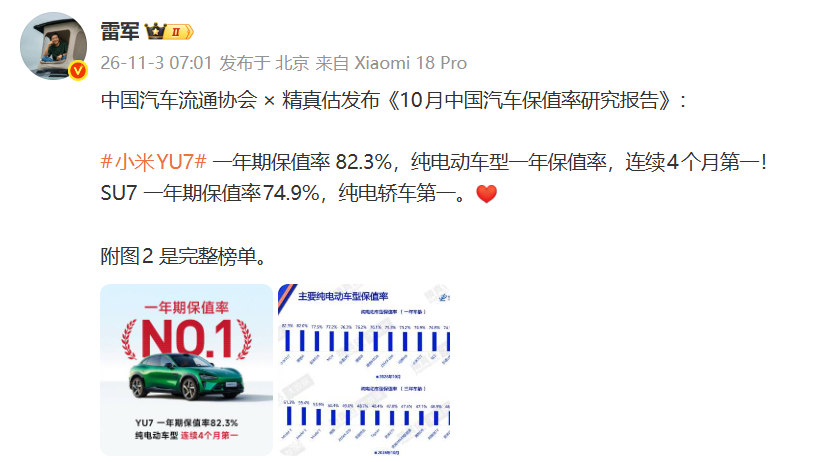 Image source: Weibo
According to the "October China Automobile Value Retention Rate Research Report" jointly released by the China Automobile Dealers Association and Jingzhengu, the one-year value retention rate of the Xiaomi YU7 reached 82.3%, taking first place among pure electric models for one-year value retention and topping the list for four consecutive months; the Xiaomi SU7 ranked first among pure electric sedans with 74.9%.
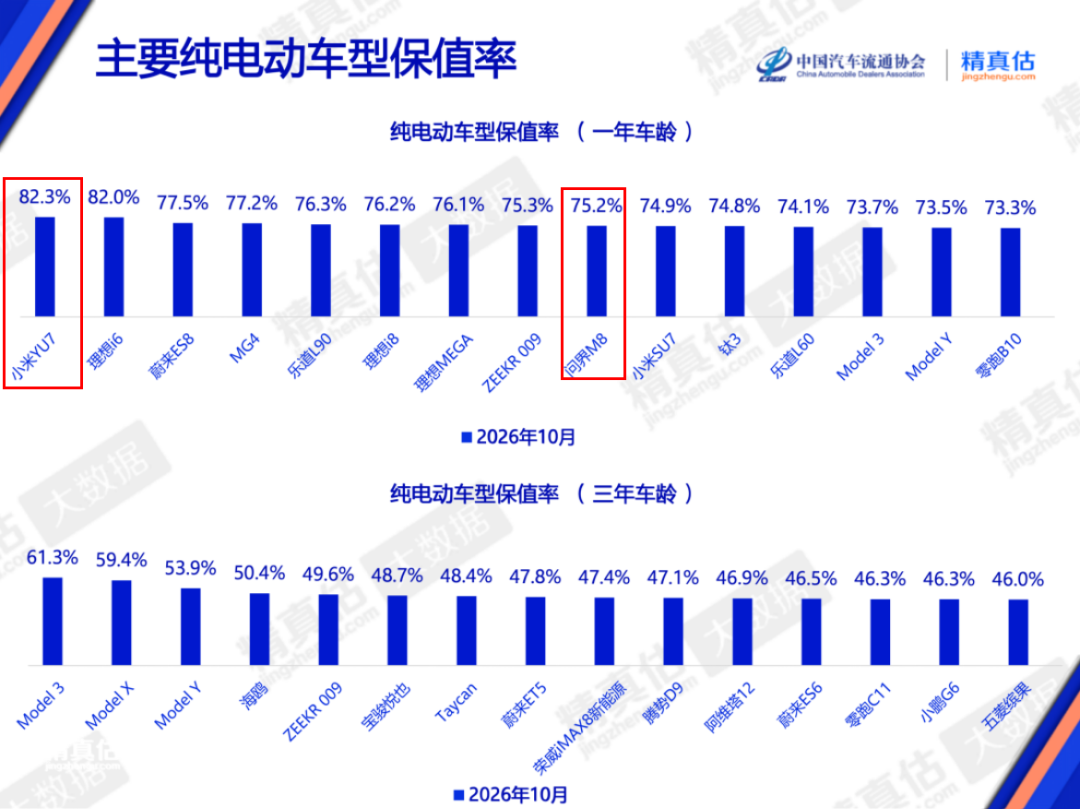
Image source: Jingzhengu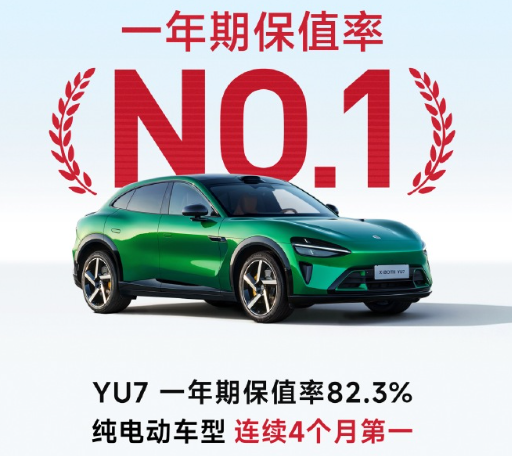 Image source: Weibo
The news spread rapidly across the automotive world, and Xiaomi Auto once again became the focus of public attention. The official account made the announcement simultaneously. The phrase "first for four consecutive months" in the poster was particularly eye-catching, and it also reignited discussion about "foreign brands dominating the list and domestic brands rising."
01 Lei Jun Officially Announces the List: Two Xiaomi Cars Make the Cut, Self-Owned Brands Dominate
That same day, Xiaomi Auto's official Weibo released a poster officially announcing the results. On the list, the Xiaomi YU7 left the Tesla Model Y (73.5%) of the same period nearly 9 percentage points behind, with the Li Auto i6 and NIO ES8 following closely, holding second and third places with 82.0% and 77.5%. Popular models such as the MG4, ONVO L90, Li Auto i8, Li Auto MEGA, Zeekr 009, AITO M8, and Xiaomi SU7 also joined the upper tier, with one-year value retention rates all exceeding 74.9%. A one-year value retention rate of over 82% is rare in the new energy field. This number itself is the market's most intuitive pricing of the YU7's product strength and delivery scarcity.
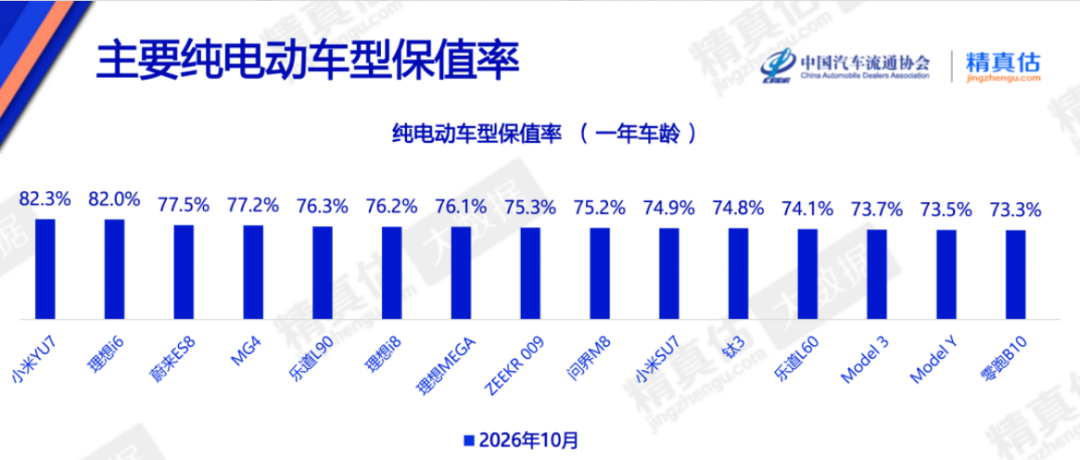 Image source: Jingzhengu
The most striking change in this one-year value retention list is that self-owned brands collectively dominate the rankings. Among the top 15, domestic models occupy the vast majority of seats, while the Tesla Model 3 and Model Y only rank 12th and 13th. Previously, foreign brands had long monopolized the top spots for high value retention rates of pure electric vehicles. Now Xiaomi, as a domestic brand, has broken that pattern. The old impression that "electric cars do not retain value and foreign brands have stronger residual value" is being rewritten by one list after another.
The industry generally interprets the high value retention rate of the Xiaomi YU7 as largely driven by supply and demand: new car orders are full, deliveries are queued, and second-hand available cars are scarce, directly supporting transaction prices. In July, August, September, and October, its value retention rate remained stable above 82%, falling only 0.5% over four months—a sharp contrast with many new cars whose residual value plunges rapidly after launch. Of course, a high value retention rate supported by scarcity also has a certain "bubble" quality—once production capacity is released and more second-hand cars become available, whether prices can remain high remains to be seen.
The real invisible winner on the list is actually Li Auto. Three main models—the i6, i8, and MEGA—made the list at the same time. Li Auto has stabilized its sales base through extended-range technology and family positioning, and its product matrix and residual value performance are being recognized by more and more people. Competition in value retention rates among leading new energy brands has entered a white-hot stage. Domestic brands represented by Xiaomi and Li Auto are gradually reshaping the industry's value retention evaluation system through stable product quality, improved after-sales systems, and rising market recognition year by year, so that consumers no longer need to worry excessively about large losses when reselling a new energy vehicle.
02 Another List: Xiaomi Has Declined for Three Consecutive Months
But behind the bustling list, there is another completely different observation standard. The September new energy value retention rate list from Jielanlu shows an opposite trend: Xiaomi Auto's value retention score was 79.6 points. Although it ranked fourth in the industry, it had declined for three consecutive months since July, and in September it even fell below the 80-point mark.
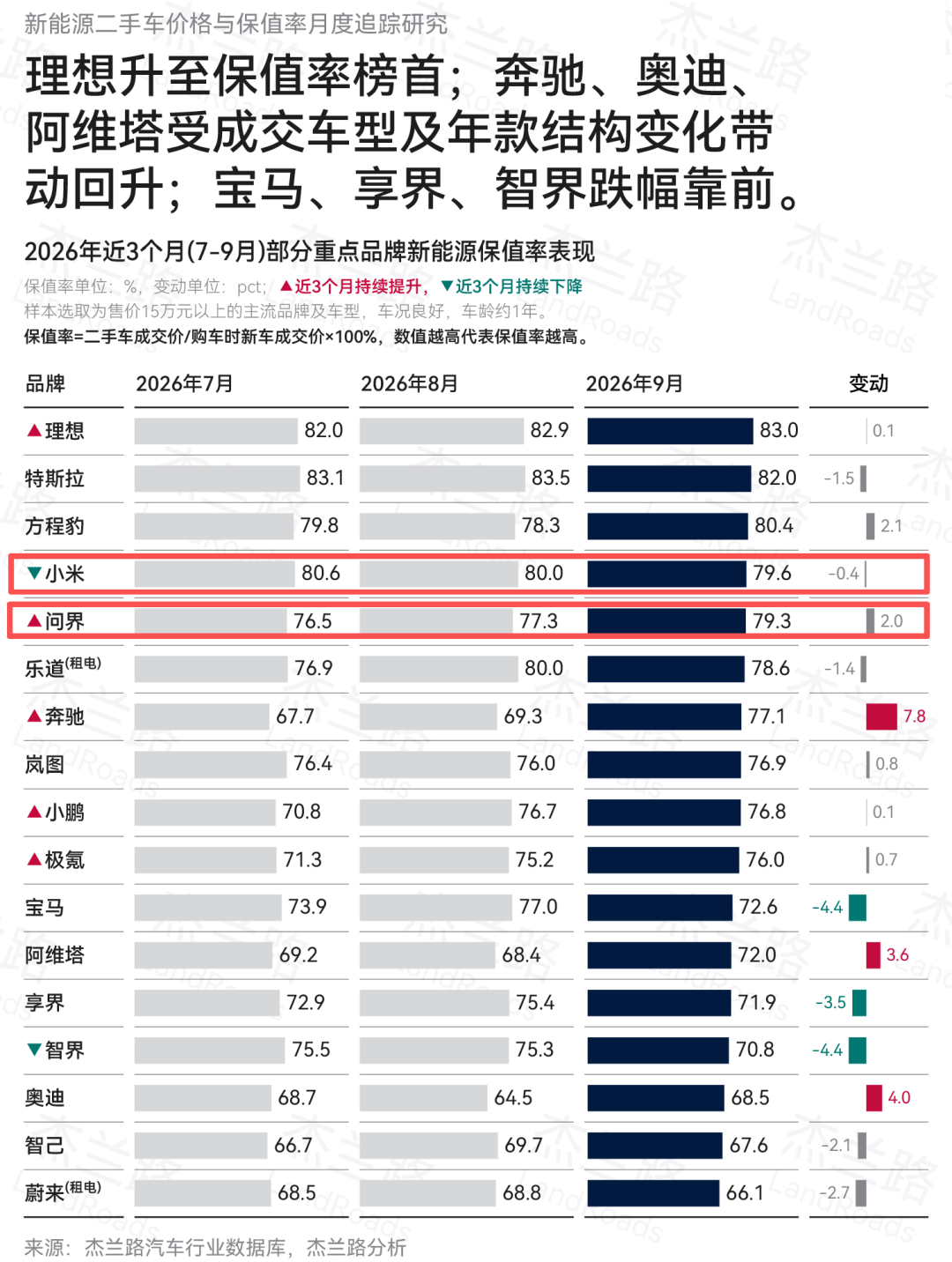 Image source: Jielanlu
On one side, in the China Automobile Dealers Association list, the YU7 ranks first in value retention rate for four consecutive months; on the other side, in third-party institution data, Xiaomi's overall value retention trend has been declining for three consecutive months. The two sets of data are not contradictory; they simply use completely different statistical dimensions, samples, and logic: the former looks at the scarcity of a single hit model, while the latter looks at overall brand confidence in the used car market. A single hit model can raise list rankings, but may not be enough to support the long-term value of the entire brand.
However, this should also be viewed objectively: 79.6 points is still in the first tier, indicating that the market's recognition of Xiaomi's products themselves still has a foundation, and the pullback is more a natural fluctuation of short-term supply and demand and product rhythm. What is truly worth observing is whether this decline can be reversed by subsequent new products and volume release—if it stops falling and rebounds in the next period, it shows that the hit-model effect is spilling over to the entire lineup; if it continues to decline, it reminds the market that the scarcity dividend of a single hit model has boundaries. The value of this list lies precisely in providing a more complete perspective: short-term rankings and long-term trends often do not point to the same answer. Rather than obsessing over which number is more "authoritative," it is better to understand what different standards are measuring.
03 AITO: Rising for Three Consecutive Months
In sharp contrast to Xiaomi is HarmonyOS Intelligent Mobility's AITO. AITO's value retention score has steadily risen for three consecutive months and is close to the 80-point threshold. The support behind this is continuously climbing sales and an expanding market inventory. With the M6 gaining momentum and the M9 maintaining stable monthly sales at the ten-thousand level, used car dealers' confidence in AITO's residual value is slowly being established, and the market generally expects there is still room for upward movement.
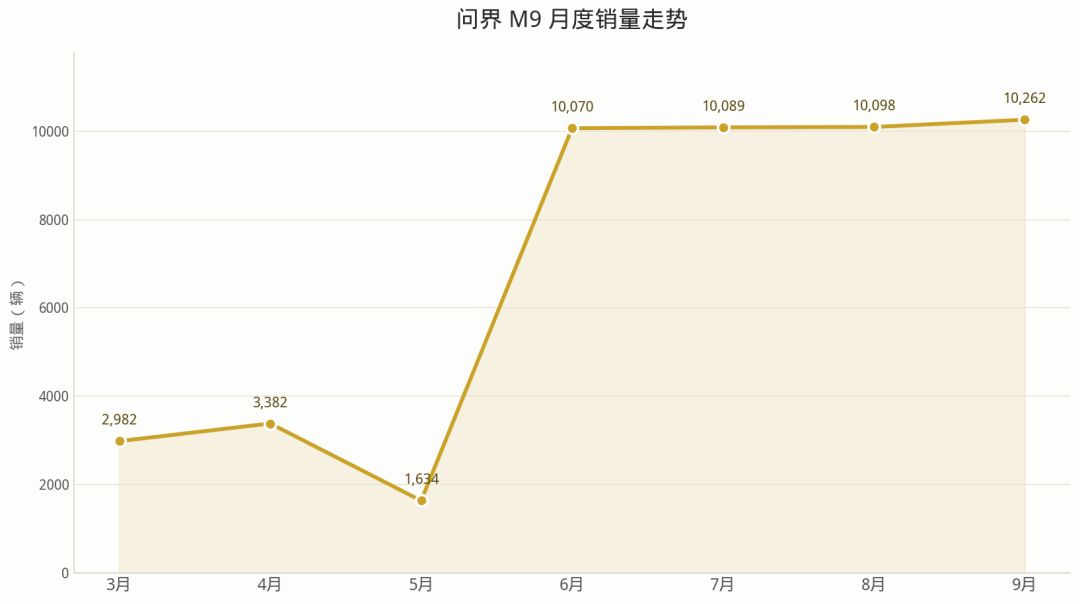 Image source: Jingzhengu
AITO's upward logic is also clear: continuous iteration of intelligent driving capabilities, deep integration with the HarmonyOS ecosystem, and a stable product rhythm have gradually transformed it in users' minds from a "new brand" into a "trustworthy long-term choice," and residual value has settled accordingly.
Value retention rate has never been a single-number game. It is essentially a vote cast by used car dealers with real money, stacking up supply and demand heat, model replacement rhythm, product stability, after-sales network, long-term OTA, and brand reputation as multiple variables. Stable product iteration, continuously improved service networks, and a mature intelligent ecosystem are slowly transforming into value confidence in the used car market. A continuously rising value retention rate is the most direct proof of the market's recognition of this system.
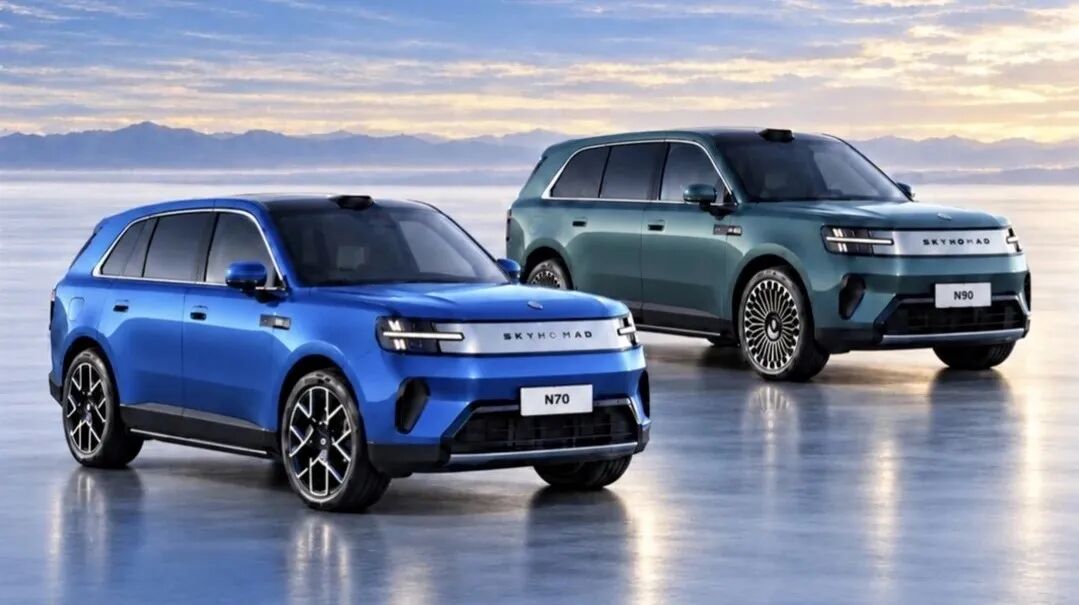
Image source: Jingzhengu
Just like the AITO M8 in this list, its one-year value retention rate of 75.2% ranks ninth—already an upper-tier level—but affected by the upcoming launch of new models and clearance of old models, short-term residual value is under pressure. The replacement cycle is a residual value disturbance factor that all automakers cannot avoid. AITO is accumulating long-term compound interest, while Xiaomi is enjoying hit-model dividends. There is no absolute right or wrong between the two paths; they are simply at different stages.
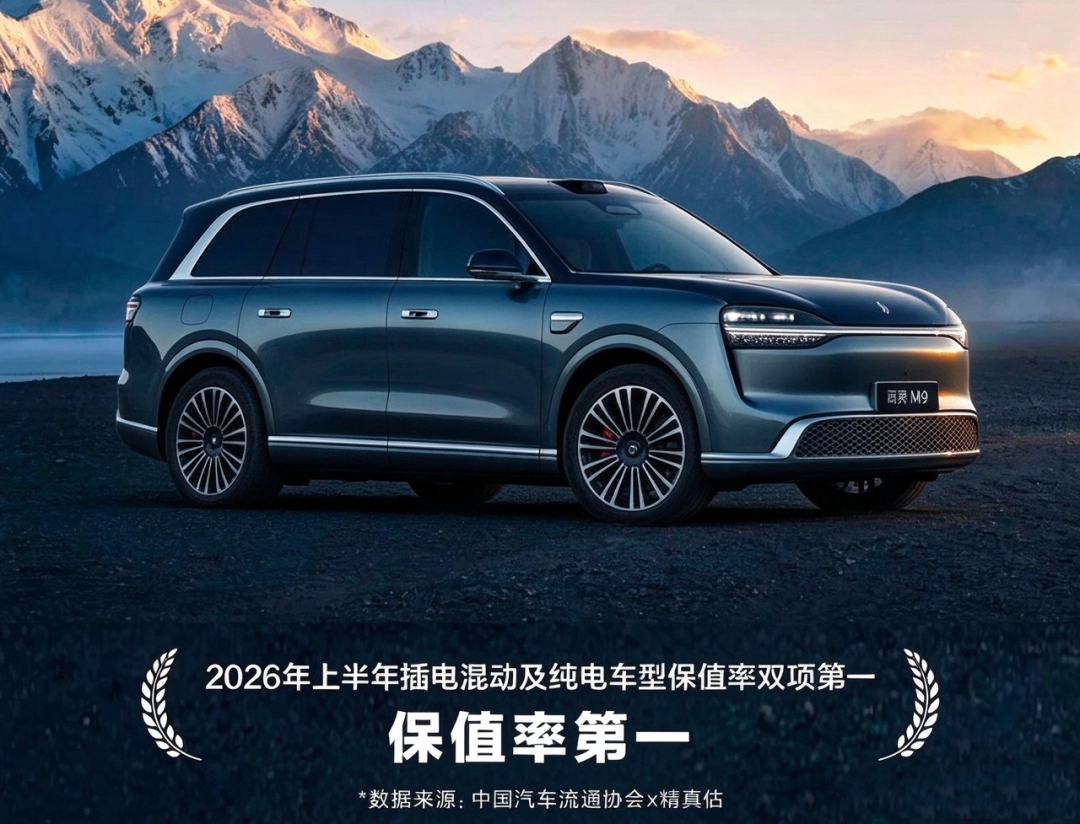 Image source: Jingzhengu
04 One Year Looks at Popularity, Three Years Look at Strength
There is also an easily overlooked dividing line: one-year value retention rate looks at popularity, while three-year value retention rate looks at long-term strength. On the three-year-old vehicle value retention list, the landscape reverses again, with the Tesla Model 3, Model X, and Model Y sweeping the top three. Relying on a stable product strategy with no model changes, a huge inventory, and a mature used car circulation pool, Tesla's long-term residual value foundation remains solid; while the best results among self-owned brands are the Seagull at 50.4% and the Zeekr 009 at 49.6%, with three-year residual values close to halving—equivalent to a 50% discount over three years. This also reminds us that short-term rankings are only a mirror of popularity. What truly tests a brand's long-term product strength, service, and ecosystem is often a longer holding cycle.
Short-term hit-model popularity can quickly raise one-year residual value; scarcity and queued orders can both serve as boosters. But the three-year dimension is the touchstone for testing a brand's long-distance capability. Traffic can create short-term high prices, but stabilizing long-term residual value depends on things beyond temporary orders: long-term stable quality control, continuously reliable service, a continuously iterating software ecosystem, and stable and orderly production capacity and replacement rhythm. In this round between Xiaomi and AITO, Xiaomi wins the present. Who is stronger three years later will still depend on the long run.
For ordinary consumers, value retention rate is an important reference for car buying, but it should not be the only criterion. Many people focus only on the new car's on-road price when choosing a car, but ignore a key issue: when reselling a few years later, the residual value gap will directly widen the total cost of ownership. For the same car, changing it after one year and planning to keep it for three to five years require completely different lists. The new car's driving experience, after-sales convenience, long-term failure rate, and the loss from resale after several years jointly determine the real cost of ownership. Value retention rate provides a reference system, not a standard answer. This is also why simply comparing value retention numbers is of limited significance—what it reflects behind the numbers is whether a brand can give owners peace of mind and make used car dealers willing to buy. The truly smart way to buy is to incorporate value retention rate into the overall cost of the vehicle, rather than only looking at the ranking at a certain point in time.
Lists are always only a snapshot of a certain moment in the market. Value retention curves are always fluctuating, and no one can stay at the top forever. The new energy used car market is no longer the simple conclusion of early years that "electric cars depreciate quickly." Short-term impressive data deserves applause, but long-term value is a harder exam question for automakers—there is no forever solid value retention rate, only brands continuously recognized by the market. For automakers, this list is also a mirror: in the short term, marketing and scarcity can win a wave of popularity, but in the long term, solid quality control, sincere service, and continuous iteration are needed to protect residual value. Time will give the answer as to who is swimming naked.
Interactive topic: When buying a car, would you prioritize value retention rate as a core decision-making indicator?
Disclaimer: This article is only a financial commentary on major companies and does not constitute any investment advice. The corporate data and regulatory events involved in the article all come from public information and are for reference only; the specific official release shall prevail. Image sources are from the internet. If there is any copyright issue, please contact us for deletion.
-
![]()
"Rush-built cars" face regulatory crackdown
-
![]()
Long Gone From View, These New Forces Are Still Fighting to Come Back
-
![]()
Can Li Jiaqi Help Chen Yusen Land a Big Result?
-
![]()
Attention Inflation: Big Tech Is Busier but Earning Less -
China's Auto Export Champion Sees Revenue Hit Record High
-
![]()
"Little Blue Light" Returns with Its Exclusive Color—Is the L3 Era Approaching?
-
![]()
Can the M-Hero X700 Become the Ultimate Box That Balances Off-Road Capability and Family Use?
-
![]()
Young People Are No Longer Buying Cars